You’ll find McMillenville’s ghost town remains at milepost 265.1 on US Highway 60, about 15 miles north of Globe in Gila County. Look for a weathered stone monument marking where this 1876 silver mining settlement once thrived with 1,500 residents before Geronimo’s 1882 attack and ore depletion ended the boom. Scattered adobe foundations lie on both sides of the highway, accessible through a gate past the milepost, though dense brush now conceals larger structural remains that tell the complete story of this vanished frontier camp.
Key Takeaways
- McMillenville ghost town is located along US Highway 60 at milepost 265.1, approximately 15 miles north of Globe, Arizona.
- Access the town site through a gate past the milepost marker where a stone base indicates a former historical marker.
- Explore scattered adobe foundations and crumbling walls on both sides of the highway, hidden under dense brush overgrowth.
- The site marks a silver mining settlement established in 1876 that boomed to 1,500 residents before declining by 1884.
- Geronimo’s warriors attacked the settlement on July 7, 1882, a significant historical event preceding the Battle of Big Dry Wash.
The Rich History of McMillenville’s Silver Mining Era
In 1876, a casual swing of Theodore H. Harris’s pick struck silver ore that’d transform Gila County’s wilderness. His partner Charles McMillen recognized the native silver instantly, understanding prospector roles demanded quick claim-staking. They founded the Stonewall Jackson mine at 4,600 feet elevation, and McMillenville materialized around the discovery.
You’ll find the town peaked by 1880 when a twenty-stamp mill tackled mineral processing challenges, crushing ore from deepening shafts served by steam hoists. Adobe structures lined the Globe road as silver ingots traveled 100 miles to Casa Grande. The mine yielded silver, copper, and lead until Geronimo’s 1882 attack disrupted operations.
Pinpointing McMillenville’s Location Along Highway 60
When you’re traversing US Highway 60 through Gila County’s high desert terrain, watch for milepost 265.1—approximately 15 miles north of Globe where McMillenville’s remnants await discovery. You’ll spot a stone base on the highway’s west side where on site trail markers once stood, though the historical marker itself has vanished. The actual town site lies a half-mile north, accessible through a gate just past the milepost.
Navigate carefully around the large concrete culvert marking the valley. While protective road barriers are absent on these backcountry routes, your 4WD vehicle will handle the terrain. Explore both highway sides: west reveals substantial foundations, while east showcases numerous structural remains. Dense brush and wildlife-tracked washes add authentic wilderness character to your self-directed exploration.
The Historic Apache Attack of 1882
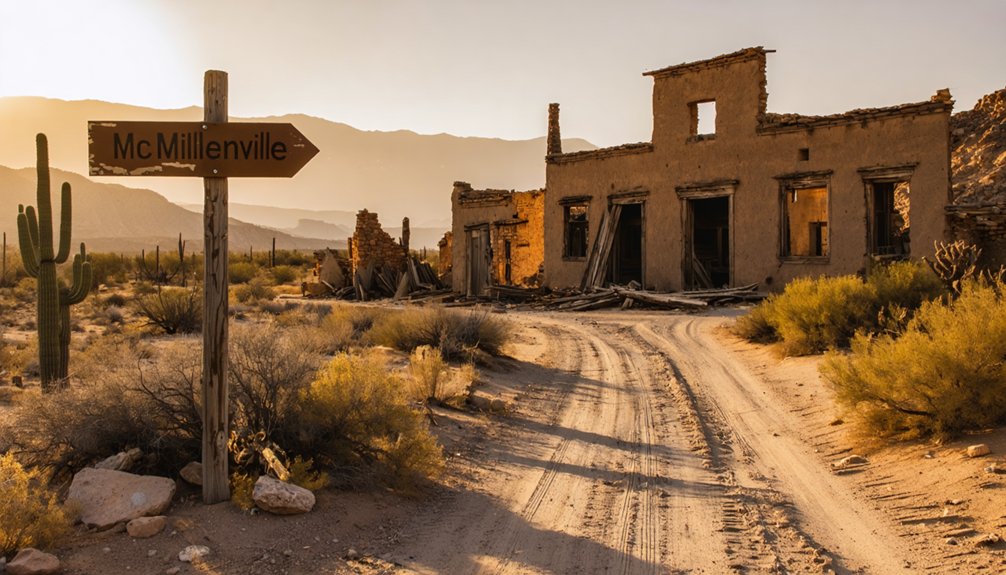
On July 7, 1882, Geronimo’s warriors descended upon this remote mining settlement twenty miles east of Globe, forcing its residents into a desperate fight for survival. The miners hastily fortified their camp’s perimeter while frantically evacuating women and children into the safety of underground mine shafts, transforming the tunnels that once yielded silver into makeshift refuges.
You’ll find the echoes of that terrifying day still lingering in McMillenville’s abandoned shafts, where frightened families huddled in darkness while gunfire erupted above ground.
exploring the history of meredith can shed light on the events that shaped the town and its resilient spirit. Many residents recall stories passed down through generations, each tale a thread woven into the fabric of McMillenville’s past. As people gather to share their memories, the essence of that fateful day transforms from fear into a testament of unity and survival.
Defending the Mining Camp
As peaceful morning routines unfolded across McMillenville on July 7, 1882, Geronimo’s warriors descended upon the mining camp with devastating swiftness. You’ll find no records of defensive reinforcements arriving in time—the isolated settlement stood alone against the assault.
The Army’s fourteen cavalry companies were spread thin across Arizona Territory, responding to Na-tio-tish’s band moving through Tonto Basin. McMillenville’s miners had little opportunity for fortification preparations before the attack struck. This vulnerability typified frontier mining camps, where extraction of ore took precedence over military readiness.
The assault prompted urgent demands from settlers for protection, ultimately contributing to the massive military mobilization that culminated in the Battle of Big Dry Wash just ten days later—forever changing Apache resistance.
Women’s Refuge Underground
The chaos of Geronimo’s assault sent McMillenville’s women scrambling toward their only sanctuary—underground refuge carved into the earth beneath the bustling mining camp. These weren’t elaborate fortifications—just raw earth and timber positioned where women could disappear from the surface fighting above.
The women’s survival strategies relied on speed and silence. They’d practiced evacuation routes through the adobe homes and tent clusters, knowing seconds mattered when Apache warriors swept through the settlement. Underground, they’d wait in darkness while chaos reigned topside, their refuge providing the only buffer between frontier life and sudden violence.
You’ll find the refuge design was brutally practical: residents had converted existing mine shafts and dugouts into concealed shelters near the Lady Franklin works. This grim preparedness defined territorial Arizona’s reality.
Understanding McMillenville’s Rapid Decline and Abandonment
You’ll find McMillenville’s story mirrors countless Western mining camps—a meteoric rise followed by an even swifter collapse. By 1884, just ten years after Charles McMillen’s discovery, the fabulous Stonewall Jackson Ledge had surrendered its last profitable ores, transforming a thriving community of 1,500 into an economic dead end.
The post office’s closure in 1882 had already signaled the camp’s fate, as miners abandoned their claims and the settlement returned to the desert silence it had briefly interrupted.
Silver Depletion by 1884
Within just eight years of discovering nearly-pure silver in the Stonewall Jackson Ledge, McMillenville’s miners had exhausted the very resource that created their boomtown. By 1884, the high yield deposits that once drew 1,500 prospectors to this remote location had completely vanished. You’ll find it remarkable how quickly determined miners stripped the accessible veins clean—their efficiency ultimately sealed the town’s fate.
The mine’s owners desperately sought London investors, offering the operation for £350,000 in 1884-1885, but savvy buyers recognized a depleted asset when they saw one. Without profitable ore to extract, even the access road infrastructure couldn’t justify continued operations. The rapid depletion exemplified the unsustainable boom-and-bust cycle that defined Arizona’s silver era, leaving behind only weathered ruins.
Ten-Year Boom Period
From 1876 to 1886, McMillenville experienced one of Arizona’s most compressed boom-and-bust cycles—a complete rise and fall in just a decade. You’ll find these boom cycle characteristics defined the settlement: explosive growth to 1,000 residents, rapid infrastructure development, and complete abandonment within ten years.
The town’s fate was sealed by its singular dependence on native silver veins, which depleted by 1884. Unlike sustainable frontier communities, McMillenville ignored economic diversification opportunities—no cattle ranching, timber operations, or agricultural development emerged alongside mining. When Geronimo’s warriors attacked in 1882 and silver production collapsed two years later, nothing remained to sustain the population.
Post Office Relocation Impact
This communication infrastructure disruption coincided with Geronimo’s warriors attacking the vulnerable camp. The deadly combination proved fatal—settlers fled en masse, abandoning their adobe homes and saloons.
What Remains at the Ghost Town Site Today
Along Arizona’s US Highway 60 at mile marker 265, a weathered stone monument stands as the primary beacon to McMillenville’s vanished past. Five empty screw holes mark where a commemorative plaque once explained the 1874 silver discovery—now just another mystery in this forgotten place.
The actual town site lies half a mile north, where a large culvert marks your gateway to scattered adobe foundations. You’ll find ruins on both sides of the highway, with larger structures hidden beneath dense brush overgrowth on the west side. Navigate carefully through the thick vegetation, watching for animal tracks in the nearby wash.
The mines and twenty-stamp mill have vanished completely, leaving only crumbling walls to hint at the bustling camp that once extracted silver from the Stonewall Jackson Ledge.
Planning Your Visit to McMillenville Ghost Town
Before you venture to McMillenville, understand that this isn’t a polished tourist attraction—it’s raw Arizona backcountry where rattlesnakes outnumber visitors and cell service vanishes into the mountain air.
This isn’t a polished tourist attraction—it’s raw Arizona backcountry where rattlesnakes outnumber visitors and cell service vanishes into the mountain air.
You’ll find the site 28 miles northeast of Globe along U.S. Highway 60 at mile marker 265. Look for the Arizona Highway Department’s “McMillan (Old Town)” sign, though the actual ruins lie half a mile north in a valley marked by concrete culverts.
Terrain challenges include thick brush concealing foundations and uneven ground that’ll test your footing. Wildlife considerations demand vigilance—recent cat tracks spotted in washes suggest mountain lions patrol these abandoned streets.
Pack water, wear sturdy boots, and bring a first-aid kit. The gate west of the highway grants access, but you’re responsible for your own safety.
Frequently Asked Questions
Are There Any Entrance Fees to Visit Mcmillenville Ghost Town?
There’s no entrance fee—you’ll explore McMillenville freely. However, accessibility options are limited due to rugged terrain. While guided tour options aren’t officially available, you’re free to wander and discover this abandoned mining settlement independently at your own pace.
What Is the Best Time of Year to Visit Mcmillenville?
Escape the ordinary during fall and spring when you’ll discover Mcmillenville at its finest. Mild winters also beckon explorers, offering fewer crowds and perfect temperatures for wandering abandoned streets. You’ll have this forgotten treasure practically to yourself.
Is Camping Allowed Near the Mcmillenville Site?
Camping isn’t allowed directly at McMillenville, but you’ll find freedom in nearby dispersed camping options throughout surrounding National Forests. Limited campsites available at established state parks require permits, though backcountry spots offer unrestricted adventure.
How Long Does a Typical Visit to Mcmillenville Take?
A whisper in the desert, your McMillenville visit typically lasts just minutes—there’s only a plaque remaining. Unlike destinations offering self-guided tours or guided walking tours, you’ll find no structures to explore, making it a quick roadside stop.
Are Pets Allowed at the Mcmillenville Ghost Town Location?
There aren’t official pet policies at abandoned McMillenville, so you’re free to bring pets. However, no accessibility accommodations exist at this remote site. Keep your animals leashed, hydrated, and protected from extreme desert heat.