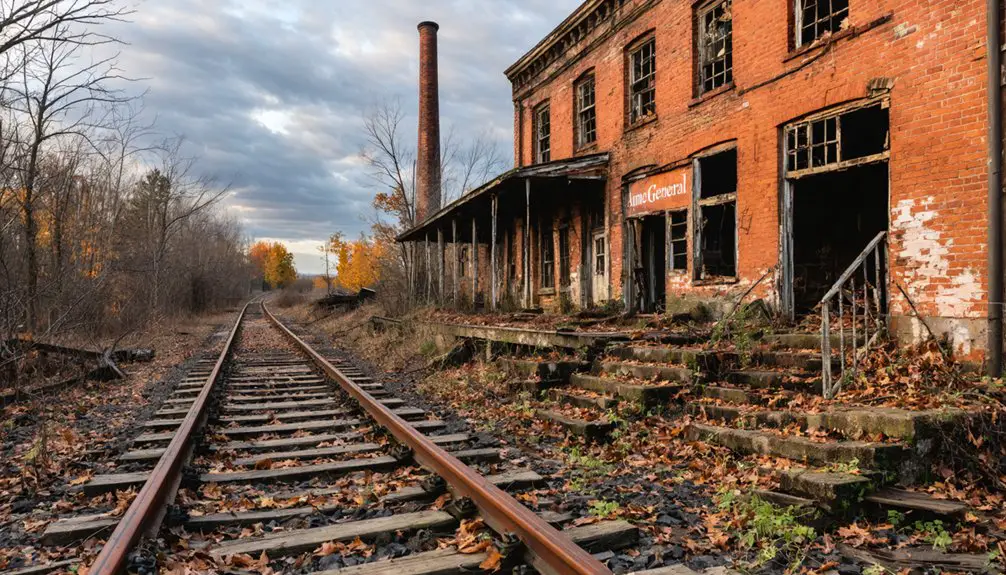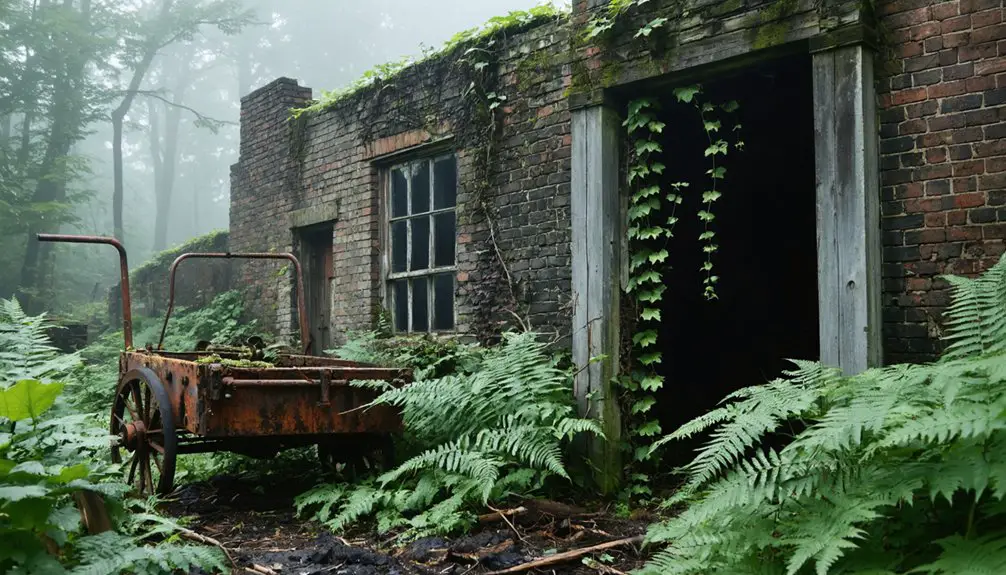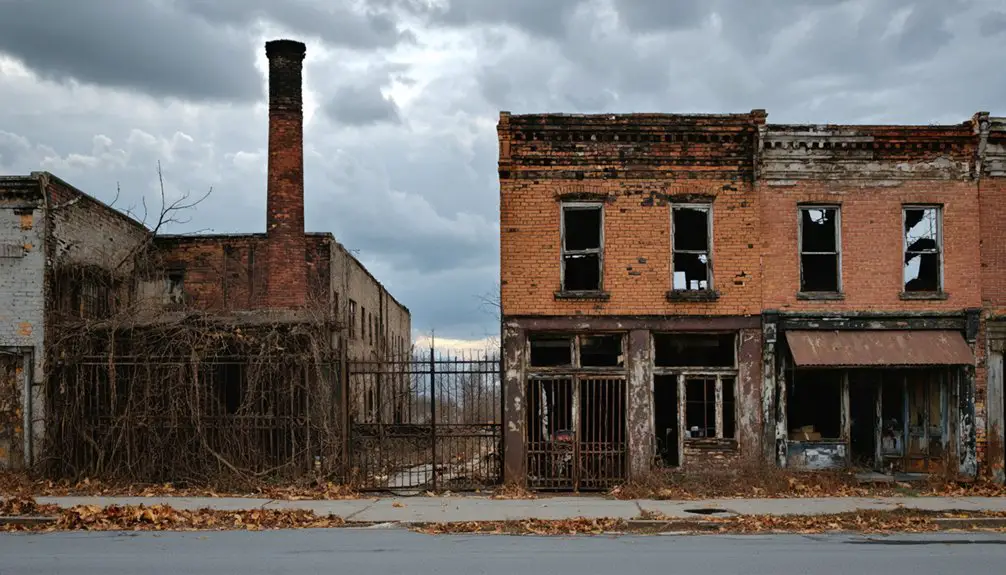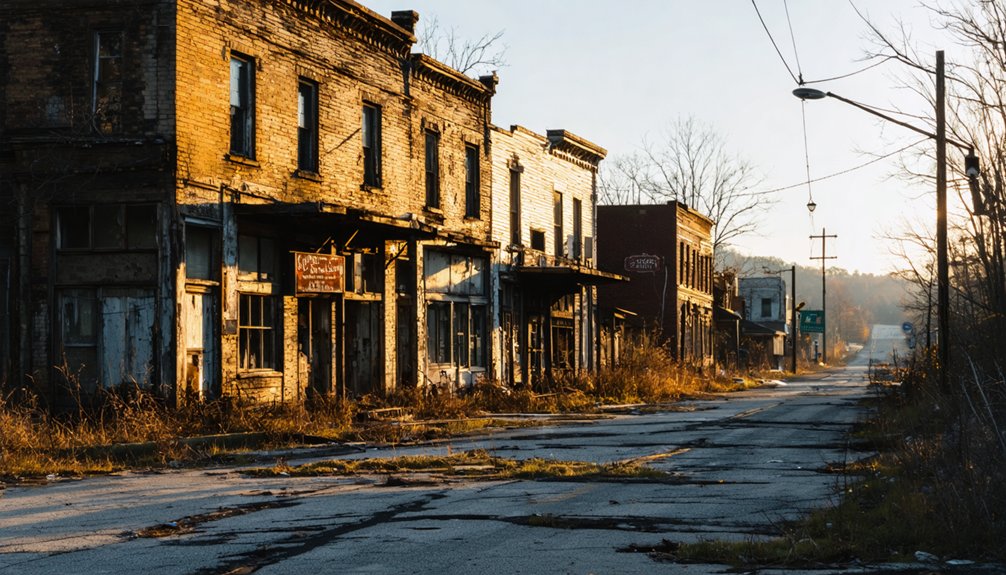
Planning a ghost town road trip to Meco, Pennsylvania means trading polished tourist stops for coal-era silence and overgrown foundations deep in Indiana County’s Yellow Creek basin. Meco boomed during the late-19th-century coal rush, producing roughly 3,500 tons before its seams thinned and its people vanished around 1920. You won’t find visitor centers or roadside signs here—just raw, unfiltered history waiting to be uncovered. There’s far more to this forgotten corner of Western Pennsylvania than you’d expect.
Key Takeaways
- Meco sits in Indiana County’s Yellow Creek basin; start your route from Indiana Borough and follow township roads to reach it.
- Bring offline maps and wear sturdy footwear, as Meco has no visitor center, no signage, and limited cell service.
- Combine Meco with nearby ghost towns Wehrum and Iselin, all clustered along the same corridor for an efficient road trip.
- The 36-mile Ghost-Town Trail, built on an old railroad bed, connects roughly 10 ghost towns across Indiana and Cambria Counties.
- Meco offers a quiet, uncommercial experience unlike Centralia; expect overgrown ruins and coal-era remnants without dramatic tourist attractions.
What Makes Meco a True Pennsylvania Ghost Town?
Although countless Pennsylvania mining towns faded quietly into the landscape, Meco stands out as a textbook example of what coal-boom abandonment looks like in Indiana County’s Brush Valley Township. You’ll find no tourist signs pointing the way, no visitor center explaining its past — just the quiet weight of mining legends embedded in forgotten ground.
Meco emerged during the late-19th-century coal rush, thrived briefly alongside other Yellow Creek mining communities, then collapsed as the seams ran dry. Ghost town myths often romanticize these places, but Meco’s story is straightforward: extraction ended, people left, and the land reclaimed what industry once claimed.
If you crave authentic regional history without the crowds, Meco delivers exactly that kind of raw, unfiltered freedom.
Meco’s Coal Mining Roots in the Yellow Creek Basin
When you trace Meco’s origins, you’ll find them buried in the Yellow Creek coal seams that once drove Indiana County’s economy during the late 19th and early 20th centuries.
The broader Yellow Creek mining area pulled roughly 3,500 tons of coal from the earth between 1886 and 1920, feeding a regional boom that built small settlements like Meco almost overnight.
Once those seams thinned and the demand shifted, the community’s reason for existing simply vanished.
Yellow Creek Mining Origins
Nestled in the Yellow Creek basin of Indiana County, Meco took shape during Pennsylvania’s late-19th-century coal boom, when small extraction settlements sprouted across the region almost overnight. Miners arrived chasing steady wages, and the community grew around the rhythm of the shaft and the tipple.
The broader Yellow Creek mining area reportedly produced around 3,500 tons of coal between 1886 and 1920, a figure that quietly tells you everything about why these towns eventually vanished.
Today, ghost town legends cling to places like Meco because the departure was so complete. When you walk the ground, you’re stepping into a landscape stripped of its purpose.
Mining artifacts scattered across the region give you tangible proof that real people once built their lives here before the seams ran dry.
Coal Boom And Decline
The coal seams that built Meco didn’t last forever, and that’s the hard truth behind every ghost town in the Yellow Creek basin. Advances in mining technology pushed early extraction hard and fast, pulling roughly 3,500 tons from the region between 1886 and 1920.
Once the seams thinned, the economics collapsed and the people followed. You won’t find a dramatic disaster story here — just the quiet math of depletion.
What remains is cultural heritage worth understanding on your own terms, away from curated exhibits and entrance fees. Meco represents a pattern repeated across Indiana County: a coal camp rises, works itself out of existence, and disappears into the treeline.
Knowing that pattern sharpens everything you’ll see when you walk the site yourself.
The Boom-and-Bust Story Behind Meco’s Disappearance
Like so many small coal towns scattered across Indiana County, Meco didn’t fade quietly — it followed a boom-and-bust arc that defined nearly every mining settlement in Pennsylvania’s Yellow Creek region.
Underground mining drew workers and families here during the late 19th century, fueling growth that felt permanent but wasn’t.
The Yellow Creek area produced roughly 3,500 tons of coal between 1886 and 1920, and when those seams thinned out, the economic foundation collapsed beneath the town just as surely as exhausted shafts collapsed underground.
Workers left, structures disappeared, and Meco slipped off the map.
Today, historical preservation efforts across Indiana County help keep stories like Meco’s alive.
You’re not just visiting a forgotten place — you’re tracing the human cost of an industry that built and abandoned entire communities.
Why Meco Is Less Famous Than Centralia but Worth the Detour
You’ve probably heard of Centralia, the Columbia County borough where an underground mine fire has burned since 1962, shrinking a community of 1,000 residents down to just five by 2020 and turning it into Pennsylvania’s most photographed ghost town.
Meco, tucked quietly into Brush Valley Township in Indiana County, never got a dramatic burning-ground story to pull in the crowds, just the slow, unglamorous exit of a coal town after the seams gave out.
That obscurity is exactly what makes it worth your time, because you’ll find the raw, unfiltered texture of Yellow Creek mining history here without the tour buses.
Centralia’s Fiery Fame
When most people think of Pennsylvania ghost towns, Centralia dominates the conversation — and for good reason. A coal-seam fire ignited beneath the borough in 1962 and never stopped burning. You can still see steam rising from cracked earth, smell sulfur in the air, and walk roads buckled by decades of underground heat.
The urban decay is visceral and visible. Population collapsed from roughly 1,000 residents in 1980 to just five by 2020. What remains are industrial relics, broken pavement, and a handful of stubborn holdouts refusing to leave.
Centralia gives you drama, spectacle, and a story that writes itself. That visibility is exactly why it draws crowds. But that same spotlight leaves quieter places — places like Meco — sitting forgotten in Indiana County’s coal-scarred hills.
Meco’s Quiet Obscurity
Centralia has the fire, the cracked asphalt, and the photographs that spread across every ghost-town listicle online — Meco has none of that, and that’s precisely what makes it worth finding. No urban legends fuel its reputation, no viral images circulate online.
What you get instead is raw, unfiltered coal-country silence in Brush Valley Township, Indiana County.
Meco belonged to the Yellow Creek mining landscape, a cluster of small extraction towns that quietly disappeared after the coal ran out. Preservation efforts here are minimal, which means you’re reading the land itself rather than a curated exhibit.
That demands more from you as a traveler — better mapping, sharper attention, and genuine curiosity. If you want a ghost town that rewards effort over spectacle, Meco delivers exactly that.
Hidden Value Worth Exploring
Fame has a way of flattening the places it touches — Centralia draws thousands of visitors every year precisely because it’s easy to explain, easy to photograph, and easy to share. Meco offers something different. It’s industrial nostalgia without the crowds, a hidden landmark that rewards curiosity over convenience.
You won’t find roadside signs or gift shops here. What you’ll find is the raw outline of a coal community that quietly disappeared after the Yellow Creek mines dried up. That absence tells its own story.
Choosing Meco means choosing a road trip on your own terms — no guided tour, no curated experience, just you and a landscape that remembers something most people have already forgotten. That freedom is exactly the point.
Wehrum and Iselin: Meco’s Forgotten Indiana County Neighbors
Though Meco rarely appears on any map today, it’s far from alone in Indiana County’s catalog of vanished coal towns—Wehrum and Iselin share that same quiet erasure. Each community rose quickly during the coal boom, then collapsed just as fast when the mines played out.
Industrial decay claimed the buildings, the streets, and eventually the names themselves.
When you visit this region, you’re traveling through layered history. Wehrum once housed miners and their families in tight company rows. Iselin followed a similar pattern.
Both towns now exist mainly in heritage preservation efforts and local historical records.
Grouping these three sites into a single itinerary makes your road trip more meaningful. You’re not just visiting ruins—you’re reading a regional story written in abandoned foundations.
Plan Your Route Through Indiana County’s Abandoned Coal Towns
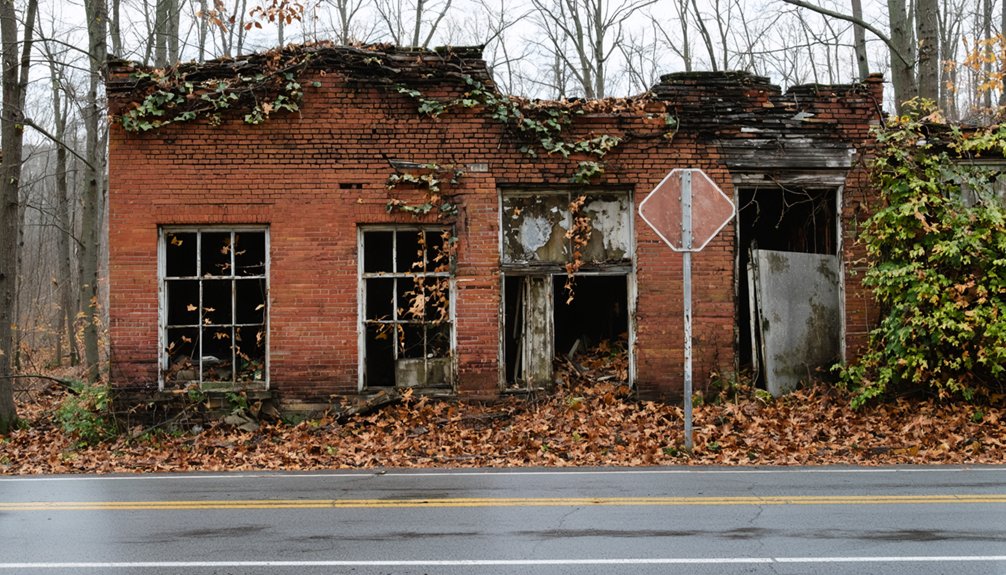
Planning a route through Indiana County’s abandoned coal towns rewards patience and a good paper map. You’ll want to cluster Meco, Wehrum, and Iselin together since they sit within the same regional corridor. That grouping honors the cultural significance each site carries as a record of Yellow Creek’s coal era.
Start in Indiana Borough, then work outward toward the smaller township roads. Cell service gets thin, so download offline maps before you leave. Watch for unmarked turnoffs and respect private land boundaries.
If you have an extra day, connect your route to the 36-mile trail corridor linking Indiana County to Cambria County. That trail passes roughly ten ghost-town sites and directly supports historical preservation efforts across the region. Pack water, wear solid shoes, and go early.
The 36-Mile Ghost-Town Trail Linking Indiana and Cambria Counties
If you’re ready to stretch your legs after the car ride, the 36-mile trail linking Indiana and Cambria Counties delivers one of Pennsylvania’s most concentrated ghost-town corridors in a single route. Built along an old railroad bed and opened in 1994, it draws roughly 75,000 hikers and bikers annually who come to witness urban decay and industrial relics firsthand.
- Pass through approximately 10 ghost towns in one continuous route
- Travel at your own pace without schedules or crowds controlling your experience
- Photograph industrial relics left behind by coal’s collapse
- Connect Meco’s story to the broader regional pattern of abandonment
- Access the trail by bike or foot for full freedom of exploration
This corridor turns scattered history into one coherent, unforgettable journey.
What Visitors Actually Find at Meco Today
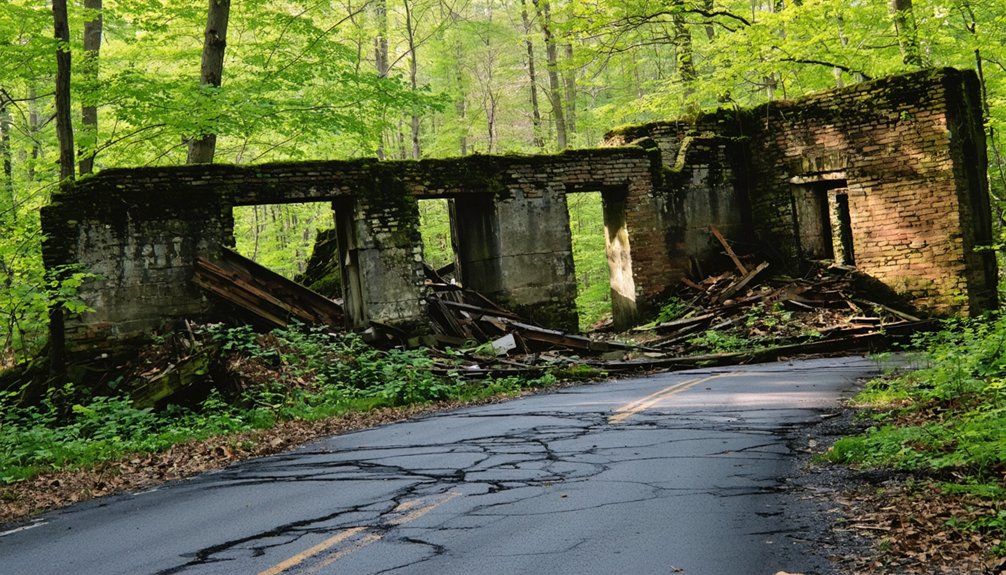
Arriving at Meco, you’ll find none of the visitor centers or interpretive signs that mark more developed historic sites — just the quiet remnants of a coal community that the region slowly swallowed back into itself.
Abandoned structures hint at what daily mining life once looked like here, though nature has reclaimed most of what workers and families left behind.
Local folklore keeps some of the town’s memory alive, passed down through Indiana County residents who remember stories of Yellow Creek’s coal era.
You won’t encounter crowds or guided tours. Instead, you’ll move through overgrown ground on your own terms, piecing together history from landscape clues.
Bring good maps, sturdy footwear, and realistic expectations — Meco rewards curiosity, not comfort-seeking.
Road Trip Tips for Exploring Western Pennsylvania Coal Country
Once you’ve absorbed what Meco has to offer, the surrounding coal country rewards a longer look. Indiana County holds layers of industrial decline waiting to be read across the landscape. Heritage preservation efforts are scattered but real, and knowing where to look makes the difference.
The surrounding coal country rewards a longer look — its industrial decline written plainly across the landscape.
Pack your trip around these practical anchors:
- Wehrum and Iselin sit nearby and round out Indiana County’s forgotten coal-town circuit.
- The 36-mile ghost-town trail, open since 1994, connects roughly 10 abandoned sites between Indiana and Cambria Counties.
- 75,000 annual visitors use that trail, so weekday visits offer quieter exploration.
- No visitor centers exist at Meco, so download offline maps before leaving home.
- Road access varies, so verify conditions locally before committing to remote routes.
Frequently Asked Questions
Is There Cell Phone Service Available Near Meco’s Remote Location?
Cell phone coverage isn’t guaranteed near Meco’s forgotten hollows. You’ll likely find weak signal strength in these remote Indiana County coalfields, so download your maps beforehand and embrace the freedom of exploring Pennsylvania’s raw, unconnected mining heritage.
Are There Restroom Facilities or Rest Stops Close to Meco?
You won’t find restrooms near Meco’s remote, historically preserved landscape, so plan ahead. Nearby towns hold local legends and practical rest stops, giving you the freedom to explore Indiana County’s forgotten coal heritage comfortably.
What Should Visitors Wear When Exploring Abandoned Coal Town Sites?
Like a seasoned explorer, you’ll want to dress smart — wear sturdy appropriate footwear to tackle uneven terrain, and practice weather preparedness by layering up, since Pennsylvania’s coal country winds cut right through you.
Is Visiting Meco in Indiana County Legal and Publicly Accessible?
Before you roam Meco’s forgotten coal-scarred landscape, verify local regulations and historic preservation rules — accessibility isn’t guaranteed. You’ll want to confirm land ownership and legal access to freely explore Indiana County’s haunting, history-rich mining remnants.
Are Guided Ghost Town Tours Available in Indiana County, Pennsylvania?
No formal guided tour options exist for Indiana County’s ghost town history, but you’re free to explore independently. Combine Meco with nearby Wehrum and Iselin, letting the region’s forgotten coal corridors tell their own haunting stories.
References
- https://www.academia.edu/44093116/APPALACHA_Coal_Mining_Ghost_Towns_of_Appalacha_Ferrier_Meco_and_Tidedale_On_Yellow_Creek_Brushvalley_Center_and_White_Townships_Indiana_County_Pennsylvania_U_S_A_Contains_Miners_Memorial_for_the_Mines_Includes_Appalacha_A_Forgotten_Mining_Town_
- https://en.wikipedia.org/wiki/List_of_ghost_towns_in_Pennsylvania
- https://en.wikipedia.org/wiki/Centralia
- https://en.wikipedia.org/wiki/Concrete_City
- https://jamesrada.com/pennsylvanias-ghost-towns/
- https://www.youtube.com/watch?v=Qj5LjacccJ0
- https://uncoveringpa.com/ghost-towns-in-pa