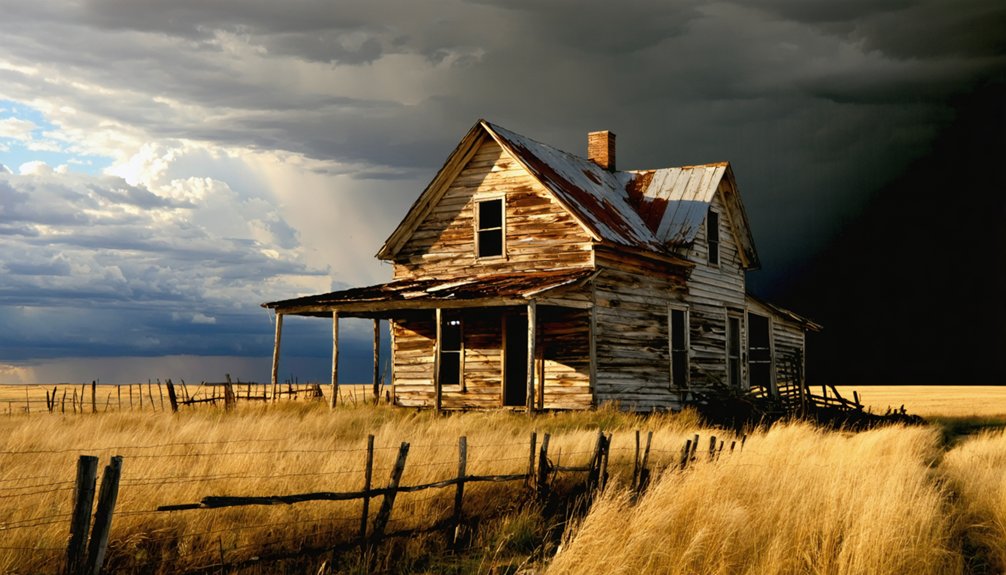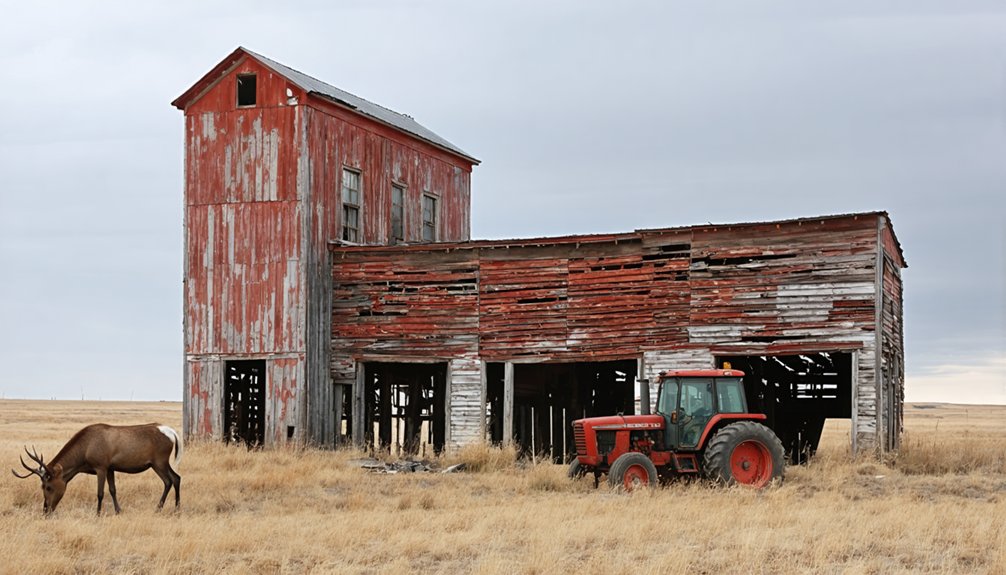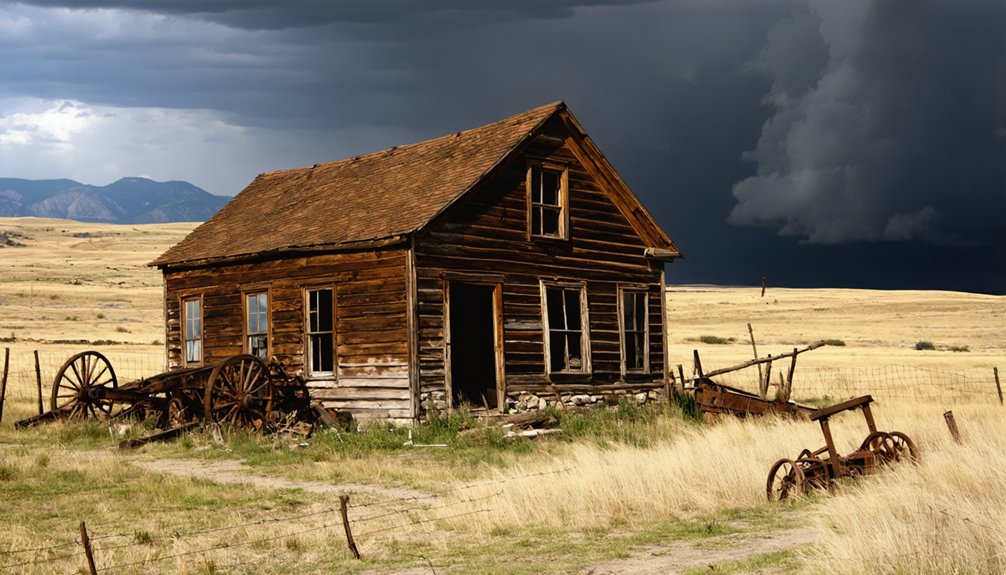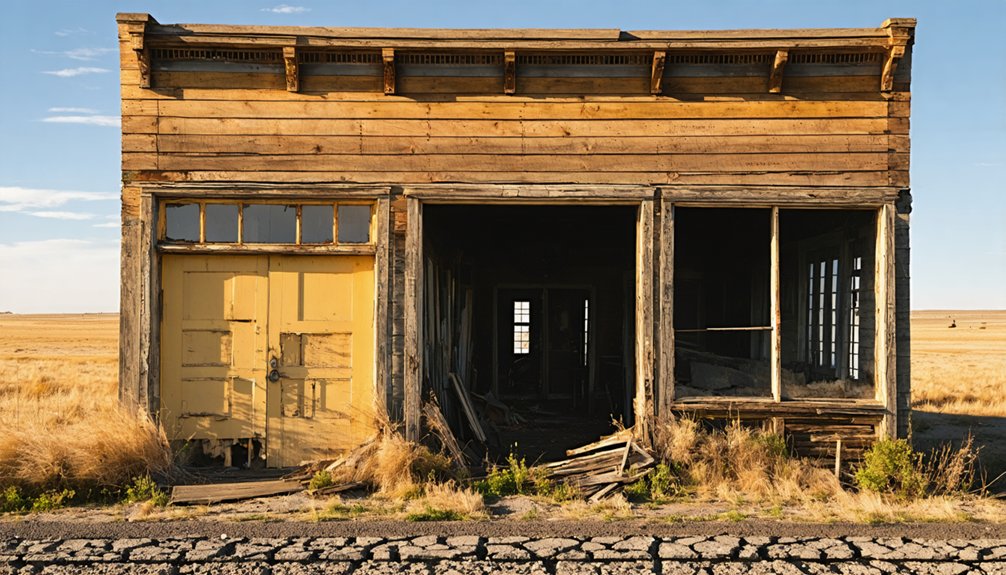
Start your ghost town road trip in Rapid City and head 40 miles east to Merritt, South Dakota, where 15 to 25 abandoned buildings sit frozen in the Black Hills. You’ll find a brick bank, an iconic chapel, and an active grain elevator alongside decades of silence. The sawmill closed in 1952, the families left, and history stayed behind. There’s far more to this forgotten logging town than you’d expect.
Key Takeaways
- Merritt, located 40 miles east of Rapid City in the Black Hills, is an accessible starting point for a Southwest South Dakota ghost town road trip.
- Between 15 and 25 abandoned buildings remain on private property, including a historic brick bank and iconic chapel, best viewed from public roads.
- Begin your trip in Rapid City, prioritize morning photography, use highway pullouts for safe viewing, and carry a paper map for spotty cell service areas.
- Combine your Merritt visit with nearby landmarks like Mount Rushmore, Deadwood, Wind Cave National Park, and Custer State Park for a fuller itinerary.
- Historical highlights include Merritt’s 1889 logging and railroad origins, its post-WWII decline, and President Calvin Coolidge’s notable 1927 picnic visit.
Where Is Merritt, South Dakota and How Do You Get There?
Tucked into the rugged Black Hills of South Dakota, Merritt sits at the intersection of Lawrence County and Pennington County, roughly 40 miles east of Rapid City.
The Merritt location places it within southwest South Dakota’s fascinating ghost town cluster, making it a natural stop on any regional road trip.
Accessing Merritt is straightforward if you know what to look for. You won’t find bustling signage or a busy main street.
Instead, watch for remnants of the old railroad grade visible from the highway, a quiet hint at the town’s logging and rail history. A present-day fish farm now occupies the site of the original town.
You’re fundamentally reading the landscape itself, piecing together a forgotten community from whatever fragments time has left behind.
How Merritt Was Founded as a Black Hills Logging Town
When the Black Hills timber industry pushed deeper into South Dakota’s rugged interior during the late 1880s, Merritt emerged from that expansion as a purposeful logging and railroad community. Founded in 1889, the town’s logging history traces directly to Homestake Mining‘s operational needs, as the company extended logging rails south into the region to harvest timber supporting its massive gold mining enterprise.
Railroad expansion shaped Merritt’s physical identity from the start. You can still spot remnants of the old railroad grade today, a tangible reminder of how rail lines once drove settlement across Lawrence and Pennington Counties.
The town took root in the SW¼, Sec. 7, T2N, R5E, strategically positioned where timber resources and transportation infrastructure intersected, giving early settlers both purpose and economic momentum.
What Drove Merritt’s Decline After World War II
The forces that hollowed out Merritt after World War II weren’t sudden—they were slow, compounding, and ultimately irreversible. Economic shifts hit hard when the sawmill—Merritt’s backbone—closed in 1952, eliminating the town’s primary reason for existence. Without steady employment, residents left for opportunity elsewhere.
Transportation changes sealed the town’s fate. Better roads and automobiles gave people mobility that earlier generations never had, letting them bypass Merritt entirely. Interstate construction then redirected traffic away from local businesses, cutting off what little economic lifeline remained.
The school closed in the 1950s, signaling that families had stopped seeing Merritt as a place worth raising children.
When the schoolhouse went dark, Merritt’s future went with it.
You’re looking at a community that simply couldn’t adapt fast enough. Each departure made the next one easier, until almost nothing remained.
The Abandoned Buildings Still Standing in Merritt
Merritt’s slow death left behind a haunting inventory—somewhere between 15 and 25 abandoned buildings still standing on private property, each one a frozen moment from the town’s working past.
You’ll spot abandoned architecture that speaks directly to Merritt’s historical significance as a logging and railroad hub. The brick bank building still commands attention, defying decades of neglect with stubborn permanence.
A chapel stands as the town’s most recognized structure, drawing visitors who appreciate authentic, unpolished history. An active train line still cuts through town, and one grain elevator remains operational—small reminders that life hasn’t completely vanished.
Remember to respect private property boundaries as you explore. You’re witnessing a rare, unrestored snapshot of early 20th-century Black Hills industry frozen exactly where it collapsed.
The Chapel, the Bank, and the Grain Elevator: Merritt’s Last Structures
Three structures define what little remains of Merritt’s physical identity: a chapel, a brick bank building, and a grain elevator that’s somehow still pulling its weight.
The chapel stands as the town’s most recognized landmark, carrying chapel history that echoes a once-thriving community gathering around shared faith.
You’ll notice the bank’s solid brick construction reflects serious bank architecture — built to last long after the economy that justified it collapsed. Ghost town preservation rarely gets this generous, so take it in.
The grain elevator’s elevator significance runs deeper than aesthetics; it’s one of the few structures still serving a functional purpose amid the ruins.
When you visit, you’re walking through a rare snapshot where three distinct eras of purpose survive side by side.
When Calvin Coolidge Came to Merritt for a Picnic
Few ghost towns can claim a presidential visit, but Merritt pulls it off. In 1927, President Calvin Coolidge stopped here for a picnic, lending the town a moment of unexpected historical significance that most forgotten settlements never experience.
Think about that as you stand among Merritt’s abandoned buildings. While Coolidge enjoyed his picnic, the town was still alive, its sawmill humming and its streets populated. He chose this Black Hills community during his South Dakota summer retreat, and that choice permanently wove Merritt into presidential history.
Coolidge’s picnic transformed an ordinary logging town into a footnote worth remembering. When you visit, you’re walking ground that a sitting president once walked. That connection makes Merritt’s silence feel heavier, more meaningful, and absolutely worth the detour.
What Merritt Looks Like Now: One Resident, 20 Empty Buildings
When you visit Merritt today, you’ll find a town that’s barely breathing — just one remaining resident holding down the fort in what was once a bustling logging community.
Scattered across the landscape, roughly 15 to 25 abandoned buildings sit on private property, their weathered frames telling the story of a town that time simply left behind.
You can still spot the brick bank building standing firm among the ruins, a quiet reminder that Merritt was once worth investing in.
Last Remaining Resident
Today, Merritt is a town in name only — one solitary resident holds the line against total abandonment, surrounded by roughly 20 empty buildings slowly surrendering to time.
That last resident carries an entire community legacy on their shoulders, a living connection to the logging crews, railroad workers, and families who once made Merritt breathe.
When you visit, you’re stepping into someone’s home territory, so tread respectfully. The empty structures around you aren’t just decay — they’re chapters of a story that thriving industries once wrote.
The sawmill’s 1952 closure accelerated the silence you’ll feel here. Better roads pulled people away, and the town never recovered.
What remains is raw, honest, and worth experiencing before even this final chapter closes completely.
Abandoned Buildings Overview
Scattered across Merritt’s quiet landscape, somewhere between 15 and 25 abandoned buildings now stand as the town’s most visible testimony to its collapsed economy.
You’ll find structures ranging from weathered timber frames to a surprisingly intact brick bank building — each one a natural subject for ghost town photography. The chapel remains the most iconic stop, drawing visitors who appreciate raw, unpolished history.
These buildings sit on private property, so you’ll want to observe and photograph from respectful distances. While historical preservation efforts haven’t formally reached Merritt, the structures have survived decades of neglect, weather, and abandonment.
An active train line still cuts through town, adding an unexpected layer of life to an otherwise frozen landscape. What you’re looking at is American history standing completely unguarded.
How to Visit Merritt’s Abandoned Buildings Without Trespassing
Merritt’s 15 to 25 abandoned buildings sit on private property, so you’ll need to keep your exploration to what’s visible from public roads and highway viewpoints.
Position yourself along the highway near the old railroad grade remnants, where you can photograph decaying structures without crossing any boundaries.
The brick bank building and chapel stand as powerful reminders of historic preservation done right — you can admire both from a respectful distance.
Local legends surrounding these structures add depth to what you’re seeing, transforming a simple roadside stop into something genuinely meaningful.
Bring binoculars and a good camera with a zoom lens to capture details you’d otherwise miss.
Respecting boundaries keeps access open for future visitors who’ll want their own piece of Merritt’s haunting story.
How to Build a Southwest South Dakota Ghost Town Road Trip
Once you’ve scoped out Merritt, you can easily string together a memorable Southwest South Dakota ghost town road trip by mapping your route around the region’s clustered abandoned communities.
Start with Rapid City as your base, since it sits roughly 40 miles west of Merritt and puts you within striking distance of the Black Hills’ best historic stops.
You’ll save time and miles by planning a loop that connects ghost towns along shared highway corridors rather than backtracking across the same roads twice.
Planning Your Route Efficiently
Tucked into the rugged southwestern corner of South Dakota, ghost towns like Merritt aren’t isolated curiosities — they’re waypoints on a larger story you can drive in a single day.
Start in Rapid City, heading roughly 40 miles east toward the Black Hills region. String together stops by following natural geographic clusters — Lawrence and Pennington Counties reward patient explorers who respect historical preservation while chasing ghost town photography opportunities.
Prioritize morning light for sharper images and cooler temperatures. Keep private property boundaries in mind; many abandoned structures sit on land you can’t legally access.
Use highway pullouts near old railroad grade remnants for safe viewing. Carry a paper map as backup — cell service gets spotty fast once you leave the main corridors behind.
Combining Nearby Attractions
Ghost towns don’t exist in a vacuum, and once you’ve mapped your route through Lawrence and Pennington Counties, you’ll realize how naturally Merritt fits into a broader Southwest South Dakota itinerary.
Rapid City sits roughly 40 miles west, giving you a solid base for exploring the Black Hills region. From there, you can chase ghost stories across multiple abandoned settlements, piecing together local legends that connect logging camps, mining booms, and railroad communities.
President Calvin Coolidge even picnicked near this area in 1927, adding a surprising historical footnote to your journey.
String together several ghost towns along the southwest corridor, blend in Black Hills landmarks, and you’ve built a road trip that rewards curious travelers who prefer authentic discovery over scripted tourism.
What to See Near Merritt on a Black Hills Road Trip
Merritt sits roughly 40 miles east of Rapid City, making it a natural launching point for a broader Black Hills road trip.
You’re already deep in territory rich with ghost town history, so push further into the region and let curiosity guide your route.
Mount Rushmore and Crazy Horse Memorial are within easy reach, offering dramatic contrast to Merritt’s quiet, forgotten streets.
Deadwood’s wild past connects directly to the logging industry and mining boom that once fueled towns like Merritt.
Wind Cave National Park and Custer State Park deliver stunning landscapes just south of your route.
You don’t need a rigid itinerary here — just a full tank, an open map, and a willingness to stop wherever the road pulls you.
Frequently Asked Questions
Is Merritt, South Dakota Safe to Visit for Solo Travelers?
You’ll find Merritt’s solo safety manageable if you follow smart travel tips. Respect private property, stay on public roads, and you’re free to explore this remote ghost town’s haunting charm independently.
What Is the Best Time of Year to Visit Merritt?
You’ll find the best seasons are late spring or early fall, when weather conditions stay mild, letting you freely explore Merritt’s haunting abandoned structures comfortably.
Are There Any Guided Ghost Town Tours Available Near Merritt?
You won’t find official guided tours at Merritt, but you can explore nearby Black Hills operators who’ll bring ghost town history and local legends to life, making your freedom-filled adventure through southwest South Dakota’s abandoned landscapes truly unforgettable.
Can You Camp Overnight Near the Merritt Ghost Town Area?
You’ll find camping options near Merritt’s ghost town area, but you’ll need to secure camping permits first. Embrace the freedom of South Dakota’s wilderness, but watch for local wildlife roaming the Black Hills surroundings!
Are There Any Documented Paranormal Reports From Merritt’s Abandoned Buildings?
You won’t find documented paranormal reports or ghost sightings from Merritt’s abandoned buildings, but the town’s haunted history—decaying structures, eerie silence, and forgotten lives—will fuel your imagination as you explore this mysterious, freedom-calling ghost town.
References
- https://kids.kiddle.co/Merritt
- https://www.youtube.com/watch?v=_0WNYsFLSLA
- https://kxrb.com/south-dakota-ghost-towns-2/
- https://www.sdhspress.com/journal/south-dakota-history-2-2/some-black-hills-ghost-towns-and-their-origins/vol-02-no-2-some-black-hills-ghost-towns-and-their-origins.pdf
- https://www.powderhouselodge.com/black-hills-attractions/fun-attractions/ghost-towns-of-western-south-dakota/
- https://mad-peak.com/blog-posts-and-info/f/black-hills-ghost-towns-are-real—and-you-can-ride-through-them
- https://en.wikipedia.org/wiki/List_of_ghost_towns_in_South_Dakota