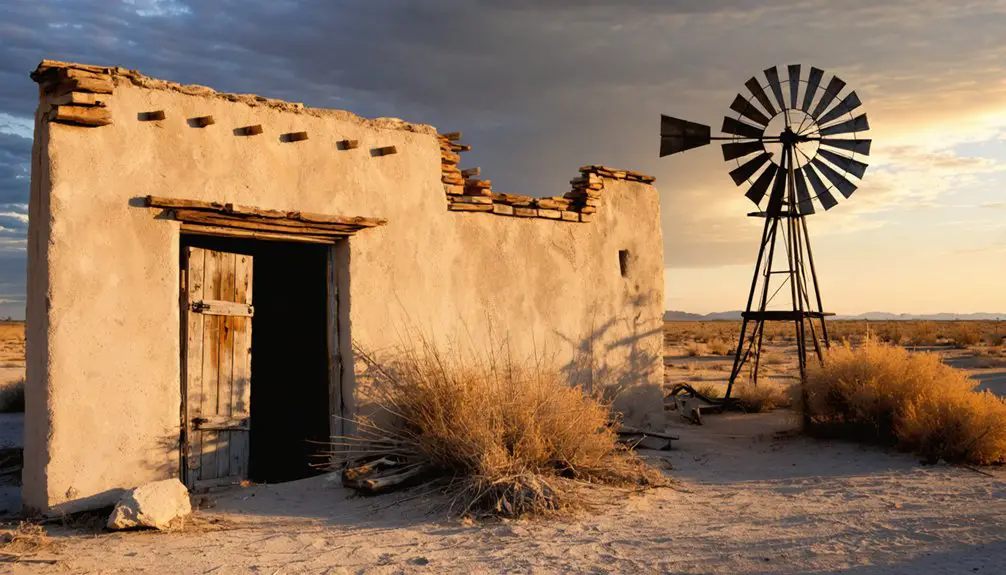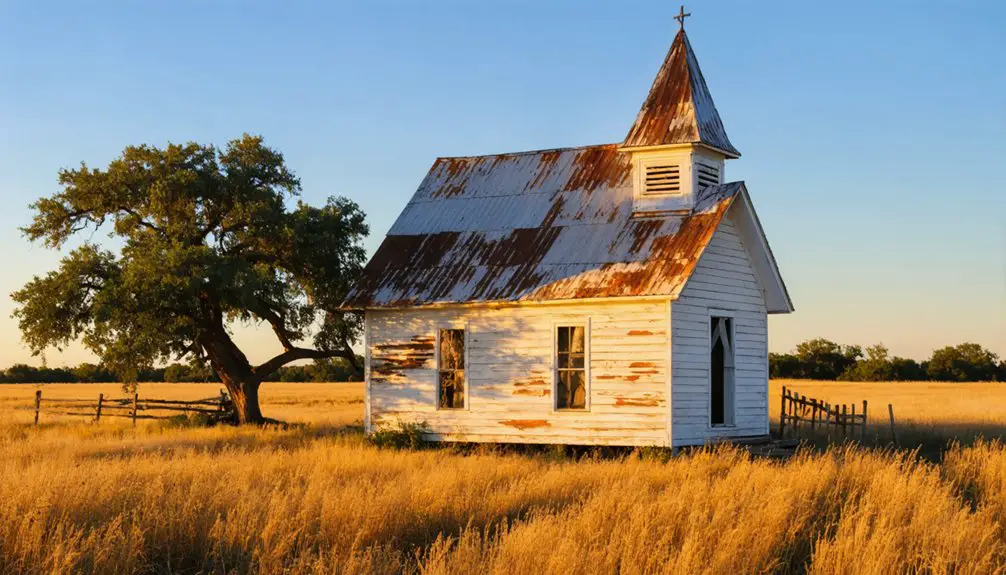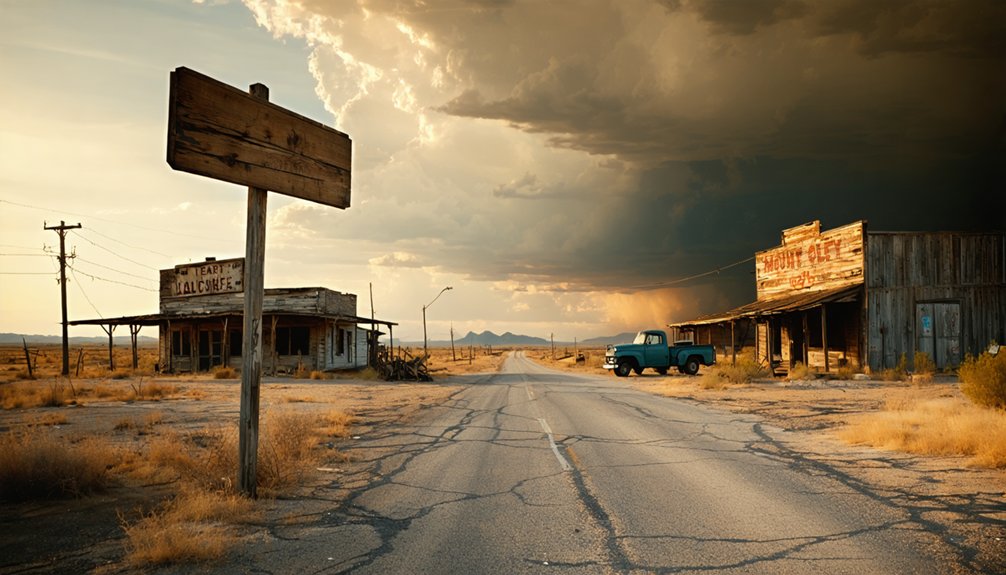
You’ll find Mount Olive’s haunting remnants fifteen miles from Stephenville, where 250 cemetery graves and the 1884 meat market’s crumbling foundations tell stories of freedmen who settled 162 acres during Reconstruction’s aftermath. Navigate Hill Country’s winding FM roads through oak-studded limestone terrain, ideally in spring or fall when temperatures cooperate. The designated Historic Texas Cemetery anchors multi-stop ghost town routes threading through Central Texas counties, where radar-detected unmarked graves and weathered headstones await explorers willing to venture beyond typical tourist paths into Texas’s layered abandonment patterns.
Key Takeaways
- Mount Olive Cemetery features 250 known graves and 90 unmarked locations revealed by 2021 ground-penetrating radar surveys.
- Visit during fall or spring to avoid oppressive summer heat while exploring Hill Country’s rolling limestone terrain.
- The 1884 meat market ruins mark Mount Olive’s commercial district, which once processed over 4,000 livestock monthly.
- Combine Mount Olive with nearby ghost towns like Sycamore and Sweet Home for a multi-stop Hill Country route.
- Use GPX files for navigation precision through 25 counties while respecting private property boundaries on scenic highways.
The Dark Origins of Mount Olive’s Settlement in 1877
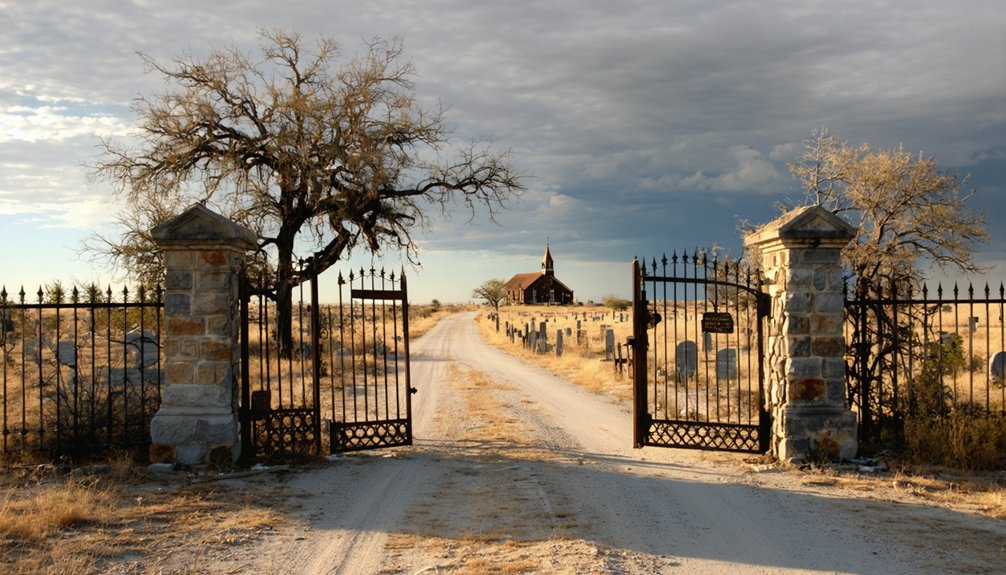
In the lingering shadow of Reconstruction, Jacob Armstrong stood at the headwaters of Peach Creek in December 1875, surveying 162 acres that would cost him $755—a fortune for a freedman who could only scrape together $5 as a down payment. You’ll understand the financial challenges when you realize he’d be paying five $150 promissory notes, each representing months of backbreaking labor.
Understanding the Violent Legacy of Big Spring’s First Eight Deaths
Long before Big Spring became a railroad town, the natural spring that gave it life drew cultures into deadly collision. You’ll find the story of Big Spring’s first recorded massacre near the Prido attack site, where eight soldiers confronted Comanche warriors. Two died immediately; arrows and lances struck every man.
The violence escalated at a nearby mission, where ten people—including three priests—were killed in brutal fashion that shocked even hardened frontiersmen. Eyes, tongues, and genitals were removed; bodies eviscerated. Survivors watched flames consume the mission for three days before fleeing to the presidio. This frontier violence legacy intertwined with Native American sacred rituals centered on the life-giving spring, creating a haunting foundation for the settlement that followed.
Whether you’re launching from Austin’s western suburbs or San Antonio’s historic River Walk, Texas Hill Country unfurls across 25 counties of rolling limestone terrain, spring-fed rivers carving through ancient canyons, and scenic highways that ribbon through oak-studded hills. Your self guided tour recommendations span from Spicewood through Fredericksburg to Wimberley—148 miles extendable to 300+ with strategic loops.
Chase roads less traveled like the Twisted Sisters (Ranch Roads 335, 336, 337), where dramatic curves slice through Leakey’s backcountry, or tackle FM32 along Devil’s Backbone for winding vistas punctuated by alpaca ranches. Download GPX files for navigation precision, respect private property boundaries, and time your journey for fall or spring when Hill Country reveals its truest character without summer’s oppressive heat.
What Remains: The Historic Cemetery and Architectural Ruins
Your journey through Hill Country’s winding backroads eventually leads to discoveries far quieter than scenic overlooks—places where history rests beneath Texas soil, marked only by weathered stones and the whispers of those who came before.
Mount Olive Cemetery stands as a monument to Stephenville’s African American heritage since 1922. You’ll find 250 known graves along a barely noticeable dirt road at 1002 S. College Farm Rd., though headstone conditions tell stories of time’s passage—stones sinking into wetlands, others fallen or facing wrong directions from long-ago relocations. Ground-penetrating radar revealed 90 unmarked grave locations in 2021, prompting preservation efforts. Temporary markers from the 1970s still await permanent replacements. This designated Historic Texas Cemetery invites exploration beyond conventional tourist trails, where authentic history dwells undisturbed.
The 1884 Meat Market and Commercial District Remnants
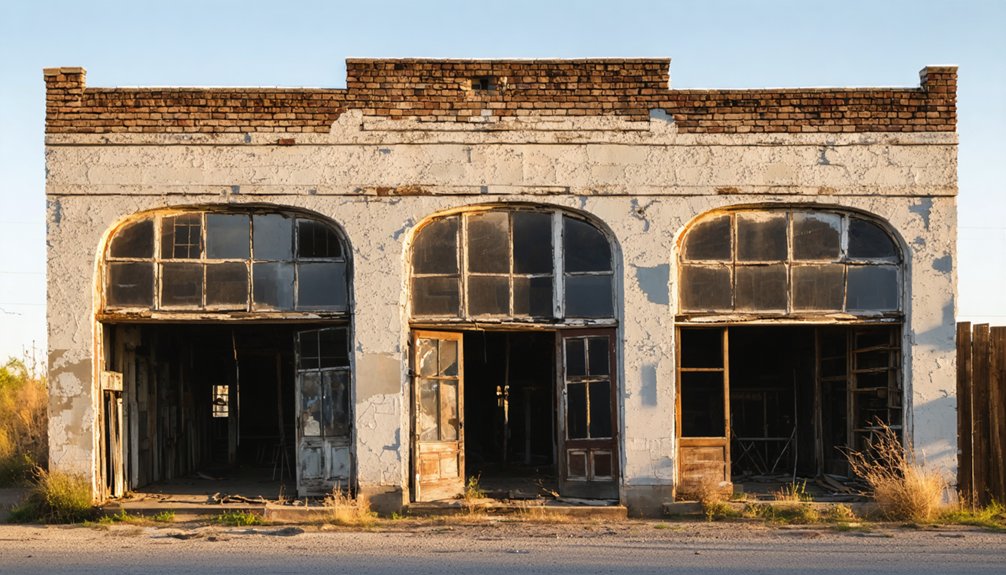
You’ll find the weathered bones of Mount Olive’s 1884 commercial heart scattered across forgotten lots where merchants once traded cattle and dry goods. The meat market, sold to H.A. Lagranduer that pivotal year, anchored a bustling district that processed over 4,000 head of livestock monthly and served families from frame houses lining Franklin and Paradise Streets.
Today, crumbling foundations and partial walls mark where steers fetched $4.85 per hundredweight and proprietors built their two-story establishments within sight of Taylor’s Hill.
Historic 1884 Structure Details
The weathered bones of Mount Olive’s 1884 meat market stand as a skeletal reminder of frontier commerce, its collapsed frame walls and crumbling stone foundation marking what was once the town’s commercial heart. You’ll spot the intact smokehouse chimney rising above scattered tin roofing sheets, while hook racks and butcher blocks reveal the building’s meat processing capabilities.
The $500 construction cost reflected typical architectural design evolution for frontier Texas—practical wooden facades with large display windows, exposed beam supports, and essential drainage channels carved into packed dirt floors. Ice storage pits demonstrate pre-refrigeration ingenuity, and the rear processing area connected directly to local ranchers’ supply chains.
Today’s fenced ruins preserve scattered butchery tools, offering you tangible connections to 1880s self-reliant commerce.
Commercial Development Timeline
Before the 1884 meat market rose from Smith County’s red clay, Mount Olive existed as little more than a scattered school community with no commercial heartbeat. That landmark structure changed everything, anchoring the town’s first true commercial district and establishing early business operations tied directly to the region’s agricultural roots.
You’ll find that meat market revenue trends peaked briefly in those nascent years before isolation strangled growth—no railroads carved through these plains, no canals channeled prosperity inward.
Visible Architectural Remains Today
Standing at the corner of West 5th Street today, nothing marks where the 1884 meat market once anchored Mount Olive’s fleeting commercial aspirations. You’ll search in vain for architectural artifacts—no weathered frame buildings, no crumbling foundations, no rusted signage. The commercial zone remnants have vanished completely, erased by time and neglect.
The Mt. Olive Cemetery Society’s zoned master files track nearby graves but ignore the market’s physical footprint. Census records place the Grabill family residence here, lodgers and live-in cooks populating frame houses that once dotted this district. By 1894, small rental structures lined Paradise Street and Taylor’s Hill, but today’s landscape offers no trace. You’re left piecing together a ghost town from documents alone, walking streets where commerce briefly thrived before disappearing without architectural witness.
Best Times to Visit for Paranormal Tours
Planning your paranormal adventure to Mount Olive requires timing that aligns with when spirits are most active—and when tour operators throw open their doors to ghost hunters. Weekend event timings dominate Texas ghost tours, with Friday and Saturday evenings offering prime slots between 7:00pm and 9:15pm across multiple locations.
You’ll find Dallas excursions launching at 8:00pm, while Texarkana’s Saturday night walks begin at 9:00pm from the Lindsey Railroad Museum. Weather contingency measures vary by operator—most tours power through wind, rain, and oppressive Texas heat, though Grapevine cancels during severe conditions or private events. December sees suspensions due to holiday crowds.
Book ahead since space fills quickly, and arrive fifteen minutes early wearing comfortable shoes ready for 90-minute to two-hour treks through haunted darkness.
Combining Mount Olive With Other Ghost Town Destinations
You can craft an unforgettable Central Texas ghost town circuit by pairing Mount Olive with Comyn’s three documented abandonment sites, just a short drive through Mills County’s rolling hills.
Exploring ghost towns to visit in Texas offers a unique glimpse into the state’s rich history and the stories of those who once called these places home. With each stop, you’ll uncover remnants of architecture and engage with captivating tales of perseverance and decline. This journey not only highlights the beauty of the Texas landscape but also reminds us of the fleeting nature of time and community.
The region’s cluster of forgotten settlements—including Cheapside in Gonzales County and Chalk Mountain in Erath County—creates natural loops for day trips or weekend explorations.
This concentrated network of abandoned towns lets you experience multiple layers of Texas history without logging endless highway miles between destinations.
Multi-Stop Hill Country Route
While Mount Olive itself offers a glimpse into Hill Country abandonment, combining it with neighboring ghost towns transforms a single-site visit into an immersive journey through Texas’s forgotten settlements. You’ll trace the region’s boom-and-bust cycles by sequencing sites northwest through Central Texas counties, where peak population estimates once reached hundreds before railroad bypasses and resource depletion emptied entire communities.
Start at Mount Olive’s 1877 homesteads, then progress to Guadalupe County’s vanished Sycamore and Sweet Home settlements. Push toward Nolan County’s Wastella, where a skeletal grain elevator marks agricultural collapse. These routes reveal forgotten pioneer families who gambled on railroad promises that never materialized. Each stop layers another chapter of abandonment, creating a detailed narrative of Hill Country resilience and surrender across 800 miles of Texas’s most hauntingly beautiful backroads.
Nearby Abandoned Settlement Clusters
Because Mount Olive sits at the crossroads of five distinct regional ghost town networks, you can architect weekend expeditions that reveal Texas’s layered abandonment patterns—from sawmill collapses in the piney East to mining failures across Western deserts.
The Mills County Cluster positions you fifteen miles northeast of Goldthwaite, where vanished social institutions like Morris Ranch’s forgotten gathering halls dot Gillespie County’s limestone hills. Push eastward to Hardin County’s Olive, where abandoned religious structures stand sentinel beside phantom railroad tracks that locals swear still carry spectral locomotives through midnight fog.
Westward routes thread through Hudspeth County’s Arispe, population once fifty-seven, now zero. Each cluster reveals distinct collapse signatures: timber exhaustion versus mineral depletion, tornado devastation versus economic strangulation. You’re not touring—you’re decoding Texas’s ghost geography.
Photography Guidelines at the Cemetery Grounds
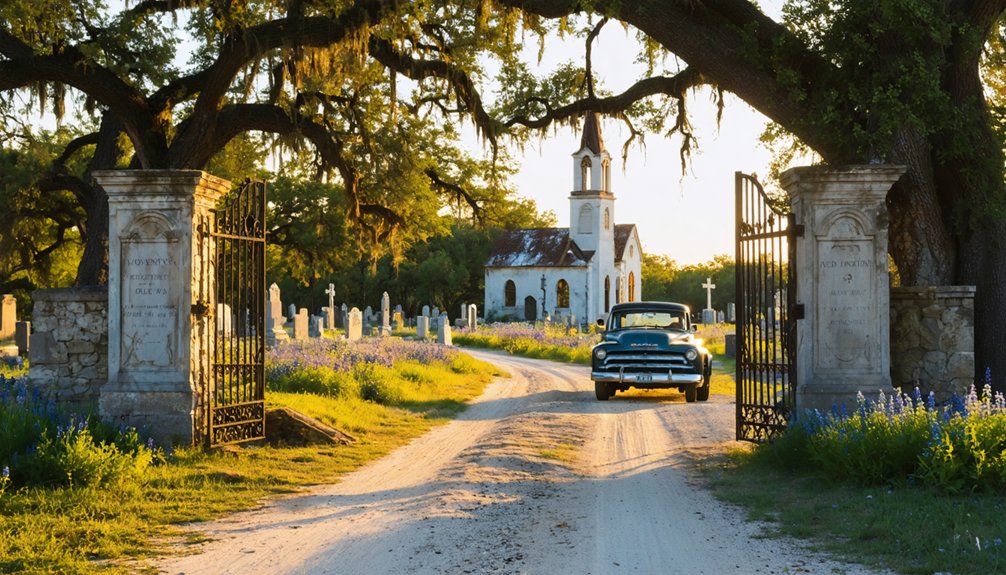
Before you raise your camera to capture weathered headstones and century-old monuments, you’ll need to understand the photography rules that govern cemetery grounds. Most historic cemeteries welcome private, non-commercial photography during daylight hours, but you’ll want to respect documented visitor etiquette and sensitive subject matter protocols.
Essential Photography Guidelines:
- Equipment restrictions – Keep your setup simple with handheld cameras and available light; tripods and external lighting typically require written permission from cemetery administration.
- Visitor privacy – Never photograph mourning families or active burial services without explicit consent from those present.
- Access limitations – Stay within posted visiting hours, maintain the 10 mph speed limit, and avoid walking on graves or driving on grass.
Submit written requests for commercial shoots well in advance, as permits aren’t guaranteed.
Historical Records and Research Resources Available
Your camera has captured the weathered stones and fading inscriptions, but the stories behind those dates and names await discovery in archives and digital databases scattered across Texas. The Texas State Historical Association’s Handbook of Texas Online offers detailed entries on Mount Olive’s scattered communities, while the Texas Historical Commission’s Atlas preserves marker documentation like the Erath County cemetery’s number 5507018656.
You’ll find primary source records challenging to access—courthouse fires in 1873 destroyed Limestone County’s earliest documents, leaving gaps in settlement histories. Secondary research materials compiled by county historical commissions fill these voids through oral histories and family records. Texas Escapes and the Historic American Buildings Survey provide additional context.
These dispersed resources demand patience, but they’ll transform grave markers into narratives of pioneers who carved communities from wilderness.
Safety Considerations for Exploring Abandoned Sites
While the pull of Mount Olive’s weathered structures whispers promises of photographic treasures and historical discoveries, these decaying sites harbor genuine hazards that demand respect and preparation. Your environmental hazards assessment begins before you step from your vehicle—scan for unstable walls, sagging rooflines, and vegetation concealing hazardous debris.
Before entering any abandoned structure, conduct a thorough visual assessment from a safe distance to identify structural weaknesses and hidden dangers.
Essential equipment maintenance planning includes:
- Protective gear: Heavy-duty gloves, long sleeves, sturdy boots, and FFP3 masks shield against sharp edges, collapsing materials, and airborne contaminants like asbestos or mold
- Navigation tools: Headlamp with backup batteries, offline maps, and marking chalk prevent disorientation in maze-like ruins
- Emergency provisions: Fully charged phone, first aid kit, and pepper spray address medical needs and unexpected encounters
Never venture solo—share your route and return time with someone who’ll notice if you don’t come back.
Frequently Asked Questions
Are There Any Entrance Fees to Access Mount Olive Cemetery?
You won’t pay entrance fees to explore Mount Olive Cemetery’s grounds. You’ll find free access to this site of historical significance, where ongoing preservation efforts protect burials dating to 1883, welcoming visitors seeking authentic Texas heritage connections.
What Nearby Accommodations Are Available for Overnight Stays?
You’re in the middle of nowhere, so local motels and bed and breakfasts are scarce near Mount Olive’s ghost town. You’ll find better options in Alpine or Marfa, where authentic Texas hospitality meets your adventurous spirit perfectly.
Can Visitors Bring Metal Detectors to Search for Artifacts?
You’ll need landowner permission first, as Mount Olive sits on private property. Authorized metal detection rules require written consent, and historical preservation concerns mean you must report any artifacts found—don’t remove them without proper agreements.
Are Pets Allowed on the Ghost Town Grounds?
Yes, you can bring pets to explore the grounds under pet friendly policies. You’ll need to follow leash requirements—keeping your dog on a six-foot leash, maintaining visual supervision, and ensuring they’re well-behaved throughout your visit.
What Cell Phone Coverage Can Be Expected in the Area?
Wondering if you’ll stay connected? Expect spotty cellular network connectivity in Mount Olive’s remote location. Available data speeds will likely disappoint as you’re far from towers. Consider downloading maps offline before exploring this isolated Texas ghost town.