Planning a ghost town road trip to Nolia, Oklahoma starts with a 60-mile drive northeast from Tulsa on US-169 toward Nowata, then another 20 miles on county roads. You’ll discover collapsed oil derricks, scattered foundations, and open grassland slowly swallowing what was once a 500-person boomtown. Nearby stops like Picher and Route 66’s forgotten towns make this a rich 200-mile loop. There’s far more waiting for you ahead.
Key Takeaways
- Nolia, Oklahoma, is an abandoned oil boomtown featuring collapsed derricks, rusted metal, and concrete foundations spread across open grassland.
- From Tulsa, head northeast on US-169 toward Nowata, then take county roads 20 miles further northeast, totaling roughly 200 miles round trip.
- Scenic stops along the route include Barnsdall’s Main Street oil well and the historic Persing schoolhouse in Osage County.
- Nearby ghost towns like Picher and Route 66 sites Douthat and Zincville make worthwhile detours for a fuller road trip experience.
- Nolia’s wide, silent skies and deteriorating structures offer a raw, unfiltered glimpse into Oklahoma’s early 1900s oil rush history.
Why Nolia’s Abandoned Oil Derricks Still Draw Visitors
Even decades after the oil dried up, Nolia’s skeletal derricks still punctuate the northeast Oklahoma skyline like frozen sentinels from another era.
You’re stepping into abandoned history the moment you arrive — collapsed wooden legs, scattered foundations, and rusted metal whispering stories of a boomtown that once housed 500 people chasing oil fortunes.
Collapsed wooden legs and rusted metal whisper stories of 500 people who once chased oil fortunes here.
Nolia’s oil legacy isn’t just visually striking; it’s a raw, unfiltered connection to early 1900s ambition.
No crowds, no admission fees, no curated narratives — just open land and honest ruins. You can wander freely, photograph deteriorating derricks against wide Oklahoma skies, and feel the weight of a community that rose fast and vanished faster.
That unscripted authenticity is exactly what keeps curious travelers returning to this forgotten northeast Oklahoma corner.
How Nolia Went From Oil Boomtown to Ghost Town?
When oil flooded Nolia’s fields in the early 1900s, it transformed a quiet patch of northeast Oklahoma into a bustling community of nearly 500 residents almost overnight.
The Oil Discovery sparked fierce ambition, drawing workers, merchants, and dreamers chasing prosperity.
But once the wells ran dry in the 1920s, Population Decline hit fast and hard, leaving structures to rot and dreams to fade.
Here’s what sealed Nolia’s fate:
- Oil reserves depleted faster than anyone anticipated
- Workers abandoned the town seeking new booms elsewhere
- Businesses collapsed without a steady labor force
- Buildings deteriorated with no community left to maintain them
You’re now walking into a landscape that tells that entire story through collapsed derricks, scattered foundations, and eerie silence stretching across open Oklahoma skies.
How Do You Get to Nolia via Route 66 From Tulsa?
Nolia’s ghost story pulled you in, and now it’s time to go find it. From Tulsa, head northeast on US-169 toward Nowata, covering roughly 60 miles in about an hour.
These route directions keep it straightforward, but don’t rush past the scenic stops along the way. Swing through Barnsdall to catch the working Main Street oil well, a living echo of Nolia’s past.
Continue toward the Persing schoolhouse in Osage County for another forgotten relic. From Nowata, take county roads off the Route 66 alignment roughly 20 miles further northeast.
You’ll cross quiet bridges and open landscapes before the ghost town reveals itself. The full loop back via I-44 wraps a satisfying 200-mile day trip through Oklahoma’s forgotten oil country.
What Will You Actually See at Nolia’s Abandoned Site?
Arriving at Nolia feels like stepping into a photograph that time forgot to develop. The Nolia remnants scattered across the landscape tell a raw, honest story of boom-and-bust survival.
You’ll immediately notice the historical significance etched into every rotting timber and crumbling foundation.
Here’s what greets you on-site:
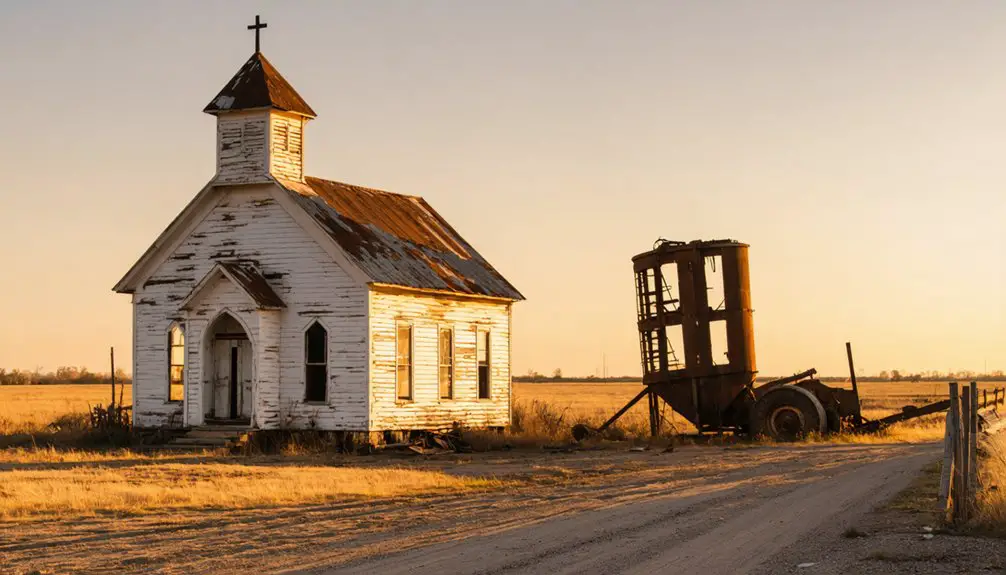
- Collapsed oil derricks with wooden legs still jutting from the earth
- Scattered concrete foundations outlining where homes and businesses once stood
- Open grassland swallowing structures slowly reclaimed by northeast Oklahoma’s terrain
- Wide, silent skies framing the desolation with striking visual power
You’re not walking through a museum — you’re standing inside an unfiltered chapter of Oklahoma’s oil history, completely free to explore on your own terms.
Which Ghost Towns Near Nolia Are Worth the Detour?
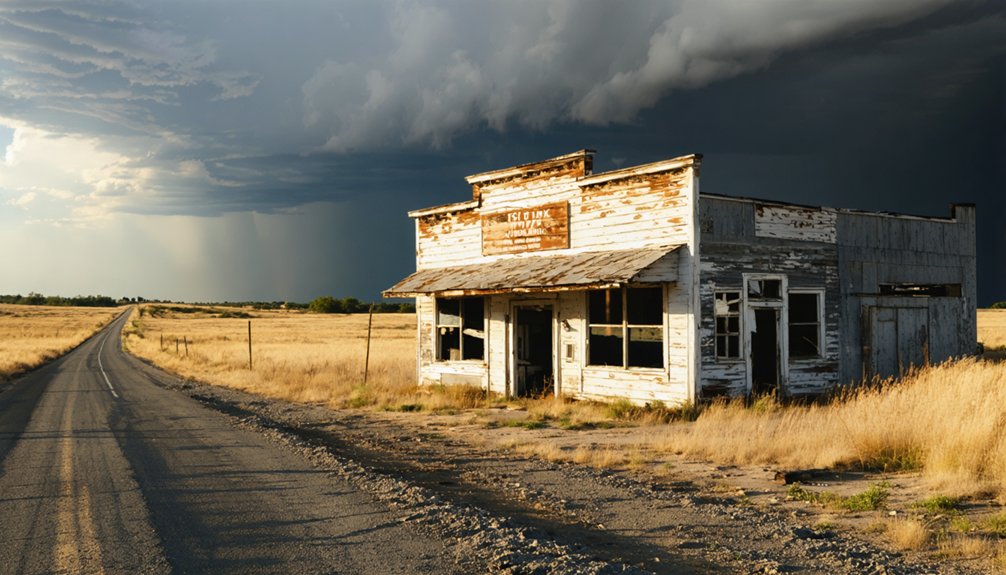
While you’re in the area, you’d be remiss to skip the nearby ghost towns that amplify Nolia’s story.
Route 66 connects several abandoned communities worth exploring, from quiet forgotten railroad stops to the eerie, toxic ruins of Picher, a former mining boomtown so contaminated it became a federal Superfund site.
Picher’s massive chat piles and crumbling structures are haunting, but proceed with extreme caution since the ground and air carry serious environmental hazards.
Picher’s Toxic Ruins
Once you’ve soaked in Nolia’s oil-field remnants, Picher stands as the most haunting detour in the region — a former mining boomtown the federal government fully evacuated after declaring it a toxic superfund site.
Picher history reads like a cautionary tale: decades of lead and zinc mining left poisonous chat piles towering over empty streets. Toxic cleanup efforts couldn’t reverse the damage, forcing every resident out.
What you’ll encounter there’s unforgettable:
- Massive grey chat piles stretching across the horizon
- Crumbling structures frozen in mid-abandonment
- Contaminated waterways running through hollowed neighborhoods
- Eerie silence where thousands once lived freely
Proceed with extreme caution — the ground and air carry real hazards.
Picher isn’t just a ghost town; it’s a warning carved into the landscape.
Route 66 Nearby Towns
Picher’s desolation is hard to shake, but the ghost towns scattered along nearby Route 66 offer a different kind of haunting — one rooted less in toxicity and more in quiet abandonment.
Towns like Douthat and Zincville sit close to the historic highway, each carrying its own forgotten story. You’ll find collapsed structures, overgrown lots, and silence where communities once thrived.
Route 66 itself contributed to many of these towns’ declines — when bypasses rerouted traffic, businesses dried up fast.
Driving these stretches, you’ll feel the weight of that history without the chemical hazard warnings. Each detour rewards you with raw, unfiltered Americana.
Keep your map handy, watch for unmarked county roads, and embrace the freedom of exploring places most travelers completely overlook.
What Should You Know Before Visiting Nolia?
Before you head out to Nolia, there are a few practical things worth knowing. This remote oil boomtown delivers raw ghost town experiences, but it’s not a polished tourist destination. Understanding Nolia history helps you appreciate what you’re seeing among collapsed derricks and scattered foundations.
- Navigation: Use county road maps; GPS signals can drop on backroads off Route 66.
- Access: Dirt roads connect Nolia to Nowata, so check conditions after rain.
- Safety: Deteriorated structures are unstable — stay alert and watch your footing.
- Supplies: Fuel up and pack water in Nowata before heading out; there are no services nearby.
Go prepared, stay curious, and you’ll experience one of Oklahoma’s most authentic forgotten places.
Frequently Asked Questions
How Many Ghost Towns Exist Across Oklahoma in Total?
You’ll find approximately two thousand ghost towns scattered across Oklahoma, proving the theory that Oklahoma history’s boom-bust cycles left lasting marks. Explore these ghost town preservation sites and reclaim your freedom on open roads!
What Caused Some Oklahoma Towns to Become “Liquor Towns”?
You’ll find that some Oklahoma towns became “liquor towns” because they existed beyond early liquor laws, serving cowboys freely. Economic decline followed once the 1890 Organic Act enforced restrictions, stripping these wild communities of their profitable, rebellious purpose.
Can Nolia Be Accessed From Coffeyville, Kansas Instead of Tulsa?
Yes, you can access Nolia via a Coffeyville access route! Head south from Coffeyville into Nowata County’s backroads, following the Nolia route through northeast Oklahoma’s open landscapes. It’s a fantastic alternative for adventurous freedom-seekers exploring ghost towns!
Are There Native American Historical Sites Near Nolia to Visit?
With over 2,000 Oklahoma ghost towns carrying Native heritage, you’ll find the Lewis Shawnee Native American cemetery near Nolia holds deep cultural significance. Stop in Pawhuska, too — it’ll enrich your understanding of Osage history beautifully.
How Does Nolia Compare to New Mexico Ghost Towns Like Cuervo?
You’ll find Nolia’s history rooted in oil booms, while a Cuervo comparison reveals desert cemetery remnants along I-40. Both ghost towns captivate free-spirited explorers, but Nolia’s collapsed derricks offer a uniquely industrial, raw Oklahoma experience.
References
- https://z94.com/explore-oklahoma-ghost-towns/
- https://usghostadventures.com/americas-most-haunted-trending/ghost-towns-to-visit-on-your-summer-road-trip-along-route-66/
- https://www.youtube.com/playlist?list=PL4jqwLUrhjNSZCapB5hABG_w3PIwx66mn
- https://www.youtube.com/watch?v=2Umqz7LrpyE
- https://www.youtube.com/watch?v=TCrMouVV5Xw
- https://www.okhistory.org/publications/enc/entry?entry=GH002
- https://en.wikipedia.org/wiki/List_of_ghost_towns_in_Oklahoma