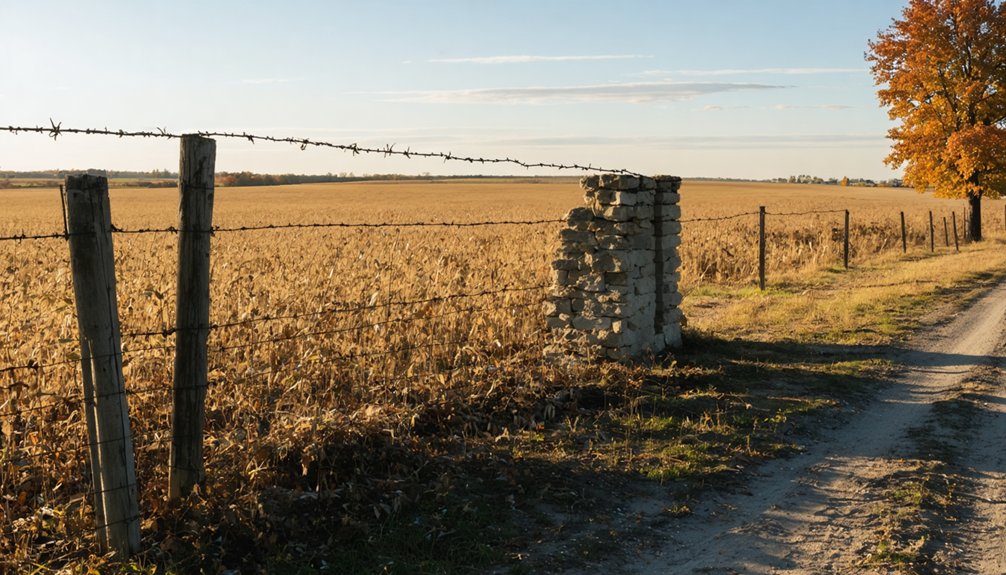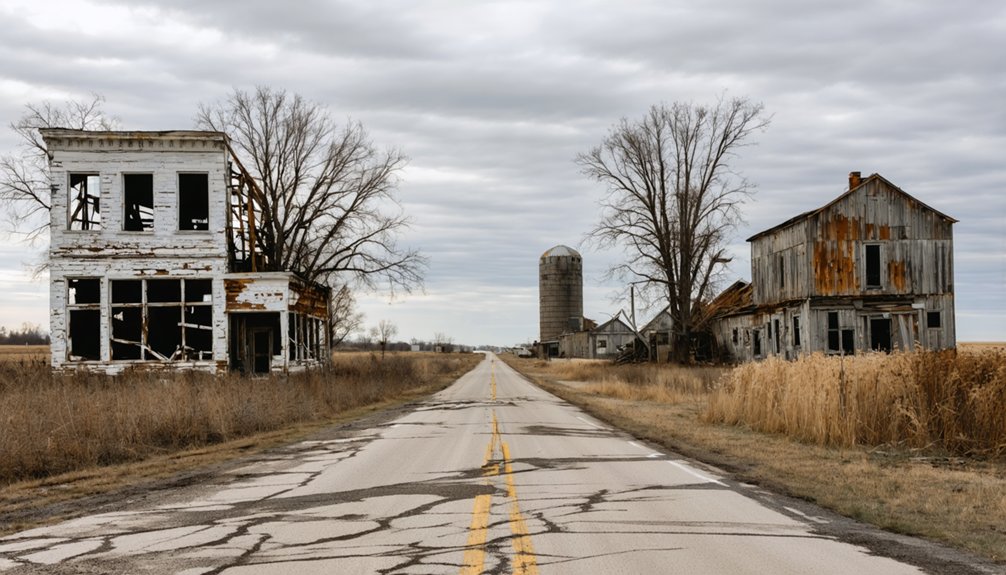
Planning a ghost town road trip to Evans, Illinois means driving out to a windswept Marshall County prairie crossing where railroad ambitions once thrived and then quietly vanished. You’ll find no buildings, no markers — just the old Chicago & Alton grade and an enormous prairie silence that’s genuinely haunting. Visit between May and October for the best road conditions. Bring water, sturdy boots, and a paper map. There’s far more to this forgotten Illinois railroad town than emptiness alone.
Key Takeaways
- Evans, Illinois, a former railroad hub, is a ghost town with no remaining buildings, offering only the historic railroad grade as a landmark.
- Nearby ghost towns Custer, Porterfield, and Garfield share similar railroad histories and can be explored along the old Chicago & Alton grade.
- Visit between May and October for optimal road conditions, mild temperatures, and long daylight hours suitable for exploration and photography.
- Roads to Evans are Grid 3 access routes; bring sturdy boots, water, a paper map, and an emergency kit due to no nearby services.
- Respect local wildlife, stay on designated paths, and research travel routes in advance to minimize environmental impact during your visit.
What Was Evans, Illinois and Why Did It Disappear?
Once a promising railroad station carved out of the vast Illinois prairie, Evans—also known as Evans Point—rose and fell within a few decades, leaving behind nothing but a footnote in Marshall County’s history.
Evans history traces back to its founding as a grain and livestock shipping hub where the Illinois Central and Chicago & Alton railroads crossed. Its railroad significance attracted early optimism, but settlement challenges proved insurmountable.
At the crossing of two railroads, Evans was born with ambition—and burdened from the start with the weight of it.
No community truly took root. A general store and blacksmith shop briefly operated, and the post office ran from 1873 until 1905, when Rural Free Delivery made it obsolete.
Evans mirrors broader ghost town trends across Illinois—towns born from railroad ambition, abandoned when that ambition faded.
You’re fundamentally chasing a place that the land itself has reclaimed completely.
What Makes Evans Point Worth the Drive Despite Having Nothing Left?
You might wonder why you’d burn gas driving to a place where “absolutely nothing” remains, but Evans Point delivers something most tourist stops can’t — raw, unfiltered prairie silence on ground where two railroads once crossed and a forgotten town briefly flickered to life.
The landscape itself becomes the attraction, offering wide-open views across Marshall County’s terrain that earned Evans its claim as the highest point between the Illinois and Wabash Rivers.
And since nearby ghost towns like Custer, Porterfield, and Garfield sit along the same old railroad grades, you can stitch together a full day of haunted Illinois history without doubling back.
Ghost Town Historical Allure
Though nothing remains of Evans Point but open prairie and old railroad grades, the drive out here carries a quiet pull that’s hard to explain until you’re standing in the middle of it.
Ghost town nostalgia hits differently when there’s nothing left to distract you. You’re left with pure railroad heritage and open sky.
Here’s what makes Evans worth your time:
- Standing at the crossing where two railroads once intersected
- Feeling the scale of Illinois prairie that surrounded early settlers
- Tracing the old Chicago & Alton grade beneath your feet
- Imagining grain shipments rolling out across Marshall County
- Experiencing a place that history simply walked away from
Evans doesn’t reward you with ruins. It rewards you with perspective.
Rare Prairie Landscape Views
Beyond the railroad nostalgia, Evans Point hands you something even rarer: a genuine slice of Illinois tallgrass prairie that’s swallowed up most of what civilization tried to plant here.
You’re standing where grain and livestock once shipped out by the carload, yet nature reclaimed every board and brick without apology.
That erasure is precisely the draw. Prairie preservation doesn’t always happen in designated parks — sometimes it just happens, quietly, where towns surrender.
You’ll find open horizon stretching toward the Illinois and Wabash River divides, unbroken sky, and light that serious landscape photography enthusiasts genuinely chase.
Come in May through October when color peaks and access holds. Bring your camera, leave your expectations of ruins behind, and let the prairie speak for itself.
Nearby Ghost Town Stops
Evans Point earns its place on your itinerary not by standing alone, but by anchoring a tight cluster of forgotten railroad communities that together tell a richer story than any single site could.
Combine your visit with these nearby stops to fully grasp the ghost town dynamics and railroad significance shaping Marshall County’s Evans history:
- Custer – another two-railroad crossing town, mirroring Evans Point’s structural DNA
- Porterfield – a quiet station stop revealing prairie ecology undisturbed by development
- Garfield – vanished but historically connected through the same rail corridors
- Varna – living railroad town offering local knowledge and context
- Old Chicago & Alton grade – driveable remnant connecting these ghost communities
Together, these stops transform a single ghost town visit into a compelling cross-country railroad expedition.
Where Exactly Is Evans in Marshall County, Illinois?
Tucked into Marshall County, Illinois, you’ll find Evans sitting in section 28 of Evans Township, right where the Illinois Central and Chicago & Alton railroads once crossed.
The Illinois Central ran along the eastern border, while the Chicago & Alton cut through the southern half, making this crossing central to Evans history and railroad significance.
Two railroads defined Evans — the Illinois Central along its eastern edge, the Chicago & Alton slicing through its southern heart.
Historical maps show this remote prairie junction claimed the highest point between the Illinois and Wabash Rivers.
Settlement patterns here tell a familiar ghost town myth — founders envisioned a thriving shipping hub, but the surrounding prairie ecology swallowed those ambitions whole.
Community stories and local legends from nearby Varna confirm nothing remains today.
You’re fundamentally chasing coordinates, open sky, and the faint echo of a town that never quite materialized.
How Do You Get to Evans, Illinois by 2WD Road?
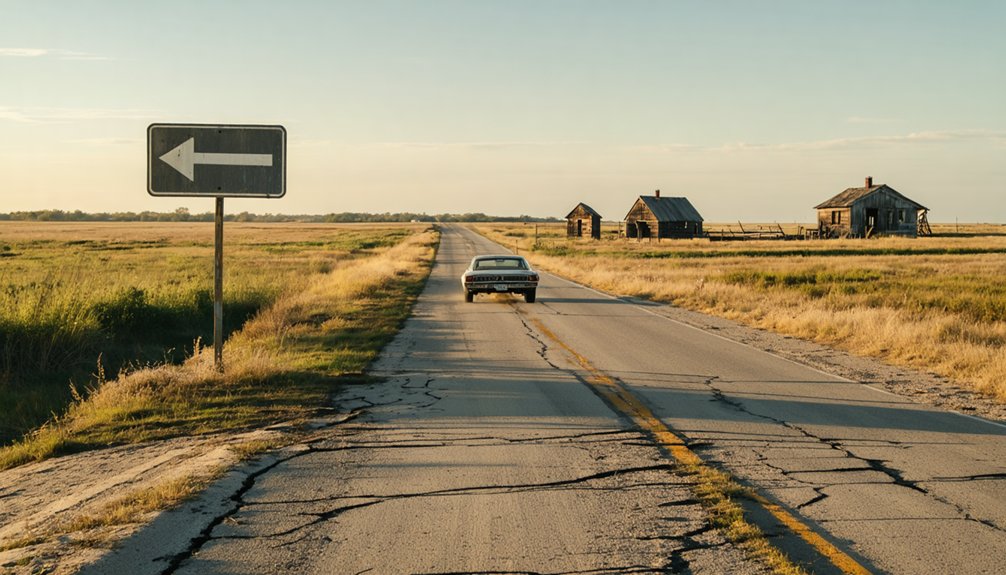
Knowing where Evans sits is half the battle — getting there completes it. You’ll navigate 2WD-accessible roads along the old Chicago & Alton railroad grade, rated grid 3, meaning open, sparse terrain perfect for prairie exploration.
Here’s your practical checklist before rolling out:
- Start in Varna — your nearest reference town, rich with local legends and railroad significance
- Follow the old railroad grade — abandoned infrastructure traces ghost towns beautifully
- Travel May–October — harsh winters compromise rural life road conditions
- Drive 2WD confidently — scenic routes here don’t demand heavy equipment
- Respect the Evans history — this land shaped Illinois agricultural commerce
You’re chasing genuine disappearance here — wide prairie, quiet crossings, and the unmistakable silence of something that almost became something.
What’s Left to See at the Evans Ghost Town Site?
When you arrive at the Evans ghost town site, you’ll find exactly what locals in Varna and Wenona have warned you about — absolutely nothing.
Locals warned us about Evans — and they were right. There’s absolutely nothing there. That’s exactly the point.
No buildings, no foundations, no markers hint at Evans history. The old Chicago & Alton railroad grade beneath your feet is your only tangible connection to what once bustled here as a grain and livestock shipping point.
But don’t underestimate prairie exploration as its own reward. You’re standing at what settlers claimed was the highest point between the Illinois and Wabash Rivers, surrounded by open terrain that looks remarkably similar to what early railroad founders surveyed.
Bring your imagination, a camera, and an appreciation for vast Illinois skies. The emptiness itself tells the story of a town that never quite became one.
What Do Historical Records and Railroad Archives Reveal About Evans?

While the prairie offers nothing for your eyes to grab onto, historical records and railroad archives fill in the gaps with surprising detail.
Evans carried real historical significance as a documented grain and livestock shipping hub, and its railroad impact shaped Marshall County’s economy briefly but meaningfully.
Here’s what the archives confirm:
- Post office operated from 1873 to 1905, closing when Rural Free Delivery made it obsolete
- Illinois Central ran along Evans Township’s eastern border
- Chicago & Alton cut through the southern half, crossing at the station site
- Evans claimed the highest elevation between the Illinois and Wabash Rivers
- Section 28 of Evans Township pinpoints the exact railroad crossing location
These records let you stand on that open grade and actually understand what once moved through here.
What Do Varna Locals Say About Evans Today?
Before driving out to Evans, stop in Varna — locals there cut straight to the point.
Ask anyone about Evans memories, and you’ll get the same honest answer: there’s absolutely nothing left. No foundations, no markers, no trace of the old rail station that once shipped grain and livestock across the prairie.
Nothing remains of Evans — no foundations, no markers, no trace of the station that once shipped grain across the prairie.
Varna stories paint a clear picture of a town that simply faded when the railroads declined and Rural Free Delivery killed the post office in 1905.
Locals don’t romanticize it. They’ll tell you the land reverted to open prairie, and severe weather makes even finding the old Chicago & Alton grade a challenge.
That local candor saves you time — and sets realistic expectations before you head out to explore the site yourself.
What Is the Best Time to Visit Evans, Illinois?

If you’re planning a ghost town road trip to Evans, Illinois, you’ll want to aim for May through October, when the weather cooperates and the open prairie terrain is easiest to navigate.
Summers run humid, so expect heat and moisture, while fall rewards you with crisp air and scenic views across the flat Illinois landscape.
You’ll want to avoid January through March entirely, as cold temperatures and harsh conditions make the already sparse, exposed site even less hospitable.
Ideal Visiting Seasons
Although Evans, Illinois, sits on an open, windswept prairie with no buildings to shelter you from the elements, the weather plays a surprisingly big role in making your visit worthwhile.
Following seasonal attractions and travel recommendations, plan your trip between May and October for the best experience.
Here’s what each season offers:
- Spring (May): Mild temps, blooming prairie grasses, soft light for photography
- Summer (June–August): Long daylight hours, warm, dry roads fully accessible
- Fall (September–October): Crisp air, stunning golden prairie views, comfortable hiking
- Winter (January–March): Harsh cold, icy roads, difficult 2WD access
- Year-round: Open skies and flat terrain remain constant companions
Skip the winter months entirely—they’ll fight you every step of the way.
Weather Patterns To Expect
Evans, Illinois sits in a humid continental climate zone, so you’ll encounter dramatic seasonal swings that directly shape your visit. Weather trends here follow predictable seasonal variations that reward smart planning.
Summers run hot and humid, but they open the prairie landscape beautifully, making May through October your prime window.
Spring brings wildflower blooms and mild temperatures, perfect for walking the old railroad grade.
Fall delivers crisp air and stunning golden vistas across the surrounding farmland.
January through March turns brutal, with biting cold and unpredictable storms that can make rural 2WD roads genuinely dangerous.
You’ll want to avoid those months entirely. The terrain offers no shelter, so harsh winter conditions expose you completely.
Respect the climate, and Evans rewards you with raw, open prairie beauty.
Monthly Climate Breakdown
Breaking down Evans, Illinois by month helps you pinpoint the sharpest window for your visit. Climate trends shift dramatically here, and understanding seasonal variations keeps you ahead of rough conditions.
- January–March: Bitter cold, icy roads — avoid entirely
- April: Warming but unpredictable; mud can block rural grades
- May–June: Mild temperatures, dry roads, ideal prairie exploration
- July–September: Hot and humid, yet fully accessible with stunning open skies
- October: Crisp, clear days — arguably the finest month for ghost town hunting
You’ll find May through October delivers the most freedom to roam Evans’ old railroad grade without weather fighting you.
October especially rewards you with sharp visibility across the flat prairie terrain where this forgotten rail station once stood.
Which Ghost Towns Near Evans Are Worth Adding to Your Route?
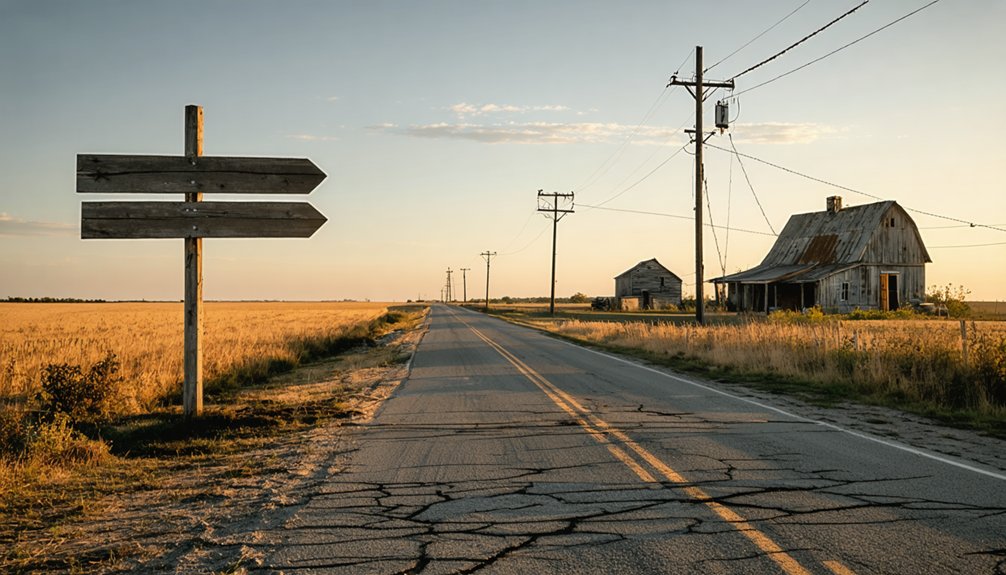
While you’re already making the trek out to Evans, why not extend your route to include a few neighboring ghost towns that share its railroad heritage?
Custer is a natural first add — two railroads once crossed there, mirroring Evans’ own story.
Porterfield, a former rail station, offers another quiet stop worth investigating.
Garfield rounds out a solid loop through this forgotten corridor of Marshall County.
Each site rewards patient ghost town exploration, where reading the land matters more than finding standing structures.
Ghost town exploration rewards patience — success means reading the land, not counting walls still standing.
The flat, open terrain reflects authentic prairie preservation, unchanged by the commercial world.
Stop in Varna before heading out — locals there know the roads and can point you toward the best access points across this vanishing railroad landscape.
How Do You Stay Safe Visiting Evans and Illinois Prairie Ghost Towns?
When you head out to Evans and the surrounding Illinois prairie ghost towns, you’re stepping into open, exposed terrain where the land offers little shelter and conditions can shift fast.
You’ll want to check road ratings carefully — Evans sits on a Grid 3 access route, meaning sparse, open stretches where 2WD roads can turn treacherous after rain.
Stick to the May-through-October window for the safest visits, and always let someone know your route before you go, since cell service in remote Marshall County prairie land isn’t guaranteed.
Prairie Terrain Safety Tips
Exploring Illinois prairie ghost towns like Evans means stepping into open, exposed terrain where preparation matters as much as curiosity. Smart prairie navigation and wildlife awareness keep your adventure rewarding rather than risky.
- Wear sturdy, ankle-supporting boots for uneven railroad grade terrain.
- Carry water since no services exist near Evans or surrounding ghost towns.
- Watch for snakes, coyotes, and insects common in open Illinois prairie.
- Bring a paper map since cell coverage can disappear in Marshall County.
- Visit May through October to avoid dangerous winter conditions and mud.
You’re chasing freedom out here, not fighting the land. Respect the open terrain, stay alert, and you’ll move through Evans’ vanished landscape exactly the way it deserves — deliberately and confidently.
Weather And Road Awareness
Illinois prairie weather shifts fast, and if you’re heading out to Evans or any Marshall County ghost town, you need to respect what the sky can do.
Spring storms roll in without much warning, and winter road conditions between January and March can make even basic 2WD routes treacherous. Stick to the May through October window when weather patterns are most forgiving and visibility across open terrain is clear.
Always check local road conditions before leaving Varna, your best reference point for current access info.
Prairie roads built on old railroad grades drain poorly after heavy rain, turning firm ground into mud fast. Carry a basic emergency kit, watch the horizon constantly, and never assume stable conditions.
Out here, preparedness isn’t optional — it’s what keeps the adventure moving.
Frequently Asked Questions
Can You Camp Overnight Near the Evans Ghost Town Site?
You’ll need to check local camping regulations before pitching a tent near Evans. No formal sites exist, but nearby attractions like Varna’s open prairie terrain offer you that raw, freeing overnight adventure you’re craving.
Are There Any Guided Ghost Town Tours Available in Marshall County?
Like a lone pioneer forging their own trail, you won’t find guided tours covering ghost town history in Marshall County — so chart your own course through Evans’ forgotten railroad echoes and vanished prairie dreams.
Is the Evans Ghost Town Site on Private or Public Land?
The records don’t confirm whether Evans history sits on private or public land. You’ll want to check locally before exploring ghost town legends, so contact Varna residents or Marshall County officials to secure proper access permissions first.
Are There Any Evans Historical Artifacts Preserved in Nearby Museums?
No confirmed Evans history artifacts exist in local museums. You’ll want to check Varna’s resources directly, as locals there know the area best and might point you toward any preserved remnants of this vanished prairie railroad town.
Does Evans Appear on Any Vintage Illinois Railroad Maps for Purchase?
You’ll likely find Evans on vintage maps showcasing Illinois railroad history! Search antique dealers, online marketplaces, or historical societies for Chicago & Alton line charts — they’re your ticket to uncovering this forgotten prairie ghost town’s fleeting existence.
References
- https://drloihjournal.blogspot.com/2022/09/lost-towns-of-illinois-evans-illinois.html
- https://www.ghosttowns.com/states/il/evans.html
- https://www.youtube.com/watch?v=X-k9IxjPWqc
- http://genealogytrails.com/ill/jefferson/ghostowns.html
- https://drloihjournal.blogspot.com/p/lost-towns-of-illinois-series.html
- https://libsysdigi.library.illinois.edu/oca/Books2008-06/oldsandyremember00mars/oldsandyremember00mars.pdf
- https://en.wikipedia.org/wiki/List_of_ghost_towns_in_Illinois
- https://storymaps.arcgis.com/stories/6ea7c4b9b0594c039c2792d5be7456c9