You won’t find Northrop on any ghost town trail map because the Virgin River’s Great Flood of 1862 erased every trace of this doomed Mormon cotton settlement at the North Fork confluence. Unlike photogenic ruins at nearby Grafton or Silver Reef, Northrop offers only wilderness where pioneers’ ambitions drowned. You’ll need 4WD, GPS coordinates, and dry-season timing to reach this remote site where history vanished completely, though the surrounding backcountry reveals other abandoned settlements with stories worth discovering.
Key Takeaways
- Four-wheel drive vehicle is required to navigate rutted riverbank trails where paved roads end in wilderness terrain.
- Visit during dry season to avoid Virgin River flooding; bring water, fuel, and emergency supplies as no services exist.
- No structures or artifacts remain at Northrop site; the 1862 Great Flood erased all traces of the settlement.
- Obtain GPS coordinates and respect private property boundaries marked by trespass signs throughout the area.
- Combine trip with nearby ghost towns like Grafton or Silver Reef for preserved structures and tangible historical remains.
Northrop’s Role in Mormon Pioneer Settlement History
Where does a forgotten settlement like Northrop fit into the sweeping saga of Mormon colonization that transformed the American West? You’ll discover it emerged during that explosive 1847-1900 expansion when Brigham Young’s followers established 500 communities across harsh frontier terrain.
Like other remote outposts, Northrop followed the classic pattern: church-appointed leaders allocated community resources, treating timber and water as collective property. Yet Northrop’s spiritual leadership faced unique challenges coordinating isolated families across rugged landscape. Northrop’s water rights conflicts reflected the tensions inherent when survival depended on scarce desert resources.
While neighboring settlements like Manti and Fillmore thrived, Northrop struggled with the brutal conditions that tested even the most determined pioneers. The community’s early struggles mirrored the desperation of pioneers who first arrived in Salt Lake Valley on July 22, 1847, immediately beginning planting and irrigation to ensure survival. The vanguard company of 143 men who blazed the trail west demonstrated the organized determination that would characterize subsequent settlement efforts throughout the territory. Understanding its place reveals how some communities flourished while others simply vanished into Utah’s unforgiving landscape.
Getting to Northrop and the Upper Virgin River Area
The ghost of Northrop awaits at 37°09′45″N 113°00′45″W, where the North Fork and East Fork collide to birth the Virgin River in Washington County’s wild backcountry. You’ll launch from St. George, threading UT-9 toward Zion before branching onto dirt tracks near Grafton.
The remoteness considerations demand serious preparation—no structures survive the floods that claimed this settlement.
Essential approach tactics:
- Four-wheel drive becomes your lifeline on rutted riverbank trails where pavement surrenders to wilderness
- Dry season timing protects you from Virgin River’s violent mood swings despite modern flood mitigation efforts
- GPS coordinates guide you through private property mazes where trespass signs complicate historical exploration
- Zero services exist at the confluence—pack water, fuel, and escape plans
This isn’t Springdale’s tourist corridor. It’s raw Utah backcountry where pioneers’ ambitions drowned. The abandoned settlement shares its name with Northrop, Minnesota, a surviving city in the American heartland. Nearby Adventure in Washington County marks another failed settlement attempt in this unforgiving landscape.
What Remains at the Northrop Ghost Town Site
When you arrive at the Northrop site, you’ll find nothing but an empty river confluence—the Great Flood of 1862 erased every trace of Isaac Behunin’s short-lived settlement.
Unlike typical ghost towns with crumbling walls and rusted equipment, this location offers only bare earth where the Virgin River’s forks meet. The catastrophic floodwaters that destroyed the town just one year after its founding left no stone foundations, no mining traces, and no artifacts to mark where Utah pioneers once attempted to build their lives.
In contrast, nearby historic mining sites like Frisco still display stone foundations and commercial building ruins despite years of exposure to desert conditions. For those interested in exploring more accessible abandoned settlements, ghost towns like Grafton feature well-preserved structures including a pristine schoolhouse that survived where Northrop did not.
Stone Building Foundations Persist
Unlike other Utah ghost towns where crumbling stone walls and weathered foundations mark the passage of time, Northrop’s landscape tells a story of complete erasure. You’ll find no archaeological evidence of the settlement that Isaac Behunin established in 1861—the Great Flood of 1862 saw to that.
When you compare Northrop to other abandoned Utah settlements, the difference strikes hard:
- Silver Reef’s Wells Fargo building still stands defiant
- Old Iron Town’s beehive kiln remains a memorial to iron-forging dreams
- Silver City’s foundations and cemetery markers endure
- Thistle’s water-damaged homes tell their slow decline
But Northrop? Complete flood destruction swept away everything before substantial structures could rise. The settlers barely broke ground before nature reclaimed it all, leaving you with only virgin wilderness where pioneer ambitions once took root.
Located 30 minutes west of Cedar City, Old Iron Town represents what ghost town preservation can achieve when ruins remain standing. The settlers barely broke ground before nature reclaimed it all, leaving you with only virgin wilderness where pioneer ambitions once took root.
At Mosida, only building foundations survive on private property, offering a glimpse of what brief agricultural prosperity looked like before the project died out.
Mining Work Area Traces
While Northrop’s original 1860s settlement vanished without trace, a later chapter in its history left tangible scars across the landscape. You’ll find rusting gas tanks baking in the desert sun, metal fragments embedded in crumbling ore-processing structures, and scattered equipment from silver mining’s glory days. Mining equipment artifact analysis reveals wooden ledges and conglomerate stones resembling early concrete—all tied to extracting $60 million worth of ore before opportunists abandoned the site.
The regional mining extraction history tells of silver, gold, copper, and zinc operations that once thrived here. Tailings piles, cinder dumps near old tracks, and pyritized quartz formations mark where miners fractured sedimentary rock chasing mineral veins. Like other coal mining camps with foundations scattered across Utah’s ghost town landscape, Northrop’s structural remnants tell stories of industrial ambition meeting harsh reality. In nearby Emery County, Connellsville’s coal miners produced coke for steel-making before poor quality coal led to the project’s failure and abandonment by 1878. Navigate carefully through sheep dung and scattered debris—these grounds preserve extraction’s brutal efficiency.
Nearby Shunesburg and Tonaquint Abandoned Settlements
While exploring Northrop’s ruins, you’ll find two more ghost towns within striking distance of your adventure. Shunesburg managed a remarkable 41-year run from 1862 to 1902 before the Virgin River’s relentless flooding finally drove out its last resident, Oliver DeMille.
Tonaquint’s story proved far shorter—this nearby settlement joined the upper Virgin River communities in 1862 but left little trace of its existence in historical records.
Shunesburg’s Four-Decade History
Three miles up the East Fork of the Virgin River, where Parunuweap Canyon’s towering walls begin their ascent, Brigham Young dispatched a determined group of families from Sanpete County in 1861. They purchased land from Paiute Chief Shones, establishing what locals variously called Shonesburg, Shuenesburg, or Shirensburg.
The Cotton Mission settlers built their dreams with log cabins, orchards, and irrigation ditches. By 1865, they’d harvested their first successful crops, but the Virgin River had other plans:
- Relentless flooding devoured farmland repeatedly
- Shunensburg’s Indian troubles forced complete abandonment by 1867
- Most families relocated to nearby Rockville
- Oliver DeMille’s dedication kept him there until 1902—the last holdout after four decades
Today, you’ll find only scattered chimney stones and a neglected cemetery marking their remarkable perseverance.
Tonaquint’s Brief Settlement Period
Just downstream from Shunesburg’s ruins, an even earlier Cotton Mission settlement met its fate before most families could unpack their wagons. You’ll find Tonaquint’s story preserved only in street names now, but what a story it holds. Founded in 1856 by missionaries Rufus Allen and Hyrum Burgess, this Cotton Mission outpost represented Utah Territory’s southernmost frontier.
They built irrigation systems designed to share water equally with Chief Tut-se-gavits’ band, establishing cotton farms where the Virgin River meets Santa Clara Creek.
Four families committed to these agricultural operations under Harmony Ward’s religious organization ties. Then the Great Christmas Flood of 1861-62 erased everything—homes, cotton fields, dreams—burying them under miles of mud. Survivors fled to St. George’s tent schoolhouse, never returning. Modern St. George swallowed their ghost.
Exploring Stateline Ghost Town in Iron County
Tucked into Stateline Canyon near the Utah-Nevada border, this weathered mining camp tells stories of fortune-seekers who chased gold and silver into these remote hills starting in 1894. When the Ophir mine opened in 1896, mining community demographics shifted dramatically—tent camps transformed into a bustling town of 300 residents by 1903.
The canyon’s native american history in the area intertwines with Mormon pioneer trails and cattle rustlers who smuggled livestock through these passes.
Today’s explorers discover:
- Photogenic stone ruins from the 1909 era standing defiant against attempted fires
- A well-preserved cemetery honoring those who gambled everything on precious ore
- Crumbling mill remnants where fortunes were processed before the 1918 abandonment
- Outlaw legends echoing through saloon foundations where shootouts once erupted
Silver Reef: Southern Utah’s Largest Ghost Town
Where sandstone cliffs glow crimson against the desert sky, Silver Reef sprawls as southern Utah’s most improbable mining legend—a place where prospectors struck silver in rock formations that geologists swore couldn’t hold precious metals.
John Kemple’s 1866 discovery sparked silver reef development that transformed wilderness into southern Utah’s largest town by 1876. Over 2,000 fortune-seekers carved 450 mine openings into White and Buckeye Reefs, extracting 7.5 million ounces of silver worth $25 million.
Silver reef cultural diversity thrived here—Chinatown housed 250 Chinese workers under their own mayor while miners gathered at race tracks and shooting matches. The 1879 fire, plummeting silver prices, and labor disputes emptied the boomtown within five years.
Today you’ll explore Wells Fargo’s restored building housing mining artifacts and town dioramas near Leeds.
Old Irontown and Its Historic Beehive Charcoal Oven
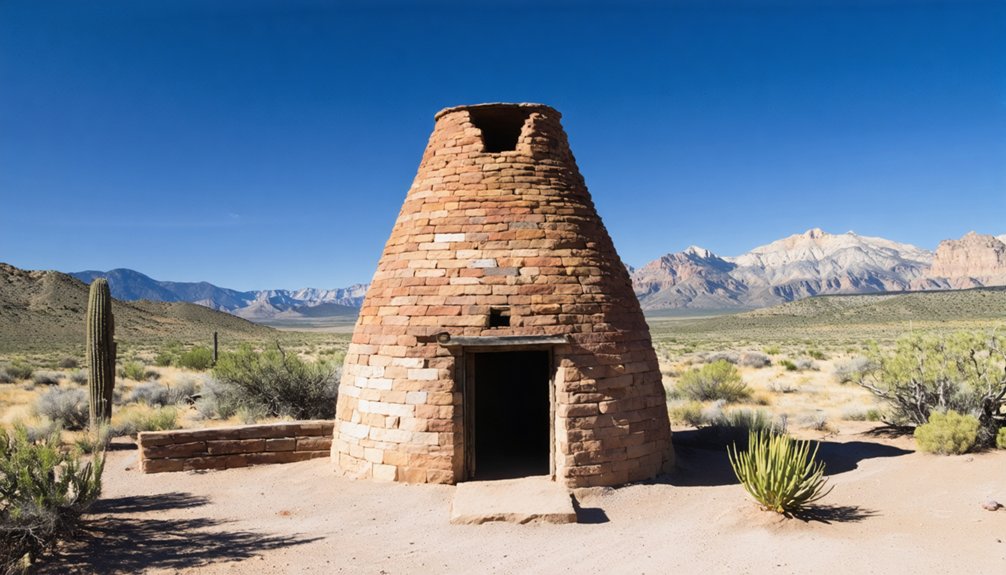
A twenty-three mile drive east from Cedar City along State Route 56 brings you to Iron Mountain’s southwestern base, where Mormon pioneers launched their most ambitious quest for metal independence. At the sign, turn left and travel three miles to Old Irontown’s haunting ruins.
Founded in 1868, this cooperative venture represented Brigham Young’s determination to break free from expensive eastern iron suppliers. You’ll discover remnants of primitive charcoal production and foundry operation challenges that ultimately doomed the enterprise:
- The preserved beehive charcoal oven standing silent against desert skies
- Crumbling furnace walls where molten iron once flowed five tons daily
- Rusted foundry parts scattered across sagebrush terrain
- Utah’s first ghost town, abandoned when railroad expansion made local production obsolete
The fenced site features interpretive trails managed by Frontier Homestead State Park Museum.
Grafton’s Mormon Cotton Mission Legacy
Grafton’s weathered schoolhouse and crumbling farmsteads tell the story of Brigham Young’s audacious 1861 gamble—transforming 300 Mormon families into cotton farmers along the Virgin River Basin. You’ll walk through what became Utah’s “Dixie,” where Nathan Tenney led five families to establish this agricultural outpost in 1859. The settlement peaked at 168 residents in 1864, balancing cotton cultivation with fruit orchards and grain fields.
Cotton mill operations centered in nearby Washington, where colonists shipped their harvests to imported machinery from Salt Lake. The Virgin River’s relentless flooding destroyed their cotton-focused economy, forcing evacuation after Paiute conflicts in 1866. Today’s ruins reflect their ambitious pivot to silk production efforts and cattle ranching—testament to pioneers who chose self-sufficiency over surrender.
Best Practices for Exploring Private and Public Ghost Town Properties
Before you follow Brigham Young’s cotton pioneers into Utah’s backcountry, you’ll need to master the unwritten rules that separate responsible explorers from trespassers. With over 1,000 ghost towns scattered across Utah—most on private land—understanding private land permissions and public access regulations becomes your ticket to adventure without legal trouble.
As you embark on your journey exploring ghost towns in Utah, you’ll encounter remnants of history that tell fascinating stories of the past. Each town offers a unique glimpse into the lives of those who once inhabited these desolate sites, making it essential to research their backgrounds. Be sure to equip yourself with local maps and resources to enhance your exploration and truly experience the spirit of these abandoned places.
Start with beginner-friendly sites like Grafton near Zion, where public trails lead to preserved schoolhouses and graveyards. For ranches like Iosepa, stick to marked roads reaching the cemetery pavilion while respecting working farmland boundaries.
Essential exploration protocols:
- Research ownership status through BLM maps and county records before departure
- Follow Leave No Trace principles—pack out everything, disturb nothing
- Avoid unstable mine shafts and flood zones like submerged Thistle
- Photograph from public viewpoints when sites remain off-limits
Frequently Asked Questions
What Camping or Lodging Options Are Available Near Northrop Ghost Town Sites?
Like a desert wanderer discovering hidden oases, you’ll find dispersed camping opportunities scattered across BLM land near Northrop. Local bed and breakfast inns in nearby towns offer cozy alternatives when you’re craving hot showers and warm beds.
Are Guided Tours Available for Any Ghost Towns in the Area?
You won’t find guided tours offered specifically for Northrop, but you’ll discover self-guided walking routes throughout the abandoned townsite. Explore freely at your own pace, discovering crumbling foundations and weathered structures without crowds or schedules.
What Is the Best Time of Year to Visit These Ghost Towns?
You’ll ironically find ghost towns *most alive* during shoulder season visitation—spring or fall—when mid-summer weather conditions won’t roast you alive. You’re chasing freedom, not heatstroke. Visit April-May or September-October for comfortable exploration without crowds.
How Much Time Should I Budget for a Complete Ghost Town Road Trip?
Budget 6-8 hours for Northern Utah’s ghost towns in one Saturday, or plan 1-2 days for Southern Utah’s remote sites. Your road trip planning and transportation logistics depend on which adventure calls to your freedom-seeking spirit.
Exploring ghost towns to visit near Joy, Utah offers a unique glimpse into the past, where stories linger and nature reclaims forgotten spaces. Each site tells a tale of resilience and adventure, making them perfect for photographers and history buffs alike. Be sure to bring a camera to capture the eerie beauty and charm of these abandoned locations.
In addition to ghost towns, consider exploring other road trip destinations in Utah that showcase the state’s stunning landscapes and rich history. From the breathtaking vistas of Arches National Park to the unique rock formations in Goblin Valley, each stop offers its own distinct charm and adventure. Take the time to immerse yourself in the diverse natural beauty that Utah has to offer, making every moment of your journey memorable.
Are There Any Entrance Fees for Visiting These Ghost Town Locations?
Your wallet can breathe easy—Grafton’s free with self-guided tours, while Silver Reef charges just $3 per person. Always respect private property considerations, as some ghost towns require permission. Zion nearby needs park passes if you’re exploring that area too.
References
- https://www.youtube.com/watch?v=dCg_xiclHxA
- https://www.valleyjournals.com/2024/10/02/507818/exploring-utah-s-ghost-towns-seven-abandoned-settlements-with-fascinating-histories
- https://www.visitutah.com/things-to-do/history-culture/ghost-towns
- https://en.wikipedia.org/wiki/List_of_ghost_towns_in_Utah
- http://superstitionmountaintomkollenborn.blogspot.com/2011/11/
- https://jacobbarlow.com/tag/northrop/
- https://historytogo.utah.gov/mormon-settlement/
- https://en.wikipedia.org/wiki/Mormon_pioneers
- https://saintsunscripted.com/faith-and-beliefs/living-the-gospel/what-the-first-mormon-pioneers-did-when-they-got-to-utah/
- https://www.mormonpioneerheritage.org/welcome-to-the-mormon-pioneer-national-heritage-area/