Your ghost town road trip begins in Ohio’s Hocking Hills, where you’ll explore Moonville’s haunted railroad tunnel and San Toy’s coal mining ruins before heading southwest toward Texas. There, you’ll discover Thurber’s industrial architecture, Terlingua’s mercury mining remnants in Big Bend, and Indianola’s vanished port city along the Gulf Coast. Pack sturdy boots, camera gear for low-light photography, and safety equipment for traversing crumbling structures. This 1,200-mile journey requires careful route planning, proper permissions, and understanding the historical context behind each abandoned settlement’s rise and fall.
Key Takeaways
- Visit Ohio’s Moonville tunnel and San Toy coal ruins, then explore Texas’s Thurber industrial site and Terlingua mercury mines.
- Focus on Ohio’s Hocking Hills Region for clustered ghost towns; use state highways for route optimization between states.
- Pack sturdy boots, cut-resistant gloves, respirator mask, camera with low-light capability, and wide-angle lens for documentation.
- Schedule daylight-only visits to infrastructure-free locations and obtain permission before exploring to avoid trespassing charges.
- Plan trips during fall, spring, or winter months for optimal weather conditions and unique seasonal exploration experiences.
Understanding Ghost Town History in Ohio and Texas
The forgotten settlements scattered across Ohio’s countryside tell stories of boom and bust that shaped America’s heartland. You’ll discover over 6,000 documented ghost towns where abandoned infrastructure stands as memorial/record/chronicle/reminder to bygone eras. From Orbiston’s iron furnaces that served 500 residents to San Toy’s coal boomtown housing nearly 1,000 miners, these community demographics shifted dramatically when industries collapsed.
You can explore Moonville’s haunted 1850s railroad tunnel or walk among Sprucevale’s remaining canal locks, abandoned since 1870. Claylick disappeared beneath floods and the Dillon Dam project, while Rural Hill vanished when its slaughterhouse closed. The Center for Ghost Town Research, founded in 1976, has documented these sites across all 88 counties, offering you freedom to trace paths where thriving settlements once stood before economic forces swept them into history.
Must-Visit Abandoned Sites in Ohio
Your Ohio ghost town adventure begins at Moonville, where the 1850s railroad tunnel cuts through Vinton County‘s dense forest—a crumbling brick passage where phantom lanterns reportedly flicker in the darkness and spectral figures appear in photographs.
Just south, San Toy’s coal mining ruins sprawl across Perry County hillsides, with collapsed mine entrances still visible among foundation stones and rusted metal remnants from a boomtown that housed nearly 1,000 souls.
These two sites anchor your exploration of southeastern Ohio’s most haunting abandoned settlements, each offering tangible connections to the region’s dangerous industrial past.
Moonville’s Haunted Railroad Tunnel
Deep in Vinton County’s densely wooded hills, where Raccoon Creek winds through Ohio’s forgotten corners, a brick-lined tunnel emerges from the earth like a portal to another era. Built in 1856 through hillside bedrock, this architectural relic once transported coal and clay for the Marietta and Cincinnati Railroad. The geological features of the tunnel create an eerie atmosphere—its curved brick walls absorb sound while cool air flows from the darkness within.
You’ll walk the same path where tragedy struck repeatedly. Local legends surrounding deaths tell of a decapitated brakeman in 1859, Engineer Theodore Lawhead’s fatal 1883 collision, and mysterious lantern sightings that prompted a 1981 signal installation. The dangerous single-track operations claimed multiple lives, their restless spirits reportedly still wandering this remote rail corridor turned haunting trail.
San Toy Mining Ruins
Among southeastern Perry County’s rolling hills, crumbling foundations and overgrown roads mark where San Toy once thrived as Ohio’s most notorious coal mining town. You’ll discover coal mining artifacts scattered through the woods, where over 2,000 residents once lived amid shootouts and moonshine operations.
The town’s violent reputation stemmed from desperate times—after fires and strikes shuttered both mines by 1927, residents turned to illegal distilling until 17 of 19 voters abandoned their home in 1931.
Today, you can explore the eerie atmosphere at San Toy, where only the jail remains intact among the ruins. Navigate along San Toy Road to find building foundations and sealed mine entrances hidden beneath the forest canopy. Approximately 50 people still inhabit this wild corner of Perry County, maintaining its untamed spirit.
Essential Texas Ghost Town Destinations
While modern Texas bustles with metropolitan energy, its forgotten corners harbor remarkably preserved ghost towns that transport you straight into the Old West’s tumultuous past. You’ll discover Thurber’s unusual architecture rising from Erath County’s prairie—once a thriving coal mining hub now showcasing industrial ruins.
Head south to Calhoun County’s Indianola, where hurricane-swept beaches whisper local folklore about the vanished “Queen City of the West” that welcomed thousands of immigrants. Near Big Bend, Terlingua’s rugged mercury mining remnants offer unmatched desert solitude. Don’t miss Glenrio’s mid-century roadside relics straddling the New Mexico border, or Medicine Mound’s mysterious dolomite hills where Comanche spirits seem to linger. Each destination rewards your wanderlust with authentic freedom from civilization’s constraints.
Mapping Your Multi-State Route
Your ghost town odyssey demands strategic route planning that accounts for Ohio’s dense concentration of abandoned settlements scattered across southeastern counties and Texas’s vast distances between isolated prairie remnants. Start with mapping navigation tools like Google Maps, entering GPS coordinates for town centers since most locations lack signage.
You’ll find Ohio’s Hocking Hills Region—containing Moonville, Haydenville, San Toy, and Orbiston—perfect for clustering multiple sites within short distances. Planning route optimizations means measuring shortest current routes between destinations, using state highways as primary references. Record alternative road names and waterways exactly as they appear on your mapping application. Schedule daylight-only visits to these infrastructure-free locations.
The Center for Ghost Town Research’s documentation and historical markers will guide your exploration through over 6,000 Ohio sites and Texas’s scattered prairie settlements.
What to Pack for Exploring Abandoned Settlements
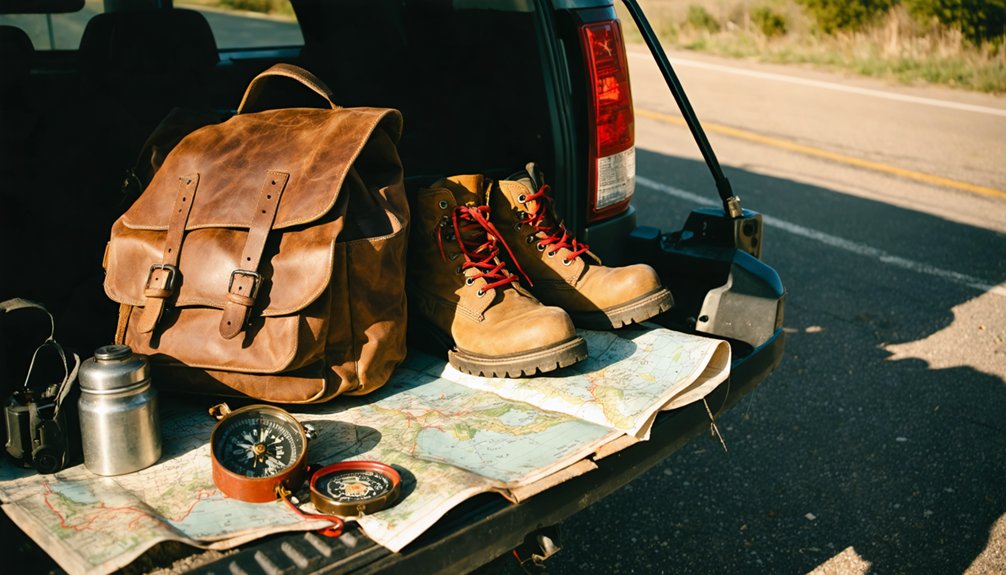
Before you set foot into Ohio’s weathered structures and sun-bleached Texas ruins, you’ll need gear that keeps you safe while capturing every haunting detail. Your backpack should balance protection—from sturdy boots traversing collapsed floors to respirators filtering decades of dust—with documentation tools that preserve these forgotten places.
Layer your clothing strategically for Texas heat and Ohio’s unpredictable weather, ensuring you’re prepared for both crumbling interiors and overgrown exteriors where nature reclaims civilization.
As you step across the weathered threshold of Ohio, Texas’s crumbling structures, the crunch of broken glass beneath your feet serves as an immediate reminder: abandoned settlements don’t forgive ill-prepared visitors. Maintaining digital mapping systems becomes essential when cell towers fade into distant memory, while managing unexpected obstacles requires proper illumination and protective gear.
Your essential safety arsenal includes:
- Head torch or flashlight for traversing pitch-black interiors
- Cut-resistant gloves protecting against rusted metal and debris
- Respirator mask (3M 6000/7500) filtering asbestos and mold spores
- Sturdy boots with ankle support handling uneven terrain
Pack a compact first-aid kit, pocket knife, and small mirror for checking blind corners. These ghost town corridors reward the self-reliant explorer who respects decay’s hidden dangers.
Weather-Appropriate Clothing Layers
The abandoned storefronts of Ohio, Texas demand strategic layering for temperature swings that plummet from 91°F afternoons to 42°F predawn explorations. Start with moisture wicking base layers—synthetic tees that’ll handle 70% humidity when you’re photographing crumbling facades under threatening skies.
Add a lightweight fleece pullover you can shed as temperatures climb through the 70s. Your weather resistant outer shells become non-negotiable with 70% overnight rain probability and gusty afternoon thunderstorms rolling across these desolate plains.
Pack convertible pants that zip to shorts when southeast winds gust to 25 mph, and don’t skip rain pants for those sudden downpours. A buff handles wind-whipped dust through skeletal buildings, while a wide-brimmed hat shields you from that relentless Texas sun. Extra socks mean freedom to wade through flooded schoolhouses without cutting your adventure short.
Photography and Documentation Equipment
Pack your imaging arsenal carefully—crumbling walls and shadow-choked interiors of Ohio’s skeletal buildings won’t forgive forgotten gear. Your camera needs exceptional low light performance; mirrorless or DSLR bodies paired with fast glass like a 20mm f/1.8 prime capture decay’s intimate details without flash intrusion. Master handheld techniques with image stabilization for spontaneous shots when tripods can’t navigate collapsed floors.
Essential documentation tools:
- Wide-angle lens (14-24mm f/2.8) for sweeping abandonment vistas
- Sturdy tripod enabling 30-second exposures in pitch-black rooms
- Powerful LED flashlight doubling as light-painting instrument and safety beacon
- Rugged camera bag protecting equipment from Texas dust storms
Clean your sensor every fifteen minutes—ghost towns breathe particulate chaos. Pack backup batteries; these ruins drain power like they drain hope.
Safety Precautions and Legal Considerations

Before you set out for Ohio, Texas, understanding safety protocols and legal boundaries separates a memorable adventure from a dangerous mistake. Complete thorough equipment maintenance before departure—check oil, tires, and warning lights while carrying three days’ water supply and communication devices for this remote destination.
You’ll need permission to explore abandoned structures, as trespassing carries legal consequences and insurance claim denial. Ohio’s weathered buildings present environmental hazards including structural instability, rotten floorboards, and potential ground collapse from historical mining operations.
Carry recovery gear, first aid supplies, and maintain quarter-tank fuel capacity minimum. Verify property boundaries and local regulations before exploring, ensuring your freedom to roam doesn’t transform into an emergency requiring rescue intervention in this isolated Texas landscape.
Best Times to Visit Each Location
With your safety gear packed and permissions secured, timing your visit to Ohio’s ghost towns can transform a good exploration into an extraordinary one. Seasonal impacts dramatically shape your experience across these abandoned sites.
Proper timing elevates ghost town exploration from merely interesting to truly unforgettable—seasons dictate accessibility, atmosphere, and the stories these ruins reveal.
Optimal visiting windows for Ohio’s ghost towns:
- Fall (late September-November): Vibrant foliage frames ruins with temperatures 30-60°F, fewer crowds at Hocking Hills and Lake Hope
- Spring (March-May): Wildflowers bloom along trails, comfortable 30-60°F conditions for Little Egypt tours and Vinton Furnace hikes
- Winter (December-February): Snow-covered San Toy becomes a frozen wonderland at 15-40°F with solitude-seekers rewarded
- Year-round: Daylight exploration essential at Moonville Tunnel and overgrown paths
Turkey hunting season demands bright clothing for safety while exploring remote locations.
Frequently Asked Questions
Can I Bring My Dog to Ghost Town Sites in Ohio and Texas?
You’ll find limited dog-friendly amenities at most ghost town sites due to pet-related restrictions and no-trespassing signs. However, nearby state parks and campgrounds welcome your four-legged explorer with proper leashes, letting you roam responsibly together.
Are There Nearby Campgrounds or Hotels for Overnight Stays During the Trip?
You’ll find pet-friendly accommodations near both regions’ ghost towns. Ohio’s Hocking Hills offers campgrounds and hotels within 10-20 miles, while Texas sites near Rusk provide similar options. Nearby dining options complement your adventure, letting you explore freely without sacrificing comfort.
Do Any Ghost Towns Offer Guided Tours or Visitor Centers?
You’ll discover excellent tour availability at Ohio’s ghost towns, with visitor facilities at Boston Mills Historic District and Little Egypt’s lockmaster house. Texas locations lack dedicated centers, offering you self-guided freedom to explore abandoned ruins independently.
As you delve into exploring gunsight ghost town history, you’ll encounter stories of resilience and the impact of the Old West on local communities. Each site reveals remnants of a bygone era, inviting you to imagine the lives once lived among these abandoned structures. Don’t miss the chance to take in the eerie beauty of the landscape that has witnessed so much change over the years.
What Cell Phone Coverage Should I Expect at Remote Ghost Town Locations?
Like whispers fading into wilderness, you’ll find minimal cell phone coverage at remote ghost towns. Data connectivity becomes unreliable as cell tower accessibility diminishes across isolated Texas landscapes, leaving you authentically disconnected from modern networks and truly off-grid.
Are Drone Photography and Metal Detecting Allowed at These Abandoned Sites?
Drone photography and metal detecting face significant legal concerns at abandoned sites. You’ll need property owner permission and park permits, respecting the historical significance of these locations. Federal FAA rules and trespassing laws always apply to your adventures.