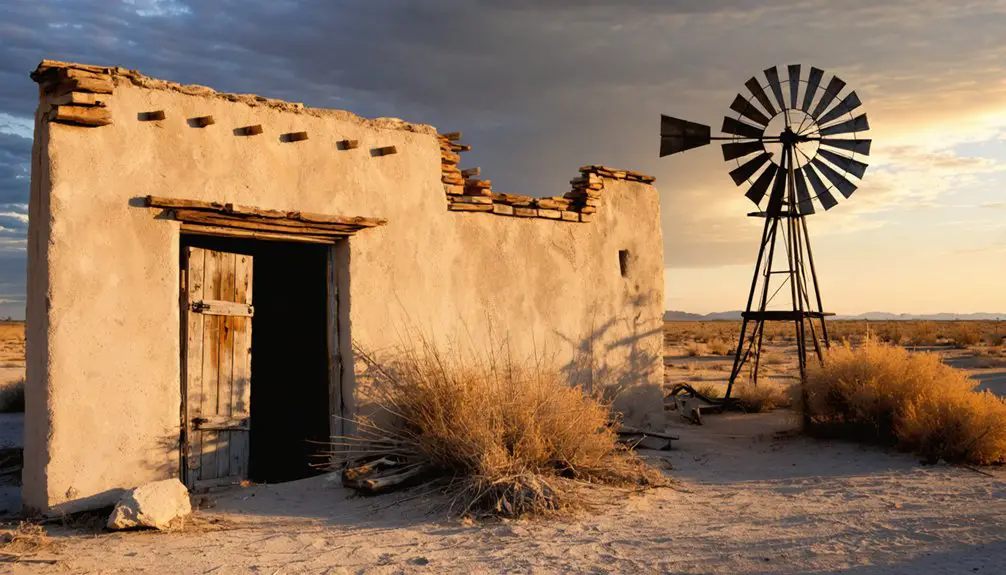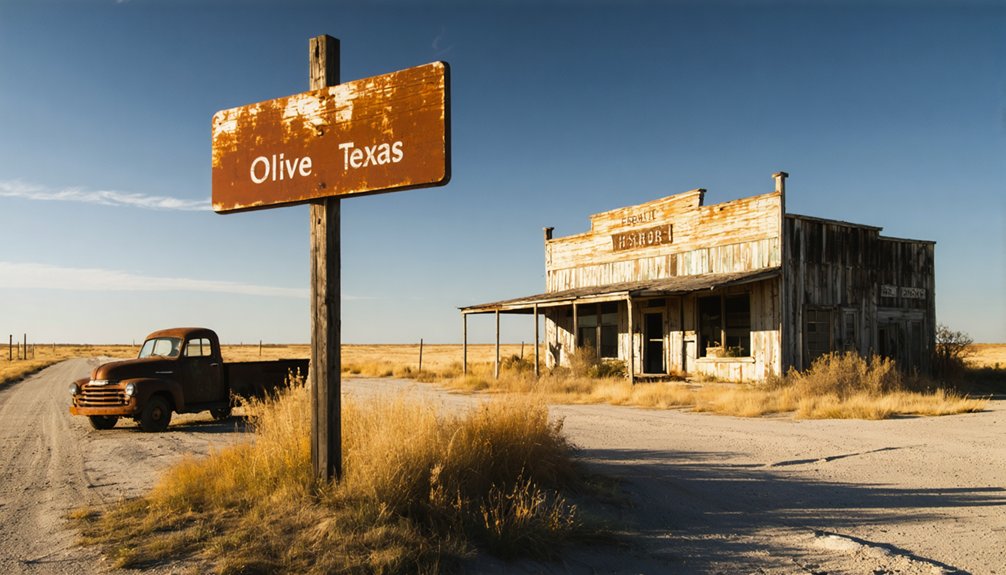
Start your Olive ghost town journey by heading north on U.S. Highway 69 from Beaumont, stopping in Kountze for supplies before reaching the forgotten cemetery three miles north. You’ll find the old burial ground marking where this once-prosperous lumber town thrived from 1881 until devastating fires erased it from the map. The well-maintained cemetery, adorned with pennies left by visitors, stands as the only tangible reminder of Olive’s brief existence. Time your visit for Halloween Eve to experience the legendary phantom locomotive that’s said to appear along the vanished railroad tracks.
Key Takeaways
- Take U.S. Highway 69 north from Beaumont to the FM 1003 intersection in north central Hardin County.
- Stop in Kountze, 3 miles south of the site, to gather supplies before exploring the ghost town.
- The old cemetery off Highway 69’s east shoulder is the only remaining feature marking Olive’s location.
- Visit the well-maintained cemetery with intact tombstones where visitors traditionally leave pennies on graves.
- Plan your trip for Halloween Eve to possibly witness the legendary phantom locomotive of Mart Hargraves.
Getting to Olive Ghost Town From Beaumont and Beyond
When you point your vehicle north from Beaumont on U.S. Highway 69, you’re following the same path the Sabine and East Texas Railroad carved through the Big Thicket in the 1880s. The thirty-mile journey takes roughly an hour, giving you time to absorb the dense forest that once swallowed this settlement whole.
Watch for the FM 1003 intersection in north central Hardin County—that’s where Olive stood. For directions from Beaumont, stick to Highway 69; it’s the most direct route. Scenic route considerations include stopping at Kountze, three miles south, for supplies before reaching the ghost town site.
The old cemetery just off the highway marks your destination, a weathered monument that’s survived hurricanes and fire.
What Remains of This Historic Texas Settlement
The cemetery stands alone now, a weathered collection of headstones pressed against the eastern shoulder of Highway 69. You’ll find early settlers’ graves among the monuments, survivors of hurricanes and the 2011 brush fire that swept through.
Beyond this sacred ground, nothing else remains—no lumber mill foundations, no canning factory ruins, no trace of the post office that once served 1,200 residents.
Historical documentation challenges plague researchers today. Railroad maps listed Olive until 1918, but the tracks vanished decades before the ghost train legends emerged. Current conservation efforts focus solely on preserving the cemetery, though even determining accurate burial records proves difficult.
Walk the wide path cutting through the forest north of Kountze, and you’ll understand why Olive shares the fate of East Texas’s forgotten sawmill towns.
The Rise and Fall of a Lumber Town
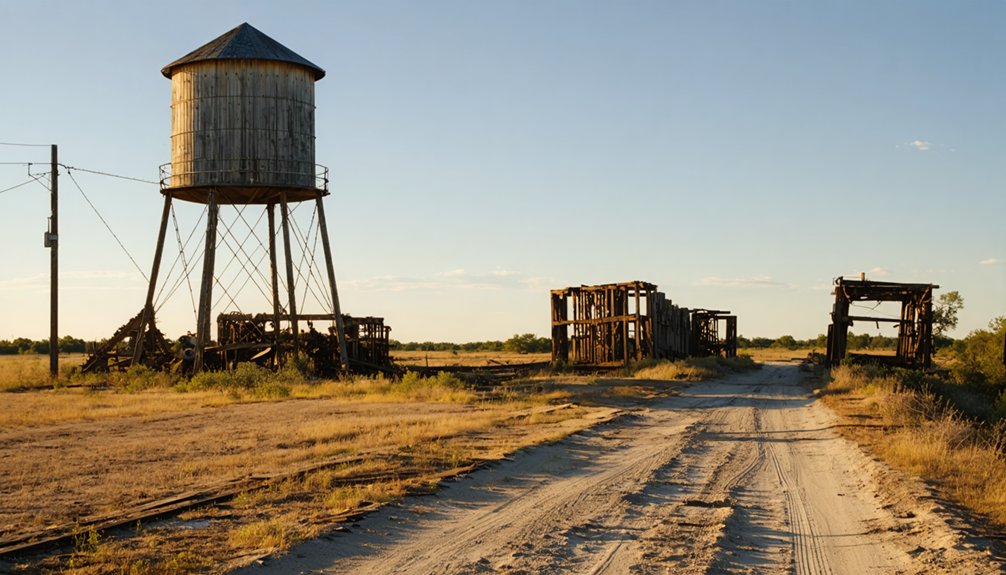
You’ll find Olive’s story mirrors countless Big Thicket lumber towns—a rapid thirty-year arc from railroad-fueled prosperity to ash and abandonment. The Olive-Sternenberg mill thrived from 1881 to 1912, supporting workers’ families and even operating a canning factory alongside its lumber operations.
Two catastrophic fires in 1903 and 1907 ultimately sealed the town’s fate, with the second blaze ending operations permanently and transforming this once-bustling settlement into the silent forest clearing you can visit today.
Olive’s Economic Boom Period
Long before Olive became a ghost town marker on faded railroad maps, its story began with an ambitious partnership that would transform this remote Big Thicket location into a thriving lumber hub. In 1875, John A. Sternenberg and Sid Olive staked $56,000 on a vision—betting that the coming Sabine and East Texas Railroad would open fortunes hidden in the dense pine forests.
Their gamble paid off spectacularly. When tracks finally pierced the Big Thicket in the early 1880s, Olive exploded with economic development. The mill’s screaming saws attracted workers seeking employment opportunities far from conventional society. By 1884, the boom warranted a post office. A canning factory soon followed, diversifying beyond lumber. For thirty years, this wilderness outpost hummed with prosperity, defying its isolation through sheer industrial determination.
Devastating Fires End Prosperity
While Olive’s sawmills churned profits for three decades, the town’s wooden infrastructure harbored a fatal vulnerability that would ultimately consume everything its founders built. Devastating wildfires repeatedly swept through the timber-dependent community, each blaze erasing prosperity acre by acre.
By 1915, Olive’s population plummeted from its peak of 1,200 residents as flames devoured sawmills, homes, and the precious loblolly pines that sustained the economy. The drought impacts on local economy proved catastrophic—without timber, there was no industry.
You’ll find echoes of this destruction in the 2011 Bastrop County Complex Fire, which burned 34,000 acres and destroyed 1,600 homes. Today’s ecological restoration challenges mirror Olive’s fate, with experts estimating generational recovery timelines for the Lost Pines region’s fragile ecosystem.
Finding the Old Cemetery Off Highway 69
Driving north from Kountze on US Highway 69, you’ll spot the Old Olive Cemetery about three miles up on the west side of the road. Pull off carefully—the small site sits on old Highway 69, just west of the current roadway. You’ll find an aged sign marking this compact burial ground, all that remains of the vanished town of Olive.
Despite surviving hurricanes and a 2011 brush fire, the cemetery’s well-maintained with just a handful of intact tombstones. Accessing the cemetery requires only a brief walk from the highway’s shoulder. You’ll notice pennies placed on every visible grave—a touching tradition among visitors.
When photographing the headstones, the clean grounds and open layout make documentation straightforward. Check topographic maps beforehand for precise GPS coordinates.
The Legend of Mart Hargraves and the Phantom Train

As you stand on the abandoned tram road where rails once carried timber to the Olive mill, you’ll hear locals recount how Mart Hargraves met his death on these very tracks—long after the sawmill closed and he’d moved to work the Kirby mill’s log train.
The most chilling part of the legend describes his nephew Tim’s arrival in 1930, searching for an uncle already a decade in the grave, only to witness a phantom locomotive materialize from the darkness with Mart at the controls.
Listen carefully on Halloween Eve, they say, and you might see what Tim saw: a fully-loaded log train that vanishes into thin air, leaving nothing but silence where the tracks no longer exist.
Mart Hargraves’ Fatal Journey
On a bright moonlit night in October 1930, eighteen-year-old Tim Hargraves stepped off the train in Beaumont, Texas, clutching an address that would lead him into one of East Texas’s most enduring supernatural mysteries. He’d traveled from West Virginia seeking Uncle Mart, unaware his destination had vanished years before.
When Tim’s train stopped past Kountze on Halloween Eve, the conductor pointed toward abandoned buildings. Walking the wide forest path where tram tracks once lay, Tim encountered a homeowner who revealed the truth: Mart had died a decade earlier.
The Halloween night tragedy transformed the engineer into legend. Each October 31st around midnight, witnesses claim Mart Hargraves’ final run continues—a phantom locomotive loaded with logs, racing along vanished rails near the ghost town of Olive.
Tim’s Ghostly Encounter
Tim’s walk down that moonlit dirt road should’ve been peaceful—just a quarter-mile stretch between him and answers about his uncle. Instead, Tim’s supernatural encounter changed everything. A steam locomotive materialized roughly 100 feet ahead, its engineer’s silhouette sharp against the cab window. Five loaded cars trailed behind, hissing steam into the October darkness before vanishing into the forest.
You’ll find no rational explanation for this unexplained train manifestation. Tim searched that path thoroughly—no tracks, no cross ties, nothing but carved earth where rails once lay. The infrastructure had been removed long before his arrival, yet Mart Hargraves’ phantom train continues its Halloween Eve run through these woods, operating on a schedule that death itself couldn’t derail.
The Vanishing Train Phenomenon
The locomotive barreled through that East Texas forest with no tracks beneath its wheels, carrying Mart Hargraves into local legend. You’ll find the spectral locomotive’s origins rooted in timber industry decline—when Olive’s prosperity vanished, so did its railway infrastructure. Yet locals insist Mart never abandoned his route.
The annual visitation details remain consistent: Halloween Eve brings the phantom engineer back, chugging through pines where cross ties once connected this forgotten settlement to civilization. You’ll hear the whistle first, then spot the headlight piercing darkness. Five loaded cars follow the engine before everything dissolves into forest silence.
If you’re seeking genuine strangeness beyond commercialized haunts, position yourself along that dirt road under October’s full moon. No guarantees—just possibility and abandoned cemetery stones keeping watch.
Best Time to Visit for the Halloween Eve Experience

If you’re planning to witness Olive’s legendary ghost train, your calendar has exactly one option: Halloween Eve. The spectral locomotive makes its single annual round trip only on this night, demanding your arrival after sunset around 7-8 p.m. when darkness transforms the abandoned railroad path into folklore territory.
October’s mild 55-65°F temperatures make overnight exploration comfortable, while clear skies maximize your paranormal visibility. A full moon amplifies the moonlit ambiance across the desolate tracks. You’ll avoid evening crowds in this remote ghost town, giving you unobstructed access to the legend’s epicenter.
Consider timing your visit around North Texas Halloween events like Joe Bob’s Spooktacular, which runs until 7 a.m., letting you combine supernatural experiences. Pack accordingly for extended nighttime observation—the legend waits for no one.
What to Look for Along the Former Railroad Path
Walking along Olive’s former railroad corridor, you’ll find yourself on an overgrown dirt path where tracks and crossties vanished decades ago—yet the route itself remains discernible through the dense Big Thicket forest. You’re tracing the Sabine and East Texas Railroad‘s 1880s route, three miles north of Kountze where lumber barons once hauled fortunes in virgin timber.
Watch for deteriorated infrastructure remains: foundation stones from the Sunset Sawmill, scattered brick from the canning factory, and the weathered post office structure that marked the rail junction. Overgrown vegetation patterns reveal where buildings once stood—clearings now choked with pine and hardwood saplings. The old tram road’s dirt surface still accommodates vehicles during daylight, letting you explore freely without gatekeepers or admission fees. You’re walking through industrial history that nature’s steadily reclaiming.
Nearby Attractions and Trip Planning Tips

Unlike Terlingua’s thriving artist colony near Big Bend or Glenrio’s well-preserved Route 66 structures, Olive offers no restaurants, visitor centers, or amenities—you’re visiting a true abandonment where nature’s overtaken commerce. Plan accordingly by packing water, snacks, and a full tank of gas.
You’ll find nearby accommodations in Kerrville or Fredericksburg, both offering RV parks and rental options similar to Big Bend’s casitas and yurts. Local cuisine options flourish in these Hill Country towns—German bakeries, Texas barbecue joints, and farm-to-table restaurants provide proper fuel for exploration.
Visit during cooler months when Texas heat won’t punish your wandering. Bring sturdy boots for traversing overgrown foundations, a camera for documenting decay, and respect for private property boundaries. This ghost town demands self-reliance.
Frequently Asked Questions
Are There Any Safety Concerns When Visiting the Cemetery at Night?
Ever wondered what lurks beyond those cracked tombstones? You’ll face possible trespassing concerns, scattered debris, and uneven terrain in darkness. Take safety precautions for night visits—bring flashlights, notify someone, and respect posted hours to avoid legal trouble.
Can I Camp Overnight Near the Ghost Town Site?
Yes, you’ll find overnight camping options nearby. While exploring abandoned structures during the day, you can observe historical markers at Route 66 Ghost Town Farm in McLean or Terlingua Ghost Town RV Park, both offering convenient boondocking experiences.
What Equipment Should I Bring to Document Paranormal Activity?
Bring night vision cameras to capture shadowy manifestations in Olive’s abandoned structures. Utilize EMF detectors like a MEL meter to track energy spikes. Pack voice recorders for EVPs, extra batteries, and red-light flashlights to document your supernatural encounters freely.
Are There Any Local Guides Available for Ghost Town Tours?
Looking for authentic guidance through Texas’s vanished past? You’ll find local historical society tours and ghost town preservation efforts offer knowledgeable experts who’ll reveal hidden stories. Contact Historic Tours of Texas for custom itineraries tailored to your adventure.
Is the Cemetery Accessible for Visitors With Mobility Limitations?
The cemetery lacks documented accessibility options or wheelchair friendly paths. You’ll encounter rocky, uneven terrain typical of rural Texas ghost towns. Contact Kountze’s historical society beforehand to explore possible accommodations for your independent exploration needs.