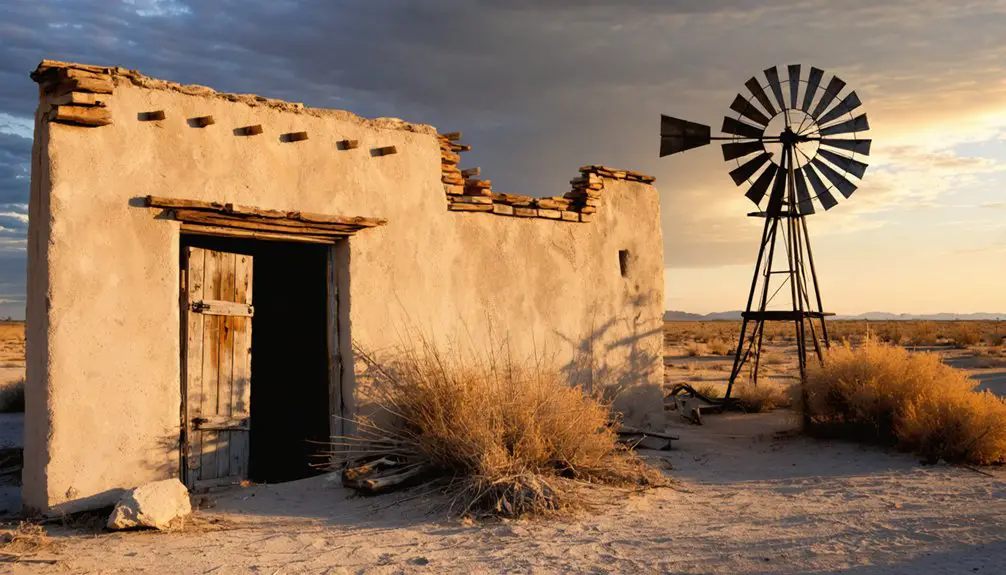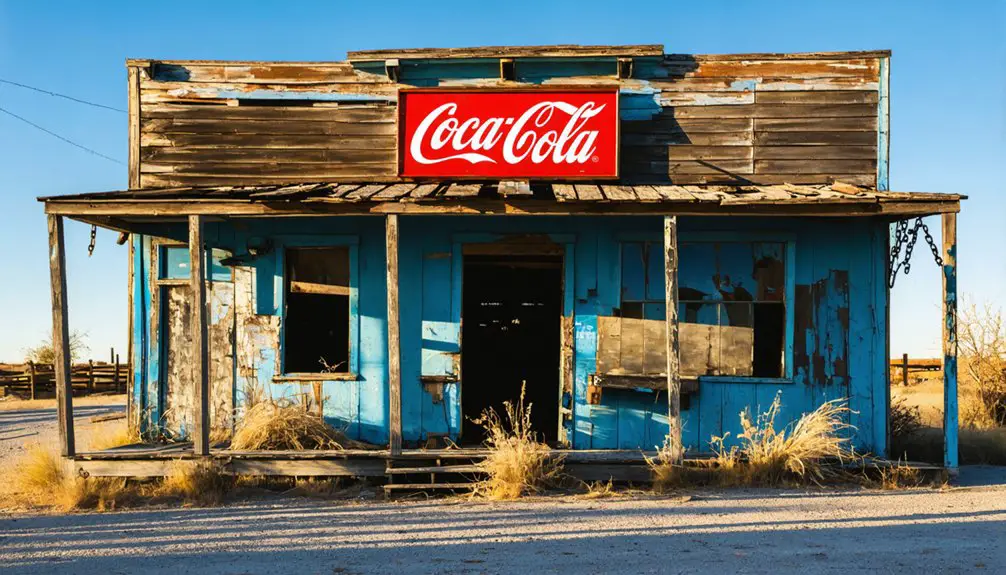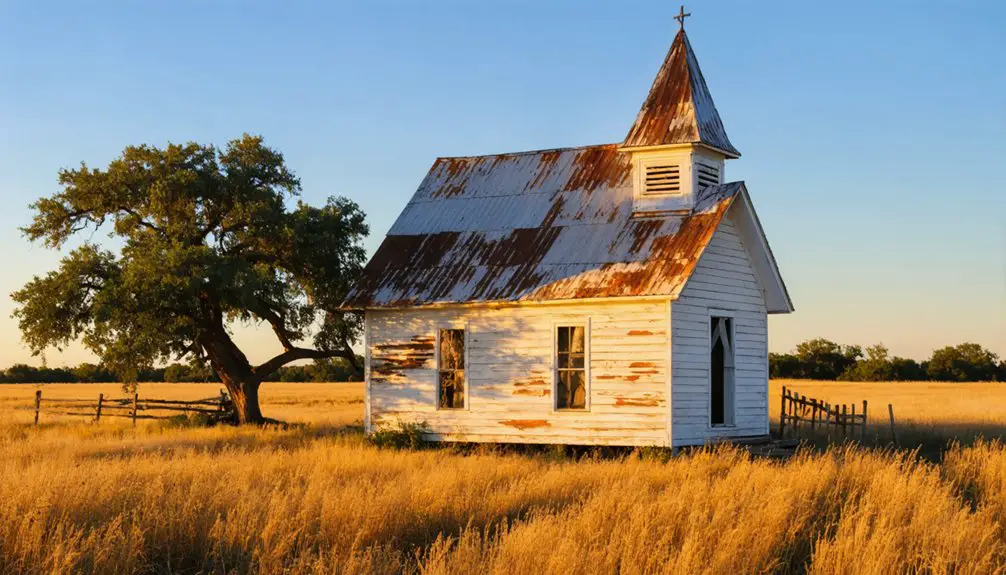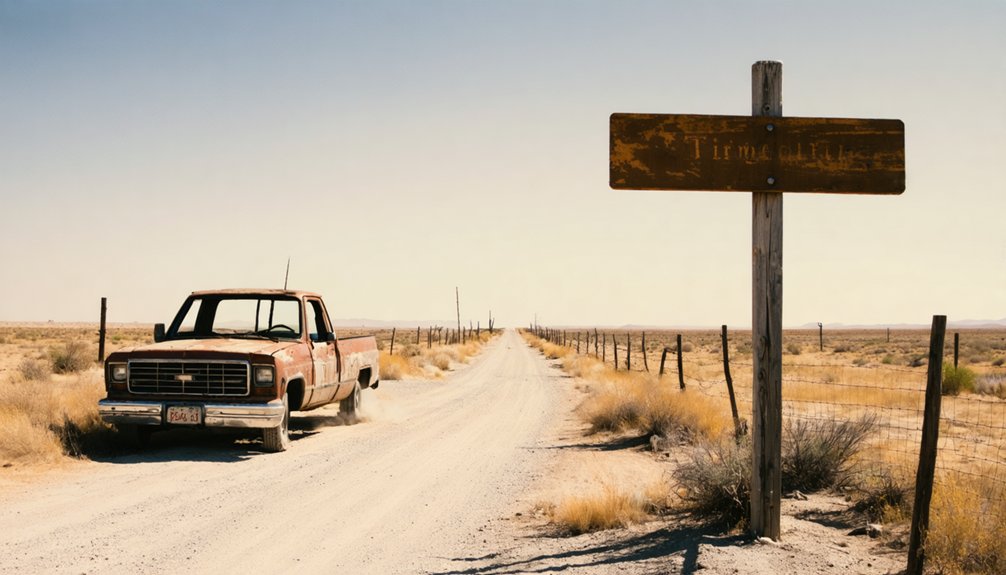
You’ll find Otis Chalk’s weathered structures scattered across private ranchland 24 miles southeast of Big Spring, where oil derricks once punctured Howard County soil during the 1926 boom. Pack a four-wheel drive vehicle, extra water, and communication devices for traversing rough ranch roads through open range where cattle roam freely. Secure landowner permission before exploring this authentic frontier ghost town, where 79 souls still persist among remnants of the post office and temporary boom-town structures. The surrounding article reveals detailed access strategies and nearby exploration opportunities.
Key Takeaways
- Otis Chalk sits 24 miles southeast of Big Spring in Howard County at coordinates 32.125278, -101.260833.
- Four-wheel drive with high ground clearance is essential for navigating rough, unpaved ranch roads through open range.
- Obtain landowner permission before visiting, as the entire ghost town site sits on private property.
- Pack extra water, first aid supplies, spare tire tools, and communication devices for remote travel safety.
- Expect free-roaming cattle, unpredictable weather, and 227 sunny days annually with temperatures ranging from 54°F to 90°F.
The Rise and Fall of a Texas Oil Boom Town
When the first oil derrick punched through Howard County soil in 1925, nobody imagined the chaos that would follow. The strike east of rancher Otis Chalk‘s land sparked instant transformation—a sleepy stretch of West Texas ranchland became Chalkton by 1926, teeming with roughnecks and fortune-seekers called Boomers.
You’d have witnessed oil boom expansion at breakneck speed: temporary structures rising overnight, drilling equipment rumbling across virgin prairie, and cash flowing as freely as crude.
But Texas learned hard lessons from uncontrolled extraction. When East Texas fields produced 900,000 barrels daily by 1931, prices collapsed catastrophically. Governor Sterling deployed the National Guard that August, shutting down wells under martial law.
The industry regulation impact that followed stabilized markets but killed towns like Chalkton. The Boomers vanished, leaving behind Otis Chalk—a ghost town memento to unbridled ambition.
Where to Find Otis Chalk in Howard County
Tucked into southeastern Howard County where the caprock breaks into red-dirt prairie, Otis Chalk sits approximately 24 miles southeast of Big Spring along Farm to Market Road 821. You’ll find this forgotten settlement near Chalk Hill at coordinates 32.125278, -101.260833, roughly 2,421 feet above sea level.
The Otis Chalk fossil sites have earned significant Otis Chalk paleontological importance, hosting quarries within the Colorado City Formation that define the Otischalkian Land Vertebrate Faunachron.
Essential navigation details:
- Four-wheel drive recommended for accessing remote ranch roads
- Open range means cattle roam freely across highways
- All land is privately owned—permission required before exploring
Named for a local rancher, this ghost town once supported fifty residents. Today, rattlesnakes outnumber people in this vast, unforgiving landscape.
What Remains of the 1926 Settlement Today
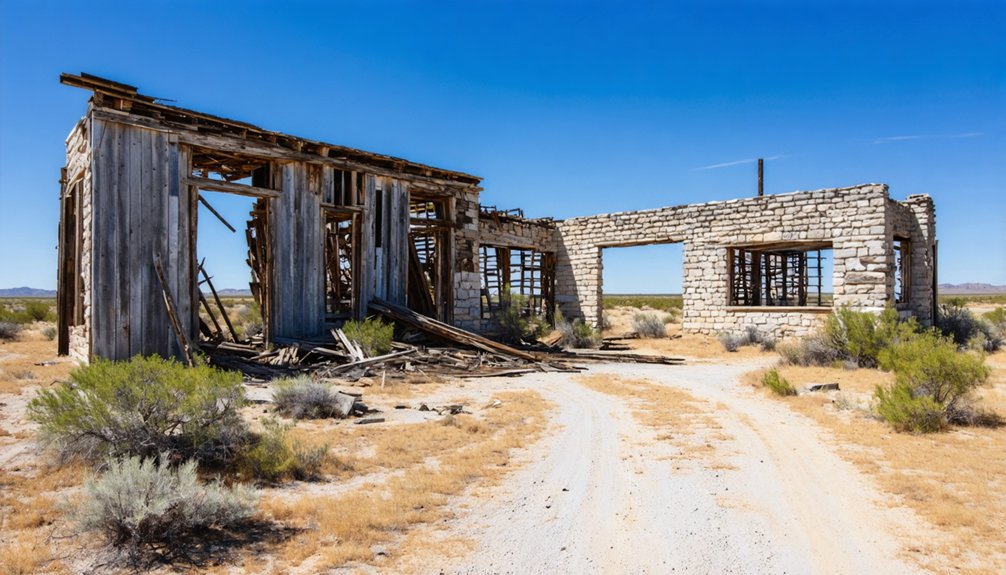
After the oil dried up and the roughnecks moved on, Otis Chalk faded into the red dirt that birthed it. What you’ll find today isn’t much—the post office history marks 1939 as its opening, and that weathered structure still stands as the primary remnant of this oil-boom settlement. It sits on private land off Farm to Market Road 821, accessible only by 4WD roads through open range where cattle roam free.
Here’s the wild part: despite its ghost town status, there’s a persisting population of 79 souls who still call this place home. That’s more than the fifty residents who stuck around after WWII. You’ll need permission before exploring—this is private property, and Texas takes trespassing seriously. Know your rights, respect the land, and you’ll glimpse authentic frontier persistence.
There are many hidden gems in the region, so make sure to explore Hughes, Texas ghost towns where remnants of the past echo through the abandoned buildings. Each location tells a story of the settlers who once thrived here, leaving behind artifacts that spark the imagination. You might even stumble upon fascinating historical insights that connect you to who we were and how far we’ve come.
Understanding West Texas Weather and Wildlife
Before you venture into Otis Chalk’s backcountry, you’ll need to understand the brutal honesty of West Texas weather. Seasonal temperature variations swing from January lows around 54°F to summer peaks near 90°F, sometimes exceeding 100°F when you’re most exposed.
Precipitation patterns impact your journey dramatically—you’ll face an average 0.40 to 0.72 inches monthly, with brief thunderstorms punctuating the driest stretches.
Wildlife concentrates near scarce water sources during scorching summers:
- Plains animals forage year-round thanks to mild winters with minimal snowfall
- Spring rains trigger vegetation bursts, drawing active fauna into tornado-prone zones
- Severe thunderstorms disrupt habitats, affecting migration patterns you might witness
Pack accordingly for 227 sunny days annually, but respect the region’s unpredictable temperament—it demands preparation, not assumptions.
Essential Preparations for Your Visit
Before you set out for Otis Chalk, you’ll need to secure permission from landowners since the entire site sits on private property—trespassing in Texas carries serious legal consequences.
Your vehicle must have four-wheel drive and high ground clearance to handle the rough, unpaved roads where cattle wander freely across FM 821.
Pack a thorough safety kit including extra water, first aid supplies, spare tire tools, and communication devices, because you won’t find gas stations or emergency services in this remote corner of Howard County.
Obtain Property Access Permission
How do you reach Otis Chalk when abandoned roads have crumbled and private land surrounds the ghost town on all sides? You’ll need legal access before making this journey into Texas history.
Consider your options carefully:
- Express easement – Negotiate directly with landowners for written permission, avoiding statutory easement requirements and court battles
- Easement by necessity – Prove historical common ownership and lack of alternative access through legal proceedings
- Public road request – Petition your county commissioners court under Texas Transportation Code Section 251.053
Ghost town properties carry unique complications. Unclear ownership records spanning generations make negotiations challenging. Express easement disadvantages include potential refusal by neighboring owners, forcing you toward costlier legal routes. Without secured access, you’re trespassing—hardly the freedom you’re seeking in these forgotten landscapes.
Prepare Four-Wheel Drive Vehicle
The dusty trail to Otis Chalk demands more than your standard SUV—you’ll need a properly equipped four-wheel drive vehicle that’s legally compliant and mechanically sound. Vehicle maintenance starts with checking your brake system, as it’s legally required for operation on public lands.
Install a muffler system to control noise and fit a U.S. Forest Service-qualified spark arrester to prevent wildfires in the dry West Texas brush.
Equipment preparation means ensuring your headlights and taillights function properly for visibility. Display your $16 OHV decal from Texas Parks and Wildlife Department—fines reach $500 without it. If you’re crawling along at 25 mph or less, attach a slow-moving vehicle emblem.
Pack a fire extinguisher, communication device, and travel with at least one companion vehicle for safety.
Pack Safety Essentials
Your vehicle’s ready for the rough terrain—now focus on what you’ll carry on your body and in your pack. Texas sun demands sunscreen, wide-brimmed hats, and long sleeves protecting against both UV rays and contaminated soil. Pack respiratory masks for dusty exploration and sturdy gloves for handling debris.
Essential protective gear storage includes separate containers keeping contaminated items isolated from clean equipment:
- Hand wipes and cleaning supplies for on-site decontamination procedures
- Barrier materials preventing direct contact with questionable surfaces
- Medical kit with antibiotic ointment for treating cuts immediately
Don’t forget recovery essentials: earth anchors for vehicle extraction, offline GPS maps, and emergency communication devices. Flash flood zones require route documentation showing higher ground options. Your independence depends on self-sufficiency—pack accordingly for situations where help’s hours away.
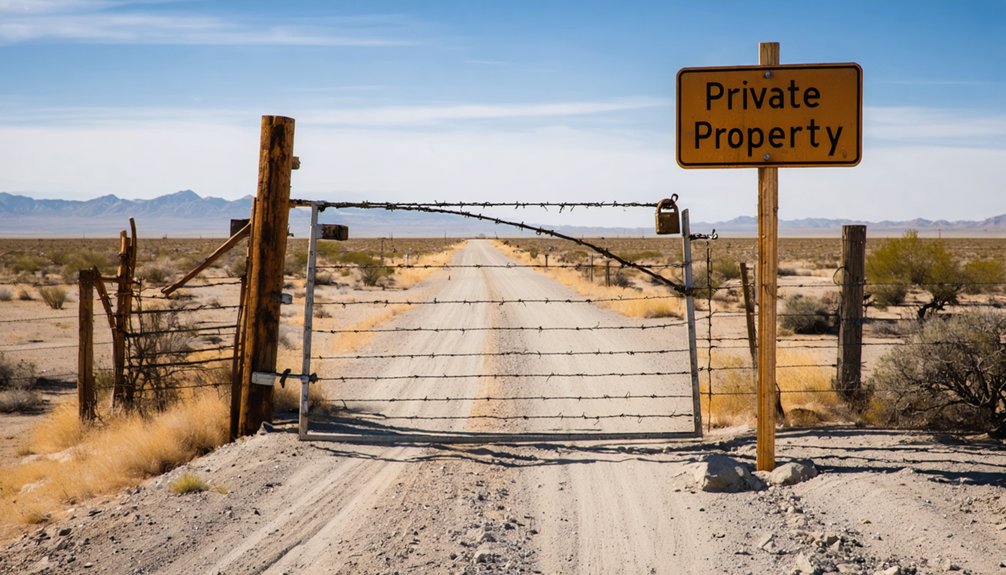
Getting to Otis Chalk means venturing off the beaten path into southeastern Howard County, where Farm to Market Road 821 cuts through one of Texas’s last true open ranges. You’ll need 4WD for these rugged roads, and you’ll share the highway with free-roaming cattle—remnants of the ranching legacy that predates the 1926 oil boom.
Here’s the catch: everything you’ll see sits on private land. Land ownership considerations aren’t optional—they’re essential. The entire ghost town belongs to descendants of rancher Otis Chalk, whose name still marks this remote corner.
Before you go, familiarize yourself with local trespassing laws under the Texas Penal Code. Contact landowners for permission first. Without it, you’re risking legal trouble that’ll cut your freedom-seeking adventure short.
Other Ghost Towns Worth Exploring Nearby
While you’re exploring Otis Chalk in Howard County, you’ll find yourself in prime territory for discovering West Texas’s forgotten oil boomtowns that rose and fell with equal intensity. The surrounding landscape holds dozens of abandoned settlements where wooden derricks once pierced the sky and roughnecks chased black gold—now reduced to crumbling foundations and rusted equipment baking under the relentless sun.
Within a day’s drive, you can trace the boom-bust cycle that defined this region, where fortunes materialized overnight and ghost towns emerged just as quickly when the wells ran dry.
Howard County Ghost Towns
The ghost towns scattered across Howard County tell stories of boom, bust, and the relentless West Texas wind that eventually reclaimed them. Beyond Otis Chalk, you’ll find remnants of communities that thrived briefly before fading into legend.
These vanished settlements share common threads in town records and resident memories:
- Knott and Vealmoor – Once-vibrant stops along forgotten routes, now marked only by abandoned foundations
- Ross City – A mysterious community that appears in county documentation yet left barely a trace on the landscape
- Elbow – Features an abandoned schoolhouse standing sentinel over empty prairie, its name’s origin still debated
Each location offers different terrain to explore. You’ll navigate dirt roads where prosperity once flourished, discovering what happens when oil runs dry and people move on, leaving only stories behind.
West Texas Oil Boomtowns
Beyond Howard County’s boundaries, West Texas oil boomtowns rise and fall across the Panhandle like fever dreams made of derricks and desperation.
You’ll find Roxana’s ghost town legacies in Carson County, where railroad bypasses killed what a dozen oil rigs built. Skellytown’s dual refineries and carbon black plant once supported over 100 wells before collapse. Thurber’s 10,000 miners disappeared when coal dried up, leaving only brick-paved memories. Ranger’s transformation from hundreds to 30,000 residents proves how fast oil town expansion can remake reality—waterworks, sewers, and electric lights installed in under two years.
Back-City’s 1927 gusher pumped 6,000 barrels daily before vanishing into the Llano Estacado dust. Now only foundations mark where fortunes bloomed and died. These abandoned sites tell your story: freedom’s price, paid in boom-and-bust cycles.
Frequently Asked Questions
Are There Any Guided Tours Available to Otis Chalk?
Unfortunately, guided tours aren’t available to Otis Chalk since it sits on private property requiring permission. You’ll need to navigate this adventure independently, respecting landowner rights while exploring the remnants of this forgotten oil boomtown on your own terms.
Can I Camp Overnight Near the Ghost Town Site?
You’ll find no public camping areas nearby at Otis Chalk itself. The historical significance of this remote ghost town site means you’ll need to explore designated camping zones farther out, respecting preservation rules while embracing your adventurous spirit.
What Photography Restrictions Apply When Visiting Otis Chalk?
You’ll face private property concerns at Otis Chalk since it’s on restricted land. Legal restrictions require you to respect no-trespassing signs and photograph only from public roads. Always obtain permission before entering to avoid fines or legal trouble.
Are There Restaurants or Gas Stations Near Otis Chalk?
You’ll find minimal services directly in Otis Chalk—just a small general store and occasional pop-up vendors. For full restaurants and reliable gas stations, you’ll need to drive to nearby Cibolo, Schertz, or New Braunfels communities.
How Long Should I Plan to Spend Exploring the Area?
Want to explore true frontier isolation? You’ll need just 1-2 hours to experience the abandoned buildings and historical significance of Otis Chalk’s remnants, plus extra time traversing rugged 4WD roads to reach this remote oil boom relic.