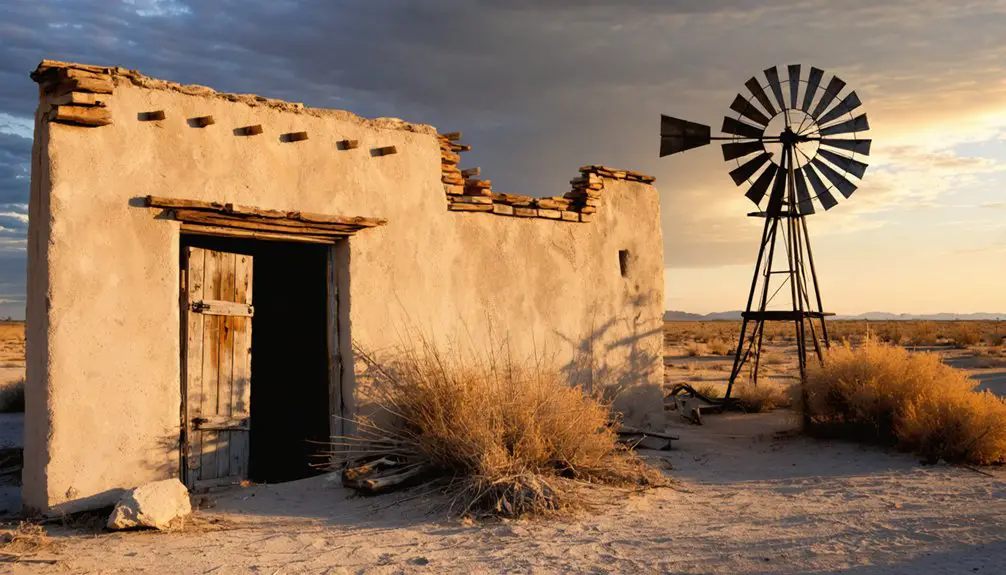
You’ll find Peach Tree Village two miles north of Chester on FM 2097, where coordinates 30°56’41″N, 94°36’47″W mark what remains of an Alabama-Coushatta settlement called “Ta-Ku-LA.” Plan your visit between late October and November when temperatures drop from summer’s brutal highs and fall foliage frames the 1912 Memorial Chapel—the last brick sentinel standing where timber baron John Henry Kirby honored his parents and Native Americans once signaled neutrality with white cloth during the Runaway Scrape, their stories woven into historical markers that reveal how two civilizations briefly shared this East Texas crossroads.
Key Takeaways
- Located 2 miles north of Chester in Tyler County; access via US 287 north to FM 2097.
- Visit the 1912 Memorial Chapel with artwork by Boris Bernhard Gordon, the main surviving structure from the vanished settlement.
- Best visiting period is late October through November for pleasant temperatures and fall foliage, avoiding brutal summer heat.
- Historical marker on FM 2097 and camp entrance marker provide details about the Alabama-Coushatta Indian village “Ta-Ku-LA.”
- Access requires traversing Camp Ta-Ku-LA grounds; elevated location offers views of Neches River valley and East Texas wilderness.
Getting There: Directions and Best Routes to Peach Tree Village

The coordinates 30°56’41″N, 94°36’47″W mark where Peach Tree Village once thrived in the pine forests of East Texas, though you won’t find it on modern maps. Your route planning begins at Farm Road 2097, roughly 2.5 miles north of US Highway 287.
The ghost town sits two miles north of Chester in Tyler County, where ancient trading trails once crossed. For driving directions, take US 287 through the region, then navigate north on FM 2097. You’ll traverse the same pathways where Alabama Trace and Coushatta Trace intersected, creating this vanished trading center. The village’s strategic location near the Neches River’s west bank made it the principal settlement for the Alabama Indians who entered Texas in the late 18th century.
The historical marker stands sentinel along FM 2097, guiding you to where pioneers once gathered. The 27 x 42 inch marker provides details about the Alabama Indian village of Ta-Ku-LA and the convergence of trails that made this location a significant trading hub. Liberty-Nacogdoches Road lies five miles east if you’re exploring alternative approaches through this untamed country.
What Makes This Ghost Town Unique: Alabama Indian Heritage and Frontier History
Long before Anglo settlers claimed this East Texas wilderness, the Alabama and Coushatta Indians carved out a thriving community they called “Ta-Ku-LA”—peach tree—on a commanding hill within the Kisatchie Wold ridge. You’re standing where two major traces intersected, where Chief John Scott’s family settled after Alabama Indian relocation from Louisiana in 1805.
What sets this ghost town apart is its dramatic transformation: during the 1836 Runaway Scrape, Alabamas displayed white cloth to signal neutrality, feeding desperate Texans fleeing Santa Anna’s army. Yet gratitude didn’t prevent frontier community tensions. By 1837, encroaching Anglo settlers made conditions unbearable despite Sam Houston’s friendship. James Barclay, a young Tennessean who became their Indian agent, stood as their foremost white friend during this turbulent period. The village emerged as the northern terminal of Long Kings Trace, connecting it to the critical Liberty-Nacogdoches Road. The Alabamas abandoned their peach trees for new ground, leaving behind a village that bridged two worlds before vanishing into East Texas legend.
The Memorial Chapel: John Henry Kirby’s Legacy in Brick and Stone
You’ll find the most enduring remnant of Peach Tree Village in a red brick chapel rising from the piney woods, built by lumber baron John Henry Kirby in 1912 to honor his parents.
Inside, a painting by Russian artist Boris Bernhard Gordon captures the moment Reverend Sam Mann baptized Kirby’s father in these same Tyler County woods. Gordon also painted the nearby Kirby home, both works commissioned by John Henry Kirby himself. The chapel stands today within Camp Ta-Ku-LA‘s grounds, its weathered bricks and sacred art offering you a tangible connection to the family whose fortune was born in this frontier settlement. Before the lumber barons arrived, the Alabama-Coushatta Tribe visited this same Tyler County location in 1816, establishing what they called Peach Tree Village.
Built as Parental Memorial
After building a multi-million dollar timber empire in Houston, John Henry Kirby turned his attention back to the place that shaped him—the quiet riverside settlement where he’d been born in a double-trot log cabin. You’ll find the Memorial Chapel standing as his tribute to the parents who’d settled this former Alabama Indian village. Honoring parent legacy through brick and stone, Kirby constructed this enduring marker in Peach Tree Village long after he’d left for urban success.
The chapel wasn’t his only gift. Alongside his wife, he donated the Peach Tree Village Hall to the community—handsome structures reflecting rural roots in a town that had given him everything. These buildings represent more than nostalgia; they’re physical connections between a timber baron’s fortune and the frontier soil that forged him. Photographs from the John Henry Kirby Family Collection captured the village during 1969-70, documenting these structures and the community life they anchored.
1912 Construction and Architecture
Red brick rises from the Tyler County hillside like a beacon among the pines, marking the spot where Kirby’s vision took physical form in 1912. You’ll find materials and design that speak to a lumber baron’s wealth—red brick walls punctuated by arched glass windows that flood the interior with forest-filtered light.
The architectural style and symbolism reflect traditional memorial chapels, yet Kirby added his personal touch by hiring a Russian artist to paint the interior walls. Stand before this structure on Farm Road 2097, two miles north of Chester, and you’re witnessing early 20th-century craftsmanship preserved on two acres of county-protected land.
The building crowns the hillside where Peach Tree Village once thrived, a memorial to one man’s determination to honor his roots. A state historical marker stands at the entrance of Ta-Ku-La, commemorating the site’s layered past. As the longest serving Former Governor of Texas as of 1966, Allan Shivers later purchased and gifted the Kirby property, ensuring its preservation for future generations.
Current Preservation and Access
The chapel’s journey from private memorial to public treasure began when former Governor Allan Shivers recognized what many locals already knew—this red brick sanctuary deserved protection beyond what any single family could provide. His gift to Tyler County guaranteed the chapel’s survival, though its soul belongs to Camp Ta-Ku-La, the Christian encampment that’s embraced ongoing property maintenance as sacred duty. You’ll find the camp’s presence woven into every preserved brick and carefully tended garden.
When you arrive, look for the state historical marker at Camp Ta-Ku-La’s entrance—your gateway to this vanished village. The camp’s community engagement initiatives keep the chapel alive through homecomings and gatherings, transforming what could’ve become just another abandoned relic into breathing history. Much like North Carolina’s Peachtree Baptist, which has maintained its community impact since 1837 through constant dedication, some sacred spaces survive by remaining central to the communities they serve. Access requires traversing the camp’s grounds, where stewardship meets exploration.
When to Visit: Seasonal Considerations for East Texas Travel

Timing your ghost town adventure to Peach Tree Village can transform a simple day trip into an unforgettable East Texas experience. You’ll find spring (March-May) ideal for exploration, with mild temperatures and wildflowers painting the landscape in vivid blues and golds.
Fall delivers equally spectacular conditions—September through November brings comfortable weather and fewer crowds, letting you wander freely without peak tourism seasons crushing your solitude.
Understanding seasonal weather patterns helps you avoid summer’s brutal 90-113°F heat, though winter’s mild 30s-60s°F range offers peaceful exploration opportunities. Late October through November stands out as perfect, combining pleasant temperatures with stunning fall foliage across the Piney Woods. You’re escaping crowds while experiencing authentic Texas backroads at their finest—no festivals, no traffic, just open horizons.
What You’ll Find at the Site: Exploring the Remains of Peach Tree Village
When you arrive at Peach Tree Village, the brick Memorial Chapel rises from the rural landscape as the last sentinel of a vanished town. Historical markers dot the original village site, guiding you through layers of history from Alabama Indian settlement to prosperous frontier community.
The natural setting—rolling hills of the Kisatchie Wold overlooking the Neches River valley—reveals why both native peoples and pioneer settlers chose this elevated ground as home.
The 1912 Memorial Chapel
Rising from a pine-shaded hill beside Farm Road 2097, the 1912 Memorial Chapel stands as Peach Tree Village‘s most enduring landmark. John Henry Kirby built this red brick structure to honor his father, John T. Kirby, a Kentucky-born farmer whose legacy shaped the settlement.
You’ll discover Russian artist Boris Bernhard Gordon‘s interior artwork adorning the walls, including a painted baptism scene commemorating the elder Kirby’s faith. The artist background adds unexpected international flair to this East Texas chapel.
When 3,000 guests arrived by Trinity and Sabine Railway for the January 1, 1912 dedication, they witnessed more than a building—they celebrated frontier resilience. Former Governor Allan Shivers later purchased and gifted the chapel to Tyler County, ensuring its preservation within the surrounding Camp Ta-Ku-LA Christian encampment.
Historical Markers and Signage
Beyond the chapel’s brick walls, historical markers scattered across this forgotten crossroads tell stories etched in metal and stone. You’ll discover the 1966 Site of Old Peach Tree Village marker along FM 2097, standing sentinel over where pioneer trails once intersected. The Alabama-Coushatta marker reveals Ta-Ku-La’s historical significance—”Peach Tree” in their language—where tribes established headquarters in 1816.
These weathered signs face preservation challenges yet stubbornly remain, directing you toward Kirby Memorial Park and historic log structures. Each marker represents freedom-seeking pioneers who blazed their own paths through Texas wilderness, creating crossroads where cultures, commerce, and courage intersected.
Trail markers you’ll encounter:
- Alabama Trace and Coushatta Trace convergence points
- Long King’s Trace northern terminal near the Liberty-Nacogdoches Road
- East-west Opelousas-to-San Antonio route intersection
Natural Landscape and Setting
Perched atop a hill in the Kisatchie Wold ridge, Peach Tree Village commands a strategic overlook where the Neches River bottoms stretch eastward through Tyler County’s 925 square miles of piney woods. You’ll discover why early settlers chose this elevated terrain—cool breezes sweep across the ridge while the lush forest canopy of pines and hardwoods creates natural shelter below.
The diverse wildlife habitat surrounding the site pulses with untamed energy. Stand still and you’ll hear the raw soundtrack of East Texas wilderness—birds calling through ancient trees, rustling undergrowth marking unseen movement. This isn’t manicured parkland; it’s genuine backcountry where civilization retreated decades ago.
The Neches River’s western bank curves just beyond the tree line, its waters flowing eight leagues above the Angelina confluence, unchanged since Chester’s railroad displaced this forgotten settlement.
The Story of John Henry Kirby: From Village Boy to Timber Baron
While most East Texas farm boys in the 1860s seemed destined for lives behind a plow, John Henry Kirby had different plans. Born November 16, 1860, near Peach Tree Village, he taught himself law and transformed into the South’s lumber king.
His timber empire’s rise began when he provided legal services to Boston investors, then seized opportunities during the 1893 panic, buying vast timberlands at rock-bottom prices.
By 1901, Kirby Lumber Company controlled 300,000 acres and employed 16,500 workers. His custom-built railroad opened previously inaccessible forests to exploitation.
The Empire’s Timeline:
- 1887-1896: Accumulated land through strategic panic-buying
- 1901-1920: Peak operations with 13 sawmills spanning Texas and Louisiana
- 1933: The timber empire’s downfall—bankruptcy forced him to surrender control
He died in 1940, having witnessed both triumph and ruin.
Frequently Asked Questions
Are There Any Nearby Accommodations or Camping Facilities for Overnight Visitors?
You’ll discover a treasure trove of options awaiting your adventurous spirit. Nearby bed and breakfasts offer cozy retreats, while campgrounds with RV hookups provide open-sky freedom. Peach Tree Inn & Suites stands ready, just blocks from downtown’s vibrant pulse.
Is the Memorial Chapel Open to the Public for Interior Tours?
Public access to the Memorial Chapel’s interior architecture isn’t confirmed. You’ll need to call (409) 283-3709 to discover if tours are available, letting you experience firsthand the historical significance of this evocative sacred space.
Are There Guided Tours Available at Peach Tree Village?
No guided tours whisper through Peach Tree Village’s weathered pathways. You’ll find freedom wandering independently—no self-guided tours available or audio walking tours offered. Just you, unmarked trails, and remnants of Ta-Ku-La calling explorers bold enough to discover history unscripted.
What Other Ghost Towns in Tyler County Can Be Visited Nearby?
You’ll find Doucette nearby, another Tyler County sawmill ghost town worth exploring. While historic preservation efforts remain limited and local tourism initiatives are sparse, you’re free to discover these abandoned East Texas settlements independently through self-guided adventure.
Are There Any Annual Events or Commemorations Held at the Site?
The calendar stays quiet here—no historical reenactments or community celebrations mark this sacred ground. You’ll find solitude instead, where Camp Ta-Ku-La’s retreats honor the past through reflection rather than spectacle, preserving memory in peaceful reverence.
References
- https://www.ghosttowns.com/states/tx/peachtreevillage.html
- https://www.texasalmanac.com/places/peach-tree-village
- https://scholarworks.sfasu.edu/cgi/viewcontent.cgi?article=2328&context=ethj
- https://www.texasescapes.com/EastTexasTowns/Peach-Tree-Village-Texas.htm
- https://www.tshaonline.org/handbook/entries/peach-tree-tx-medina-county
- https://texasarchive.org/2016_00387
- https://atlas.thc.texas.gov/Details/5457011451/print
- http://www.placesnamed.com/p/e/peach_tree_village.asp
- https://www.texasalmanac.com/places/peach-tree
- https://www.tshaonline.org/handbook/entries/peach-tree-village