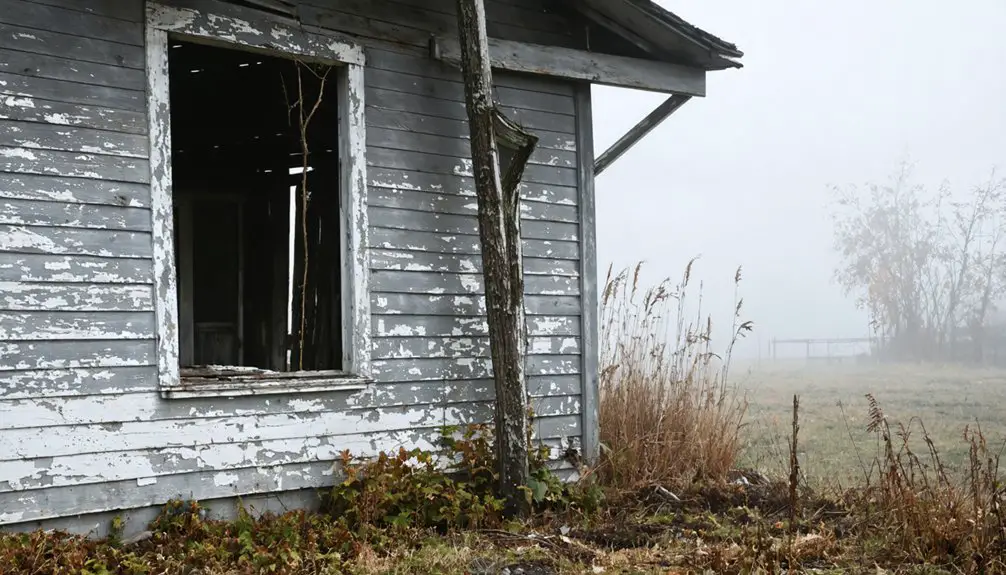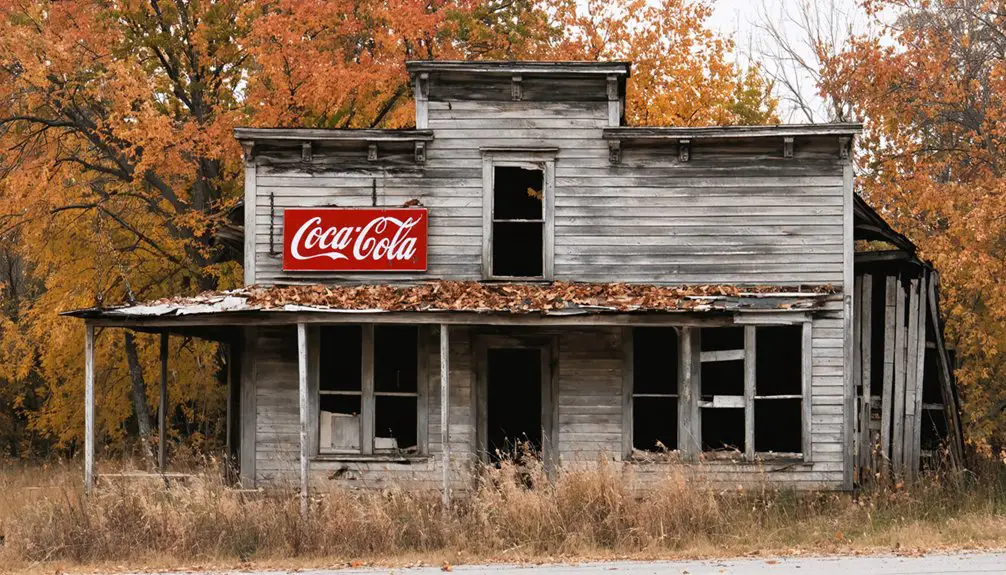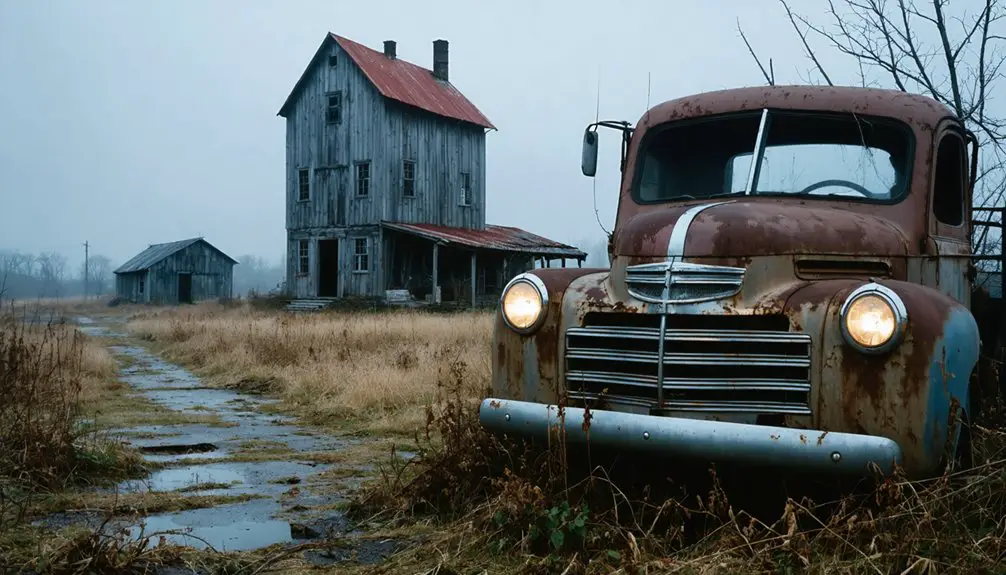
Pere Cheney sits near Grayling, Michigan, and it’s one of the state’s most haunting ghost town destinations. Once home to nearly 1,500 residents, this former lumber settlement collapsed after diphtheria outbreaks and devastating fires. Today, all that remains is an isolated cemetery filled with cracked, tilting headstones and eerie silence. Visitors report glowing orbs and children’s voices with no living source. If you’re planning a road trip here, there’s far more to this cursed town than you’d expect.
Key Takeaways
- Pere Cheney, near Grayling, Michigan, is a ghost town founded in 1874 that declined due to diphtheria outbreaks and fires by 1917.
- The cemetery in Crawford County features weathered headstones and an isolated atmosphere, making it a compelling ghost town destination.
- Visitors report paranormal activity, including glowing orbs, child ghost sightings, and EVP recordings of children’s voices near graves.
- Access requires a four-wheel-drive vehicle or sturdy footwear, with the cemetery open from 9 a.m. until sunset.
- Late summer through early fall offers ideal visiting conditions; pack navigation tools, insect repellent, water, and ghost-hunting equipment.
What Is Pere Cheney and Why Does It Matter?
Deep in the forests near Grayling, Michigan, sits all that’s left of Pere Cheney — a single, weathered cemetery surrounded by loose sand trails and silence.
This ghost town once thrived as a bustling lumber settlement, housing nearly 1,500 residents by the late 1870s. Founded in 1874, Pere Cheney served as an essential stopping point between Gaylord and Grayling until diphtheria outbreaks and devastating fires wiped it off the map by 1917.
At its peak, Pere Cheney housed nearly 1,500 residents — until diphtheria and fire erased it entirely.
What makes Pere Cheney compelling isn’t just its historical significance as a lost Michigan settlement — it’s the local legends woven into its collapse.
A banished woman, suspected of witchcraft, allegedly cursed the town before dying alone in the woods. That single story transformed a forgotten lumber village into one of Michigan’s most intriguing destinations.
The Real History of This Michigan Ghost Town
Before the legends took hold, there was a real town with real people trying to carve out a living in northern Michigan’s dense forests. Pere Cheney’s history exploration reveals a community founded in 1874, built by lumberjacks who turned a land grant into a thriving village of roughly 1,500 residents.
Positioned between Gaylord and Grayling, this ghost town functioned as a crucial stopping point along Michigan Central’s route.
But diphtheria outbreaks swept through, killing residents faster than the community could recover. Fires then destroyed the timber structures and lumber operations that held the economy together.
The Witch Curse That Allegedly Doomed Pere Cheney
When the facts of disease and fire weren’t enough to explain Pere Cheney’s total collapse, locals reached for a darker story: a woman suspected of witchcraft was driven from the village into the surrounding woods, and legend holds she cursed the town before she died.
That curse, according to town folklore, triggered the diphtheria epidemics that wiped out families and the fires that reduced the lumber operations to ash.
Whether you believe it or not, the story stuck. Pere Cheney’s witchcraft history even earned the cemetery a spot at #2 on the Top 10 Witch Graves in the Midwest list.
You can dismiss the legend as desperate storytelling from grieving survivors, or you can walk those grounds yourself and decide what feels true.
What Paranormal Activity Gets Reported at the Cemetery?
If you visit the Pere Cheney Cemetery, you’ll likely hear reports of mysterious lights and glowing orbs drifting through the surrounding trees.
Many visitors claim to have spotted the ghostly figures of children, believed to be the young victims of the diphtheria outbreaks, playing near the graves.
Perhaps most unsettling, paranormal investigators have captured EVP recordings at the site, with children’s voices audible on playback where no living child stood.
Mysterious Lights And Orbs
Among the most frequently reported paranormal phenomena at Pere Cheney Cemetery are the mysterious lights and orbs that seem to drift through the surrounding trees after dark.
Visitors describe glowing spheres floating silently between the headstones, appearing and disappearing without any logical explanation. These ghostly encounters feel intensely personal — you might spot a faint glow hovering near a child’s grave, then watch it vanish the moment you move closer.
Some witnesses believe these orbs represent the restless spirits of diphtheria victims who never left the land they called home.
If you’re visiting with a camera, keep it ready. Many photographers have captured unexplained light anomalies in their images, adding documented evidence to decades of firsthand accounts from curious travelers just like you.
Child Ghost Sightings
Beyond the drifting orbs, something far more unsettling pulls at visitors emotionally — the reported sightings of child ghosts wandering among the graves. Many of Pere Cheney’s youngest residents died during the diphtheria outbreaks, and some believe they never truly left.
Visitors report seeing spectral children playing near the broken headstones, their small silhouettes moving between graves before vanishing completely.
Others describe hearing ghostly whispers carried on the wind, soft and childlike, as though the victims are still calling out across time.
EVP recordings captured at the site have reportedly picked up children’s voices with no living source nearby.
If you’re visiting Pere Cheney Cemetery, stay alert — what you hear rustling through the silence mightn’t be the wind at all.
EVP Voice Recordings
Some of the most chilling evidence collected at Pere Cheney Cemetery comes through EVP recordings, where investigators have captured children’s voices with no living source present.
Ghost hunting teams who’ve visited the site report playful whispers and laughter embedded in audio recordings, believed to belong to young diphtheria victims buried within the grounds.
If you’re bringing recording equipment, EVP techniques work best during quiet moments between investigations. Set your recorder down near the headstones, ask direct questions, and review the audio carefully afterward.
Many visitors have discovered responses they never heard in real time.
The isolation of Pere Cheney makes it ideal for clean audio capture, with minimal traffic noise or interference.
What you record here might leave you questioning everything you thought you knew about this abandoned Michigan ghost town.
How To Get To Pere Cheney Near Grayling, Michigan
Getting to Pere Cheney Cemetery requires traversing a few key steps, but the journey is straightforward once you know what to expect.
Located in Beaver Creek Township near Grayling, Michigan, the site sits off remote sandy trails that demand either a lifted four-wheel-drive vehicle or a solid pair of walking shoes.
Follow these essential directions details before heading out: map your route to Grayling first, then navigate toward Beaver Creek Township using GPS or a reliable map.
Once you’re close, you’ll cross railroad tracks marking the cemetery entrance.
Keep these travel tips in mind — loose sand makes the trails unpredictable, so prepare accordingly.
The cemetery welcomes visitors from 9 a.m. until sunset, giving you plenty of daylight to explore this hauntingly isolated landmark responsibly.
The Broken Headstones and Eerie Landscape You’ll Actually Find
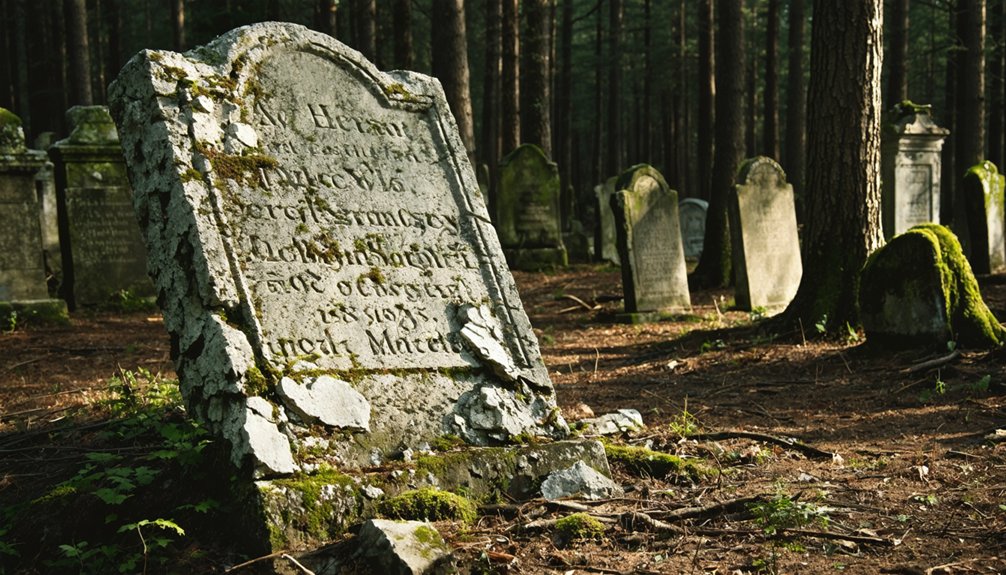
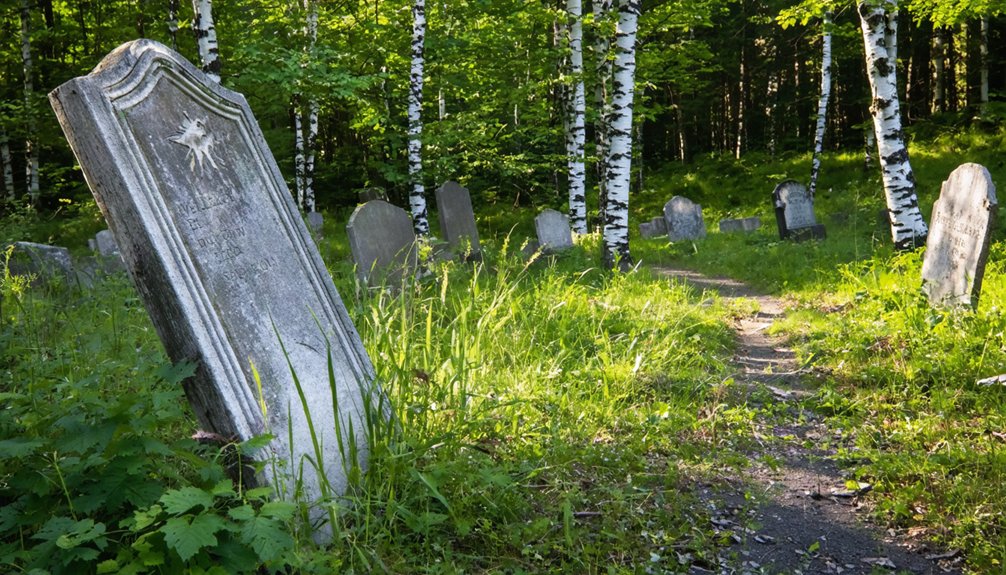
When you step into Pere Cheney Cemetery, you’ll find a hauntingly barren landscape with only a handful of cracked and weathered headstones still standing.
The ground stretches out sparse and exposed, offering little comfort or beauty to soften the weight of what happened here.
You can trace the faded inscriptions on the broken markers, each one a quiet reminder of the families that disease and disaster swallowed whole.
Weathered Headstones Remain
Once you cross the railroad tracks and push through the tree line, the cemetery opens up before you in a way that’s both underwhelming and unsettling. You won’t find dramatic iron gates or towering monuments here.
What you’ll find are weathered stones, some cracked, some sunken, some barely readable after more than a century of Michigan winters. A handful of broken headstones still mark where diphtheria victims, including many children, were buried during the town’s collapse.
The cemetery legends surrounding this place feel more believable once you’re standing inside it. There’s a stillness that doesn’t quite fit the surrounding woods. You’re free to explore, but the sparse, barren landscape has a way of making you feel like something’s watching every move you make.
Barren Cemetery Landscape
Few places strip away your expectations quite like Pere Cheney Cemetery. You won’t find manicured grounds or polished monuments here. Instead, you’ll discover a haunting barren beauty that feels both unsettling and oddly compelling.
Here’s what actually greets you:
- Cracked, tilting headstones barely readable after decades of neglect
- Sparse, patchy grass covering ground where 1,500 residents once lived
- Broken stone fragments scattered randomly, representing forgotten memories of diphtheria victims
- No surrounding structures — just isolated trees framing an empty, wind-swept clearing
The starkness hits differently than you’d expect. There’s no dramatic gothic atmosphere, just raw emptiness.
That absence becomes its own kind of storytelling. You’re standing where an entire community vanished, and the landscape refuses to let you forget it.
The Best Time of Year To Visit Pere Cheney Cemetery
Timing your visit to Pere Cheney Cemetery can make or break the experience. Late summer through early fall offers the best visiting season, when Michigan’s weather stays mild and the overgrown landscape carries an eerie, golden atmosphere.
Late summer through early fall is prime time — mild weather, golden hues, and an atmosphere perfectly, unsettlingly eerie.
You’ll want enough daylight to navigate the sandy trails safely, so plan to arrive mid-afternoon. Remember, the cemetery closes at sunset on moonless nights, so don’t push your luck.
Spring visits can leave you battling muddy, near-impassable trails, while winter makes the remote site dangerously inaccessible.
Whatever season you choose, cemetery etiquette matters here. You’re walking among real graves, many belonging to children who died tragically.
Respect the headstones, leave nothing behind, and take nothing with you — especially if you believe the witch’s curse carries any truth.
What Should You Bring for a Remote Cemetery Visit?
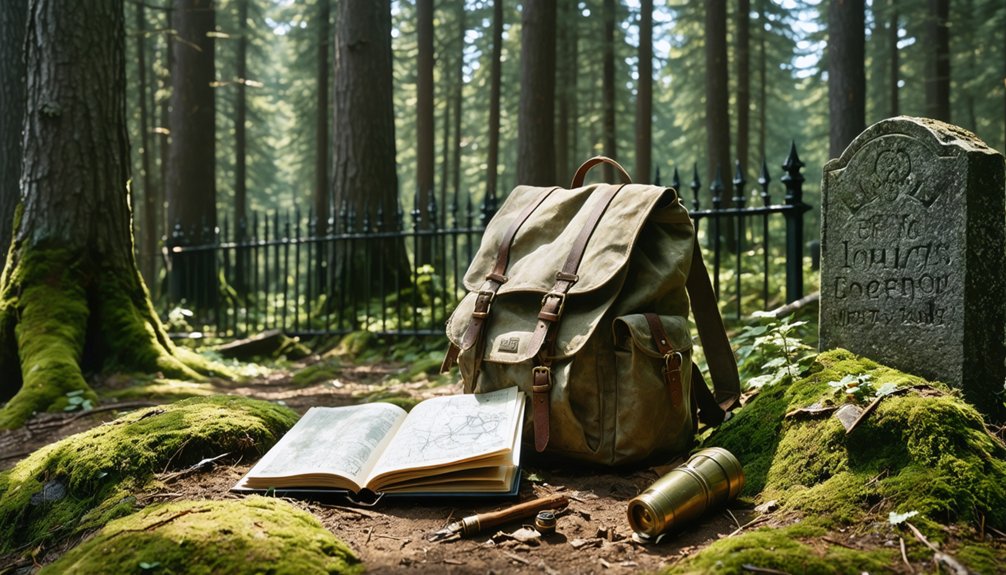
Packing smart separates a memorable visit from a miserable one. Pere Cheney’s sandy trails and remote location demand preparation before you arrive.
- Navigation tools – Download offline maps; cell service is unreliable deep in Crawford County’s backwoods.
- Sturdy footwear – Loose sand and uneven terrain make ankle support essential for reaching the cemetery entrance.
- Ghost hunting gear – Bring an EVP recorder, flashlight, and fully charged camera to document any unexplained activity.
- Water and insect repellent – Michigan summers are humid and buggy; stay comfortable during your exploration.
Practice solid cemetery etiquette by staying on pathways, never touching headstones, and leaving everything exactly as you found it.
Respecting the site keeps it accessible for every future visitor who makes the journey.
Other Michigan Ghost Towns Worth Adding to Your Route
Michigan’s Upper and Lower Peninsulas hide dozens of forgotten settlements that rival Pere Cheney for atmosphere and history, so if you’re already making the drive north, it’s worth stretching your route to catch a few more.
Fayette, a preserved iron-smelting town on the Upper Peninsula’s Garden Peninsula, offers stunning bay views alongside its haunted history of industrial-era workers.
Shelldrake, near Tahquamenon Falls, gives you crumbling riverside structures perfect for ghost town photography.
Closer to Pere Cheney, the remnants of Deward, another lumber settlement in Crawford County, tell a strikingly similar story of boom-and-bust timber culture.
Each stop adds texture to your road trip, letting you trace Michigan’s forgotten past across open highways without doubling back on yourself unnecessarily.
Frequently Asked Questions
Is There an Admission Fee to Visit Pere Cheney Cemetery?
You don’t pay an admission fee to explore Pere Cheney Cemetery’s rich cemetery history, but you’re expected to practice proper visitor etiquette — respect the grounds, honor the spirits, and leave everything undisturbed.
Are Pets Allowed at the Pere Cheney Cemetery Grounds?
Once home to 1,500 residents, Pere Cheney’s knowledge base doesn’t specify pet etiquette or cemetery rules about animals. You’ll want to contact local Beaver Creek Township authorities directly to confirm current pet policies before visiting.
Can You Legally Take Photographs Inside the Cemetery?
You can legally take photographs at Pere Cheney Cemetery, but you’ll want to practice proper photography etiquette and cemetery respect — capturing the eerie atmosphere while honoring the spirits and history resting within its haunted grounds.
Is Pere Cheney Cemetery Accessible to Visitors With Disabilities?
Unfortunately, you’ll find Pere Cheney Cemetery lacks accessible pathways for visitors with disabilities. Loose sand trails demand four-wheel drive or walking, and limited cemetery maintenance means uneven terrain makes wheelchair access extremely challenging to navigate independently.
Are Guided Tours of Pere Cheney Cemetery Available to Book?
No official guided tours are available, but you’ll discover cemetery history through independent guided exploration. You’re free to wander this eerie, abandoned site yourself, uncovering its haunting past between 9 a.m. and sunset on moonless nights.
References
- https://en.wikipedia.org/wiki/Pere_Cheney
- https://99wfmk.com/pere-cheney-2020/
- https://www.youtube.com/watch?v=9j8EIPt12k8
- https://ericchapman.com/haunted-pere-cheney-cemetery-michigan-history-witch-legend-my-october-visit/
- https://www.youtube.com/watch?v=FFGXAu50kyQ
- https://lostinmichigan.net/pere-cheney/
- https://thecoddiwomplist.com/pere-cheney-once-growing-town-is-now-a-haunted-cemetery/
- https://www.youtube.com/watch?v=v-xSbaXiMY4
- https://www.youtube.com/watch?v=mwkSpczEaYY
- https://music.amazon.ca/fr-ca/podcasts/a69ead20-bfaa-42a8-b75b-c1ed3059a36a/episodes/0715eb8a-13e2-4b73-ad1c-2cf9caebab1e/the-horror-story-podcast-the-ghost-town-of-pere-cheney