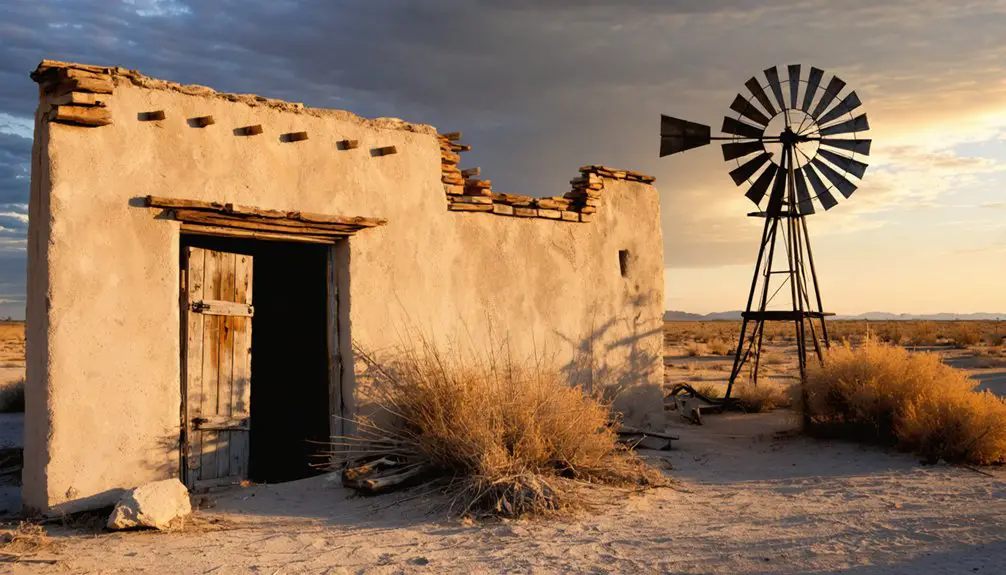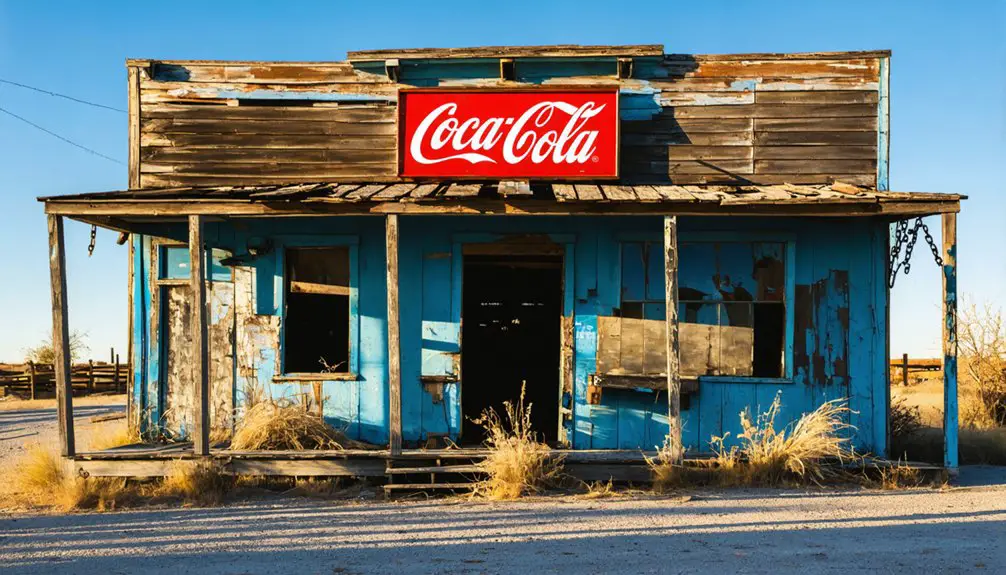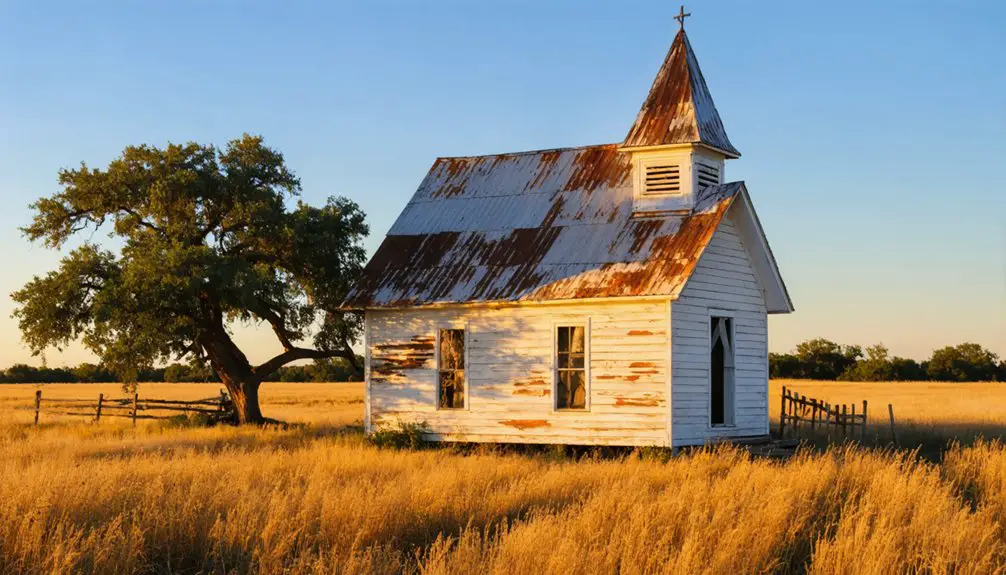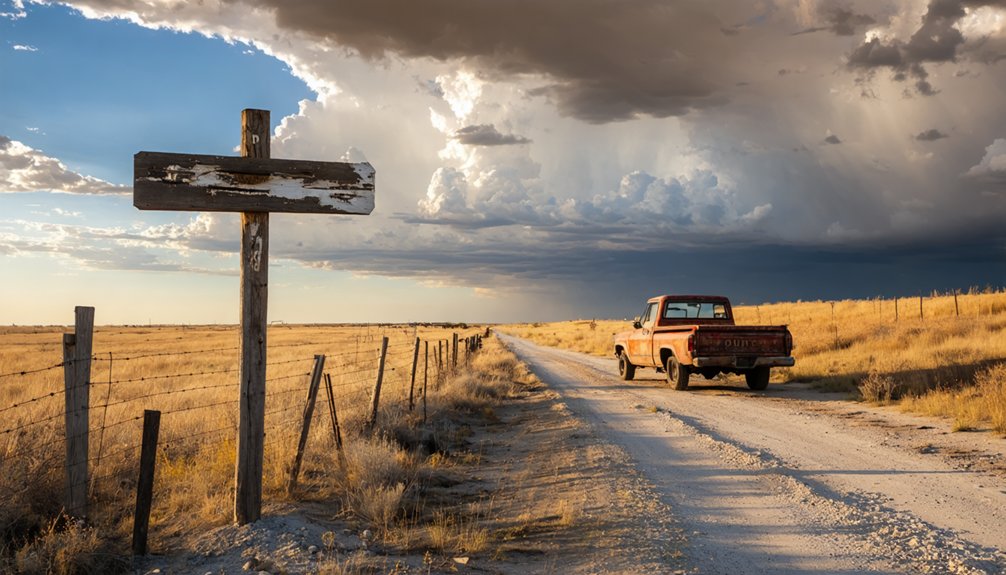
You’ll find Phillips ghost town 35 miles northeast of Amarillo, where refinery towers loom over what remains of a 4,000-person company town abandoned after the devastating 1980 explosion. Visit during fall’s mild weather to explore scattered ruins, the old high school building, and nearby vanished settlements like Electric City and Margaret. Access is restricted around active industrial areas, but public roads offer glimpses into this oil-soaked chapter of Texas history. The full story of Phillips’ rise and tragic fall reveals much more about corporate power and human resilience.
Key Takeaways
- Visit year-round with best conditions in fall (September-November) for mild temperatures and minimal crowds or spring (April) for bluebonnet blooms.
- Explore remaining structures including the old high school now operated by Phillips 66 Refinery and scattered rundown buildings across industrial landscape.
- Combine your trip with nearby ghost towns like Electric City, Margaret, and historic Adobe Walls battlefield for expanded exploration.
- Enhance your visit by exploring Borger area attractions including Johnson Park, Chad Alan Foster Memorial Trail System, and Huber Park’s War Memorial.
- Learn about the town’s history: founded 1938, peaked at 4,000 residents by 1980, abandoned after 1980 refinery explosion and corporate buyout.
The Rise and Fall of a Texas Oil Town
The flat Texas Panhandle stretched endlessly in 1938 when two modest settlements—Whittenburg and Pantex—merged to form Phillips, a company town born from oil-soaked earth and corporate ambition. You’ll find this ghost town three miles outside Borger, where Phillips Petroleum Company once employed thousands extracting black gold from fields extending in every direction.
The town swelled to 4,000 residents by 1980, though land ownership disputes and industrial safety standards barely existed in those wild early days. Houses shook from frequent minor explosions—just another Tuesday in oil country. The distinctive petroleum smell permeated everything, while workers lived in company housing along one main road.
What began as 1930s boom-town prosperity eventually withered when the wells ran dry and the company pulled out.
What Caused Phillips to Become a Ghost Town
Phillips didn’t vanish overnight—three interconnected forces gradually strangled this once-thriving community. You’ll find the catalyst in improved highways that pulled businesses toward Borger, a devastating 1980 refinery explosion that shattered windows across town, and a peculiar land ownership arrangement that left residents vulnerable to corporate pressure.
These factors converged to transform a bustling oil town into the abandoned landscape you’re exploring today.
Economic Decline and Highways
Multiple forces converged in the mid-1980s to transform Phillips from a thriving company town into an abandoned relic on the Texas plains. When oil prices crashed to $9 per barrel, the energy bust devastated upstream operations while drilling activity plummeted to a 52-year low.
You’ll find that over 100,000 Texas workers lost their jobs as wildcatters went bankrupt and 368 banks failed. But Phillips faced another killer blow: new highways bypassed the community entirely, rerouting traffic away from isolated company towns.
Without passing trade or local economy diversification, Phillips couldn’t survive the double punch of energy collapse and infrastructure shifts that favored urban areas. This stark urban versus rural development pattern left former boomtowns stranded, their populations scattered across a transformed economic landscape.
The 1980 Refinery Explosion
When hydrocarbon vapors ignited at the Phillips refinery in 1980, the blast injured approximately 34 people and set in motion the final collapse of what was already a struggling community. You’ll find conflicting accounts about the damage—some claimed entire town sections were obliterated, others reported only shattered windows. The truth lies somewhere between, with documented injuries and significant structural destruction.
The explosion aftermath revealed what locals already suspected: inadequate safety protocols had created a ticking time bomb. Rather than addressing the systemic failures, refinery management chose a different path—closing the town to residential occupancy. Through legal battles and corporate pressure, they pushed residents out entirely. What industrial safety regulations couldn’t force, economic leverage achieved. The community that survived economic decline couldn’t survive being deliberately erased.
Corporate Land Ownership Issues
The explosion merely set the stage for what would ultimately erase Phillips from the map—a corporate land grab disguised as safety precautions. Phillips 66’s corporate land acquisition strategies transformed tragedy into opportunity, purchasing ranch land from beneath homeowners who’d only ever leased their ground.
You’ll discover how systematically they dismantled this community:
- Forced exodus: Residents relocated or watched their homes bulldozed
- Tax strategy: Eliminated nearly $1 million in annual school obligations
- Total control: Company owned every structure and acre post-buyout
- Hollow victory: Homeowner rights and relocation meant nothing against corporate power
- Permanent closure: Industrial operations trumped human habitation
The cattle company, ranchers, and citizens fought back, but Phillips 66’s dominance prevailed. Freedom-loving Texans lost their town to boardroom decisions made hundreds of miles away.
The 1980 Refinery Explosion That Changed Everything
On January 21, 1980, a catastrophic sequence of mechanical failures sent a hydrocarbon vapor cloud billowing across the Phillips Refinery in the Borger area, ultimately igniting with a force that echoed for miles across the Texas Panhandle. You’ll find this explosion marks the turning point in Phillips’ descent into abandonment.
Instrument malfunctions triggered the disaster—a level control valve operators believed was open had actually closed, while a faulty flow transmitter masked the raffinate splitter’s dangerous overfilling. When relief valves released the overflow, a vehicle engine ignited the vapor cloud. The blast injured 34 workers, destroyed infrastructure, and exposed severe refinery safety failures. OSHA investigations followed with penalties, but the damage exceeded monetary fines.
This event accelerated the community devastation that transformed Phillips into today’s ghost town.
What You’ll Find at the Phillips Town Site Today
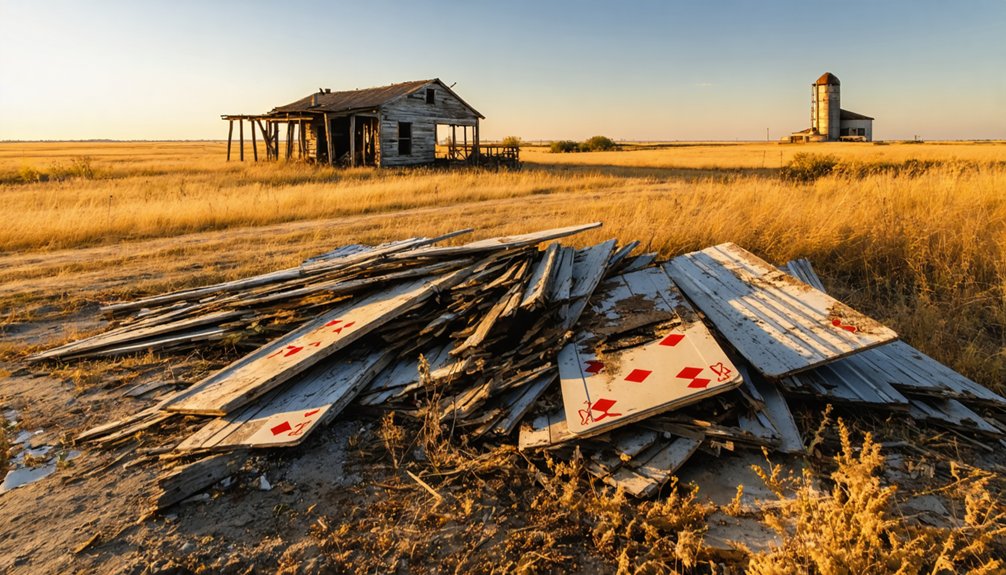
Little remains of what was once a thriving company town of 4,250 residents. When you visit Phillips today, you’ll discover a haunting landscape where industry has consumed most traces of community life. The remaining structural remnants tell a story of displacement and transformation.
The old high school – Now operated by Phillips 66 Refinery, this building stands as the primary intact structure
A few rundown buildings – Scattered remnants barely visible across the industrial landscape
Industrial facilities – Phillips 66 operations dominate where homes once stood
The Blackhawks alumni association – Keeps school spirit alive through reunions and their website
Open access – Listed as available 24/7, though restrictions may apply near refinery operations
You’re exploring authentic abandonment at 3,061 feet elevation in Hutchinson County.
How to Access the Restricted Ghost Town Area
You can’t legally enter Phillips—the abandoned town remains private property with no trespassing signs marking its boundaries. A security gate blocks the main access road, preventing vehicles from driving into the deteriorating structures where the 1968 refinery explosion forever changed this community.
Your best option is viewing the weathered buildings from the perimeter, where you’ll spot rusted equipment and skeletal frameworks against the Texas sky without risking trespassing charges.
Security Gate Restrictions
When you finally arrive at the Adobe Walls battlefield site on Turkey Track Ranch land, you’ll encounter a security gate adorned with Phillips Petroleum signage—a misleading marker since Phillips doesn’t own the property but merely operates oil wells nearby. The gate serves as your unwelcome introduction to significant access difficulties that have transformed this historical site since 1995.
Beyond this barrier, you’ll find:
- Mean-spirited warning signs threatening punishment for unauthorized entry
- Multiple cattle guards and fences crisscrossing the battlefield
- William Olds’ grave fenced off at the primary entry point
- Historical markers visible only from restricted vantage points
- Complete isolation with no ranch personnel present
Despite enforcement challenges in this remote Panhandle location, Turkey Track Ranch maintains absolute control, leaving you contemplating history from behind steel barriers.
Viewing From Perimeter
Unlike the battlefield’s steel barriers and threatening signage, Phillips Ghost Town offers surprisingly accessible perimeter viewing from public roadways along Old Route 66. You’ll discover architectural details of collapsed structures—the former Magnolia gas station, deteriorating high school, and Main Street’s rundown buildings—all visible from your vehicle or roadside positions.
Exploring ghost town adventures in Texas can lead to unexpected discoveries, each site telling its own unique story of resilience and decay. As you drive through these forgotten places, you’re struck by the haunting beauty of nature reclaiming what was once thriving. These remnants serve as poignant reminders of the past, inviting curiosity and reflection on the lives that once filled these now-silent streets.
The original street grid and crumbling sidewalks reveal topographical changes where nature reclaims what Phillips Petroleum abandoned after the 1980 hydrocarbon explosion.
Drive slowly along the perimeter, respecting private property boundaries while documenting the refinery infrastructure and company-town remnants. Weather affects accessibility—mud transforms roads during wet seasons—but you’ll find extended viewing periods in this quiet, minimally-visited location. Wildlife now owns these spaces, and structural hazards make entering inadvisable anyway. Your freedom lies in observation from public vantage points.
Phillips High School Blackhawks Football Legacy

The Phillips High School Blackhawks transformed from humble beginnings into one of Texas’s most formidable football dynasties, a legacy that still resonates decades after the school’s closure. You’ll discover a program that overcame physical disadvantages through coaching innovations and exceptional player development under legendary Coach Harold “Chesty” Walker.
Championship Achievements:
- 173-24-6 record across Walker’s 18-year tenure (1939-1956)
- 1954 Class 2A state championship with perfect 15-0 season
- 15 district titles and 9 regional crowns demonstrating sustained dominance
- Twenty-four players became coaches themselves, spreading Walker’s tactical philosophy
- Never experienced a losing season throughout Walker’s entire coaching career
This ghost town’s athletic legacy represents Texas football at its finest—underdogs who refused to be outcoached.
Nearby Ghost Towns and Historic Sites to Explore
Beyond Phillips’s faded boundaries, Hutchinson County harbors a constellation of vanished settlements that tell parallel stories of the Panhandle’s volatile oil boom era. You’ll discover Electric City, Margaret, and Isom—boom town ghosts scattered across windswept plains where wildcatters once chased black gold dreams.
Venture north to find traces of old infrastructure at Gibson-Whittenburg Camp and Supreme Camp, small Phillips Petroleum enclaves that housed roughnecks and their families. South on Highway 207, Gulf Camp‘s remnants whisper of corporate rivalries that shaped this landscape.
Don’t miss nearby historic cemeteries where pioneer oilfield workers rest beneath prairie grass. The Hutchinson County Historical Museum illuminates these forgotten chapters, while Adobe Walls beckons just 2.9 miles away—a landmark where frontier violence preceded petroleum prosperity.
Best Time to Visit and Trip Planning Tips
When should you venture into the haunting silence of Phillips? Your planning flexibility matters here, as this ghost town welcomes explorers 24/7 year-round. Seasonal crowd variations dramatically shift your experience—spring’s wildflower spectacle draws wanderers, while winter’s solitude belongs entirely to you.
Prime visiting windows:
- Fall (September-November): Temperatures hover in the 60s-80s°F with minimal crowds after summer’s retreat
- Late winter (December-February): Clear, cold skies perfect for stargazing in complete isolation
- Spring shoulder season (April): Bluebonnet blooms peak, though scenic routes see increased traffic
- Avoid May-August: Brutal 90°F-113°F heat creates dangerous hiking conditions
- Autumn festivals: Combine your ghost town exploration with nearby music events and state fairs
You’ll find the most authentic solitude during winter months when tourists vanish completely.
Combining Your Phillips Visit With Borger Area Attractions
For contrast, Johnson Park family amenities provide modern respite after dusty exploration. Scale the rock-climbing wall, then cool off at the pool opening May 2025.
The Chad Alan Foster Memorial Trail System rewards hikers with wildlife encounters and blazing Panhandle sunsets. Don’t miss Huber Park’s War Memorial, a hidden gem rendering visitors speechless. This combination of ghost town, battlefield, and vibrant recreation creates the ultimate Texas freedom trail.
Frequently Asked Questions
Can Former Residents or Their Families Visit the Old Phillips Town Site?
Remember your childhood home? Unfortunately, you can’t visit old Phillips—it’s locked behind refinery gates. Personal property rights transferred to Phillips 66, and local government oversight permits this restriction, blocking all public access to the former townsite.
What Happened to the Cemetery and Graves When Residents Were Relocated?
The cemetery remains intact at its original location, preserved as a Texas historic site since 1991. You’ll find relocation challenges were avoided—graves stayed protected while unmarked graves received documentation through the cemetery association’s dedicated preservation efforts.
Are There Any Annual Reunions for People Who Lived in Phillips?
No formal annual community gatherings exist for former Phillips residents, though memories echo through resident oral histories in books and articles. The town’s spirit lives on through individual storytelling rather than organized reunions.
Did Residents Receive Fair Compensation When Forced to Sell Their Homes?
You’ll find no evidence residents received fair compensation. Since they didn’t own the land beneath their homes, Phillips 66 forced them out without documented payments. Home values weren’t honored, and the relocation process left families bearing their own moving costs.
What Specific Products Does the Phillips 66 Refinery Currently Produce There?
The refinery’s industrial heartbeat pumps out gasoline and distillates—up to 100,000 and 70,000 barrels daily respectively. You’ll find fuel blending components flowing through pipelines, though lubricating oil production isn’t part of Borger’s current operations.