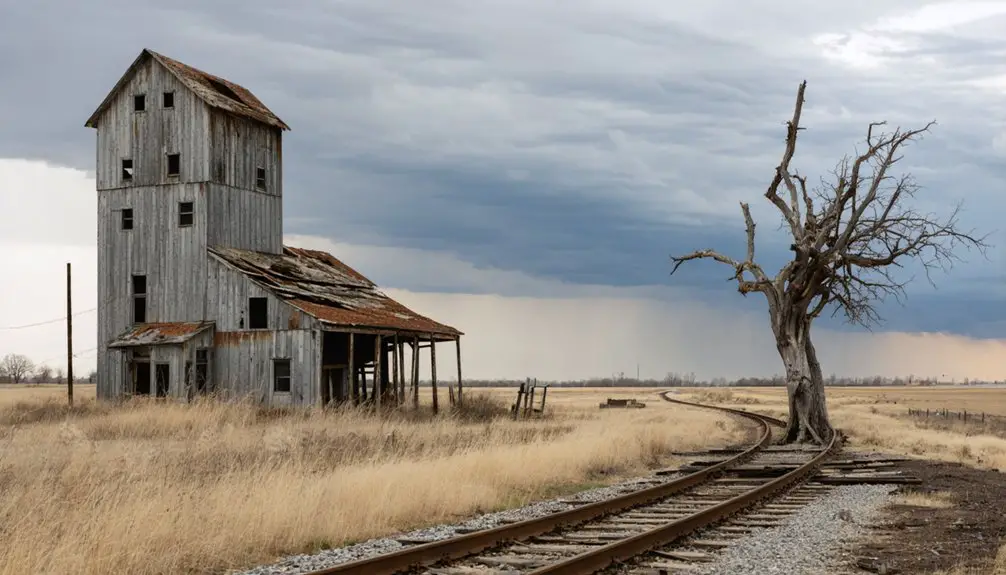
Your ghost town road trip to Pinewood starts 25 miles northeast of Bemidji, where deteriorating county roads test your vehicle’s suspension before revealing Minnesota’s most thoroughly abandoned settlement. You’ll need GPS coordinates (47.59722°N 95.12778°W), sturdy boots for uneven terrain, and a camera to document skeletal structures along dirt avenues that still bear their original names. Pack all essentials before leaving Bemidji—there’s nowhere to buy forgotten items once you’re surrounded by boarded-up homes and silent commercial buildings that haven’t served customers in decades. The journey ahead reveals how quickly prosperity vanishes.
Key Takeaways
- Navigate to Buzzle Township using GPS coordinates 47.59722°N 95.12778°W and check Minnesota DOT updates for unpaved road conditions.
- Pack essential supplies including camera, layered clothing, and offline navigation tools before leaving Bemidji, as no services exist onsite.
- Explore original dirt avenues lined with boarded-up homes, an old grocery store, bar, and the still-operating Dawg Shack business.
- Exercise caution around questionable structures with decades of decay and navigate uneven terrain throughout the abandoned settlement.
- Learn Pinewood’s history as an Iron Range community shaped by timber speculation, agricultural decline, and Depression-era depopulation.
When you navigate to Pinewood, you’ll find yourself tracing the path of Minnesota’s logging heritage along highways that cut through Beltrami County‘s dense pine forests. Your journey starts 19 miles northwest of Bemidji—fuel up there, because civilization gets scarce fast.
Follow state highways toward Buzzle Township, using GPS coordinates 47.59722°N 95.12778°W for pinpoint accuracy. The Soo Line Railroad once connected this 1879 settlement to the world, but now you’re on your own through increasingly rural terrain.
Road maintenance challenges define these back routes—unpaved sections demand respect, especially after snowmelt. Check Minnesota DOT updates before departing. Yet these rough roads grant local tourism opportunities: combine Pinewood exploration with Iron Range adventures, embracing the raw, unpolished character of Minnesota’s forgotten corners where ghost towns whisper their stories. These abandoned settlements remain packed with untold stories waiting to be discovered, much like Hennepin County’s forgotten communities. Many Minnesota ghost towns once had post offices that served as the heart of their communities before rural free delivery closed them in the late 19th century.
What Remains: Exploring the Abandoned Structures
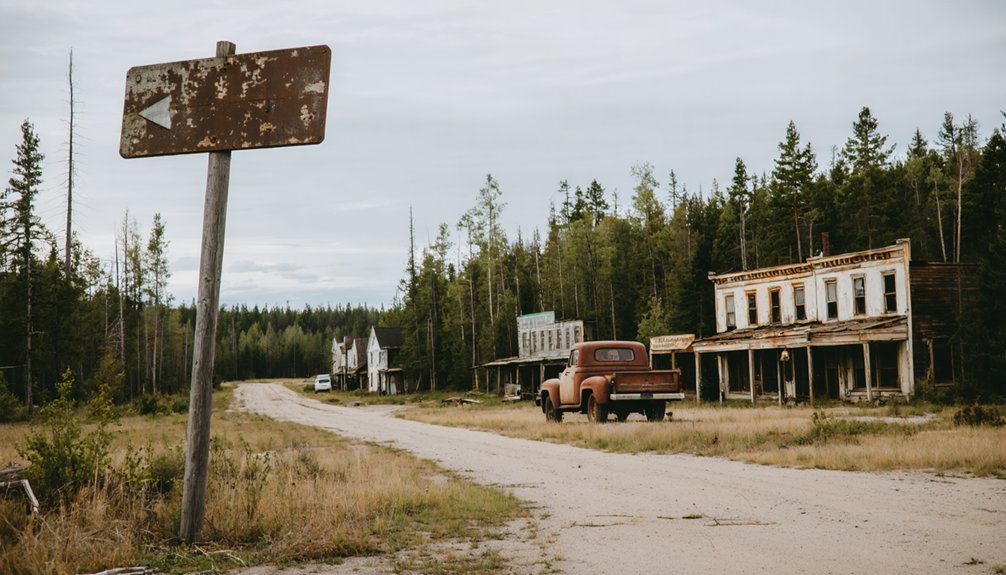
Pinewood’s skeletal remains stretch across dirt avenues that still bear their original names—Carl, James, and Walter—like tombstones marking a community that once thrived. You’ll find boarded-up homes standing beside empty lots where neighbors once lived. Most structures show questionable stability after decades of abandonment, so keep your distance.
A few occupied houses and trailers signal life persists here, though barely. The old grocery store and bar sit silent, their commercial days finished. Without official preservation efforts, nature’s reclaiming what mining built. That stop sign at town center? It’s your reference point for navigation.
The Dawg Shack pet grooming business proves you’re not entirely alone in this near-ghost town, maintaining its presence through social media while surrounded by Pinewood’s fading bones. Just beyond the trees, the Quarry Golf Course at Giants Ridge Resort offers an unexpected contrast to the abandonment. As you explore, wear appropriate clothing and footwear since the uneven terrain and deteriorating structures demand practical preparation.
The History Behind Pinewood’s Rise and Fall
You’ll find Pinewood’s story mirrors countless Iron Range communities that rode the mining boom before quietly fading into the forest. The town’s trajectory—from a bustling settlement fueled by resource extraction to a scattering of empty buildings—unfolded over just a few decades.
Understanding what drew people here, what sustained them, and what ultimately drove them away will transform your visit from a simple photo stop into a meaningful encounter with Minnesota’s industrial past.
Early Settlement and Boom
Long before Pinewood emerged as a timber settlement in the 1880s, waves of human activity had shaped the forests and waterways of northern Minnesota. You’re standing on land where Paleo-Indians roamed 9,000 years ago, followed by Dakota and Ojibwe nations who understood these woods intimately.
By 1883, everything changed. Timber speculators descended on the Pinewood-Debs area, exploiting land acquisition policies that favored railroad companies and Civil War veteran scrip holders. Government surveys reached only to township 148 north in Beltrami County, creating a legal patchwork that savvy investors manipulated. French-Canadian voyageurs and fur traders had arrived in these Minnesota forests as early as the 1600s, establishing the region’s first European economic networks centuries before the timber boom. The fur trade economy connected Minnesota’s indigenous populations to global markets, transforming traditional lifeways and introducing European manufactured goods that gradually replaced stone tools and native pottery.
These demographic shifts accelerated when the Fosston to How’s road opened access in the early 1890s. Suddenly, virgin timber stands became gold mines, and Pinewood positioned itself perfectly to extract that wealth.
Economic Decline Factors
The timber ran out faster than anyone expected. By 1910, Minnesota’s annual pine cut had plummeted, and sawmills across the state shuttered their doors. The Virginia and Rainy Lake Lumber Company—the region’s largest white pine operation—closed in 1929, sending lumber companies fleeing to the Pacific Northwest. You’re looking at classic resource exhaustion that killed towns overnight.
Meanwhile, agricultural shifts hammered rural communities. Farm income crashed from $438 million in 1918 to just $155 million by 1932. Mechanization stole jobs, and drought plus grasshopper plagues devastated west-central farmers in 1933-1934. As food insecurity worsened across Minnesota, rural towns like Pinewood saw residents flee to cities seeking relief programs. The mechanization of agriculture drove people from farmlands to urban centers, accelerating the depopulation of small communities.
When Black Tuesday hit in 1929, unemployment skyrocketed from 3% to 33%. Nearly 3,000 Minnesota farms went bankrupt between 1922 and 1932. Pinewood didn’t stand a chance.
Abandonment and Aftermath
How does a town that once buzzed with 150 residents and twin hotels vanish from Minnesota’s map? You’ll find the answer in 1854’s forced removal of the Ojibway people to White Earth reservation. Overnight, Pinewood lost half its population. The local impact of abandonment hit fast—two general stores and hotels stood empty, their doors creaking open to nobody. Stage coaches still rolled through, but they found only ghosts where community once thrived.
The implications for community were devastating. What remained wasn’t a town anymore—it was a skeleton of broken dreams. You can still trace building foundations in the woods today, silent witnesses to how government policy erased both Indigenous presence and the settlers who’d built their lives around it. Freedom, once promised here, proved fragile.
Essential Gear and Supplies for Your Visit
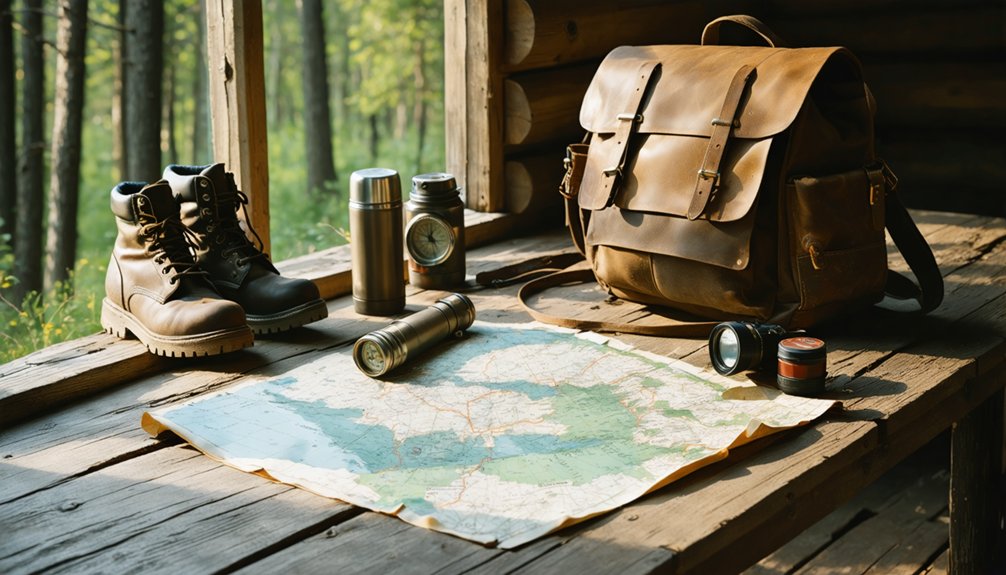
You’ll need three categories of gear to safely explore Pinewood’s remnants: a camera with extra batteries for documenting crumbling foundations before they disappear, layered clothing that adapts to Minnesota’s unpredictable weather swings, and navigation tools that work without cell signal.
I learned this the hard way during my first visit when my phone died two miles from my car, leaving me scrambling to retrace barely-visible trails in fading light.
Pack these essentials before you leave Bemidji, because there’s nowhere to buy forgotten items once you turn onto those abandoned logging roads. Like other former lumber camps in northern Minnesota, Pinewood’s remote location means you’ll be relying entirely on what you bring with you. Since multiple locations share the Pinewood place name, confirm your coordinates before setting out to ensure you’re heading to the correct ghost town site.
Photography and Documentation Equipment
When you’re documenting an abandoned Minnesota ghost town like Pinewood, your camera becomes both historian and storyteller. Pack a full-frame body like the Nikon D700 for low light photography during those moody twilight explorations. Your 16-35mm f/2.8L captures sweeping interior ruins while the 70-200mm f/2.8L compresses distant structures into compelling compositions.
Bring a sturdy tripod for 2-30 second exposures—essential when darkness swallows these forgotten buildings. Remote flash control through RadioPopper triggers lets you paint light across multiple rooms simultaneously, revealing architectural details hidden for decades. Don’t forget your Giottos Rocket Blower; Minnesota’s dusty abandonment will coat your sensor quickly.
A headlamp keeps your hands free while maneuvering collapsed floors and missing stairwells. Shoot RAW, manual everything—you’ll need that flexibility later.
Weather-Appropriate Clothing Layers
Minnesota’s abandoned settlements don’t forgive poor layering choices—I learned this the hard way during a February visit to Pinewood when my cotton hoodie turned ice-stiff within twenty minutes. Proper layering techniques start with merino wool thermals against your skin, followed by fleece mid-layers, then a waterproof hardshell when temperatures hover around 14°F. Pack insulated socks and neck gaiters—frostbite doesn’t care about your exploration schedule.
Summer demands different seasonal clothing considerations. You’ll face humid 79°F days with sudden thunderstorms, so moisture-wicking synthetics and a packable rain jacket become essential. Long sleeves protect against bugs during those 30-40 thunderstorm days annually.
The freedom to explore Pinewood year-round depends on carrying three-season versatility. Test your layers before arriving—these ruins won’t wait.
Because Forest Road 369 exists only as tire ruts through jack pine stands—no signs, no paint markers, just your best guess at intersections—a GPS unit loaded with offline topographic maps becomes your lifeline to Pinewood. Your four-wheel-drive vehicle’s clearance handles the rocky washouts, but navigation demands more than intuition. Pack a satellite communicator since cell towers don’t reach these Beltrami County backwoods. I’ve watched travelers backtrack for hours after missing unmarked turns.
Your communication tools expand beyond digital devices—carry two-way radios if you’re traveling in convoy. Vehicle requirements include spare tires and recovery straps. Add a first aid kit, headlamp for exploring dim structures, and water reserves. The freedom to explore Minnesota’s forgotten corners requires self-reliance when roads disappear and help sits fifty miles away.
Nearby Attractions and Alternative Stops
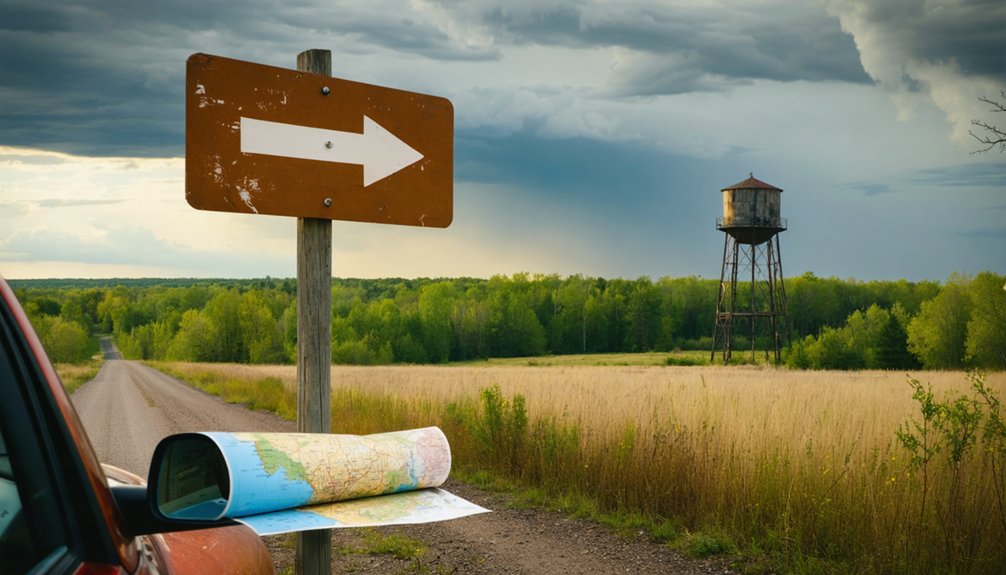
While Pinewood itself may not take more than an hour to explore, the surrounding Pine County area rewards curious travelers with enough attractions to fill an entire weekend.
Start at Snake River Fur Post on Pine City’s outskirts, where historic preservation efforts have reconstructed an 1804 trading post on an original Ojibwe encampment site.
Rev your engine through Chengwatana State Forest‘s ATV trails, then snap photos at Voyageur Park‘s 35-foot redwood statue—Minnesota’s largest.
The muddy Million Dollar Bridge hike offers spring adventure just two miles from a local winery.
South in Sandstone, Banning State Park showcases environmental conservation initiatives while hosting the Kettle River Paddle Festival.
You’ll find ice climbing at Robinson Park and miles of Willard Munger State Trail connecting everything together.
Safety Considerations and Visitor Guidelines
Every ghost town adventure carries inherent risks that proper preparation can minimize. Your freedom to explore remote places like Pinewood depends on responsible vehicle maintenance—check your oil, fluids, tire pressure, and tread before departure. Warning lights mean postponing your trip.
Advanced recovery planning becomes critical when you’re miles from civilization. Pack recovery gear, earth anchors, and consider traveling with another vehicle for mutual assistance. Share your detailed route plan and expected return time with someone trustworthy.
Respect the land and legal boundaries. These sites fall under federal and state protection—removing artifacts, even rusty nails, violates preservation laws. Check weather conditions beforehand and stick to daylight visits. Bring water, sturdy footwear, and first aid supplies. Remember: leaving only footprints preserves these historical treasures for future adventurers.
Frequently Asked Questions
Are There Any Accommodations Available for Overnight Stays Near Pinewood?
You’ll find freedom’s scattered outposts near this ghost town—no bed and breakfasts or short term rentals exist in Pinewood itself, but nearby resorts like Garrison’s offer lakefront cabins where you can dock between adventures into Minnesota’s vanished past.
exploring the history of Pinewood can lead you to intriguing tales of the area’s early settlers and their struggles. The remnants of old structures tell stories of resilience and community spirit, inviting visitors to step back in time. As you wander through the haunting landscapes, you’ll uncover a rich tapestry of events that shaped this once-thriving locale.
What Is the Best Season to Photograph Pinewood’s Abandoned Structures?
Winter’s your best bet for photographing Pinewood’s abandoned structures. You’ll capture crisp architectural features through bare trees, while snow creates stunning contrast. The lighting conditions are perfect—no humidity haze obscuring those weathered details you’re chasing.
Can I Bring My Dog to Explore the Ghost Town?
You can absolutely bring your dog to explore Pinewood’s ruins! Dog-friendly exploration is welcome here, though you’ll want to follow leash requirements near wildlife areas. Watch for rusty debris and unstable structures during your adventure.
Are There Guided Tours Available for Visitors to Pinewood?
Like a forgotten trail reclaimed by wilderness, Pinewood has no guided tours for visitors. You’ll explore solo—no walking tours of Pinewood exist. Nearby Stillwater and Red Wing offer ghost walks if you crave structured experiences beyond self-guided freedom.
Is Camping Permitted on or Near the Pinewood Ghost Town Site?
Camping isn’t permitted directly on Pinewood’s ghost town site due to site preservation efforts. However, you’ll find dispersed camping opportunities on nearby public lands. Check public land use regulations and maintain that 200-foot buffer from historical areas.
References
- https://www.youtube.com/watch?v=5bCG6B2rzZY
- https://www.minnesotahistory.org/post/a-complete-guide-to-the-ghost-towns-of-hennepin-county
- https://b105country.com/30-years-ago-this-tiny-minnesota-town-was-on-my-bus-route-now-its-a-ghost-town/
- https://www.mprnews.org/story/2025/10/13/minnesota-womans-quest-preserve-the-stories-of-disappearing-towns
- https://bringmethenews.com/minnesota-lifestyle/southern-mn-ghost-town-signs-are-up-for-auction-this-weekend
- https://freepages.rootsweb.com/~gtusa/history/usa/mn.htm
- https://en.wikipedia.org/wiki/Pinewood
- https://thievesriver.com/blogs/articles/ghost-towns-in-minnesota
- https://www.youtube.com/watch?v=btvFiKT3Quw
- https://www.forgottenminnesota.com