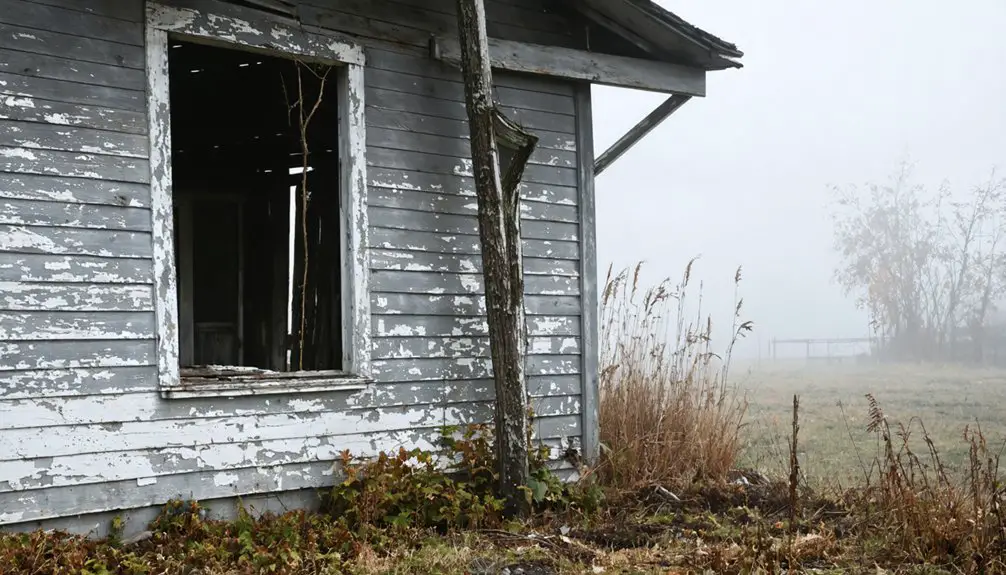
You’ll find Pokagon’s ghost town along Michigan’s southwestern backroads, accessible via US-12 and M-51 from Chicago (2.5 hours), Detroit (3 hours), or South Bend (30 minutes). Pack sturdy boots for exploring skeletal structures and the historic cemetery where Chief Leopold Pokagon’s descendants rest. Fuel up in Dowagiac before venturing into these woods, and consider November through March carefully—weather turns quickly. Nearby stops include the Pokagon Band’s cultural center and Michigan’s mining heritage sites, each revealing another layer of this remarkable survival story.
Key Takeaways
- From Chicago, take I-80/90 east to US-12, then M-51 north—approximately 120 miles in 2.5 hours.
- Explore skeletal structures, abandoned homes, and the historic cemetery with the oldest gravestones marking Potawatomi history.
- Fuel up in Dowagiac or Niles before visiting; monitor weather patterns carefully from November through March.
- Extend your trip to Dowagiac’s Center of History & Culture to learn about Pokagon Band cultural activities.
- Experience eerie timber groans, ghostly footsteps, and nature reclaiming the abandoned village along forest paths.
The Rise and Fall of Pokagon Village
Before white settlers planted their stakes in the fertile soil of Pokagon Prairie, the Potawatomi had already called this land home for generations. When Abram Townsend, Israel Markham, and Uzziel Putnam arrived from Ohio in May 1825, they found themselves sharing territory with the indigenous community whose name meant “the rib”—something used to shield.
The Pokagon Band managed what others couldn’t: they stayed. While thousands marched westward on the Trail of Death in 1836, Catholic Potawatomi secured legal exemptions through Judge Ranson’s opinion and General Brady’s pass. They’d even bought back 840 acres near Dowagiac with treaty funds.
But shifting land disputes after 1841 fractured their unity. Declining population numbers followed as families relocated to Brush Creek and Rush Lake, leaving only memories behind.
Chief Leopold Pokagon and the Band’s Strategic Survival
While thousands of Potawatomi trudged westward in chains, Leopold Pokagon played a different game entirely. This Chippewa-born leader, adopted into the tribe and rising through sheer competence, understood something his contemporaries didn’t: survival required strategic thinking, not just resistance.
Leopold Pokagon grasped what others missed: survival demanded strategy over defiance, negotiation over confrontation, calculated adaptation over pure resistance.
His calculated moves included:
- Jesuit missionary influence – Converting to Catholicism and personally traveling to Detroit to request priests, transforming his band into “civilized” Christians in government eyes
- Land acquisition strategy – Using treaty money to purchase property in his own name, becoming a private landowner
- Forging white alliances – Building relationships with influential settlers while maintaining dignified sobriety
- Securing the 1833 Treaty exemption – The only southwestern Michigan band to avoid forced removal
You’re visiting land his descendants still call home.
What Remains: Exploring the Ghost Town Today
Today, Pokagon exists as little more than whispers in the underbrush. You’ll find skeletal structures leaning against hillsides, empty homes with toppled fences, and rusted machinery slowly surrendering to forest.
The cemetery holds the oldest gravestones—silent witnesses to lives lived when timber mills still ran. Walk carefully among the ghostly street skeletons and collapsed cabins. There’s a haunting ambiance here that settles deep: timber groans without wind, footsteps echo from empty buildings, soft sudden noises drift along forest paths.
Visitors report an unsettling presence that lingers long after departure. Few stay overnight unchanged. The weight of abandonment presses harder the longer you remain, as nature continues reclaiming what the 1910 timber depletion first surrendered. Bring your curiosity, but respect the ghosts.
Getting There: Routes and Road Trip Logistics
Reaching Pokagon requires threading through the patchwork farmland of southwestern Michigan, where amber cornfields press against the horizon and weathered barns lean like old sentinels.
Your journey unfolds along these routes:
- From Chicago: I-80/90 east to US-12, then M-51 north—120 miles of open highway cutting through two states in 2.5 hours.
- From Detroit: I-94 west merging to US-131 south spans 180 miles through Kalamazoo’s rolling countryside.
- From South Bend: A quick 30-mile northbound dash on US-31 to M-51.
- From Indianapolis: I-69 north connecting to the toll road, exiting at US-12.
Monitor weather patterns November through March—snow transforms these flat roads treacherously. Fuel up in Dowagiac or Niles, where small town amenities cluster along the main corridors before civilization thins.
Connecting Your Journey: Nearby Historical Sites and Extensions
Pokagon’s story doesn’t end at township boundaries—the surrounding countryside unfolds layer upon layer of frontier history that deepens your understanding of this vanished settlement. Head to Dowagiac’s Center of History & Culture to witness Pokagon Band cultural activities firsthand—contact coordinator Amy Jo Morseau at (269) 783-3513 to explore “Keepers of the Fire” exhibits featuring Simon Pokagon’s writings and traditional black ash baskets.
Venture north to Ontonagon County’s Michigan mining sites where LaFayette Mine‘s 1845 shafts and Nonesuch Location’s interpretive trails reveal the state’s mineral extraction heritage. Historic White Pine Village near Ludington presents 30 restored buildings documenting the lumber boom that transformed these territories. Each destination represents another chapter in Michigan’s frontier narrative—forge your own path through these remnants of westward expansion.
Frequently Asked Questions
Are There Any Guided Tours Available for Exploring Pokagon’s Historical Sites?
You’re barking up the wrong tree—Pokagon doesn’t offer guided walking tours or historical interpretations. You’ll need to explore independently, discovering weathered foundations and forgotten streets yourself. That’s where real freedom lies: charting your own adventure through time.
What Accommodations Are Closest to Pokagon for Overnight Stays?
Potawatomi Inn offers you the closest stay, right inside the park with cozy cabin rentals nearby on Lake James. While bed and breakfast options are limited, you’ll find comfortable hotels within two miles offering freedom to explore.
Is Photography Permitted at the Old Rugged Cross Church?
Photography’s your ticket to capturing timeless memories at this sacred sanctuary. While no restrictions exist, you’ll find architectural preservation celebrated through your lens. Accessibility for visitors extends to the garden year-round, where you’re free to document its thirteen-foot cross.
Are There Any Annual Events Commemorating Pokagon’s History?
Yes, you’ll find annual cultural festivals celebrating Pokagon Band heritage through pow-wows with traditional dancing and ceremonies. Historical presentations occur throughout the year, though they’re educational talks rather than historical reenactments, preserving authentic Potawatomi stories and values.
Can Visitors Access the Pokagon Band’s Trust Lands From 2016?
Trust land access restrictions apply due to tribal sovereignty concerns. You’ll find the 166-acre South Bend site serves tribal members with housing and facilities. Public access isn’t guaranteed—it’s sovereign territory, not a tourist destination you can freely explore.