You’ll find Proffitt nine miles west of Newcastle on Highway 380, where an unmarked turnoff leads 0.2 miles north to the haunting cemetery that started this ghost town’s story. Your 2WD vehicle handles the rural roads fine as you explore weathered church ruins, scattered homestead foundations, and pioneer graves marking those killed in brutal 1864 and 1867 Indian raids. The Texas Historical Commission marker erected in 1990 reveals the violent frontier history that shaped this windswept settlement, and there’s much more beneath these crumbling stones.
Key Takeaways
- Located nine miles west of Newcastle on U.S. Highway 380 with an unmarked turnoff leading 0.2 miles north to the cemetery.
- Accessible by 2WD vehicle on rural roads with no bureaucratic restrictions for visiting the publicly accessible historical sites.
- Main attractions include Proffitt Cemetery, weathered church ruins, Episcopal Church remains, and scattered homestead foundations across rangeland.
- Cemetery features a 1990 Texas Historical Commission marker and pioneer headstones documenting the 1867 Indian raid and influenza epidemic victims.
- Best combined with exploring the 1864 Elm Creek Raid history and architectural remains of this former thriving settlement.
The History Behind Young County’s Forgotten Settlement
When Robert S. Proffitt arrived in Hood County in 1852, he couldn’t have imagined his family’s legacy would shape Young County’s frontier. This part-time Methodist minister and storekeeper pushed further west into Young County during the early 1860s, where the impact of ranching would define the region’s character.
By 1862, the Proffitt family established cattle operations along the Brazos River and Elm Creek, nine miles west of present-day Newcastle.
Despite Indian raids that plagued the settlement—including the devastating Elm Creek Raid of 1864—the Proffitts persevered. After the Civil War, son John expanded Proffitt family business ventures beyond cattle, launching a freighting operation and general store. He donated land for a cemetery, churches, and school, transforming a remote ranching outpost into a thriving community.
What Remains of Proffitt Today
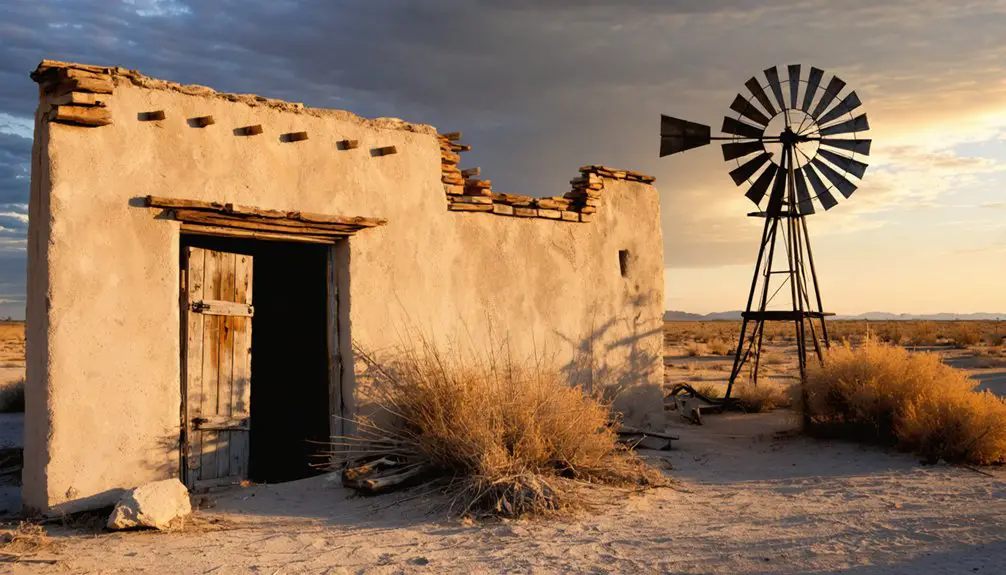
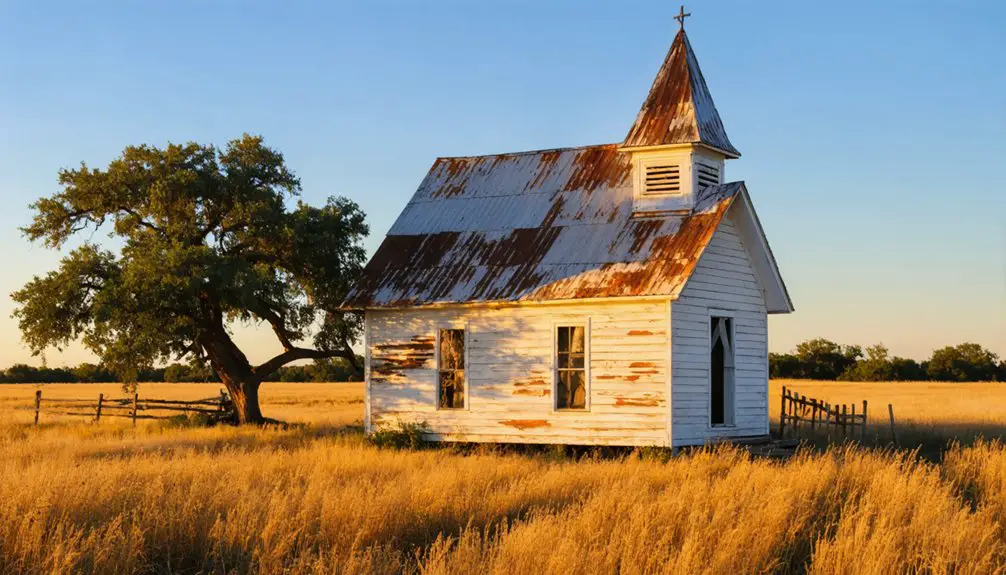
What greets visitors to Proffitt today is a landscape stripped to its essentials—a weathered church, a modest community center, and the cemetery that holds the town’s deepest stories. You’ll find architectural remains scattered across ranch country accessible by standard two-wheel-drive vehicles.
The commercial structures John Proffitt built have vanished, leaving these haunting markers:
- The Cemetery — resting place of three nineteen-year-olds killed in an 1867 Indian raid, two-tenths of a mile north of Highway 380
- Episcopal Church ruins — crumbling walls showcasing early settlement construction
- Scattered homesteads — foundations dotting the rangeland where families once thrived
- Historical markers — telling stories the structures can’t
Visit during cooler months when Texas heat won’t overwhelm your exploration of these tangible connections to frontier persistence.
Getting to Proffitt: Directions and Road Conditions

Finding Proffitt requires traversing nine miles of west central Young County rangeland from Newcastle, where the last vestiges of frontier commerce still service travelers. You’ll head west on U.S. Highway 380, watching for the unmarked turnoff that leads north 0.2 miles to Proffitt Cemetery—the settlement’s sole survivor.
Your 2WD vehicle handles these rural roads fine, though you’re witnessing firsthand the rural infrastructure impacts that accelerated this community’s fade. The absence of post offices, maintained thoroughfares, and county services reflects economic decline factors that swept countless Texas settlements into obscurity.
Spring and fall offer ideal visiting conditions before summer’s brutal heat descends. Navigate by the 1966 USGS map coordinates: latitude 33.19205320, longitude -98.87312190, where scattered homes hint at Proffitt’s vanished Main Street dreams.
The Elm Creek Raid and Indian Conflicts That Shaped the Town
The cemetery you’ve just located marks ground soaked in frontier violence, where the October 13, 1864 Elm Creek Raid rewrote Young County’s destiny in blood and fire. Five hundred Kiowa and Comanche resistance fighters, driven by Chief Little Buffalo’s vision, swept down from Indian Territory during the Civil War’s chaos. This wasn’t isolated violence—it represented broader regional conflicts over contested lands.
The raid’s brutal arithmetic:
- Twelve settlers and soldiers killed in initial attacks and ambushes
- Six women and children dragged into captivity
- 6-10,000 cattle and hundreds of horses vanished overnight
- Young Elijah Carter burned alive near Pease River
Three years later, the July 1867 attack claimed three nineteen-year-olds herding cattle here—their scalped bodies creating Proffitt Cemetery’s first burial.
Exploring Proffitt Cemetery and Its Historical Markers
Standing before the weathered Texas Historical Commission marker erected in 1990, you’re confronted with the cemetery’s grim founding story—three nineteen-year-olds massacred together, buried together, commemorated together in a common grave that became Proffitt Cemetery’s cornerstone.
The 27″ x 42″ marker guides you eight miles west of Newcastle on US 380 to this roadside cemetery maintenance labor of love. You’ll discover pioneer headstones marking Young County’s earliest settlers—Civil War veterans, World War casualties, and heartbreakingly numerous infant graves that bear witness to frontier mortality rates.
The decade between 1910-1920 saw the most burials, including influenza epidemic victims. Today’s cemetery association preserves these grounds as publicly accessible documentation to those who carved civilization from hostile territory. No bureaucratic restrictions bind this space—just weathered stones and windswept grass honoring the dead.
Best Times to Visit This North Central Texas Ghost Town
North Central Texas rewards ghost town explorers with forgiving weather patterns that transform Proffitt from a sun-scorched frontier relic into an accessible historical destination during most months of the year.
You’ll discover prime conditions from October through May, when temperatures hover between comfortable and pleasantly cool. Summer’s brutal heat makes examining historical artifacts and wandering among weathered headstones an endurance test rather than an adventure.
Plan your visit during these ideal seasons:
- Fall (October-November) – Crisp mornings perfect for cemetery exploration and photography
- Winter (December-February) – Mild days allowing extended time among ghost town attractions
- Spring (March-May) – Wildflower-dotted landscapes framing crumbling foundations
- Early mornings year-round – Beat the heat while discovering scattered homesteads
Your two-wheel-drive vehicle handles Highway 380’s route effortlessly, granting you unrestricted access to forgotten Texas history.
The Rise and Fall of a Frontier Community
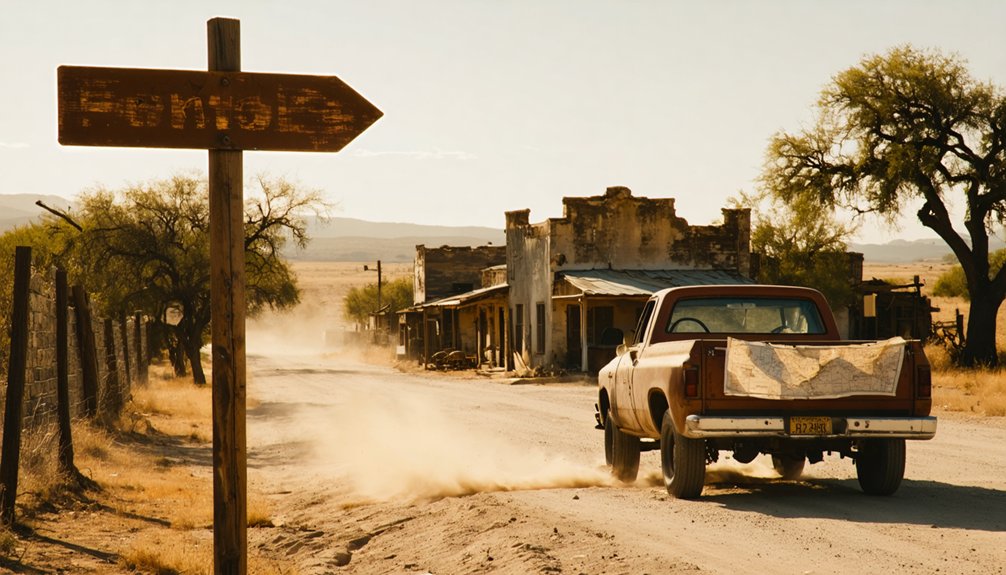
Before you can appreciate what remains of Proffitt today, you’ll need to understand the remarkable—and violent—story of how this frontier settlement came to be. Founded in 1862 by Robert S. Proffitt along the Brazos River, this community endured devastating Indian raids that claimed thirteen lives between 1864 and 1867. Yet survivors persisted.
Nearby Attractions and Fort Belknap
You’ll find Fort Belknap Historic Site just eleven miles northwest of Graham, where weathered stone buildings stand as silent witnesses to decades of frontier conflict.
The fort’s restored commissary now houses artifacts from the Comanche and Kiowa raids that once terrorized this region, while the Brazos River meanders nearby—the same water source that forced soldiers to relocate the entire post two miles south in 1851.
Beyond exploring the fort’s grounds, you can arrange group tours, visit Young County’s museums, or spend an afternoon along the Brazos where cavalry troops once watered their horses.
Fort Belknap Historic Site
Just eleven miles northwest of Graham, Fort Belknap stands as a remarkably preserved reminder of Texas’s frontier defense system. This frontier fort served as the northern anchor protecting settlers from Kiowa and Comanche raids between 1851 and 1867, giving pioneers the courage to establish new communities across untamed territory.
You’ll discover authentic structures built from locally quarried stone, including:
- The restored powder magazine, a Recorded Texas Historic Landmark since 1962
- The old commissary building housing museum exhibits of military life
- Infantry Quarters Number Four, rebuilt in the 1970s for the Fort Belknap Archives
- Original stone foundations scattered across the park-like grounds
The site’s open Monday through Saturday from 9am to 5pm, with Sunday hours from 1:30pm to 5pm. Admission’s free—perfect for independent explorers seeking authentic history without constraints.
Brazos River Recreation
The diversity of camping options means you’re not boxed in. Claim a primitive site on state-owned riverbanks, set up on a sandbar for multi-day paddling trips, or hook up your RV at established sites.
Beyond the water, 3.3 miles of trails challenge mountain bikers, a 22,426-square-foot pump track tests your skills, and Go Ape’s zipline course sends you soaring through the canopy. This 67-acre riverside escape delivers pure, unfiltered freedom.
Young County Museums
Stepping off Proffitt’s windswept ruins into Graham’s museum quarter feels like trading whispers for declarations. The Young County Museum of History & Culture and Old Post Office Museum anchor downtown’s square, their museum collections spanning Native American pottery to oil boom photographs.
You’ll find frontier ranching tools beside military uniforms from Indian Wars, while rotating art exhibits breathe contemporary life into 1936 art deco architecture.
What awaits your exploration:
- Research libraries housing oral histories and Peters Colony land grants
- Oil field photographs documenting 1800s–1900s wildcatter culture
- Rodeo heritage displays celebrating cowboy traditions through memorabilia
- Fort Belknap’s mid-19th century military outpost near Newcastle
Both museums open weekdays with extended weekend hours. Call (940) 549-1470 before riding out—appointments guarantee access when you’re ready to roam beyond ghost town solitude.
What to Bring on Your Ghost Town Adventure
Before you venture into the remote stretches of Texas backcountry where Proffitt’s weathered remnants await, you’ll need to pack strategically for isolation. Cell service disappears quickly out here, so download offline maps and bring paper backups—when you’re chasing haunted town folklore, GPS won’t save you.
Stock your vehicle with emergency essentials: jumper cables, flashlight, first aid kit, and tire repair supplies. The dusty roads leading to local legends surrounding Proffitt demand preparation. Pack multiple water jugs and a cooler with ice—Texas heat shows no mercy to unprepared explorers.
Don’t forget your multi-tool, extra cash, and AAA card. Throw in wet wipes, sunscreen, and bug spray for comfort. Blankets help if you’re photographing ruins at dawn. This isn’t a manicured tourist attraction; it’s genuine backcountry exploration.
Capturing the Spirit of Texas Frontier Life
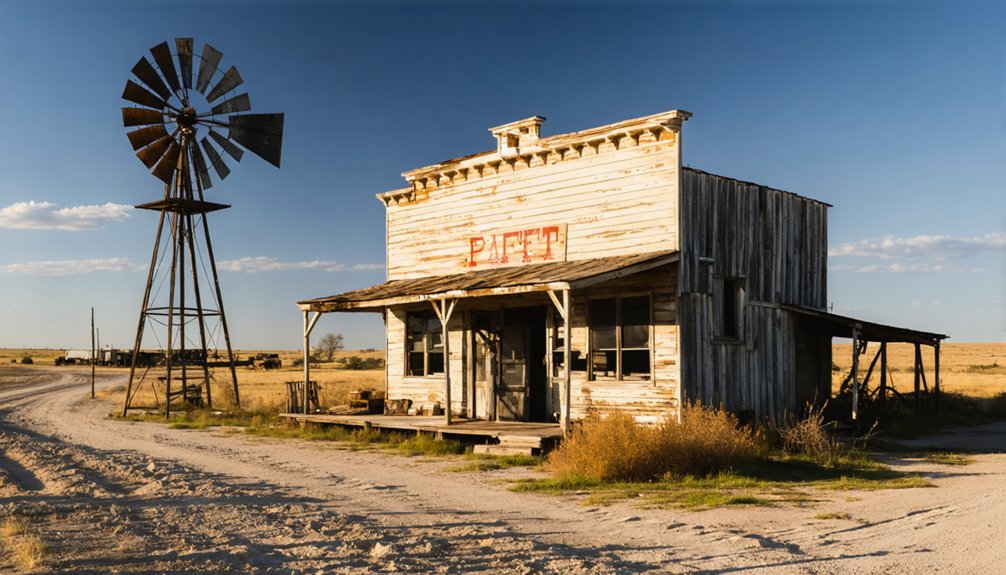
Standing among Proffitt’s weathered ruins, you’ll sense the raw determination that drove Robert S. Proffitt and his family to carve out existence on this unforgiving frontier. The settlement legacy speaks through silent markers:
Weathered ruins whisper stories of raw determination, where one family carved survival from an unforgiving Texas frontier through sheer will.
- Cemetery headstones commemorating the three young men killed in 1867, their names eternally bound together
- Empty foundations where John Proffitt’s general store once anchored community commerce
- Scattered ranch lands where cattle still graze the terrain Robert recognized as perfect grazing country
- The persistent Methodist church grounds he donated, representing faith amid violence
Each element captures the authentic frontier spirit—not romanticized Western mythology, but honest testimony to settlers who risked everything for autonomy. You’re witnessing Texas as it actually was: brutal, beautiful, and uncompromising.
Frequently Asked Questions
Are There Any Nearby Accommodations or Camping Options for Overnight Stays?
You’ll find limited options near Proffitt’s remote location. Nearby bed and breakfasts require significant driving, while local campground facilities are scarce. You’re better off bringing camping gear and embracing the wilderness, or staying in distant Alpine or Marfa.
Is the Proffitt Cemetery Open to the Public Year-Round?
Stretching endlessly across the Texas prairie, Proffitt Cemetery welcomes you anytime. You’ll find no Proffitt cemetery hours posted or Proffitt cemetery regulations restricting your visit—just wide-open freedom to explore this historic burial ground whenever wanderlust strikes your soul.
Can Visitors Explore Inside Any Remaining Historical Buildings in Proffitt?
No, you can’t explore inside historical buildings—none remain standing in Proffitt. The structural integrity of original structures has vanished over time, leaving no historical artifacts within structures to discover. Only the cemetery and scattered modern homes exist today.
Are Guided Tours Available for the Ghost Town and Cemetery?
No guided tours operate at Proffitt’s ghost town or cemetery. You’ll experience complete freedom exploring independently—self-guided tours let you wander the pioneer graves, church remnants, and cattle-ranching history at your own pace without commercial restrictions or schedules.
What Safety Precautions Should Visitors Take When Exploring the Area?
Prepare properly by bringing proper supplies like GPS, water, and first-aid kits. Watch for wildlife encounters, flash floods, and extreme heat. You’ll find freedom here, but remote terrain demands respect—tell someone your plans before venturing out.