You’ll navigate 20 miles of winding Hill Country backroads from Goldthwaite to reach Regency, a Colorado River settlement frozen in time since its post office closed in the 1930s. Spring and fall offer ideal visiting conditions as you explore Texas’s last driveable wooden suspension bridge spanning 343 feet, a defiant historic church, and pioneer cemetery headstones from the 1800s. Pack sturdy boots, long pants, sun protection, and plenty of water for this remote location where civilization fades and Hannah’s transformation awaits discovery.
Key Takeaways
- Located 20 miles from Goldthwaite via winding Hill Country backroads at coordinates 31°25′14″N 98°51′03″W near Colorado River.
- Features Texas’s last driveable wooden suspension bridge, spanning 343 feet and listed on the National Register.
- Explore historic church, pioneer cemetery with 1800s headstones, and scattered houses from the abandoned settlement.
- Visit in spring or fall to avoid extreme heat; bring sturdy boots, water, sun protection, and weather-appropriate gear.
- Remote location with no parking concerns; nearby J. Lorraine offers haunted ghost town tours during October.
Getting to Regency: Routes and Road Conditions
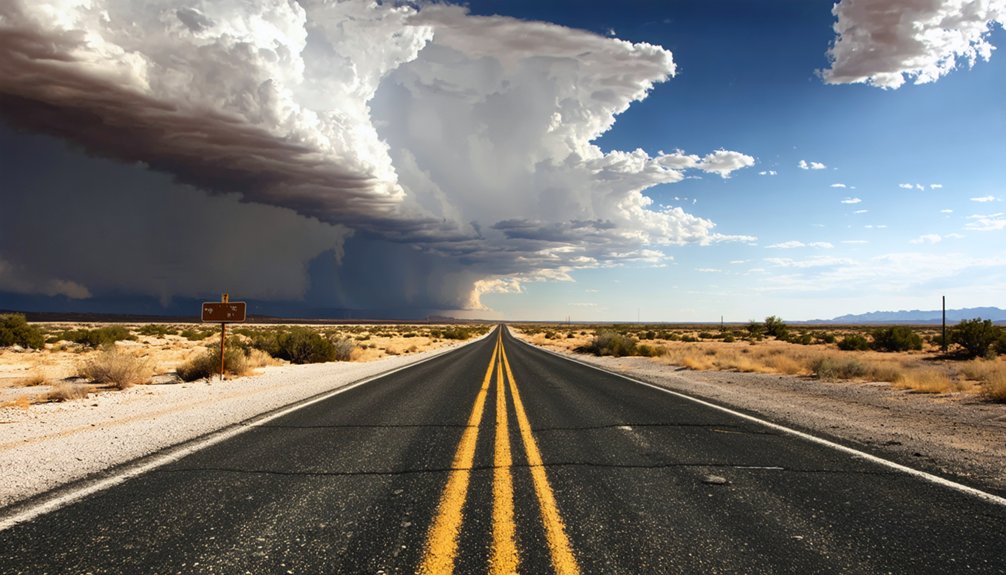
Twenty miles of winding Hill Country backroads separate Goldthwaite from the ghost town of Regency, carrying you south through the rugged limestone terrain of Mills County where civilization gradually fades into memory. You’ll navigate rural highways maintained just enough for the town’s twenty-five residents, following coordinates 31°25′14″N 98°51′03″W to this Colorado River settlement.
The historic Regency Bridge—a suspension span on the National Register—becomes your gateway across the water, connecting Mills and San Saba counties. Road conditions reflect the area’s semi-abandoned status: passable but rugged, demanding attention as you approach Colorado River access points. The bridge span bounces noticeably when your vehicle crosses, a thrilling reminder of the 1924 suspension construction that replaced the original 1903 structure.
These backroads double as hiking trails near Regency, where every turn reveals another layer of Texas’s forgotten frontier, perfectly suited for explorers seeking authentic solitude. Like other semi-abandoned Texas communities such as Trickham in Coleman County, which had a 2000 population of 12 residents, Regency represents the enduring remnants of once-thriving settlements.
The Story Behind Hannah’s Transformation to Regency
Long before it became a ghost town marked by coordinates and crumbling foundations, this Colorado River settlement answered to a different name—Hannah, christened for David Hannah who staked his claim here in 1854.
You’ll find the community identity shift happened not through revolution but bureaucracy—postal officials demanded a new name when another Texas town claimed “Hannah” first. The rechristening to “Regency” in the 1890s coincided with the settlement’s golden age, when 200 residents built their lives around ranching and river commerce.
But agricultural economy changes swept through after 1895, triggering a population exodus that wouldn’t stop. The post office shuttered in the 1930s, the final store locked its doors in 1970, and Hannah—now Regency—faded into legend. Today, only a handful of houses remain where a thriving community once stood, a reminder that ghost towns can still happen even as Texas leads the nation in population growth.
Exploring the Last Driveable Wooden Suspension Bridge in Texas
Local legends tell of Raymond Burns, killed when the original 1903 bridge collapsed, and teenagers who torched sections in 2003.
Navigate the remote dirt roads to reach this one-lane crossing, where limestone bluffs tower above and you’ll share the path with the occasional cattle drive, connecting you to frontier-era Texas. The bridge’s iconic appearance earned it a featured spot in the opening segment of Texas Country Reporter, making it a recognizable landmark across the state.
Spanning 343 feet across the Colorado River, the wooden deck stretches 16 feet wide, just enough for a single vehicle to cross between Mills and San Saba counties.
What Remains of the Original Settlement Today
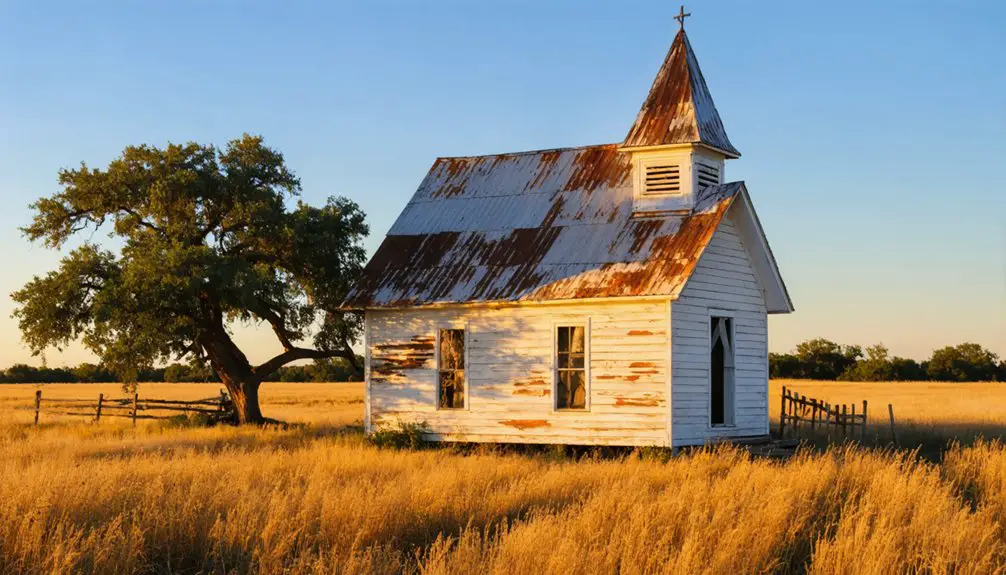
Beyond the weathered planks of the bridge, Regency exists now as whispers and shadows. You’ll find a handful of houses scattered across open pasture where cotton once depleted the soil. The church stands defiant against time, while crumbling settlement remnants mark where forty residents once lived through the 1920s and ’40s. Four ranchers now call this area home.
The preserved pioneer cemetery tells Regency’s truest story. Headstones from the 1800s outnumber modern markers, with Jodie May McNeely’s 1884 grave among the oldest. This final resting place anchors a community that peaked at 200 souls in 1895, then slowly surrendered to isolation. The post office closed by the early ’30s, leaving only these stone testimonies to pioneer determination. The boll weevil beetle devastated local cotton crops in the early twentieth century, delivering an economic blow from which the settlement never recovered. With fewer than 50 residents, Regency qualifies as a semi-abandoned site where buildings still stand but the community has nearly vanished.
Best Times to Visit and What to Bring
When planning your journey to Regency, timing separates a memorable exploration from a sweltering ordeal. Spring and fall deliver ideal conditions for wandering these ruins without battling Central Texas’s brutal summer heat.
October’s especially rewarding, with haunted tours at nearby ghost towns like J. Lorraine. Parking availability isn’t an issue at this remote location, and peak visitation times remain blissfully nonexistent—you’ll likely have the place to yourself.
Pack sturdy boots for rocky terrain, long pants against brush, and sun protection since shade’s scarce. Bring plenty of water and snacks; there’s nothing here but history. Comfortable, closed-toe shoes help you navigate the uneven ground safely throughout your visit.
Check weather forecasts before departing—thunderstorms strike suddenly in Hill Country. Toss a first-aid kit, flashlight, and spare tire in your vehicle. These backroads don’t forgive the unprepared. If you’re seeking more outdoor activities, J. Lorraine Ghost Town offers spaces for playing horseshoes and ax throwing alongside its historic structures.
The Rise and Fall of a Colorado River Community
David Hannah arrived at this bend in the Colorado River in 1854, staking his claim where Mills and San Saba Counties meet. His family followed, transforming wilderness into a settlement initially bearing his name. When postal authorities demanded a change due to duplication, Regency was born in 1884.
The community’s trajectory tells a familiar Texas story:
- Peak prosperity in 1895 – 200 residents thrived on early settlement infrastructure and economic reliance on cotton
- The 1903 bridge – Connected ranchers and farmers to distant markets across the Colorado’s waters
- Inevitable decline – Bridge collapses (1924, 1936), post office closure (1930s), and shifting trade routes emptied the town
Notable Landmarks and Historical Markers to Find
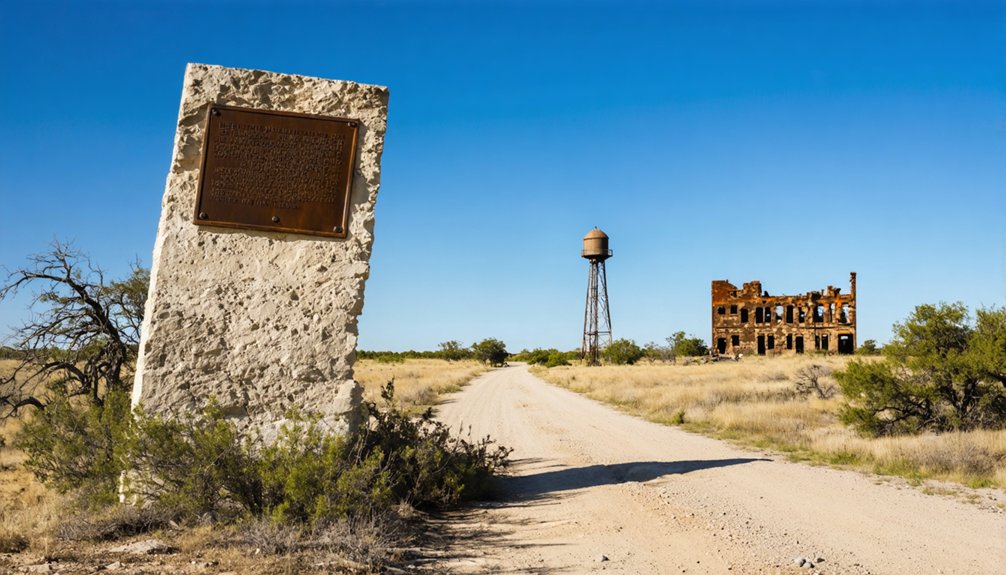
At Regency’s heart stands the 1939 suspension bridge, a memorial to Depression-era determination where 90 percent hand labor transformed steel and cable into the last automobile-carrying suspension bridge in Texas.
You’ll find the historical significance of suspension bridge documented on a 1976 marker five miles down a dirt road, commemorating the tragic 1924 collapse that claimed a boy, horse, and cattle.
Compelling restoration efforts in 2005 preserved this engineering marvel, though it’s now closed to traffic. Navigate the rutted path to discover scattered house foundations and the ghost town’s skeletal remains.
The bridge still dominates this forgotten landscape, connecting emptiness to emptiness—a tribute to vanished ambitions along the Colorado River where ranchers once gathered for market days and moonlit dances.
Nearby Attractions and Goldthwaite Connections
Your journey to Regency opens the door to Goldthwaite’s rich tapestry of history and outdoor recreation just eight miles north. The town serves as your gateway to Mills County’s rolling landscapes, where the Colorado River carves through limestone hills and century-old museums preserve the region’s frontier heritage.
From the Welcome Center at 1219 Fisher Street, you’ll find curated routes that connect ghost town exploration with botanical gardens, spring-fed parks, and rural backroads that reveal Central Texas at its most authentic. As you venture further, consider taking a trip to explore ghost towns near Texas, where remnants of the past tell captivating stories through weathered buildings and silent streets. Each destination offers a unique glimpse into history, inviting you to imagine the lives once lived in these forgotten places. Don’t forget to capture the stunning landscapes that surround these towns, enhancing your adventure with beautiful scenery.
Goldthwaite Historical Points of Interest
Before venturing out to Regency’s windswept ruins, you’ll find Goldthwaite offers several compelling historical attractions that illuminate the broader story of Mills County’s past.
Essential stops include:
- Mills County Courthouse – This 1913 Classical Revival masterpiece at 1011 Fourth Street showcases Henry T. Phelps’s architectural vision, rising three stories with cast stone detailing after fire claimed its predecessor.
- Old Mills County Jail – Built in 1888, this National Register landmark merits a brief 5-10 minute walkthrough, revealing harsh frontier justice conditions.
- Mills County Historical Museum – Located at 1119 Fisher Street (325-648-2212), the Goldthwaite Historical Society preserves authentic narratives through carefully curated exhibits.
The Texas Botanical Gardens and Native American Interpretive Center at 1201 Fisher Street adds natural and indigenous perspectives to your historical exploration.
Colorado River Recreation Opportunities
While Regency’s abandoned structures tell tales of frontier hardship, the Colorado River—flowing just thirty miles southwest of Goldthwaite—offers modern-day explorers a contrasting landscape of renewal and recreation.
You’ll discover kayaking opportunities along the El Camino Real Paddling Trail‘s six-mile stretch through canyon lands, or challenge yourself with the 23-mile Colorado Vista Trail requiring overnight camping.
Colorado Bend State Park provides access to a variety of water activities across six miles of river frontage—swim in spring-fed pools at Spicewood Springs, fish without licensing requirements, or launch larger watercraft toward Lake Buchanan.
The slow-moving current suits both novice paddlers and seasoned adventurers seeking solitude. LCRA’s riverside parks complement these experiences with equipment rentals, making spontaneous river excursions effortlessly achievable beyond Regency’s haunting silence.
Mills County Rural Routes
Beyond Regency’s weathered remnants, Mills County’s rural routes weave through 749 square miles of central Texas terrain where U.S. Highway 84/183 cuts east-west and State Highway 16 runs north-south. You’ll navigate agricultural landscapes dotted with pecan orchards and historical cattle ranches scattered across rolling hills.
Your journey connects three distinct experiences:
- Goldthwaite – The county seat sits ten miles southwest, offering supplies and the Mills County Historical Museum
- Big Valley – This Colorado River settlement represents the county’s agricultural backbone since the 1870s
- Mount Olive – A community northeast of Goldthwaite dating to 1890
These backroads follow paths where telegraph wires once stretched along the Wire Road, connecting frontier outposts. You’ll discover freedom in landscapes unchanged by urban sprawl, where deer and turkey roam freely.
Frequently Asked Questions
Is It Safe to Drive Across the Suspension Bridge Today?
No, you can’t drive across today—the bridge is closed to vehicles due to structural concerns. While bridge stability allows pedestrian walking regardless of weather conditions, driving isn’t permitted. You’ll need to explore on foot instead.
Are There Any Facilities or Restrooms Available Near Regency?
No facilities or restrooms exist at remote Regency. You’ll find minimal nearby amenities in this ghost town setting. The availability of facilities requires planning ahead—bring supplies, as you’re exploring genuine backcountry where modern conveniences don’t reach.
Can I Camp Overnight Near the Bridge or Town Site?
Overnight accommodations aren’t available at Regency’s ghost town site. You’ll need to camp at designated areas following Texas regulations. However, the remote location offers excellent wildlife sightings if you’re exploring during daylight hours before moving on.
Do I Need a Four-Wheel Drive Vehicle to Reach Regency?
You won’t need four-wheel drive under normal weather conditions, as the dirt roads remain passable for standard vehicles. However, road accessibility deteriorates after heavy rains, so check forecasts before venturing into this remote backcountry destination.
Are There Any Guided Tours Available for the Area?
Guided tours aren’t available at Regency—you’ll explore independently, discovering its historical significance on your own terms. This freedom lets you wander authentic ruins at your pace, connecting personally with Texas’s untamed past without schedules or crowds.
References
- https://talesfromthewayside.com/blog-1/2017/3/5/regency-bridge
- https://en.wikipedia.org/wiki/List_of_ghost_towns_in_Texas
- https://www.youtube.com/watch?v=V2gnlmvAv1A&vl=ja
- https://www.tripadvisor.com/Attractions-g28964-Activities-c47-t14-Texas.html
- https://www.texasescapes.com/TexasHillCountryTowns/Regency-Texas.htm
- https://www.youtube.com/watch?v=hUzS5Pki4fU
- https://www.tshaonline.org/handbook/entries/regency-tx
- https://en.wikipedia.org/wiki/Regency
- https://www.texasescapes.com/Texas-Ghost-Towns-A-to-Z.htm
- https://www.youtube.com/watch?v=V2gnlmvAv1A&vl=ru