Your ghost town road trip through Southern California’s Mojave Desert starts with Eagle Mountain, where Kaiser Steel’s 400 abandoned homes sit frozen since 1983, just 8 miles from Joshua Tree National Park on washboard dirt roads. You’ll need a high-clearance SUV and plenty of fuel—summer temperatures exceed 120 degrees and services don’t exist for miles. Alternatively, Calico Ghost Town offers easier access three miles north of Interstate 15, where 500 silver mines once supported 3,000 fortune-seekers before collapse. The complete route requires careful planning to maximize your authentic exploration.
Key Takeaways
- Riverview is not mentioned in the background; nearby ghost towns include Eagle Mountain, Calico, and Riverside’s historic cemetery.
- Eagle Mountain requires high-clearance SUV for 8-mile washboard dirt road; fuel up at Joshua Tree before departing.
- Calico Ghost Town sits three miles north of Interstate 15, featuring restored 1880s buildings and underground mine tours.
- Summer Mojave Desert temperatures exceed 120 degrees; plan visits during cooler months with ample water supplies.
- Eagle Mountain offers authentic abandonment with 300 deteriorating homes; Calico provides restored, family-friendly historical landmark experience.
Eagle Mountain: Kaiser’s Abandoned Mining Community
Deep in the Mojave Desert, where summer temperatures climb past 120 degrees and the nearest town sits 30 miles away, you’ll find the skeletal remains of Eagle Mountain—a company town that once housed 1,500 workers and their families.
Henry J. Kaiser built this frontier community in 1948 to support the West’s largest iron mine, constructing everything from schools and churches to a bowling alley and swimming pool. For three decades, 150-ton ore trucks rumbled through streets lined with repurposed residential structures and trailer parks.
The 1983 closure left behind rusting mining equipment remnants scattered across three massive open pits that once produced 9 million tons yearly. You can still explore the abandoned infrastructure, though Joshua Tree National Park‘s expansion plans threaten access.
What Makes Eagle Mountain a True Ghost Town Experience
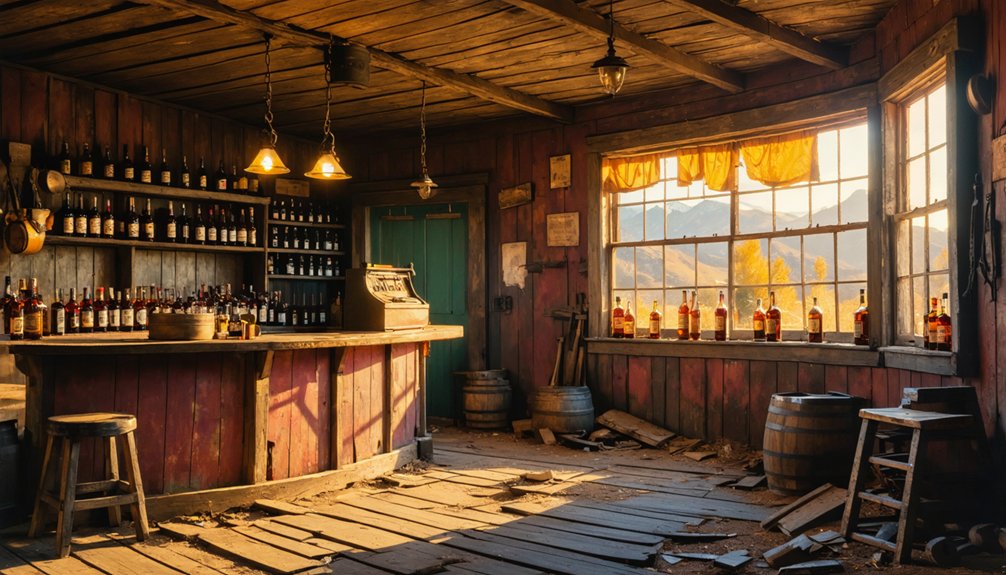
When you stand amid Eagle Mountain’s silent streets, you’re witnessing authentic abandonment—not a sanitized tourist attraction with gift shops and guided tours. The desert wind rattles through intact 1940s company housing and an empty shopping center, their sudden 1983 evacuation leaving behind a frozen snapshot of mining life that Hollywood once borrowed for its bleakest westerns.
Unlike restored sites such as Calico or Bodie, nobody’s here to collect admission fees or explain the history; you’ll explore genuine ruins where Kaiser Steel employees simply walked away, possessions still scattered inside crumbling walls.
Abandoned Mining Town History
Rising from the Riverside County desert like a monument to mid-century industry, Eagle Mountain stands as one of California’s most dramatic ghost towns—not because of some Wild West shootout, but because an entire modern community simply walked away.
You’ll find remnants of sophisticated mining town infrastructure that once housed 4,000 souls—shopping centers, schools, a bowling alley, even baseball diamonds. Kaiser Steel built over 400 homes here, creating a self-contained world 112 miles from their Fontana steel mill. The revolutionary healthcare system they developed became Kaiser Permanente’s foundation.
When foreign competition crushed the operation in 1981, workers abandoned everything. Today, you’ll wander through a 1970s time capsule, though sustainable redevelopment proposals continue surfacing, threatening this authentic ghost town’s preservation.
Film Location Desert Ruins
Hollywood discovered Eagle Mountain’s photogenic desolation decades before urban explorers made it a pilgrimage site. You’ll recognize backdrops from “Constantine,” “Tough Guys,” and “The Professionals” as you wander past crumbling facades and wind-swept streets. The abandoned infrastructure details that attracted cinematographers—wide boulevards, concrete foundations, industrial relics—now offer you unrestricted exploration through a landscape frozen in time.
The 51-mile railroad bed and massive open pit mine create dramatic vistas rivaling any movie set. This Hollywood film location appeal persists today: over 300 deteriorating homes, vacant civic buildings, and scattered mining equipment compose an authentic post-apocalyptic tableau. Security maintains a perimeter fence, but the school building outside remains accessible, letting you experience genuine abandonment without artificial restrictions.
Getting to Eagle Mountain From Joshua Tree National Park
You’ll find the old Eagle Mountain Railroad grade cutting southeast from the park’s boundary, a dusty ribbon that once hauled iron ore to Kaiser Steel’s mills in the 1940s.
The drive spans roughly 8 miles from Cottonwood Visitor Center along Kaiser Road, taking about 20 minutes on washboard dirt that’ll rattle your fillings loose if you’re pushing speed. I’ve made this run in a high-clearance SUV without trouble, but after summer rains, the washes can turn treacherous—locals swear by checking conditions at the visitor center before heading out.
Eagle Mountain Railroad Route
The Eagle Mountain Railroad traces a sweeping 51-mile arc across some of California’s most unforgiving desert terrain, connecting the ghost town to the shores of the Salton Sea. You’ll find the route beginning at Ferrum, where rusted track conditions and abandoned rail infrastructure still mark Kaiser Steel’s 1948 engineering ambition.
The line climbs from mudflats near Highway 111, carving through horseshoe curves and deep cuts in the Chocolate Mountains. You can still trace its path along Salt Creek Wash, past the crumbling Entrance siding, and through Victory Hills. The rails cross Eagle Mountain Road twice before reaching Telephone Pass.
While no trains have run since 1986, the right-of-way remains visible—a skeletal reminder of when 100-car ore trains thundered through this wilderness weekly.
Distance and Drive Time
Getting to Eagle Mountain from Joshua Tree National Park requires traversing roughly 30 miles of remote desert roads that’ll test both your vehicle and your sense of adventure. From the park’s West Entrance near Joshua Tree town, you’ll navigate internal park routes before heading north toward this abandoned mining settlement. Budget 1.5 to 2 hours total, factoring in rough terrain and mandatory slow speeds on unpaved sections.
Your fuel efficiency matters here—fill up in Joshua Tree before venturing out, as there’s nothing but wilderness ahead. While alternative routes exist via Kaiser Road off Highway 62, the park’s northern access points offer the most direct path. Pack extra water, check your spare tire, and download offline maps. This isn’t your typical Sunday drive—it’s pure backcountry exploration.
Road Conditions and Accessibility
Once you’ve cleared the park’s official boundaries, asphalt gives way to something far more primal—packed dirt that crunches beneath your tires like the desert itself announcing your arrival. High-clearance vehicles become essential here, traversing variable road conditions that shift from firm hardpack to braided sand paths demanding instinct over GPS.
You’ll tackle arroyo crossings where flash floods once carved deep scars, then climb rocky ridges where route-finding becomes an improvised art form. Near desert sand dunes, tracks multiply and disappear—choose the path of least resistance and trust your suspension. I learned quickly that 4WD isn’t mandatory, but it transforms anxiety into confidence when sand grabs your wheels and the horizon stretches empty in every direction.
Riverside’s Historic Haunted Locations Worth Visiting
Since its founding in the 1870s, Riverside has accumulated ghost stories that would make even skeptics pause at unmarked intersections and glance twice at historic hotel corridors.
Start your exploration at Mission Inn & Spa, where the haunted hotel atmosphere draws paranormal investigations regularly. Built in 1878, you’ll find Frank Miller and his sister Alice still occupying their former rooms—Alice’s fourth-floor quarters deliver cold spots and unexplained touches that presidents and celebrities have experienced firsthand.
Venture to Main Street Bridge, where Charles Wetzel encountered a scaly, pumpkin-headed creature in 1958. Head up Mt. Rubidoux after dark for mysteriously stacked rocks and voices echoing from nowhere. Even Castle Park carries weight—it’s built atop Native burial grounds, explaining decades of activity since 1976.
Olivewood Cemetery: Stories of Tragedy and Remembrance
Beyond Riverside’s downtown haunts, Olivewood Cemetery spreads across 75 acres near Pachappa Hill—a landscape where Victorian monuments tower beside weathered wooden crosses, each marking stories that’ve shaped this community since 1888. You’ll find early settler legacies here: citrus barons, Mexican immigrants from the 1790s Mission period, and families whose names still echo through Riverside’s streets.
Victorian funeral processions once wound through these elliptical drives past the ornate entry gate, delivering pioneers to their final rest on the hill’s most coveted spots.
Mission Inn Foundation guides you through forty-plus graves, revealing tragedy woven through triumph. Nineteen-year-old Reuben Narrango, dead after nine months of service. Juana Ramirez Trujillo, who reached 118 years. Their stories aren’t just history—they’re your inheritance, preserved where freedom-seekers built California’s promise.
Calico Ghost Town: A Silver Mining Alternative
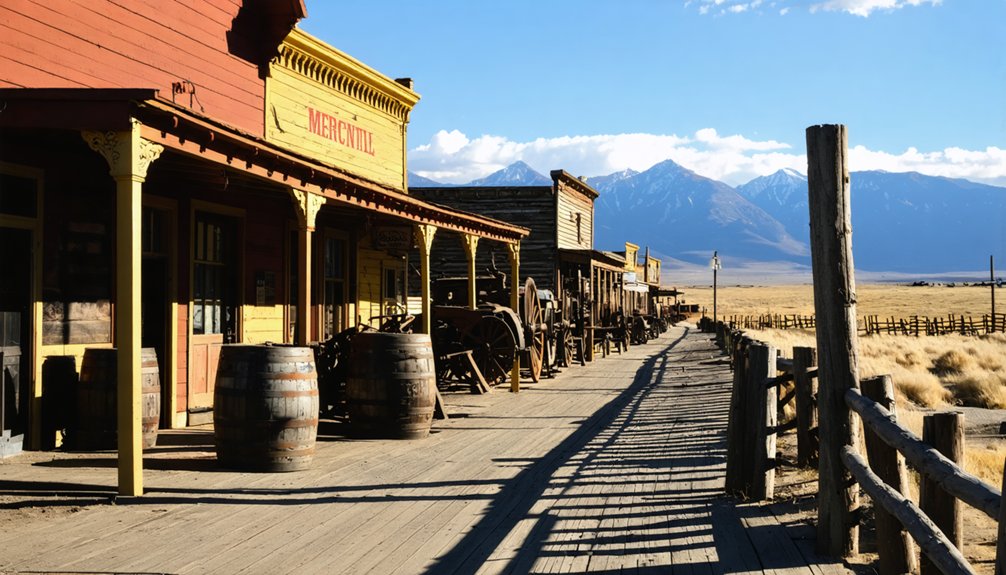
Three miles north of Interstate 15, where the Mojave Desert bakes under relentless sun, Calico Ghost Town clings to weathered hillsides at 2,283 feet—a monument to the silver fever that seized fortune-seekers on April 6, 1881.
You’ll walk streets where 3,000 souls once chased $86 million in silver through 500 mines. The assay office reveals artisanal silver smelting techniques that transformed raw ore into fortune, while Maggie’s Mine ($3.50) plunges you underground past mannequins frozen mid-shift and a glory hole displaying $65,000 worth of silver.
Daily life in a mining town wasn’t glamorous—dust choked throats, prices collapsed from $1.31 to $0.63 per ounce by the mid-1890s, and miners fled when borax deposits dried up in 1907. Walter Knott’s 1950s restoration preserved this California Historical Landmark, letting you taste authentic frontier grit.
Essential Tips for Your Southern California Ghost Town Adventure
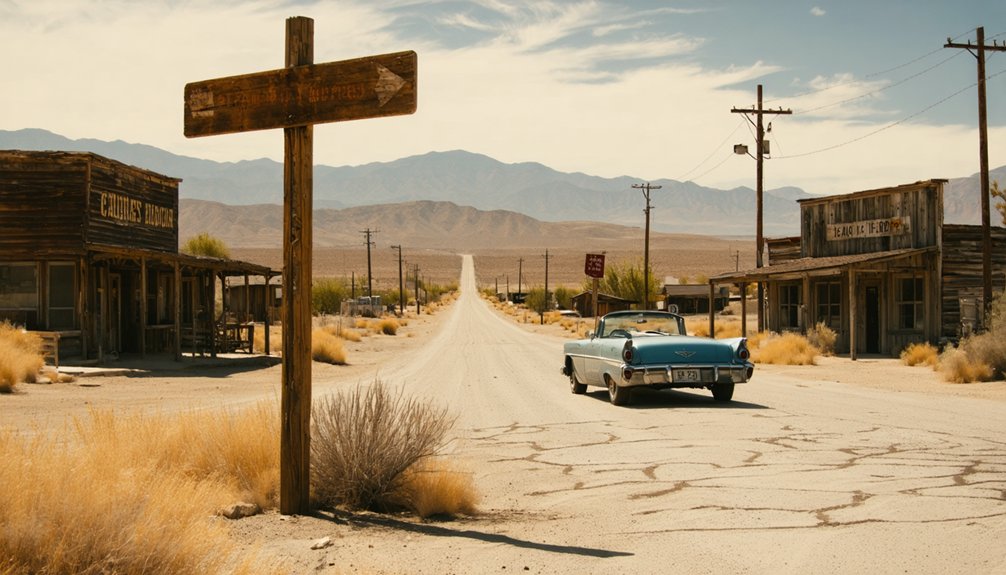
When your tires crunch onto the gravel roads leading to Riverview’s sun-bleached remains near the Salton Sea, you’ll understand why ghost town exploration demands respect for the desert’s brutal temperament.
As you plan your ghost town adventure, be prepared for the unexpected. Each turn may lead to hidden treasures of history or stark reminders of nature’s reclaiming power. Embrace the journey as much as the destination, letting the spirit of the past guide you through the desolate echoes of time.
Pack one gallon of water per person daily—desert terrain features like exposed salt flats and arroyos offer zero shade when temperatures exceed 100°F. Remote location challenges mean carrying spare tires and offline GPS apps; cell service vanishes southwest of Death Valley.
I’ve learned flashlights reveal hidden mining shafts in crumbling structures, while sturdy boots prevent twisted ankles on unstable floors. Schedule morning visits to Randsburg or Ballarat before noon’s punishing heat.
Inform someone of your route—these forgotten places reward preparedness with unfiltered freedom, where tumbleweeds roll past century-old dreams without tourist crowds diluting the experience.
Frequently Asked Questions
Are There Any Restaurants or Gas Stations Near Eagle Mountain Ghost Town?
Eagle Mountain’s abandoned landscape offers no restaurants or gas stations—you’ll find Desert Center’s lone cafe nearby for food options, but lodging accommodations are nonexistent. Fuel up beforehand; this remote desert requires self-sufficient travelers seeking authentic isolation and freedom.
Is It Legal to Enter the Abandoned Buildings at Eagle Mountain?
Don’t let curiosity kill the cat—entering Eagle Mountain’s abandoned buildings is illegal. You’d face trespassing laws and liability concerns, as security patrols the privately-owned property. Without permission from Ecology Mountain Holdings LLC, you’re risking serious legal trouble.
What Are the Best Months to Visit These Ghost Towns?
You’ll find ideal weather conditions from September through November, when fall delivers perfect exploration temperatures and stunning photography light. Seasonal visitation patterns show fewer crowds then, plus Calico’s Halloween events add authentic Wild West atmosphere to your adventure.
Do I Need a Four-Wheel Drive Vehicle to Reach Eagle Mountain?
Yes, you’ll need a high-clearance 4WD vehicle to navigate Eagle Mountain’s rugged desert terrain safely. Ideal weather conditions during spring and fall make the journey worthwhile, rewarding you with stunning scenic viewpoints across untamed wilderness.
Are Overnight Camping Options Available Near Any of These Locations?
Like desert wanderers finding oasis, you’ll discover abundant campgrounds near ghost towns. Calico offers 265 sites with full hookups at $40 nightly. Various lodging options for ghost town visitors include rustic cabins and nearby Hipcamp alternatives for your untethered adventure.