You’ll find Rocky Springs at milepost 54.8 on the Natchez Trace Parkway, about 20 miles south of Port Gibson. Park at the designated lot and cross the wooden footbridge to explore the 1837 Methodist Church where Grant positioned his field desk, wander the cemetery’s Spanish moss-draped paths dating to 1819, and discover three iron safes—the only survivors of a vanished town. Spring and fall offer perfect 70-80°F weather for exploring, though the trails and historical sites reveal their secrets year-round.
Key Takeaways
- Rocky Springs is located at milepost 54.8 on the Natchez Trace Parkway, 20 miles south of Port Gibson in Claiborne County.
- Visit the 1837 Methodist Church where Grant headquartered in 1863 and explore the historic cemetery dating back to 1819.
- The National Park Service maintains parking, a short interpretive loop trail, and a 7-mile trail to Owens Creek Waterfall.
- Spring (March-May) and fall offer ideal weather, while summer brings heat and winter provides fewer crowds and cooler temperatures.
- Nearby attractions include Emerald Mound, the second-largest ceremonial platform in North America, and Pharr Mounds at milepost 286.7.
The Rise and Fall of a Natchez Trace Settlement
In the late 18th century, a crystalline spring bubbling from Mississippi’s red clay hills became the lifeblood of what would grow into one of the region’s most prosperous settlements. You’d have found Rocky Springs thriving by 1860, with 2,616 residents and wealthy cotton plantations surpassing even Grand Gulf’s success.
But freedom comes with responsibility—something this community learned too late. When Grant’s 50,000 troops stripped the land bare during the Civil War, they triggered an irreversible decline.
Yellow fever devastated survivors in 1878. Then cotton crop failure from boll weevils and over a century of poor land management practices eroded the fertile soil into useless gullies. The 1905 boll weevil epidemic destroyed the valuable cotton crops that had once made fortunes for local planters. Today, the historic town site can be explored via self-guiding walking trails that wind through what remains of this once-bustling community. By the 1930s, even the spring itself dried up, leaving only memories and ghosts.
What Remains: Exploring the Methodist Church and Cemetery
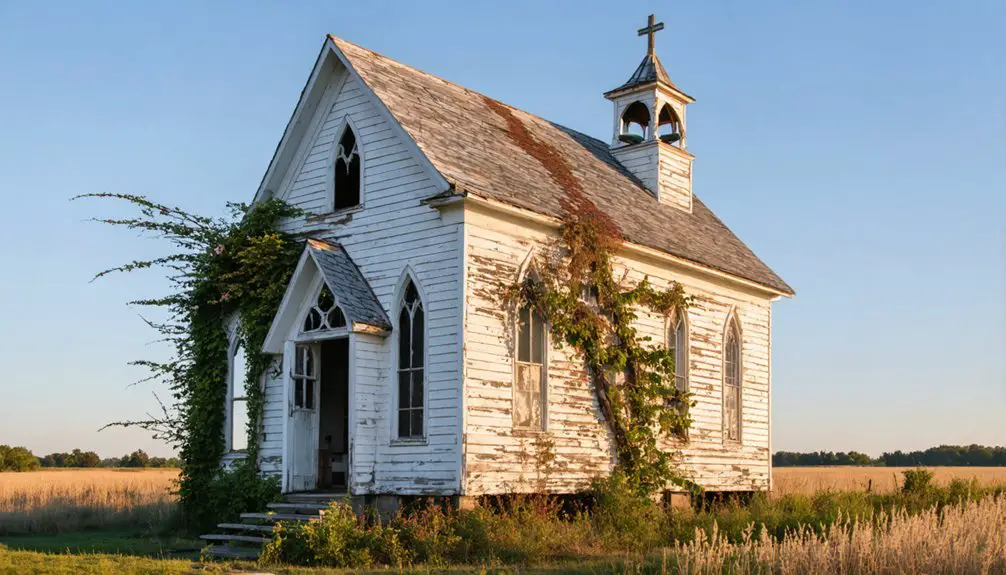
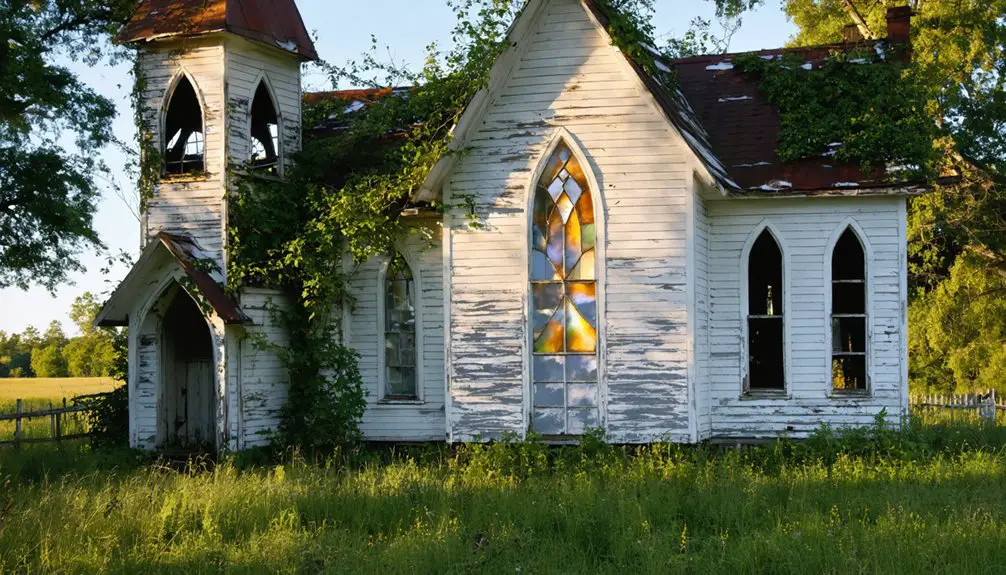
You’ll spot the white clapboard Methodist Church first—its twin entrances and Federal-style fanlight standing quiet since 1837, where Ulysses S. Grant once positioned his field desk at the pulpit during ten tense days in May 1863. The doors stay accessible if you want to step inside and run your hand along the original pews, imagining 50,000 Union soldiers sprawled across Claiborne County while their commander strategized the Vicksburg campaign from this exact spot. Rev. Thomas Owens served as the church’s first pastor when services began in those early years.
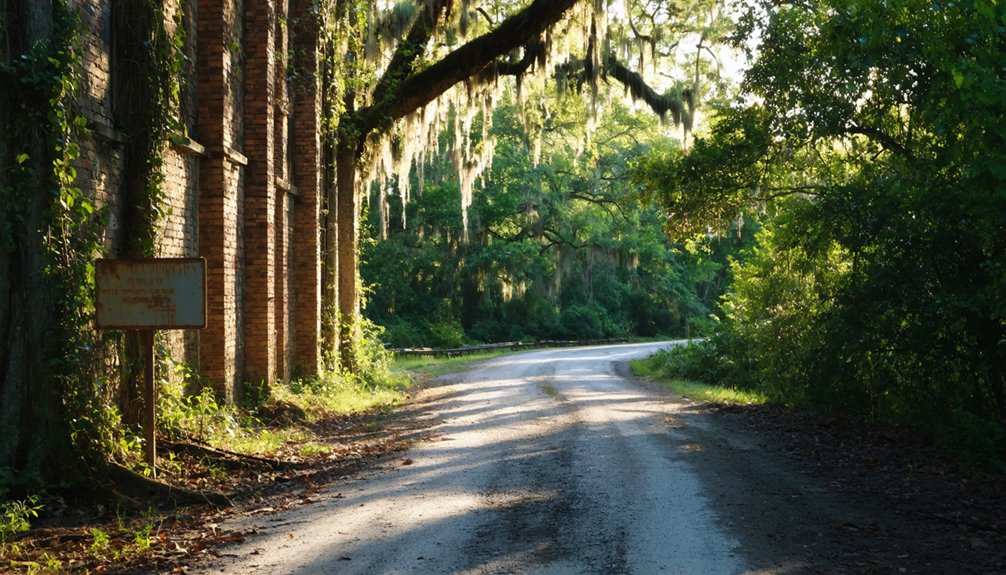
Behind the church, a shaded cemetery older than the building itself waits beneath live oaks and Spanish moss, its weathered stones marking names like Harding, Lum, and McClelland—families who watched their prosperous town dissolve into Mississippi red clay. The earliest gravestones here date back to 1819, predating the church structure by nearly two decades.
The 1837 Methodist Church
Perched on a hilltop overlooking what remains of Rocky Springs, the 1837 Methodist Church stands as the ghost town’s sole surviving structure—a simple brick monument to a community that once thrived here. The architecture and design reflects vernacular Federal style—clean lines, a round fanlight above the entrance, and distinctive thirty-six-over-thirty windows. Notice the twin doors, a fascinating detail revealing the social history of the congregation: men and women sat separately during services.
Builder George W. Reynolds constructed this front-gabled brick building under the guidance of first pastor Rev. Thomas Owens. The frame tower you’ll see today was reconstructed around 1900 after storm damage. Inside, electrification represents the only modern intrusion. You’re free to explore this remarkably intact antebellum church, where Mississippi Methodists have gathered since circuit rider Tobias Gibson established the congregation around 1800. The church remained an active congregation until its closure in April 2010.
Behind the church lies its historic cemetery, where tombstones dating from the early-to-mid 1800s to the present mark the final resting places of Rocky Springs residents.
Grant’s Civil War Headquarters
This peaceful church witnessed one of the Civil War’s most pivotal military movements when General Ulysses S. Grant commandeered it as his headquarters in May 1863. Stand where Grant stood—soldiers removed the church pews and positioned his desk at the pulpit, transforming this sanctuary into a command center for 50,000 troops. The church interior preservation remains remarkably authentic, unchanged since that consequential spring.
Grant’s forces spent ten days here, establishing supply route significance that would ultimately decide Vicksburg’s fate. They stripped Rocky Springs bare—confiscating livestock, emptying grain mills, burning what they couldn’t carry. The Union troops also took slaves with them as they moved toward Vicksburg, further devastating the community. After departing Rocky Springs, Grant’s army continued northwest through Utica and Fourteen Mile Creek before encountering Confederate forces at Raymond on May 12. You’ll find this haunting remnant at Natchez Trace Parkway milepost 54.8, maintained by the National Park Service. Visit during daylight hours to explore where military strategy reshaped America’s destiny.
Historic Cemetery Walking Tour
Beyond the church’s brick walls, the Rocky Springs Cemetery spreads beneath a canopy of Spanish moss-draped live oaks and cedars, where weathered tombstones have marked this hallowed ground since 1819—eighteen years before the church itself rose from Mississippi clay. You’ll discover notable grave markers bearing names like Harding, Lum, McClelland, and Power—the original families who carved civilization from wilderness.
Burial patterns over time tell Rocky Springs’ entire story: prosperous planters in the antebellum decades, then scattered additions as the town slowly disappeared. The National Park Service maintains a short interpretive loop trail with placards explaining what you’re seeing. Located just off the Natchez Trace, this cemetery represents the only remaining trace of what was once a thriving agricultural community.
Come during daylight hours when the church doors stand accessible. Sign the guest book, leave a donation if you’re moved, and walk quietly among these witnesses to a vanished world.
Getting to Rocky Springs: Directions and Access Points
You’ll find Rocky Springs along the Natchez Trace Parkway at milepost 54.8, roughly 20 miles south of Port Gibson in Claiborne County. The National Park Service maintains a small parking area right at the trailhead, where you can leave your car and cross a wooden footbridge that leads into the ghost town’s remains.
The history of rocky springs ghost town is rich with tales of miners and settlers who once inhabited the area. As you explore the remnants of old buildings and streets, you can almost hear the echoes of their lives. This site serves as a poignant reminder of the passage of time and the people who called this place home.
I’ve always appreciated how easy they’ve made it—no rugged off-road adventure required, just pull off the scenic parkway and step back into Mississippi’s haunted past. The trail starts from a parking lot at the end of the access road, making it convenient for visitors to begin their exploration.
Natchez Trace Parkway Milepost
Nestled at milepost 54.8 along the southern stretches of Natchez Trace Parkway, Rocky Springs sits roughly one hour’s drive south of Jackson, Mississippi. You’ll spot the turnoff easily—watch for the parkway signage and take your first right into the campground area. The coordinates (32.08645 N, -90.79871 W) place you at 312 feet elevation near Hermanville, Mississippi.
For parking options, the Highway 27 trailhead at milepost 59 offers ample space for trailers and RVs. It’s a scenic 4.5-mile ride to Rocky Springs from there. However, nearby services are sparse—bring everything you need. Potable water flows intermittently, so pack your own. Contact the parkway at (662) 680-4027 before visiting. This ghost town rewards self-sufficient travelers who embrace the road less traveled.
Parking and Trail Access
When you arrive at Rocky Springs, you’ll find designated auto parking at the historic town site itself—a convenient basecamp for exploring this atmospheric ghost town. The National Park Service maintains these parking amenities right off the Natchez Trace Parkway, letting you immediately access self-guided trails through remnants of civilization.
Your exploration options include:
- Short loop trail winding past the 1837 Methodist church, cemetery, and empty cisterns
- 7-mile Rocky Springs Trail segment heading south toward Owens Creek Waterfall (3 miles)
- Campground access providing parking for 22 primitive sites and additional trailheads
Note that the northern 4-mile section to Fisher Ferry Road remains closed. The spring itself has stopped flowing, but you’ll discover rusted safes and stone foundations—haunting testimonials to dreams abandoned.
Walking the Interpretive Trail: Key Sites and Landmarks
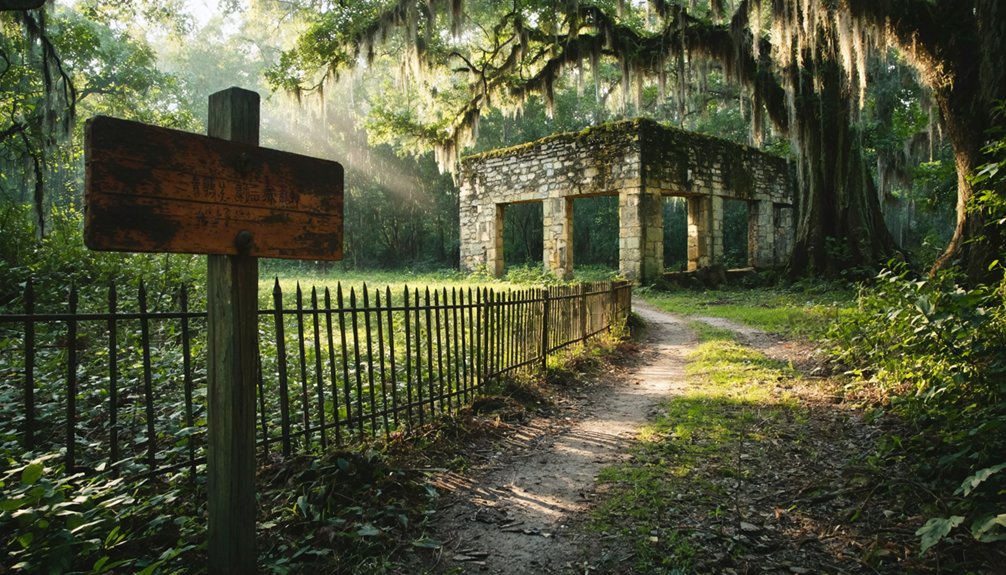
The interpretive trail at Rocky Springs unfolds across just over 6 miles of gently rolling terrain, beginning at milepost 54.8 on the Natchez Trace Parkway. You’ll navigate composite surfaces—grass, gravel, and wooden boardwalks—averaging 3 feet wide through dense forest. Despite trail maintenance challenges from Mississippi’s humid climate, the path remains accessible year-round during daylight hours.
Your first landmark appears quickly: three iron bank safes, sole survivors of a town that vanished. One sits at the visitor center; two others rest at the original townsite, reached via a short loop trail with a footbridge spanning a weathered gully. Onsite interpretive signage reveals how 2,616 residents once thrived here before yellow fever and agricultural collapse erased their community.
The southern section intensifies—steep ridges and rocky outcroppings test your endurance before reaching Owens Creek’s waterfall three miles south.
Best Times to Visit and Weather Considerations
Timing your visit to Rocky Springs means choosing between solitude and ideal weather. Peak visitation patterns show spring and fall bring the biggest crowds—especially holiday weekends—when campground reservations become essential. You’ll share those blooming trails and colorful foliage with fellow adventurers seeking mild temperatures.
Consider these strategic options:
- Spring (March-May): Expect 70-80°F days perfect for hiking, but pack insect repellent for humid mornings around the creek
- Summer (June-August): Brave 85-95°F heat and afternoon thunderstorms for ghost town exploration without crowds
- Winter (December-February): Claim first-come-first-served sites easily in crisp 35-50°F weather, though shorter daylight limits waterfall hikes
Summer’s sweltering solitude or fall’s pleasant popularity—your freedom depends on what you’re willing to trade.
Nearby Attractions Along the Natchez Trace Parkway
Rocky Springs serves as your gateway to centuries-spanning mysteries that dot the Natchez Trace like archaeological breadcrumbs. Head north to Pharr Mounds at milepost 286.7, where eight burial mounds reveal Native American rituals—crematoriums and copper treasures waiting beneath grass-covered earthworks. You’ll need just twenty minutes to walk among these ancient resting places.
South at Emerald Mound, North America’s second-largest ceremonial platform rises like a green fortress from the forest floor. The scale humbles you instantly.
For adventure mixed with history, detour to Tishomingo’s swinging bridge—it sways over rushing water, perfect for those who crave movement with their monuments. Further along, Meriwether Lewis‘s mysterious death site at milepost 385.9 offers camping and hiking trails through Tennessee wilderness where questions still outnumber answers.
Photography Tips and Historical Preservation Guidelines
When dawn’s amber light breaks through the pines at Rocky Springs, you’ll find your most powerful compositions—the 1837 Methodist Church transforms into a study of contrasts, its weathered stone glowing against deep shadows that carve definition into every crack and crevice.
To capture scenic compositions while minimizing local environment impact:
- Stick to the loop trail marked by National Park Service interpretive signs—trampling archaeological sites destroys what you came to photograph
- Use tripods only on established paths to prevent soil erosion around cisterns and cemetery headstones
- Never touch or remove artifacts from safes, structures, or burial grounds
Your wide-angle lens will tell Rocky Springs’ story best during golden hour, when natural light reveals texture without flash. Respect daylight-only access, carry out everything you bring, and you’ll preserve this freedom for future explorers.
Frequently Asked Questions
Are There Restroom Facilities Available at the Rocky Springs Site?
Yes, you’ll find restroom facilities at Rocky Springs’ campground and picnic areas, though public facilities are limited due to preserve conservation efforts. The contact station’s currently closed, but campground bathrooms offer flush toilets and running water for your visit.
Is the Ghost Town Accessible for Visitors With Mobility Limitations?
Accessibility information is limited, though parking availability exists near trailheads. The primitive trails feature rocky, steep terrain unsuitable for wheelchairs. Unfortunately, accessibility of historic structures like the church isn’t documented, making mobility-challenged visits difficult without assistance.
Can Visitors Enter the Methodist Church or Is It Locked?
You’ll find the church doors open and inviting—no guided tours available, but you’re free to explore independently. Sign the register, admire historical artifacts on display, and leave a donation for this beautifully preserved 1837 sanctuary.
Are Camping or Overnight Stays Permitted at Rocky Springs?
Yes, you’ll find surprisingly primitive accommodation options at Rocky Springs Campground—no hookups, no camping rates, completely free. This ghost town offers 22 first-come sites where you can pitch your tent under ancient oaks, fully off-grid and liberated.
Is Cell Phone Reception Available at the Ghost Town Location?
Cell phone reception exists at Rocky Springs, though you’ll find tower coverage inconsistent. Official sources confirm cellular connectivity, but campers report spotty service. Your carrier matters here—check your specific provider’s coverage before venturing into this wilderness escape.
References
- https://jamesjohnston.info/ghost-town-rocky-springs-mississippi/
- https://www.legendsofamerica.com/ms-rockysprings/
- https://www.youtube.com/watch?v=tAAp1JB7kd8
- https://civilwartalk.com/threads/rocky-springs-ms-ghost-town.209562/
- https://www.nps.gov/places/rocky-springs-town-site.htm
- https://npplan.com/parks-by-state/mississippi-national-parks/natchez-trace-parkway-park-at-a-glance/natchez-trace-parkway-historic-sites/natchez-trace-parkway-rocky-springs-mp-54-8/natchez-trace-parkway-rocky-springs-town-site-mp-54-8/
- http://www.old-new-orleans.com/Rocky_Springs.html
- http://sites.rootsweb.com/~msclaib3/rocky-springs.htm
- https://www.natcheztracetravel.com/natchez-trace-mississippi/vicksburg-port-gibson-ms/184-rocky-springs.html
- https://en.wikipedia.org/wiki/Rocky_Springs