Planning a ghost town road trip to Rollestown, Florida means heading to Putnam County’s coordinates 29.63°N, 81.59°W, where one of the South’s oldest colonial settlements quietly disappeared into history. Founded in 1765 and abandoned by 1783, it’s raw, overgrown land with no tourist infrastructure — just a 1961 historical marker and haunting silence. Visit between November and March, bring a reliable vehicle, and download offline maps. There’s far more to this forgotten colony’s story than most travelers expect.
Key Takeaways
- Rollestown sits at coordinates 29.63°N, 81.59°W in Putnam County, with no tourist infrastructure, only open land and a 1961 historical marker.
- Visit between November and March during early morning hours for cooler temperatures and a more immersive ghost town experience.
- Drive a reliable vehicle and download offline maps, as access roads are rough and cell service is unreliable in this remote area.
- Extend your road trip by exploring nearby Bartram-linked Putnam County sites and neighboring Florida ghost towns for additional historical context.
- Founded in 1765 and abandoned by 1783, Rollestown left no standing structures, only overgrown Florida vegetation and a complicated colonial legacy.
What Was Rollestown, Florida?
When you picture a ghost town, you might imagine the dusty remnants of a Wild West settlement, but Rollestown, Florida tells a far older and more complicated story.
English colonizer Denys Rolle founded this settlement in 1765, envisioning it as a utopian pioneer community along the St. Johns River in Putnam County. Instead, it became a product of plantation culture, built on the backs of enslaved people who never shared in its promised ideals.
Rolle’s utopian dream was built on broken lives — a paradise promised to some, stolen from others.
Its historical significance lies in what it reveals about colonial ambition and exploitation. Britain ceded Florida to Spain in 1783, triggering Rollestown’s rapid collapse.
Rolle returned to England, enslaved survivors were resettled in the Bahamas, and the town disappeared — leaving behind only coordinates, a historical marker, and a haunting legacy.
The Rise and Fall of Denys Rolle’s Colony
When you explore Rollestown’s history, you’ll discover that Denys Rolle arrived in 1765 with an ambitious dream — transforming Florida’s wilderness into a utopian agricultural community built on broad, productive plantations.
That dream, however, depended entirely on the brutal exploitation of enslaved labor, whose forced toil sustained every acre of Rolle’s grand vision.
The colony collapsed almost as quickly as it rose, ending in 1783 when Britain ceded Florida to Spain, scattering survivors and sending Rolle back to England with little to show for his experiment.
Rolle’s Utopian Vision
Denys Rolle arrived in Florida in 1765 with an ambitious dream: carve a utopian plantation community out of the wilderness along the St. Johns River. His aspirations reached beyond simple profit — he envisioned Rollestown as a model settlement where broad plantations and organized homes would create something genuinely new in the colonial world.
Rolle’s aspirations reflected utopian ideals common among English reformers of his era, imagining a structured yet pioneering society built from raw Florida landscape. You can almost picture his blueprint: sweeping agricultural land, purposeful architecture, and a self-sustaining community thriving at the edge of the known world.
It was bold thinking for 1765. Unfortunately, the gap between Rolle’s vision and brutal colonial reality would prove impossible to bridge.
Enslaved Labor’s Role
Behind Rolle’s sweeping utopian blueprint was a brutal engine: enslaved labor. While Rolle envisioned a pioneering agricultural paradise, enslaved communities bore the crushing weight of building it.
You’re walking ground where labor dynamics weren’t philosophical ideals — they were chains, forced cultivation, and survival under violent coercion.
Rolle’s plantation model depended entirely on enslaved workers clearing land, planting crops, and sustaining an economy that benefited only him. These weren’t nameless footnotes — they were people whose resilience kept the colony breathing.
When Britain ceded Florida to Spain in 1783, their fate shifted dramatically. Many were resettled in the Bahamas, while others scattered toward Georgia and the Carolinas.
As you explore Rollestown today, remember you’re treading soil soaked in their stolen freedom and unacknowledged sacrifice.
Colony’s Swift Collapse
From its founding in 1765, Rollestown carried the seeds of its own destruction. The colony decline accelerated rapidly once Britain ceded Florida back to Spain in 1783. That political handover sealed Rollestown’s fate almost overnight.
Denys Rolle abandoned his grand experiment and sailed back to England, leaving everything behind. The enslaved population was resettled in the Bahamas, while survivors scattered northward into Georgia and the Carolinas.
Contemporary accounts paint a grim picture — over 400 deaths earned Rollestown the haunting label “sepulchre of victims.” What Rolle envisioned as a thriving utopian settlement became a cautionary tale etched into Florida’s colonial record.
That historical significance is precisely why visiting this forgotten site matters. You’re not just exploring ruins — you’re witnessing the physical evidence of unchecked ambition and broken promises.
Where Exactly Is Rollestown Located?
Tucked away in Putnam County, Florida, Rollestown sits near coordinates 29.63°N, 81.59°W, making it a relatively remote destination that’ll require some maneuvering along rural county roads to reach.
You won’t find bustling tourist infrastructure here — just quiet, open land where a colonial experiment once stood. Despite its remoteness, the site carries tremendous historical significance as one of Florida’s most fascinating English colonial settlements.
A historical marker erected in 1961 helps you pinpoint the location and absorb the story of what once stood there. The area also connects to Bartram-related sites throughout Putnam County, giving you additional stops worth exploring.
Though no colonial architecture survives today, the landscape itself tells a compelling story of ambition, struggle, and ultimately, abandonment.
Best Time of Year to Visit Rollestown
You’ll find Rollestown most enjoyable during Florida’s cooler, drier months from November through March, when temperatures hover in the 60s and 70s rather than the brutal summer heat and humidity.
Spring and fall offer a solid middle ground, though afternoon thunderstorms can roll in fast during September and October.
Since Rollestown draws history enthusiasts rather than massive tourist crowds, you won’t battle packed parking lots, but weekday visits still give you the quietest, most immersive ghost town experience.
Ideal Visiting Seasons
Although Rollestown sits in Florida’s Putnam County year-round, when you visit makes a significant difference in your experience. Florida’s brutal summer heat and humidity can drain your energy quickly, making exploration uncomfortable and potentially dangerous.
Your best window runs from November through March, when cooler temperatures let you freely explore ghost town legends tied to Denys Rolle’s failed utopian experiment. You’ll walk the grounds with clarity rather than exhaustion, absorbing the weight of history surrounding this 1765 colonial settlement.
Spring shoulder months, particularly March and April, offer wildflower blooms that frame the landscape beautifully while remaining manageable temperature-wise.
Historical preservation efforts, including the 1961 marker, are best appreciated when you’re not racing against oppressive heat. Plan early morning arrivals regardless of season for the most rewarding experience.
Weather Considerations By Month
Florida’s climate shapes your Rollestown experience more than any other factor, so breaking the year down month by month helps you plan smarter.
Weather patterns shift dramatically across seasons, making timing everything for a comfortable exploration.
- January–March: Cool, dry, and ideal — temperatures hover around 60–70°F with minimal humidity.
- April–May: Warming quickly, with occasional showers beginning; still manageable before summer humidity peaks.
- June–August: Brutal heat, intense humidity, and afternoon thunderstorms define these months — avoid if possible.
- September–November: Seasonal changes bring cooling relief; October and November offer near-perfect outdoor conditions.
Hurricane season runs June through November, so monitor forecasts carefully during fall visits.
December remains pleasantly mild, giving you another solid window to roam this remote Putnam County site freely.
Avoiding Peak Crowds
Beyond choosing the right month for weather, knowing when the crowds thin out adds another layer to planning your Rollestown visit.
Spring break and holiday weekends draw more visitors to Florida’s historical sites, so you’ll want to sidestep those windows if solitude matters to you.
Weekdays in late January, February, or early November give you the freedom to absorb Rollestown’s colonial legacy without distraction.
You’ll stand at that 1961 historical marker and genuinely feel the weight of the site’s historical significance rather than maneuvering around other visitors.
Avoid the week between Christmas and New Year’s, when road traffic peaks statewide.
Early morning arrivals also work in your favor, giving you quiet hours to explore before any casual day-trippers roll through.
How to Get to the Rollestown Historical Marker
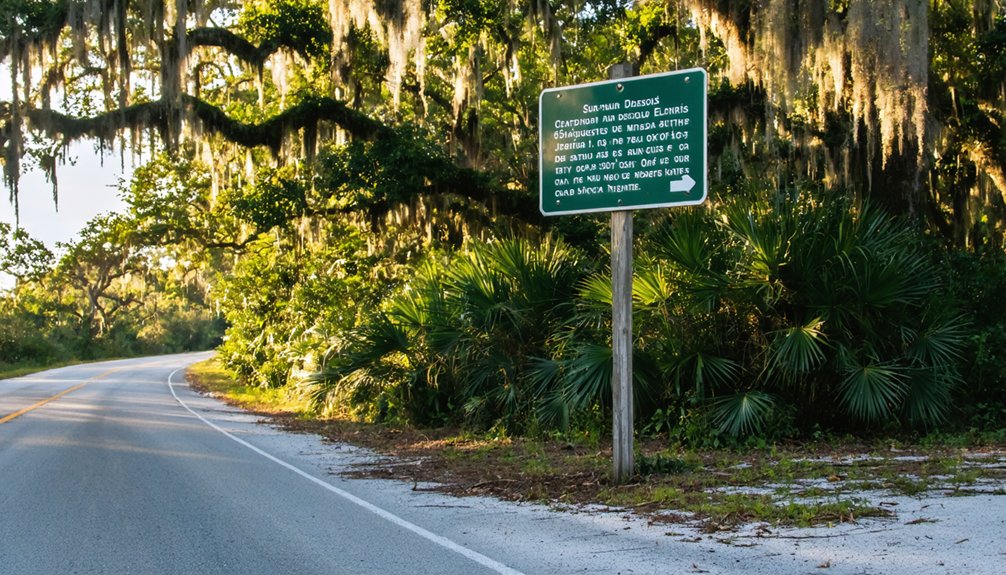
Tucked away in Putnam County, the Rollestown Historical Marker sits near coordinates 29.63°N, 81.59°W, making a GPS device your best friend for traversing the remote back roads leading to this forgotten colonial site.
Plan your route carefully before heading out:
Plan your route carefully before heading out — offline maps and a reliable vehicle are essential for navigating Putnam County’s remote back roads.
- Download offline maps since cell service along Putnam County’s rural roads can be unreliable.
- Look for the 1961 historical marker, which details the site’s colonial experiments and historical significance.
- Combine your visit with nearby Bartram-related sites in Putnam County for a fuller experience.
- Travel in a reliable vehicle since access roads near ghost town remnants can be rough.
You’re fundamentally retracing paths through English colonial Florida, discovering where Denys Rolle’s ambitious utopian vision ultimately crumbled after Britain ceded Florida to Spain in 1783.
What You’ll Actually See at the Rollestown Site
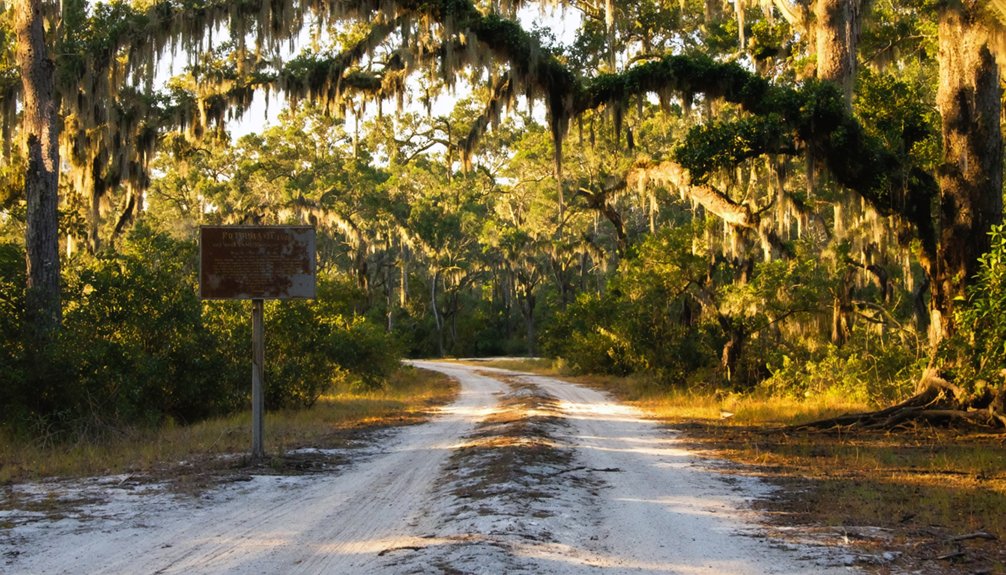
Once you’ve navigated those back roads and spotted the 1961 historical marker, don’t expect grand ruins or dramatic remnants—Rollestown offers something far more subtle. The landscape is quiet, overtaken by Florida’s relentless vegetation, with little visible evidence of the colony that once operated here.
What you’ll find is the marker itself, standing as the primary acknowledgment of this site’s historical significance. It briefly outlines Rollestown’s colonial legacy—the English experiment, the enslaved labor that sustained it, and the abrupt abandonment in 1783.
The real experience happens in your imagination. You’re standing where over 400 people died, where a utopian dream collapsed, and where history quietly erased itself beneath palmetto scrub.
That invisible weight makes Rollestown genuinely compelling for anyone who values understanding freedom’s complicated, often painful past.
What Makes Rollestown an Actual Ghost Town?
Rollestown earns its ghost town designation not through dramatic ruins or crumbling walls, but through something more complete—total erasure.
Its ghost town characteristics go beyond silence; they reflect a community that simply ceased to exist after 1783. That historical significance hits differently when you realize an entire colonial experiment vanished without leaving visible traces.
What qualifies Rollestown as a true ghost town:
- Founded 1765, abandoned 1783—only 18 years of existence
- Over 400 deaths recorded during its operation
- No standing structures remain at the site today
- Enslaved residents were forcibly relocated to the Bahamas after abandonment
You’re visiting a place where history didn’t fade—it was cut off completely.
That distinction makes Rollestown one of Florida’s most compelling and sobering ghost town destinations.
Which Florida Ghost Towns Pair Well With a Rollestown Visit?
After exploring the haunting emptiness of Rollestown, you’ll find that Florida’s ghost town trail doesn’t have to end there.
Putnam County alone connects you to Bartram-related sites that echo similar colonial settlements and ghost town history. From there, push deeper into Florida’s forgotten corners, where other abandoned communities reveal the same cycle of ambition and collapse that defined Rollestown.
Florida’s ghost town list stretches across the state, giving you genuine freedom to chart your own route.
Pair Rollestown with nearby entries that share its colonial-era roots, and you’ll build a road trip that tells a cohesive story of settlement, struggle, and desertion.
Each stop adds another layer to understanding how European ambitions repeatedly rose and fell across Florida’s landscape.
How to Plan a Florida Ghost Town Road Trip Around Rollestown
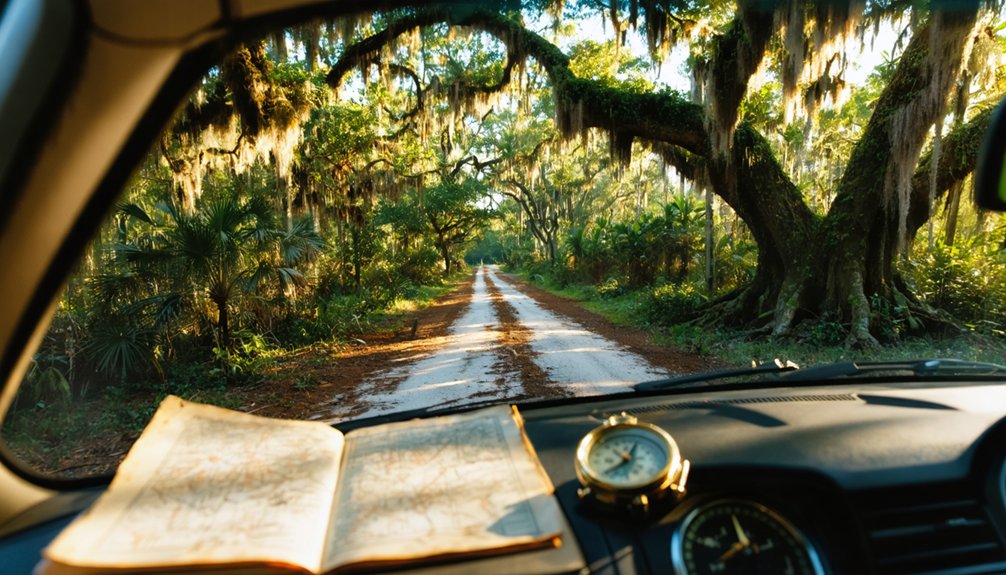
Planning your Rollestown road trip starts with pinning those coordinates—29.63 N, 81.59 W in Putnam County—as your anchor point, then building outward from there.
You’re tracing real historical significance through Florida’s forgotten colonial past, so structure your route intentionally.
Pack your trip with purpose by including:
- The 1961 historical marker — your first stop for grounding the site’s cultural heritage
- Bartram-linked Putnam County sites — natural and historical layers worth exploring nearby
- Neighboring Florida ghost towns — extend your route using ghost town lists for regional context
- Remote access roads — prepare your vehicle for rural Putnam County terrain
Travel light, move freely, and let each stop deepen your understanding of what Florida looked like before the modern world erased it.
Frequently Asked Questions
Is There an Admission Fee to Visit the Rollestown Historical Marker?
You won’t pay any admission fee to visit the Rollestown historical marker! You’ll freely explore this ghost town history, uncover local legends, and connect with Florida’s fascinating colonial past at no cost whatsoever.
Are Pets Allowed at the Rollestown Ghost Town Site?
The knowledge doesn’t confirm pet friendly policies for Rollestown’s ghost town attractions, but since you’re exploring open, remote historical land, you’ll likely enjoy bringing your furry companion along on this free-spirited adventure!
Can You Camp Overnight Near the Rollestown Historical Site?
Like a wild frontier beckoning, you’ll find camping amenities aren’t confirmed at Rollestown itself, but nearby attractions and campgrounds in Putnam County let you plant your tent and embrace true freedom overnight.
Is the Rollestown Site Accessible for Visitors With Mobility Limitations?
The site’s accessibility features aren’t well-documented, so you’ll want to call ahead before using mobility aids. You’re exploring remote Putnam County terrain, which may challenge visitors, but the 1961 historical marker area offers relatively flat ground.
Are Guided Tours Available at the Rollestown Historical Marker Location?
Like ancient scrolls unread, no formal guided tours exist at Rollestown’s marker. You’ll forge your own guided exploration, uncovering local legends independently — freedom’s truest form awaits you at Florida’s hauntingly remote colonial ghost town.
References
- https://stars.library.ucf.edu/cgi/viewcontent.cgi?article=1480&context=fhq
- https://en.wikipedia.org/wiki/List_of_ghost_towns_in_Florida
- https://www.ghosttowns.com/states/fl/rollestown.html
- https://www.hmdb.org/m.asp?m=56656
- https://www.jstor.org/stable/30149681
- https://www.youtube.com/watch?v=IGAsE7jdN_0