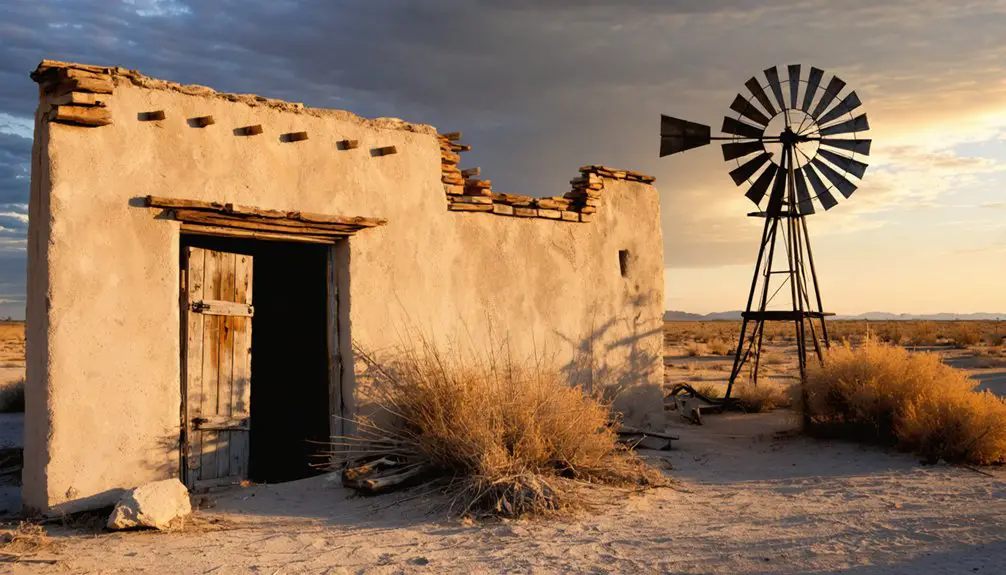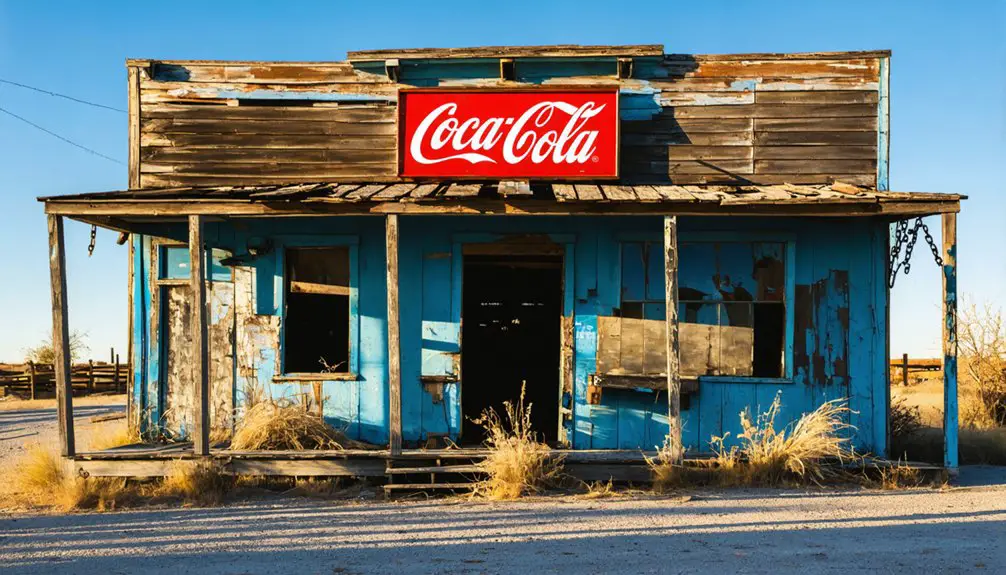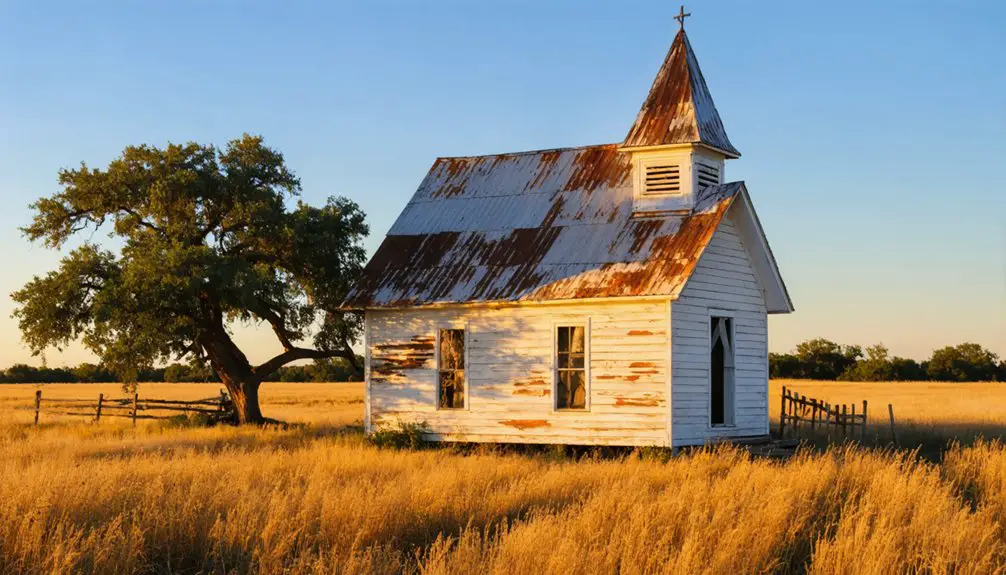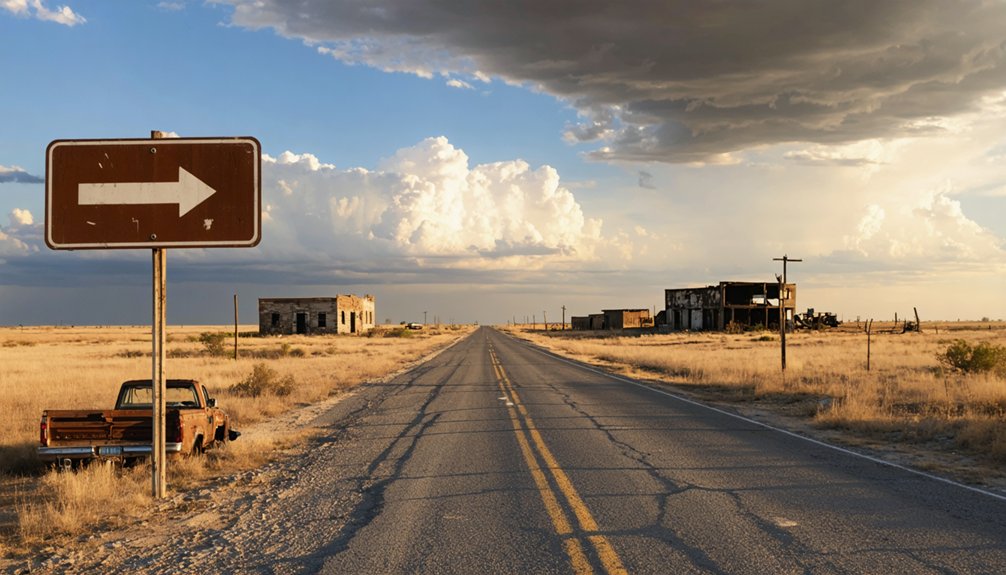
You’ll find Roosevelt 16 miles west of Junction along FM 1172—just nine residents remain in this authentic Texas ghost town where weathered structures line dusty crossroads. Exit Interstate 10 at Junction, fuel up, and pack supplies before heading into Kimble County’s raw countryside. What awaits you isn’t polished tourism but genuine solitude: a historical marker chronicling boom and bust, pioneer cemetery stones, and the skeletal remains of Simon Brothers Mercantile. The full story of Roosevelt’s century-long journey from Teddy Roosevelt’s namesake to near-abandonment reveals fascinating tales of mohair fortunes and polo matches.
Key Takeaways
- Exit Interstate 10 at Exit 456 onto Texas Loop 291, located 16 miles west of Junction in Kimble County.
- Fuel up and pack supplies in Junction before departing; bring a USGS topographic map for navigation.
- Visit the Texas Historical Commission marker and historical cemetery along FM 1172 to explore pioneer heritage.
- Expect minimal infrastructure with only nine residents, no commercial enterprises, and weathered structures at this authentic ghost town.
- Roosevelt once thrived as a mohair shipping hub with polo matches; today it offers raw Texas solitude.
Getting to Roosevelt: Routes and Coordinates
Nestled in the rugged terrain of Kimble County, Roosevelt sits at a precise crossroads of Texas geography—latitude 30.4880°N, longitude -100.0530°W—where the wind whispers through abandoned structures and the elevation reaches 1,909 feet above sea level.
You’ll find this ghost town’s centralized location along Interstate 10, positioned exactly 438 miles from both New Mexico and Louisiana borders—Texas’s true midpoint. Take Exit 456 onto Texas Loop 291, then head west sixteen miles from Junction. The access roads are straightforward: I-10 serves as your main artery, while Loop 291 cuts through ranch country directly to Roosevelt’s weathered remains.
Pack water, fuel up in Junction, and bring your USGS Roosevelt topographic map—cell service fades quickly out here in freedom’s territory.
The Historic Legacy of a Town Named for Teddy Roosevelt
When W.B. Wagner founded this Hill Country settlement in 1898, he chose a name that captured Roosevelt’s marketing influence across Texas. The future president’s hunting expeditions here in 1892 had already cemented his frontier legend, making the town’s namesake both tribute and aspiration.
A frontier president’s hunting legacy transformed into a town’s identity—where Roosevelt’s 1892 expeditions inspired Wagner’s 1898 vision.
You’ll find Roosevelt’s legacy woven through three defining achievements:
- Strategic commerce hub – Military roads converged here, positioning the town as a crucial shipping point for ranchers
- Economic diversification of agriculture – From Angora goats imported from South Africa to championship polo ponies bred for national markets
- Cultural epicenter – Masonic lodges, churches, and 1920s polo matches drew scattered ranch families together
Simon Brothers Mercantile, operating since the early 1900s, still stands as a symbol to that independent spirit you’re seeking.
What Remains: Current Businesses and Landmarks
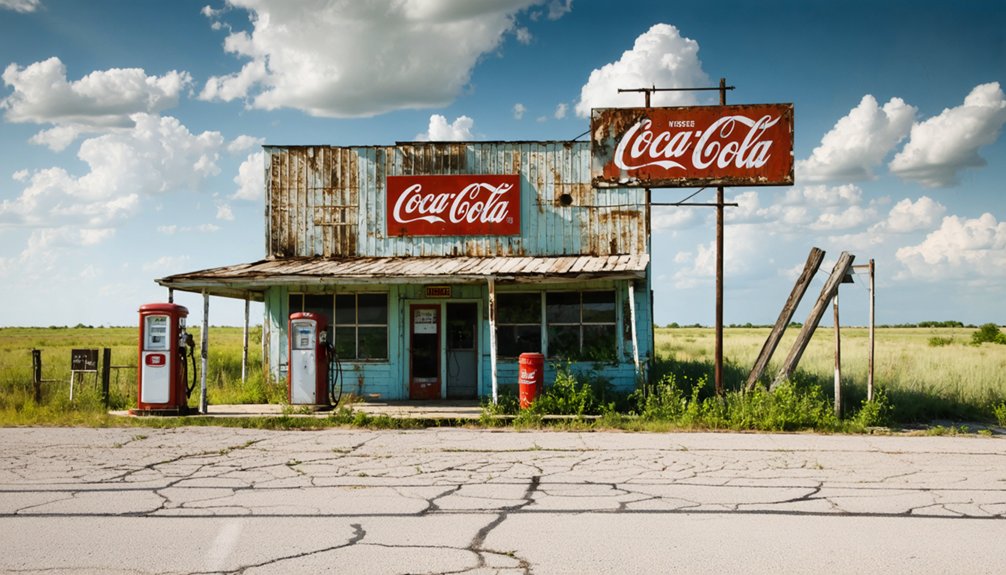
You’ll find Roosevelt today as little more than a dusty crossroads where a handful of weathered structures stand sentinel along Farm Road 1172. The Texas Historical Commission marker anchors the town’s presence, its bronze text chronicling the community’s rise and decline while cattle graze in fields that once bustled with cotton gins and general stores.
If you’re searching for active businesses, bring your own supplies—this ghost town offers only the quiet company of abandoned buildings and the occasional rancher passing through on their way to somewhere that still appears on most maps.
Active Businesses Today
Roosevelt, Texas exists today as little more than a wide spot along FM 2494 in Kimble County, where the remnants of its ranching past blend into the rugged Hill Country landscape. You won’t find bustling storefronts or tourist centers here—just authentic Texas solitude.
What persists reflects the area’s agricultural development roots:
- Working cattle ranches operate across the surrounding terrain, maintaining century-old traditions
- Private residences dot the landscape, home to families who’ve chosen this unincorporated freedom
- Historical cemetery markers stand as silent memorials to Roosevelt’s pioneer settlers
This ghost town offers no commercial enterprises courting local heritage tourism. Instead, you’ll experience raw, unpolished countryside where independence-minded ranchers live beyond municipal constraints. Bring supplies from Junction—Roosevelt’s appeal lies in what it lacks, not what it offers.
Historic Marker and Structures
Standing at coordinates 30°29′28″N 100°03′18″W along Texas Loop 291, sixteen miles west of Junction, you’ll find Texas Historic Landmark #4343—a weathered marker that tells Roosevelt’s story better than any surviving structure could. Designated in 1997, this bronze plaque stands as memorial to preservation efforts honoring a community that once shipped feed to sheep ranchers and bred horses for the U.S. Cavalry.
The Luthringer Hotel‘s foundation stones still dot the landscape where tourists once gathered for polo matches in the 1920s. What makes this place special isn’t grand architecture—it’s the historical significance of a frontier post office that dared name itself after Teddy Roosevelt in 1898. You’re witnessing Texas independence personified: stubborn, authentic, and refusing to disappear completely.
The Rise and Fall of Roosevelt’s Population
When Alice C.E. Wagoner opened that post office in 1898, she couldn’t have imagined Roosevelt’s dramatic arc. You’ll find this freedom-seeking outpost grew modestly:
- 1925: Just 25 hardy souls called it home
- 1941-1980s: Peak years averaged 100 residents, never surpassing 150
- 2000-Present: Collapsed from 98 (1990) to 14, now merely 9 people
Changing economic trends devastated this once-thriving hub. The cavalry horse market vanished, polo matches ended, and Hill Country tourism shifted elsewhere. Dwindling population figures tell Roosevelt’s stark truth—Marc-Key Company’s 35,000 poinsettias shipped in 1990 represented the last gasp of commercial essentiality.
Today, you’re exploring what ranching families abandoned, where Interstate 10’s midpoint position couldn’t sustain community life against economic realities.
Ranching Heritage: From Angora Goats to Polo Ponies
The scent of mohair and dust still seems to linger where Patterson and Riek Ranch sprawled across this rugged terrain in 1897. You’ll discover that angora goat breeding transformed Kimble County after 1925, when South African imports arrived to launch mohair production that defined the region’s economy. Roosevelt became your shipping hub for ranchers’ supplies, connecting isolated spreads to distant markets.
But the 1920s brought unexpected diversity—polo matches thundered across these hillsides as ranchers bred swift ponies for national buyers and U.S. Cavalry units. You can imagine hoofbeats echoing along what’s now Ranch Road 291, where speed and agility mattered as much as wool quality. This dual legacy of angora goat breeding and equestrian excellence reveals Roosevelt’s independent spirit—ranchers who refused single-purpose operations.
Best Time to Visit and What to Expect
Your journey to Roosevelt’s forgotten streets requires more than just curiosity—timing shapes everything you’ll experience among these limestone ruins. Spring delivers wildflower frames around crumbling walls, though you’ll share the road with peak-season travelers.
Fall’s golden light transforms ordinary stone into seasonal photography opportunities, while October’s cooler temperatures make exploration comfortable. Winter offers the rawest experience—you’ll have the ghost town practically to yourself.
Maximize your Roosevelt adventure:
- Visit weekdays October through early November for fewer crowds on weekdays and perfect hiking weather
- Arrive early morning or late afternoon to capture dramatic shadows across abandoned structures
- Pack layers year-round—Hill Country weather shifts without warning
Mid-week escapes during shoulder seasons give you the freedom to wander undisturbed, photographing history at your own pace without battling summer heat or spring tour groups.
Nearby Attractions and Junction Area Highlights
After exploring Roosevelt’s weathered remnants, you’ll find Junction just eight miles south offers a welcome contrast with its vibrant downtown square lined with limestone buildings and local cafes.
The South Llano River becomes your playground here—I’ve spent countless afternoons wading its spring-fed waters where the current runs cool even in August heat.
Take the scenic drives through Kimble County’s hill country, where each winding FM road reveals sweeping vistas of cedar-covered ridges and hidden valleys that make the detour worthwhile.
Junction’s Historic Downtown District
While Roosevelt itself slumbers in dusty abandonment a few miles south, Junction’s downtown district pulses with the kind of authentic Texas character that ghost town hunters often overlook. You’ll find preserved landmarks anchoring nearly every block, from the striking 1929 Art Moderne courthouse designed by Henry T. Phelps to the weathered 1892 county jail that once held Hill Country outlaws.
Before heading out to Roosevelt’s ruins, explore Junction’s historic architecture:
- Kimble County Courthouse – Study the geometric details of this Depression-era masterpiece
- Historic 1892 Jail – Photograph the limestone cellblock where frontier justice prevailed
- Kimble County Historical Museum – Gather context about the region’s vanished settlements
These stops transform your ghost town expedition from simple exploration into genuine historical investigation.
South Llano River Activities
The spring-fed South Llano River cuts through Junction like a liquid lifeline, offering ghost town hunters a perfect counterpoint to dusty ruins and crumbling limestone foundations. You’ll find tubing opportunities along two miles of state park frontage—float the popular 45-minute stretch between crossings, then repeat as many times as your sun-kissed skin can handle.
For longer adventures, kayaking and canoeing options stretch from two-hour paddles to epic eight-hour journeys. Launch at County Road 150 or the state park’s designated put-in, where local outfitters provide shuttles and rentals. Cast for Guadalupe bass during your float, or simply drift through turquoise pools where painted buntings flash overhead. Those cool, spring-fed waters wash away road dust better than any motel shower ever could.
Kimble County Scenic Drives
Beyond Junction’s riverbanks, Kimble County unfolds across the Edwards Plateau like a geologist’s dream—all rocky limestone outcrops, cattle-dotted pastures, and Hill Country vistas that’ll make you forget you’re chasing ghost towns.
The smallest paved driving loops start at 70-80 miles, winding through wildflower-studded terrain where oak and pecan trees frame every bend.
Three must-ride routes from Junction:
- Wine Indian Road crosses the Frio River toward Camp Wood, hugging the Nueces River through genuine cowboy country
- Four out-and-back bicycle routes let you tackle sections without committing to full loops
- Riverside paths trace limestone bluffs where 150+ bird species congregate year-round
Pack water, download offline maps, and leave early—these roads reward the prepared adventurer with solitude and sweeping plateau panoramas.
Frequently Asked Questions
Are There Any Lodging Accommodations Available in Roosevelt, Texas?
Looking for your off-grid escape? You’ll find limited options directly in Roosevelt, but nearby Junction offers motels, bed and breakfasts, and vacation rentals starting at $62 nightly—perfect basecamp for your ghost town adventure without constraints.
Is Roosevelt Safe to Visit and Explore on Your Own?
Roosevelt’s generally safe for solo exploration, though you’ll want basic safety precautions around abandoned structures. With nine residents and preserved historic sites, you’re free to wander independently, but watch for unstable buildings and bring supplies—it’s genuinely remote.
What Should I Bring for a Day Trip to Roosevelt?
Like a pioneer traversing untamed terrain, you’ll need comfortable walking shoes for Roosevelt’s ruins, plus snacks and water to fuel your adventure. Don’t forget sun protection, a camera, and your spirit of independence for this off-grid exploration.
Can You Tour the Historic Buildings and Ranch Properties?
You’ll find self-guided tours along public roads where preserved structures like the Luthringer Hotel stand weathered but proud. Respect private ranch property boundaries, but you’re free to photograph historic buildings from roadways and explore Roosevelt’s fading frontier charm independently.
Are There Restaurants Besides Simon Brothers Cafe in Roosevelt?
Simon Brothers Cafe stands alone as Roosevelt’s only restaurant—it’s ranked #1 with zero competition. You’ll find local food vendors at nearby towns, but here you’re exploring abandoned structures between hearty meals at this legendary roadside stop.