Planning a ghost town road trip to Shannon, Texas means heading to Clay County, where silence and history replace standing structures. You won’t find crumbling buildings here. Instead, you’ll discover a cemetery holding 311 graves and 104 family names, quietly preserving a community that once peaked at 112 residents. Shannon faded gradually, not dramatically, and that’s what makes it special. Stick around, and its deeper story will surprise you.
Key Takeaways
- Shannon, Texas, is located in Clay County, with the cemetery found 0.5 miles east on FM 175, then 0.5 miles south.
- The town peaked at 112 residents in the mid-1920s but declined to just 23 residents by 1990.
- No standing structures remain; the cemetery with 311 graves and 104 family names is Shannon’s primary historical landmark.
- Bring detailed maps, keep your fuel tank full, and expect rural scenery of mesquite trees, scrub brush, and rocky soil.
- Pair Shannon with nearby Clay County ghost towns to build a fuller Texas frontier road trip experience.
Shannon, Texas: The Ghost Town That Never Quite Disappeared
Before it was Shannon, it was Stampede Springs — a name that conjures dust, cattle, and the raw energy of 1878 frontier Texas. Settlers gathered here around a flourishing spring, building their freedom on farming techniques suited to harsh Clay County land and on local legends that still echo through the cemetery stones.
A general store followed, then a school, a church, and eventually a post office in 1893, when the U.S. Postal Service formalized the name Shannon. The town peaked at 112 residents in the mid-1920s, then quietly contracted.
By 1990, only 23 people remained.
Shannon never vanished completely. Its cemetery holds 311 graves representing 104 family names — proof that a community once rooted itself here and refused to be entirely forgotten.
From Stampede Springs to Shannon: A Name Worth Knowing
Before Shannon had a name, it had a story — and that story started with water. Back in 1878, settlers put down roots near a flourishing spring they called Stampede Springs, building their early community around that reliable source of life.
When the post office arrived in 1893, the name Shannon replaced Stampede Springs, and the new identity stuck well enough to carry the town into the 20th century.
Origins Of Stampede Springs
Long before the name Shannon appeared on any map, this small corner of Clay County had already earned a more evocative identity: Stampede Springs. The spring origins trace back to 1878, when settlers discovered a flourishing water source that made permanent life in this dry stretch of Texas actually possible. Water meant survival, and survival meant community.
Settlement growth followed naturally. A general store took root near the spring, giving early residents a reason to gather and trade.
The Postal Name Change
For fifteen years, Stampede Springs held its name while the community quietly grew around that original spring. Then, in 1893, a post office opened and changed everything.
Whether the U.S. Postal Service or local settlers made the call, the town became Shannon, and that new name stuck permanently.
You might find it a little bittersweet. The original name carried real weight, connecting the place to its water sources and the local legends surrounding that flourishing spring.
Shannon, by contrast, feels quieter, more ordinary.
Still, the name change signals something important for your road trip research. It marks the moment the community stepped into a more formal identity.
That post office meant Shannon was real, recognized, and briefly thriving before the long, slow decline began.
Why Shannon Stuck
Why does a name like Shannon outlast a name like Stampede Springs? Partly because postal systems favor simplicity, but also because communities shape their own identity over time. Once the post office stamped Shannon onto outgoing mail in 1893, the name became official currency.
Yet Stampede Springs didn’t vanish entirely. Local legends kept the original name alive in conversation, connecting the settlement’s roots to the water sources that made survival possible in the first place. That flourishing spring drew the earliest settlers, fed the land, and anchored the general store where community life began.
Shannon became the name you’ll find on maps, but Stampede Springs tells the truer story. When you visit, you’re standing where both names still matter.
How Shannon Grew to 112 People: and Quietly Faded to 23
By the mid-1920s, Shannon had reached its modest peak of 112 residents — a small but real community built around a spring, a schoolhouse, a church, and a post office that had only opened in 1893.
Local folklore tied the town’s early identity to those reliable water sources that made settlement possible in the first place. But Shannon never expanded beyond that quiet ceiling.
Rural depopulation, shifting economies, and the slow pull of larger towns gradually drained the population. By 1990, only 23 people remained.
No dramatic flood or railroad abandonment erased Shannon — it simply exhaled.
What you’ll find today reflects that gradual fade: a cemetery association founded in 1949, 311 documented graves, and 104 family names that once shaped a community you can still visit on your own terms.
What You’ll Actually Find When You Visit Shannon Today?
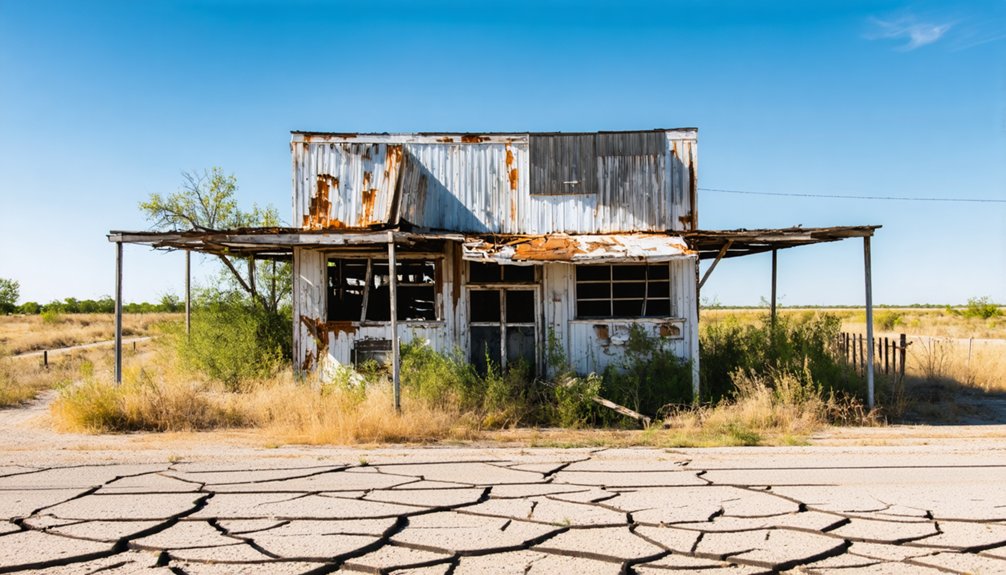
When you arrive at Shannon today, you won’t find crumbling storefronts or dramatic ruins — you’ll find a quiet rural landscape and a cemetery marker that tells the town’s story more clearly than anything else.
You’ll reach the site by heading about 0.5 miles east of Shannon on FM 175, then 0.5 miles south on a local road.
The marker and the 311 graves surrounding it stand as the strongest surviving evidence that a real community once thrived here.
The Cemetery Marker
If you’re expecting dramatic ruins or a row of crumbling storefronts, Shannon will quietly reset your expectations. What survives here is a cemetery marker, and honestly, it carries more weight than any collapsed building could. It anchors the site’s agricultural history, reminding you that real families built livelihoods on this land before the town faded.
The marker stands roughly 0.5 miles east of Shannon on FM 175, then 0.5 miles south along a local road. Follow it, and you’ll find 311 graves representing 104 family names.
Local folklore threads through those stones, connecting settlers who arrived near Stampede Springs in 1878 to the quiet ground they eventually called home. This isn’t a spectacle. It’s a document carved in granite, free for anyone willing to make the drive.
Surrounding Rural Landscape
Driving out to Shannon today, you’ll find yourself surrounded by open pasture, low scrub brush, and the kind of flat horizon that makes the sky feel enormous. The rural scenery carries that particular West Texas quietness — no crowds, no noise, just wind moving through native grasses and cedar.
The local flora stays modest, with scattered mesquite trees and wildflowers pushing through rocky soil depending on the season. FM 175 cuts cleanly through the landscape, and the turn south toward the cemetery feels genuinely remote.
You won’t encounter a townsite with standing structures or dramatic ruins. What you’ll get instead is space — wide, unhurried, and honest. That openness is part of what makes Shannon worth the detour for travelers who prefer their history served without distraction.
How to Get to Shannon, Texas
Shannon, Texas sits in Clay County, and you’ll want to head to FM 175 to find it. Understanding local folklore and settlement patterns helps you appreciate why early residents chose this specific corridor near Stampede Springs. The route itself feels like stepping into a quieter Texas.
Follow these directions to reach the cemetery marker:
- Drive to FM 175 in Clay County and locate the Shannon area roughly 0.5 miles east of the townsite.
- Turn south onto the local road that branches off FM 175 and continue approximately 0.5 miles.
- Look for the cemetery marker, your clearest on-the-ground evidence that Shannon ever existed.
You’re orienteering rural backroads here, so check your fuel, download offline maps, and embrace the open stretch of Texas ahead.
Pair Shannon With Other Clay County Ghost Towns
Once you’ve checked Shannon off your list, Clay County rewards further exploration with a loose network of similarly faded settlements that fill out the region’s frontier story. Each forgotten community carries its own local legends — tales of drought, failed crops, and families who simply packed up and moved on.
You’ll find that preservation efforts vary widely; some sites retain a weathered marker or crumbling foundation, while others exist only in county records. Mapping a loose circuit through the area lets you piece together how frontier life flourished briefly, then quietly dissolved across the Texas plains.
Bring a detailed county map, keep your tank full, and treat each stop as a small discovery. Together, these communities paint a richer portrait than any single ghost town can manage alone.
Why the Shannon Cemetery Tells the Town’s Whole Story
When a town leaves behind almost no buildings, its cemetery becomes the loudest voice it still has. Shannon’s graveyard holds 311 graves representing 104 family names, and that data tells you more than any local legends or ghost stories ever could about who actually built this place.
Walk through it and you’ll find the whole arc of the community:
Walk through a forgotten town’s graveyard and you’ll find the whole arc of a community written in stone.
- Mary W. Gibson (1824–1879) — the first burial, marking the settlement’s earliest roots
- Five acres purchased in 1880 — land set aside intentionally for school, church, and graveyard
- Cemetery association formed in 1949 — proof that descendants kept showing up long after Shannon faded
You don’t need ruins here. The names carved into stone do the talking for you.
What Makes Shannon Worth the Detour on a Texas Road Trip
Most Texas ghost town stops demand a detour through nowhere, and Shannon delivers exactly that — in the best possible way. You’re not chasing dramatic ruins here. Instead, you’re tracing a quiet story built around a reliable water source, a one-room schoolhouse, and a graveyard that outlasted everything else.
Shannon rewards travelers who move on their own terms. Local folklore ties the original settlement to Stampede Springs, giving the name change to Shannon a narrative edge worth knowing before you arrive.
You’ll find 311 graves and 104 family names waiting at that cemetery — enough history to ground any road trip stop.
It’s a short visit, but it punches above its size. Add it to your Clay County route and you won’t regret the turn.
Frequently Asked Questions
Is There an Entrance Fee to Visit the Shannon Cemetery?
You’ll find no entrance fee to visit Shannon Cemetery. It’s free to explore, honoring the site’s historical significance while supporting preservation efforts that keep this frontier burial ground accessible to every freedom-seeking traveler.
What Is the Best Time of Year to Visit Shannon?
Imagine crisp October air as you walk among 311 pioneer graves. For best visiting months, aim for seasonal weather in spring or fall — you’ll enjoy mild Texas temperatures perfect for unhurried cemetery exploration.
Are There Any Nearby Towns With Food or Fuel Stops?
You’ll find local dining and fuel stations in Henrietta, the Clay County seat, just a short drive away. Stock up before heading out, as Shannon’s remote location won’t offer you any modern conveniences.
Is the Road to Shannon Cemetery Paved or Unpaved?
You’ll trade silky asphalt for a rugged local road — a gloriously untamed stretch leading you past historic landmarks and scenic routes to Shannon Cemetery, roughly 0.5 miles south off FM 175.
Can Visitors Leave Flowers or Items at the Cemetery Graves?
You’ll likely leave flower offerings without issue, but follow grave decoration etiquette by keeping items respectful and biodegradable. Honor the pioneers resting there, and you’ll connect meaningfully with Shannon’s quiet, enduring frontier spirit.
References
- https://en.wikipedia.org/wiki/List_of_ghost_towns_in_Texas
- https://www.texasescapes.com/CentralTexasTownsNorth/Shannon-Texas.htm
- https://www.ghostsandgetaways.com/blog-1/27-fascinating-ghost-towns-in-texas
- https://www.tshaonline.org/handbook/entries/texon-tx
- https://texashistory.unt.edu/ark:/67531/metapth61101/m1/171/
- https://atlas.thc.texas.gov/Details/5077011811
- https://texashighways.com/travel-news/four-texas-ghost-towns/
- https://texashistory.unt.edu/ark:/67531/metapth61101/m1/170/
- https://en.wikipedia.org/wiki/Shafter
- https://authentictexas.com/texas-ghost-towns/