Smith’s Castle isn’t a ghost town—it’s North America’s oldest surviving plantation house, continuously inhabited since 1678. You’ll find this National Historic Landmark at 55 Richard Smith Drive in North Kingstown’s Wickford district, accessible via Route 95 South to Exit 9. The saltbox structure preserves Roger Williams’ original trading post foundation, tunnels from King Philip’s War, and architectural evidence of the Updike family’s 3,000-acre dairy plantation sustained by enslaved labor. The complete story encompasses 346 years of documented colonial violence, diplomatic negotiations, and architectural transformation.
Key Takeaways
- Smith’s Castle is located at 55 Richard Smith Drive in North Kingstown’s historic Wickford district along Narragansett Bay.
- From Route 95 South, take Exit 9 to Route 4, then Exit 5A to Route 102 South to Route 1.
- Built in 1678, it is America’s oldest surviving plantation house with distinctive saltbox architecture and central stone fireplace.
- The site features defensive tunnels to Rabbit Island, constructed during King Philip’s War for emergency evacuation.
- Free on-site parking is available; entrance is marked by signage opposite the State Police Barracks.
Getting to Smith’s Castle: Directions and Route Planning
Before setting out on your journey to this National Historic Landmark, you’ll want to establish clear navigation coordinates: Smith’s Castle stands at 55 Richard Smith Drive in North Kingstown, Rhode Island 02852, positioned along Narragansett Bay’s western shore in the historic Wickford district.
This 17th-century structure, central to colonial merchant trade operations, requires straightforward route planning. From Route 95 South, take Exit 9 to Route 4, then Exit 5A to Route 102 South. Follow it to Route 1, turning left. The entrance appears on your right, marked by signage opposite the State Police Barracks.
Free parking awaits on-site. The building construction details merit close examination year-round, with grounds accessible for independent exploration and office staff available for guidance.
The Narragansett Legacy: Before European Settlement
Thirty millennia of continuous habitation established the Narragansett people as the region’s most formidable indigenous power long before European vessels appeared off Rhode Island’s coastline. Their dominion stretched from the Providence River to the Pawcatuck River, encompassing western Narragansett Bay and territories extending into Connecticut and Massachusetts.
The tribal leadership structure centered on powerful sachems like Canonicus and Miantonomi, who governed through hierarchical authority respected across New England’s indigenous nations. Sacred geographic sites anchored tribal identity, particularly Nanihigonset at Sugarloaf Hill in Wakefield, where the confederation coalesced and extended influence over neighboring peoples.
Point Judith Pond marked their ancestral homeland—”People of the Small Point”—where sophisticated resource management and extensive trading networks sustained their autonomous power.
Roger Williams and the Founding of the Trading Post
When you examine the origins of Cocumscussoc, you’ll find that Roger Williams established his trading post here in 1637, shortly after his banishment from Massachusetts Bay Colony. The Narragansett sachem Canonicus either gifted or sold Williams this strategic location near Narragansett Bay, where Williams built the first English house in Nahigonsik Country.
For several years, Williams resided at this post, conducting trade operations and diplomatic negotiations with tribal leaders that would prove essential to maintaining peace between the colonists and the powerful Narragansett confederation.
Williams Arrives in 1637
Following his exile from Massachusetts Bay Colony in 1636, Roger Williams established a trading post in 1637 at Cocumscussoc, near the present-day site of Smith’s Castle in North Kingstown, Rhode Island. You’ll find this location marked by a plaque at Richard Smith Grove, south of Providence at the headwaters of Narragansett Bay.
Williams dwelt at this outpost for several years, conducting native american trade with Narragansett sachems including Canonicus and Miantonomoh. The post functioned as both residence and diplomatic center, where he negotiated treaties and exchanged goods—particularly wampum shell beads used ceremonially and commercially. His dealings shaped rhode island politics by maintaining peaceful relations that spared settlements for over a generation. Williams allowed Canonicus to take goods as payment for previous land deeds, establishing trust that would prove essential during the turbulent Pequot War period.
Narragansett Tribe’s Generous Gift
The Narragansett sachems’ 1636 land deed to Roger Williams established more than Providence colony—it forged a diplomatic alliance that would define Rhode Island’s early survival. Motivating factors for land gift centered on securing steady English trade access at strategic thoroughfares—the Pequot Path and east-west Narragansett route.
Chief Sachem Canonicus hosted Williams at Cocumscussoc, where the trading post emerged around 1637.
Canonicus’ conception of land ownership diverged fundamentally from English interpretation. He viewed the grant as settlement rights under Narragansett sovereignty, not absolute ownership transfer. Williams honored this distinction, defending tribal land rights against settler encroachment and insisting on literal deed interpretation.
His respect for Native consent—documented through ceremonial wampum transactions—protected Rhode Island settlements from conflict for over a generation, enabling the colony’s unprecedented flourishing.
Early Trading Post Operations
Roger Williams constructed his trading post at Cocumscussoc in 1637, positioning the stockaded structure on Narragansett Bay‘s western shore where water access facilitated commerce with both tribal partners and Atlantic markets.
The Providence Plantations founder and Baptist theologian established pathways extending from the Narragansett Tribe through colonial merchants to England and the West Indies. You’ll find that Williams’ original fortification resembled a castle, with stockade fencing and possible cannon emplacements protecting fur trade operations.
The site’s strategic location enabled direct exchange of goods between indigenous suppliers and Atlantic commercial networks. Williams maintained these operations until 1651, when he sold the post to Richard Smith to finance his charter expedition to Great Britain, marking a pivotal shift in Cocumscussoc’s commercial trajectory.
King Philip’s War and the Destruction of 1675
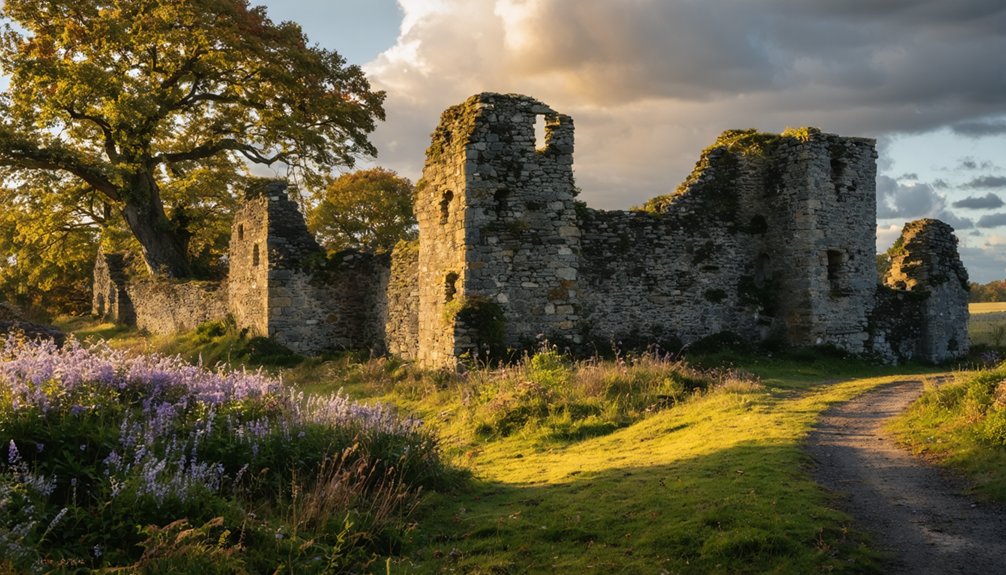
When colonial tensions erupted into violence in June 1675, incensed Indians raided the border settlement of Swansea, igniting what became King Philip’s War. You’ll discover how pre-emptive colonial tactics transformed this conflict’s scope. Despite lacking evidence of Narragansett alliance with Philip, colonial forces invaded Rhode Island’s charter territory with 1,000 troops.
On December 19, 1675, they attacked the fortified Narragansett village in Great Swamp, killing nearly 700 men, women, and children. This unprovoked assault triggered Narragansett transformation from neutral observers to committed adversaries. By March 1676, they’d burned Providence, Warwick, and Wickford.
The garrison house at Wickford—your destination today—witnessed these cataclysmic events firsthand. Over 600 English died; more than half of New England’s ninety towns suffered assault.
Rising From the Ashes: the 1678 Reconstruction
After the 1676 destruction, Richard Smith Jr. erected the current structure in 1678, constructing a saltbox house with a massive central stone fireplace and a two-story gabled porch.
The building’s sturdy fortified design earned it the “castle” nickname, while its core architectural elements—including front rooms flanking the stone hearth and a rear kitchen lean-to—survive today at 55 Richard Smith Drive.
You’ll discover that this colonial stronghold also featured practical safety measures, including tunnels reportedly connecting to nearby Rabbit Island for emergency evacuation.
Replacing the Burned Blockhouse
Following the devastation wrought by Narragansett warriors in 1676—retaliation for the colonial assault known as the Great Swamp Fight—Richard Smith Jr. returned to the charred remains of his family’s fortified blockhouse. By 1678, he’d completed reconstruction on the same property where Roger Williams established a trading post in 1637.
The renovation timeline produced a one-and-one-half story dwelling with architectural features markedly different from its militaristic predecessor. Smith designed a three-room plan flanking a central chimney, with a rear kitchen lean-to. Most striking was the massive two-story gabled porch dominating the façade, creating a saltbox profile with two front gables and a long sloping rear roofline. This sturdy construction earned the “castle” designation for its substantial size. The 1678 core survives within today’s structure, making it America’s oldest surviving plantation house.
Saltbox to Present Form
By 1678, Richard Smith Jr. had completed a robust one-and-one-half story dwelling that would anchor his family’s property for generations. The saltbox design featured a massive central stone fireplace, two-story gabled porch, and rear kitchen lean-to—practical architecture that reflected colonial self-sufficiency.
The structure’s architectural evolution spans three centuries:
- 1740: Daniel Updike’s renovation removed facade gables and added elegant interior paneling
- Late 1800s: Victorian modifications clipped gable ends and wrapped verandas around the facade
- 1940s-1950s: The Cocumscussoc Association’s restoration preserved the 1740 appearance while ensuring structural integrity
You’ll discover how historical preservation efforts transformed this working plantation into today’s museum. Each layer reveals Rhode Island’s independent spirit—from colonial resilience through Victorian prosperity to modern stewardship that honors authentic architectural heritage.
Safety Tunnels to Rabbit Island
While architectural refinements enhanced the plantation’s genteel appearance, Smith’s Castle’s earliest form emerged from violent necessity. During King Philip’s War’s escalating violence, the Smith family constructed tunnels for escape beneath their blockhouse. These subterranean passages extended from the house to nearby Rabbit Island, providing the family strategic evacuation routes when Indian attacks threatened the property. The tunnels represented colonial Rhode Islanders’ determination to maintain their autonomy despite constant danger.
When approximately 1,000 colonial troops massed at the property before the December 1675 Great Swamp Fight, these defensive measures proved prescient. Retaliation came swiftly—the house burned in 1676. Yet Richard Smith Jr. rebuilt by 1678, incorporating the original foundation and likely preserving portions of the tunnel system. These passages remain physical evidence of colonists who refused subjugation.
Life on the Updike Plantation: Agriculture and Enslavement
The Updike plantation at Smith’s Castle transformed Cocumscossoc into Rhode Island’s most significant commercial dairy operation, where enslaved labor produced the colony’s first Cheshire-style cheese from Joan Smith’s Gloucestershire recipe. By mid-18th century, this 3,000-acre operation exported through stone docks at Cocumscussoc and Wickford, establishing a dairy industry legacy that shaped South County’s crop cultivation history.
The human cost of this prosperity:
- Daniel Updike enslaved 19 people—the largest documented slaveholding in Narragansett primary sources
- Teams of 5-20 enslaved Africans managed hundreds of acres and scores of cattle per planter
- Lodowick Updike financed the 1802 schooner Betsy’s voyage to Africa, perpetuating the trade
Revolutionary War disruptions and Rhode Island’s 1784 gradual emancipation act dismantled this system, ending hereditary enslavement by the 1830s.
A Dark Chapter: America’s Only Execution of Its Kind
As you examine Smith’s Castle‘s documented history, you’ll encounter the 1676 execution of Joshua Tefft, a colonial militiaman convicted of treason for fighting alongside the Narragansetts during the Great Swamp Massacre. Tefft was subjected to drawing and quartering—hanged until nearly dead, disemboweled while alive, then beheaded and quartered—the only recorded instance of this punishment carried out on American soil.
This brutal event, combined with the mass grave of forty colonial soldiers on the property, marks one of the darkest chapters in Rhode Island’s colonial archive.
The 1676 Brutal Execution
On January 18, 1676, colonial authorities executed Joshua Tefft at Smith’s garrison house in what remains America’s only recorded case of drawing and quartering. You’ll find eyewitness accounts of execution describing colonial punishment methods that mirrored England’s most severe traitor penalties—hanging followed by systematic dismemberment.
The brutal reality of Tefft’s death:
- Public display of mutilated remains warned colonists against desertion during King Philip’s War
- State-sanctioned torture demonstrated how far authorities would go to maintain control over individual choices
- Collective witness requirement forced community participation in violence against perceived traitors
This execution reinforced European solidarity against Native forces while eliminating dissent. The quartered body parts served as grotesque markers of colonial power, reminding you that choosing different allegiances carried ultimate consequences.
Historical Context and Aftermath
Within weeks of Joshua Tefft’s execution, Smith’s Castle transformed from a private garrison into the operational center of colonial violence against Indigenous populations. You’ll find documented evidence that seventy soldiers occupied the blockhouse for three months, conducting torture and summary executions of captured Narragansett prisoners.
The massacres at Smith’s Castle intensified after December 1675’s Great Swamp attack, which claimed warrior, elder, woman, and child lives alike. Land disputes and property destruction escalated when Narragansett forces burned the original structure in 1676, retaliating against Richard Smith’s son’s war involvement.
Colonial authorities systematized enslavement operations here, with Roger Williams co-signing 1677 resolutions authorizing Indigenous captives’ sale for silver, corn, and livestock. The rebuilt 1678 plantation became one of America’s earliest documented slave operations.
Revolutionary War History at Smith’s Castle
Consider these conflicting realities:
- Lodowick Updike petitioned in 1778 to prove his loyalty after neighbors questioned his allegiance during British occupation.
- The plantation’s role in slave trade contradicted revolutionary principles of liberty.
- 1784 emancipation laws devastated the planter economy built on forced labor.
This complex history reveals freedom’s cost across different populations.
Tour Information: Hours, Seasons, and What to Expect
Smith’s Castle operates on a seasonal schedule that requires advance planning. Tours run from early May through mid-October, with May limited to weekends only.
From June through September, you’ll find Friday-Sunday availability, while October maintains this schedule until the season concludes. Docent-led tours depart at noon, 1:00, 2:00, and 3:00 p.m., with Thursday hours added during summer months.
Tour pricing stands at $10 for adults, $5 for children ages 6-12, and $8 for seniors 65+, military personnel, and groups of ten or more. Self-guided exploration isn’t permitted—docents in period clothing lead hour-long interpretive experiences through 17th- and 18th-century interiors.
The grounds remain accessible year-round from dawn to dusk without admission fees, offering trails and gardens for independent exploration.
Exploring the Grounds and Nearby Attractions
Beyond the castle’s walls, twenty-eight acres of historically significant landscape invite exploration through carefully maintained trails and period gardens. You’ll discover colonial era landscaping through authentic reconstructions: the Three Sisters garden, dye gardens featuring native tansy and marigold, and an 18th-century plot positioned to maximize sunlight.
Old Farm Road Trail connects the dairy barn complex to the main entry, revealing 1802 orchard walls and seasonal water features formed by altered drainage patterns.
Notable experiences include:
- Walking shorelines where Narragansett people established summer camps before 1651
- Observing Native American landscape management techniques through spring-burn meadows
- Accessing Rose Island Lighthouse’s living museum and overnight keeper experiences
The grounds welcome you dawn to dusk, free of charge, with leashed dogs permitted throughout the property.
Frequently Asked Questions
Are There Any Documented Ghost Sightings or Paranormal Activities at Smith’s Castle?
Yes, you’ll find documented sightings including Elizabeth Singleton’s fatal staircase fall, colonial soldiers wandering grounds, reported spectral voices from tunnels, and lingering spirits from mass graves. Four centuries of tragedy created extensively recorded paranormal activity at this 1678 homestead.
The haunting history of New England draws many adventurers eager to experience the unexplained, with a particular interest in exploring abandoned towns in Maine. These forgotten places, often left to nature, hold secrets of the past that continue to intrigue both historians and paranormal enthusiasts alike. As night falls, the eerie silence of these towns often gives way to unsettling sounds, leaving visitors with a palpable sense of the spirits that may still linger.
Can Visitors Access the Tunnels to Rabbit Island Mentioned in Records?
No, you can’t access the tunnels—they’re closed due to structural instability. Archival records confirm their existence, but restricted access and limited accessibility protect both visitors and the fragile historical infrastructure from deterioration and safety hazards.
Is Smith’s Castle Wheelchair Accessible for Guests With Mobility Limitations?
You’ll find partial accessibility—the first floor’s wheelchair-accessible with ramp entry and accessible parking, plus widened garden paths. However, the second floor requires stairs. Video tours substitute upstairs access, though wheelchair-friendly tour routes remain limited to ground level only.
Are Photography and Videography Allowed Inside the Historic House During Tours?
Smith’s Castle doesn’t explicitly prohibit photography during guided tour options, though you’ll want to follow basic photography etiquette: no flash, tripods, or disruptions. Always defer to docent instructions and respect preservation boundaries throughout your visit.
What Dining or Picnic Facilities Are Available on the Property?
You’ll find picnic areas with benches and tables across the grounds, open dawn to dusk daily. There’s no permanent restaurant, but food vendors appear at special events like the Harvest Festival, offering seasonal refreshments.