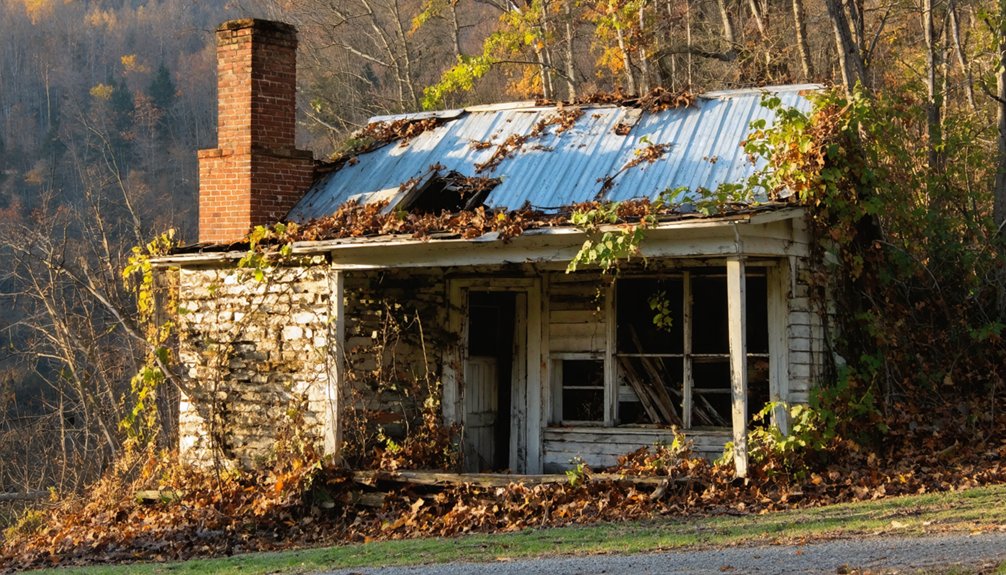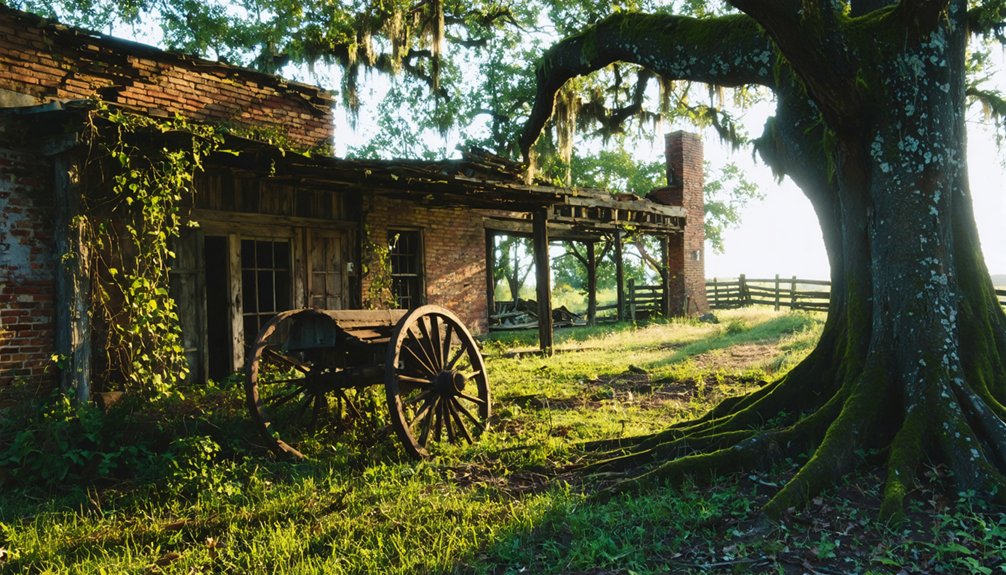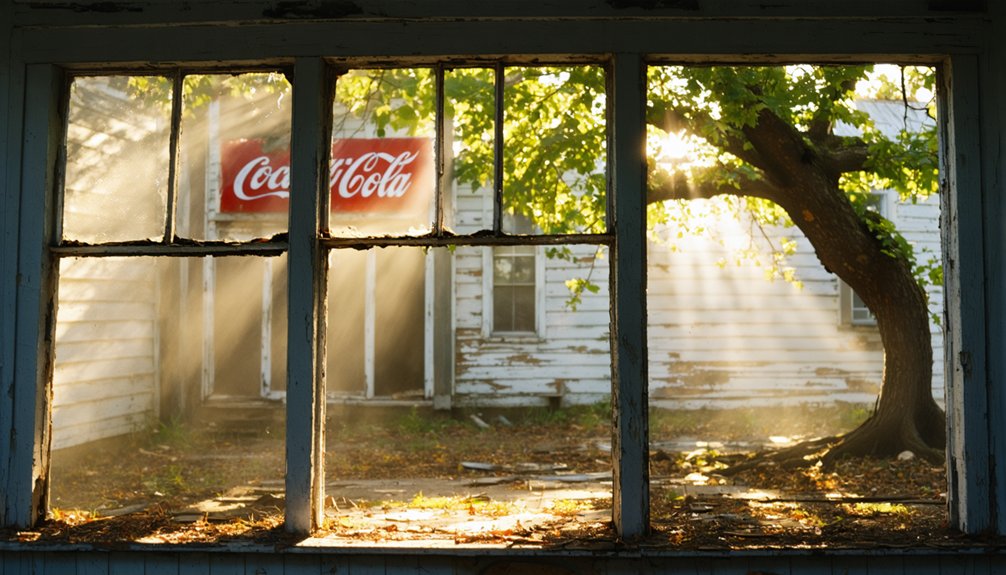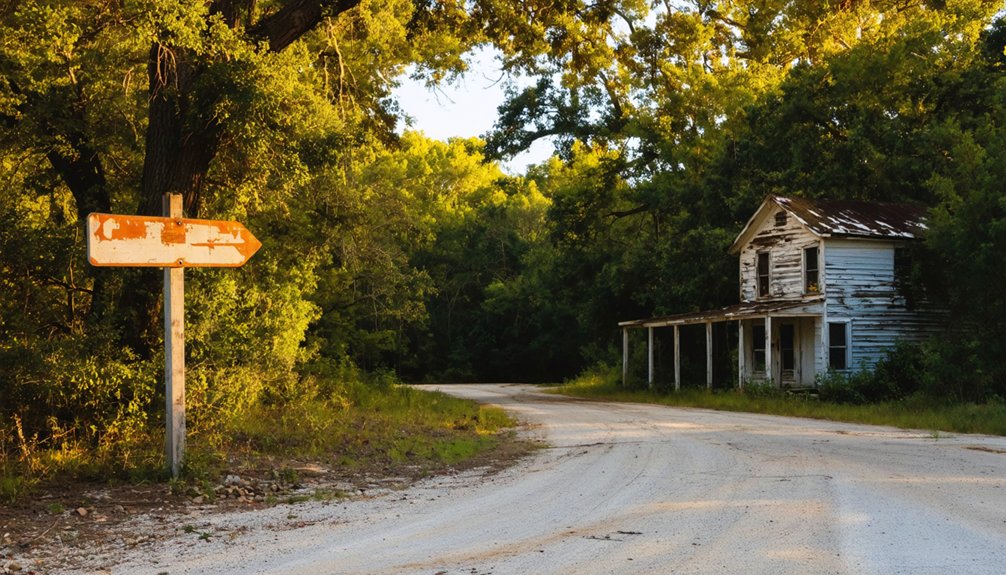
Drive seven miles west of Marshall on Arkansas Highway 74, watching for unmarked weathered buildings that signal Snowball’s location. You’ll find a shuttered general store with rusted 1941-era gas pumps, the stone Masonic Hall rebuilt in 1944 with hand-quarried local rock, and facades from the devastating 1945 fire. Bring your camera for dawn light filtering through boarded windows, and pack sturdy boots for exploring crumbling commercial district remnants where a postal clerk’s misread “H” accidentally created this ghost town’s peculiar name in 1888.
Key Takeaways
- Snowball is located seven miles west of Marshall along Arkansas Highway 74; watch for weathered buildings as the turn-off lacks clear signage.
- Key landmarks include the 1944 hand-quarried stone Masonic Hall, shuttered general store with 1941 oddities, and the reconstructed former post office.
- Arrive at dawn with a DSLR camera, wide-angle lens, tripod, and high-lumen flashlight to capture the abandoned storefronts and weathered structures.
- Combine your visit with nearby ghost towns: Rush’s crumbling smelter, Zinc’s sealed mine shafts, Pindall’s ruins, and Old Davidsonville State Historic Park.
- Navigate winding Ozark roads with switchbacks and creek crossings; use Highway 377 intersection and Snowball Baptist Church steeple as navigation landmarks.
The Story Behind the Name: From Snow Hall to Snowball
The quiet valley along Calf Creek saw its first European settlers arrive in the 1830s, though Native Americans had called this place home since the Late Archaic Period—long before John Campbell built his homestead around 1837. By 1885, the community had grown enough to establish Calf Creek Masonic Lodge No. 426, later renamed Snow Hall to honor Sheriff Benjamin Franklin Snow’s dedicated service.
When residents petitioned for a post office in 1888, they requested the name change from Calf Creek to “Snow Hall”—written as one word on the federal application. Here’s where local lore and legends get interesting: a postal clerk misread the handwritten “H” as a “b,” creating unexpected name change controversy. The bureaucratic slip stuck, and Snowball became your official destination until the post office closed in 1966.
What Remains: Historic Structures and Landmarks to Explore
You’ll find Snowball’s heart still beating faintly in its weathered structures, each building a chapter in the town’s slow fade from bustling crossroads to roadside whisper.
The shuttered general store stands guard with rusted gas pumps out front, its counter still displaying post office remnants and a roll of paper frozen in time—inside, you’ll spot oddities like the story of Buster Scott’s size 42 shoes from 1941.
Nearby, the Calf Creek Lodge looms as the town’s most prominent ghost, its early settlement architecture framing the kind of silence that makes you lower your voice without thinking.
Original Masonic Hall Monument
Standing sentinel at the heart of Snowball, the current Masonic Hall rises from hand-quarried local stone, its two-story structure telling the story of a community that’s rebuilt its gathering place not once, but twice.
The architectural significance becomes clear as you examine the construction methods—lodge members themselves hauled and set every stone when they replaced the 1885 original in 1944.
You’ll notice the craftsmanship varies between levels. The lower story displays precise, evenly coursed stonework, while the upper sections show more irregular patterns. The largest stones anchor the second story’s base, tapering upward. Look for the original cornerstone, carefully preserved from the first building that cost just $329.75 to construct. It’s tangible proof that determined communities create their own landmarks.
Abandoned Commercial District Buildings
Beyond the Masonic Hall’s carefully stacked stones, Snowball’s commercial heart lies in ruins—though what remains tells a story of resilience against disaster. The 1945 fire that ravaged three businesses and the post office left scars still visible along Highway 74.
You’ll spot the boarded-up former post office, rebuilt after flames claimed $20,000 in damages but shuttered permanently in 1966. Historic preservation efforts shine brightest at the Old Snowball House, where entrepreneurs transformed the last postal building into vacation rentals. Those weathered gas pumps out front? They’re authentic relics.
While commercial district redevelopment remains minimal, the renovated store proves Snowball’s spirit endures. Each crumbling facade whispers tales of Arkansas’s vanished frontier commerce—yours to discover without crowds or tourist traps blocking your path.
Driving Directions and Best Routes From Marshall
You’ll find Snowball waiting seven miles west of Marshall along Arkansas Highway 74—a straightforward shot that takes roughly ten minutes if you keep a steady pace. The turn-off isn’t marked with fanfare; watch for the cluster of weathered buildings appearing on your right as the road curves through hill country thick with oak and pine.
I’ve made this drive twice now, and both times the empty stretches between Marshall and Snowball felt longer than the odometer suggested, the kind of quiet that makes you check your rearview mirror for company that isn’t there.
Highway 74 Turn-Off Details
From Marshall, the journey to Snowball follows a straightforward westbound path along Arkansas Highway 74, where the seven-mile stretch unfolds through classic Ozark plateau terrain at elevations hovering around 1,450 feet. You’ll find highway signage placement sparse but adequate—watch for the Highway 377 intersection marker that signals your arrival. Snowball Baptist Church at 6017 Highway 74 W serves as your primary landmark before the final turn.
The church’s white steeple cuts through the tree line, confirming you’re approaching the ghost town’s heart. Roadside points of interest emerge sporadically: weathered barns, overgrown homesteads, and remnants of early 1900s commerce. Keep your speed moderate—this isn’t about rushing. The route rewards those who embrace the unhurried pace of backcountry exploration, where each mile peels back another layer of Arkansas’s forgotten past.
Seven-Mile Scenic Drive
The white steeple fades in your rearview mirror as the real character of this drive begins to reveal itself. Highway 74 transforms into seven miles of pure Ozark magic, where winding roads carve through hills that’ve stood untouched for centuries. You’ll navigate switchbacks that demand your attention while rewarding you with natural scenery most travelers never discover.
The route delivers:
- Dense hardwood forests pressing against weathered pavement
- Creek crossings where water cuts through limestone like it’s got all the time in the world
- Pulloffs perfect for stretching your legs and breathing air that hasn’t been filtered through civilization
Keep your speed moderate—these curves aren’t suggestions. The narrow shoulders and steep drop-offs remind you this isn’t Interstate travel. This is the kind of road that makes you remember why you left the highway.
Estimated Travel Time
Plan for fifteen minutes behind the wheel if you’re treating Highway 74 with the respect it deserves. That seven-mile stretch demands attention—winding through Buffalo River country where fog banks materialize without warning and deer cross at their leisure. I’ve watched travelers rush through in ten minutes flat, missing everything that makes this journey worthwhile.
Check real-time updates through Waze before departing Marshall, especially during spring when weather conditions shift rapidly. Morning mist clings to these hollows until mid-morning, transforming pavement into something unpredictable. Traffic patterns? Practically nonexistent. You’ll share the road with locals who know every curve intimately and the occasional adventurer following breadcrumbs to abandoned dreams.
Take your time. Snowball’s waited this long; it’ll wait fifteen minutes more.
The Rise and Fall of a Frontier Community
Long before the town earned its whimsical name, hardy settlers pushed into the Calf Creek valley during the 1830s, drawn by fertile bottomland and timber-thick hillsides. John Campbell built the first grist mill around 1837, grinding corn for families carving homesteads from wilderness.
The community’s heartbeat strengthened when:
- The Masonic Lodge erected their two-story stone hall in 1886 for $329.75—serving as church, school, and gathering place
- A postal clerk’s misreading transformed “Snow Hall” into “Snowball” in 1888
- The stave mill’s oak barrels supplied regional commerce through the early 1900s
Five hundred residents called Snowball home at its peak. Then economic decline arrived—the mill relocated, fire consumed businesses in 1945, and younger generations scattered. Today, cultural preservation exists only in crumbling stone and fading memories.
Notable Figures and Hidden Stories of Snowball’s Past
Who shapes a town’s memory when official records fade and silence settles over empty streets? You’ll find Snowball’s story etched in Benjamin Franklin Snow’s 1885 stone lodge—built for $329.75—and Benjamin Taylor’s steam-powered mill that exploded in 1879, killing four men. Jimmy Driftwood taught here during the 1950s before his folk music fame spread nationwide.
By the 1970s, the local economy’s decline had reduced the population from 500 to four families. Roger and Opal Wells’ abandoned store stood with shuttered windows and silent gas pumps—testament to what vanished. Yet community resiliency efforts emerged when back-to-the-land settlers arrived, seeking freedom from urban constraints.
Gertha Griffin witnessed these transformations, her 1984 interviews preserving voices that refused complete erasure from Searcy County’s rugged landscape.
Combining Your Visit: Nearby Ghost Towns and Attractions
Branch out from Snowball and you’ll discover a constellation of forgotten settlements scattered across the Ozarks, each within a few hours’ drive. These sites offer historical authenticity without the crowds, their remote accessibility preserving what commercial tourism destroys.
Your extended exploration includes:
- Rush Ghost Town – Skeletal zinc mining remains along Buffalo River, with accessible smelter ruins and mine shafts named Morning Star and White Eagle echoing 1900s prosperity
- Zinc Ghost Town – Twenty miles northwest, rusted equipment emerges from brush around sealed mine shafts, delivering an untouched, spooky atmosphere
- Highway 65 corridor – Link Pindall’s abandoned structures with St. Joe’s 1874 Masonic Lodge, once called Monkey Run
Old Davidsonville State Historic Park offers maintained trails eighty miles northeast, where Black River floods buried Arkansas’s early government seat beneath archaeological mysteries.
Photography Tips and What to Bring for Your Exploration
Whether you’re documenting Rush’s crumbling smelter or Snowball’s weathered storefronts, your camera becomes the bridge between these forgotten places and the stories they still whisper. Pack a DSLR or mirrorless camera with wide-angle and prime lenses to capture both sweeping architectural vistas and intimate decay details.
Tripod usage proves essential—these dim interiors demand 2-4 second exposures that handheld shooting can’t deliver. I’ve learned to arrive at dawn when soft light transforms peeling paint into gold. Lighting techniques matter: bring a high-lumen flashlight for navigation and a warm LED for painting light across subjects during long exposures.
Don’t forget backup batteries and weatherproof bags. These places won’t wait forever, and neither should your documentation.
Frequently Asked Questions
Are There Any Facilities Like Restrooms or Water Available in Snowball?
Facilities aren’t guaranteed in this ghost town, so you’ll want to plan ahead. Pack water and use restrooms at nearby accommodations before arriving. Parking options exist along the quiet streets, but don’t expect modern conveniences here.
Is It Legal to Explore the Abandoned Buildings on Private Property?
No, exploring abandoned buildings without landowner permission isn’t legal. You’ll face trespassing risks including fines and arrest. Contact property owners directly for written consent before entering any structures, even if they appear vacant or lack posted signs.
What Is the Best Time of Year to Visit Snowball?
You’ll find sweet escape during early spring’s wildflower awakening or late autumn’s golden transformation. These shoulder seasons offer comfortable temperatures, fewer crowds, and budget-friendly rates—perfect freedom for wandering Snowball’s weathered structures at your own pace.
How Long Should I Plan to Spend Exploring the Ghost Town?
Plan 2-3 hours for complete exploration. You’ll prepare for self-guided exploration through weathered buildings, cemetery pathways, and historical displays. Pack necessary supplies like water, snacks, and cameras to capture Snowball’s haunting beauty independently.
Are There Any Guided Tours Available for Snowball and Nearby Sites?
You’re out of luck for guided tours at Snowball itself—it’s purely self-guided exploration. However, you’ll find the cultural significance and historical significance of nearby Eureka Springs comes alive through numerous professional ghost tours just 90 minutes away.