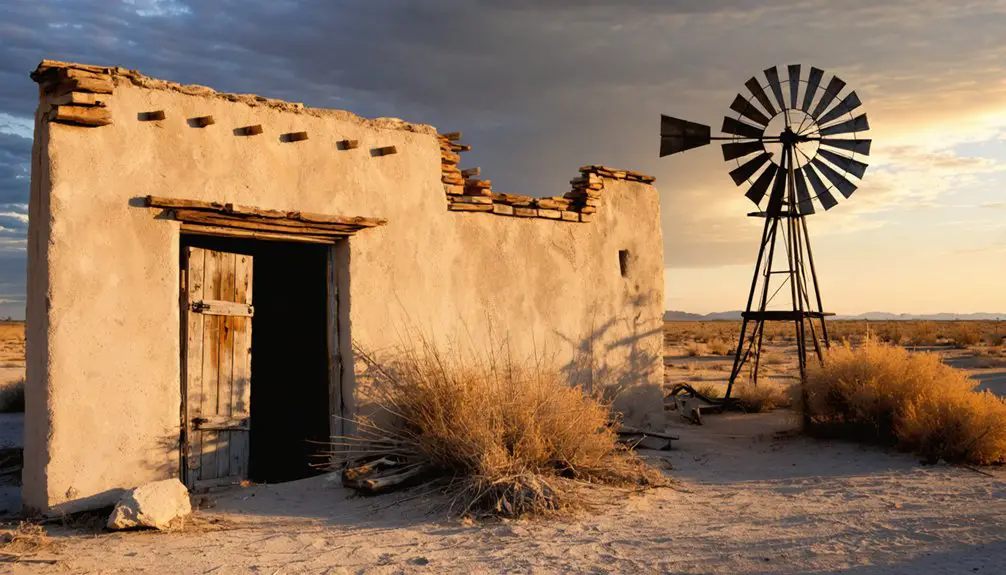
You’ll find Soash approximately 21 miles northwest of Big Spring, accessible via Interstate 20 and county roads cutting through open rangeland. The concrete foundation of the Bank of Soash stands as the primary remnant of William Pulver Soash‘s failed 1909 metropolis, which collapsed after three years of devastating drought. Plan 30-60 minutes for exploration, bring plenty of water and sturdy boots, and secure property owner permission beforehand. Spring, fall, and winter offer ideal visiting conditions for discovering what remains of this West Texas ghost town and the story behind its dramatic nine-year rise and fall.
Key Takeaways
- Soash is located approximately 21 miles northwest of Big Spring, accessible via Interstate 20 and traversing north into Howard County.
- The concrete foundation of the Bank of Soash remains the primary attraction and most substantial remnant of the abandoned town.
- Secure property owner permission before visiting, as the remote ghost town site sits on private rangeland near Howard-Borden County boundaries.
- Bring essential supplies including water, sturdy hiking shoes, a first aid kit, and GPS coordinates for accurate navigation.
- Plan 30 to 60 minutes for exploration; visit during spring, fall, or winter for optimal conditions.
The Rise and Fall of William Soash’s Dream City
In 1909, land speculator William Pulver Soash surveyed the sun-baked expanse of northwestern Howard County and saw what others couldn’t—a thriving metropolis rising from the hardscrabble earth. He contracted with Christopher Columbus Slaughter for 200,000 acres and built his vision with impressive speed: a reinforced concrete bank, electrical plant, waterworks, the Hotel Lorna, and a schoolhouse. Midwestern settlers arrived by train, drawn by economic incentives and promises of Twin Cities prosperity alongside Big Spring.
Then nature crushed his ambitions. Three years of drought from 1909 to 1911 turned crops to dust and dreams to ash. The population scattered. His W.P. Soash Company filed bankruptcy in 1912.
Another drought cycle finished what the first began—by 1917, the post office closed permanently, leaving only failed marketing promises and concrete ruins behind.
What Brought Settlers to the Big Springs Ranch Country
You’d arrive at Big Spring in the 1880s to find promotional pamphlets promising fertile ranchland, reliable water, and fortunes waiting in West Texas’s wide-open spaces.
The Texas and Pacific Railway‘s steel tracks reached this remote outpost in May 1881, transforming a buffalo hunters’ camp into a bustling divisional point where trains took on water from the ancient spring. Within months, ranchers like Joseph Heneage Finch were snapping up tens of thousands of acres, building the region’s first permanent structures, and betting their futures on cattle country that had once belonged solely to Comanche raiders and wandering herds.
Promotional Promises and Dreams
The company’s marketing arsenal included:
- Excursion trains hauling Midwestern farmers straight to the property
- Celebratory events like the July 5, 1909 gathering, immortalized in promotional booklets
- Multi-state offices spreading the gospel of affordable land at $12.70 per acre
They’d show you concrete banks, Hotel Lorna, electric lights—civilization rising from raw prairie. You’d picture yourself building something permanent, claiming independence on bargain land that promised metropolitan destiny.
Railway Access Fuels Growth
Railroad tracks meant everything to these West Texas dreamers, and Soash’s promoters knew it. They marketed the settlement’s strategic position near Big Springs Ranch country as perfectly placed for rail line construction that’d connect regional transportation hubs across the territory. You can imagine how convincing their pitch sounded—freight cars hauling crops to distant markets, passenger trains bringing customers and capital straight to your doorstep.
That railroad promise drove everything. Settlers wagered their futures on those anticipated connections, believing commerce would flow through their town like water through an irrigation ditch. Businesses rushed in, permanent buildings rose from the dirt, and the development company accelerated its timeline. This wasn’t just land speculation—it was freedom riding on steel rails that never arrived.
Why the Town Failed After Just Nine Years
Within three short years of William Pulver Soash’s grand vision taking shape, his promised land began crumbling under the relentless Texas sun. The drought impact on promised prosperity devastated everything he’d built. You’ll understand the collapse when you consider three brutal realities:
- Misleading promotions – Rainfall figures in The Golden Westmagazine painted northwestern Howard County as Midwest-comparable, but the 1909-1911 drought cycle exposed these deceptions
- Agricultural failure – Crops withered, homeseekers fled, and the population evaporated faster than the water in their wells
- Financial ruin – The W.P. Soash Land Company declared bankruptcy in 1912, sealing the town’s fate
Getting to Soash in Northwestern Howard County
Despite its dramatic collapse, Soash’s location remains accessible to modern ghost town hunters willing to venture into the windswept expanses of northwestern Howard County. You’ll find the vanished settlement approximately 21 miles northwest of Big Spring, near the county boundaries where Howard meets Borden County. Interstate 20 provides your primary transportation links into the region, bisecting Howard County east to west before you turn northward toward the old townsite.
Big Spring serves as your jumping-off point—the same role it played when organizers ran excursion trains carrying hopeful investors in 1909. From there, you’ll follow highways into ranch country where Slaughter’s Long S Ranch once sprawled across thousands of High Plains acres. The landscape remains largely unchanged: empty horizons, scattered mesquite, and that persistent West Texas wind that’s outlasted every building Soash ever erected.
What You’ll Find at the Abandoned Town Site Today
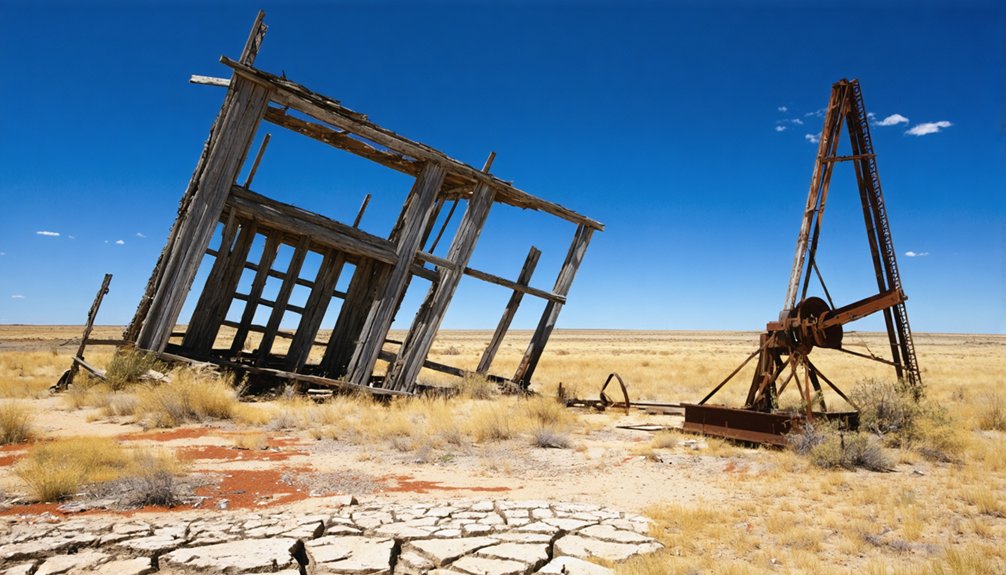
When you arrive at Soash today, the concrete foundation of the Bank of Soash emerges from the prairie grass as the sole substantial reminder of William Pulver Soash’s failed dream. The reinforced structure once anchored the town’s most impressive building, but now it sits alone in the arid South Plains landscape where wind-swept emptiness has reclaimed nearly every other trace of the 1909 settlement.
You’ll need a 2WD vehicle to navigate the site, though what awaits is more absence than presence—a stark monument to drought, broken railroad promises, and the thousands who abandoned their hopes here.
Bank of Soash Foundations
Standing alone in the West Texas scrubland, the concrete foundation of the Bank of Soash represents virtually all that survives of William Pulver Soash’s grand vision. This reinforced concrete structure showcased architectural design innovations for 1909, built to impress Midwestern travelers stepping off the train into what they hoped would become a thriving community.
The foundation’s persistence tells its own story:
- Engineering challenges overcome through cutting-edge reinforced concrete technology that outlasted wooden contemporaries by decades
- Strategic positioning near the railroad to signal permanence and prosperity to potential land buyers
- Superior construction quality that withstood drought, abandonment, and a century of weathering
You’ll need imagination to reconstruct the ambitious bank that once stood here, designed to anchor an empire that nature ultimately reclaimed.
Limited Structural Remains
The impressive foundation you’ve just examined represents nearly everything left of Soash’s ambitious settlement. You’ll find the site has reverted almost entirely to earth, with the bank and office building ruins serving as solitary sentinels of a forgotten era.
The lack of preserved buildings is striking—no Hotel Lorna, no company headquarters, just open pastureland where ambitious dreams once stood. Those massive front sill slabs, precariously held together by a single piece of rusted rebar, are the most dramatic remaining structural elements you’ll encounter.
The town that boasted electricity and permanent structures within months of its 1909 founding has been reduced to foundations and fragments, leaving you free to imagine what once thrived here before drought claimed everything.
Accessing the Historic Site
Finding Soash requires traversing approximately 20 miles north of Big Spring into far northwestern Howard County, where the ghost town sits near the Borden County line on what was once the vast Slaughter Ranch. You’ll navigate this remote location via 2WD-accessible roads, though limited signage means you’ll need solid directional skills and perhaps GPS coordinates to pinpoint the ruins.
Once there, expect to discover:
- Concrete foundations of the Bank of Soash – reinforced remnants that outlasted everything else
- Scattered office building ruins – fragmentary walls returning to the earth
- Open rangeland – vast horizons where a community once thrived
The grid coordinates receive top ratings for navigation, but come prepared with water and supplies. This remote territory rewards self-reliant explorers who appreciate historical whispers over maintained attractions.
Best Times to Visit This South Plains Ghost Town
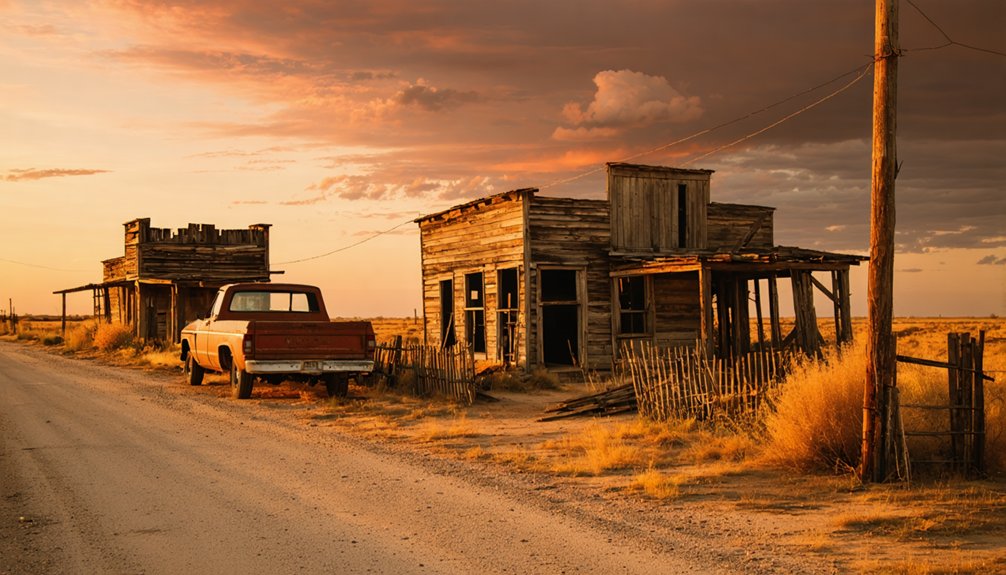
Planning your Soash expedition around South Plains’ seasonal rhythms transforms a simple ghost town visit into an unforgettable experience. Spring delivers wildflower-carpeted fields and 60-75°F temperatures—ideal weather considerations for site exploration without summer’s punishing 90°F+ heat that risks dehydration.
Fall offers equally compelling conditions: crisp 50-70°F days, reduced humidity, and clear skies that sharpen every crumbling adobe detail through your camera lens.
Understanding seasonal variations in visitor patterns maximizes your freedom to roam. Mid-November through April provides temperate perfection, with winter’s mild 30-50°F lows and site exclusivity you won’t find during crowded periods. You’ll dodge summer’s flash-flooding thunderstorms and insect swarms while capturing rare snow-dusted ruins.
October brings migrating monarch butterflies, and minimal rainfall year-round keeps those unpaved access routes passable for your adventure.
The Bank of Soash: Main Attraction Among the Ruins
Rising from the windswept prairie like a defiant monument to ambition, the Bank of Soash’s concrete skeleton commands immediate attention as you approach the ghost town site. This robust concrete construction—erected between 1909 and early 1910—outlasted every wooden structure William Pulver Soash built to impress Midwestern investors.
What makes the bank ruins historically significant:
- Sole surviving infrastructure from Soash’s 200,000-acre development scheme
- Tangible evidence of the devastating three-year drought that began in 1909
- Architectural record to early 1900s commercial banking standards on the South Plains
While partial walls and foundation remain, you’re witnessing relics of failed development that couldn’t withstand environmental adversity. The concrete’s endurance ironically preserved the story of settlement dreams crushed by nature’s unforgiving cycles.
How Long to Spend Exploring the Site
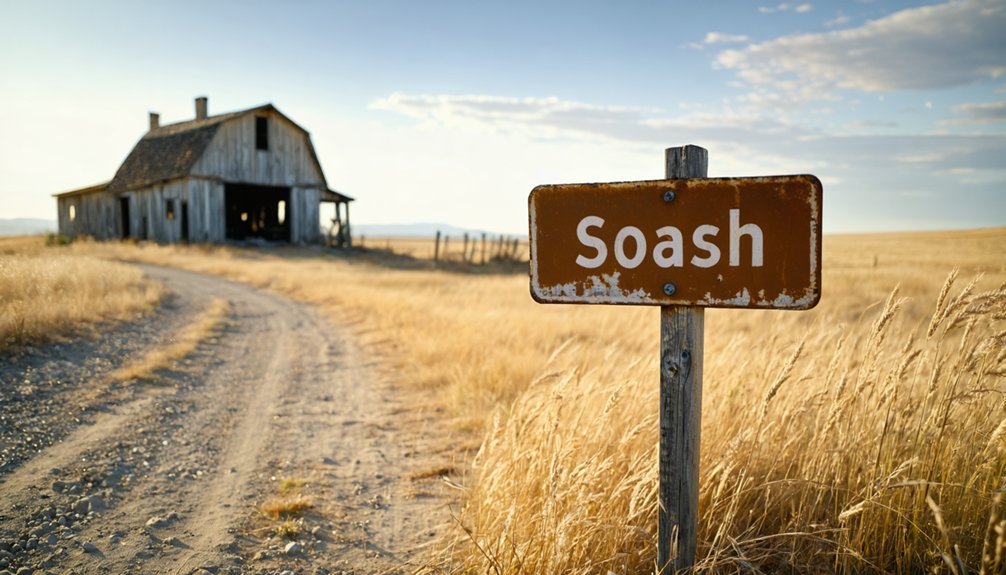
You’ll need just 30 to 60 minutes to explore Soash’s compact scatter of ruins, where the crumbling bank foundations anchor your walk through knee-high grass and weathered stone.
The site’s small footprint—remnants of a town that housed barely 50 people by its final years—means you can photograph every significant structure, from the hotel’s faint outline to the company headquarters’ broken walls, in a single focused visit.
Consider extending your ghost town hunt to include Big Spring’s historic sites or other Howard County ruins, turning this brief stop into a half-day West Texas exploration.
Exploring ghost towns near Cryer Creek, Texas can add a unique twist to your adventure. Each abandoned structure tells a story of the past and showcases the rich history of the area. Make sure to bring a camera to capture the haunting beauty of these forgotten places.
Quick Visit Recommended
Since Soash lacks developed trails, interpretive signage, or restored structures, most visitors complete their exploration in 30 minutes to an hour. You’ll find scattered foundations and deteriorated buildings visible from accessible areas, making this a minimally required time commitment compared to more developed ghost towns. Self-guided exploration depends entirely on your preparation and historical knowledge.
Plan accordingly with these considerations:
- Photography sessions typically add 15-30 minutes to document remaining structures
- Weather conditions in West Texas profoundly affect ground safety and comfort levels
- Property owner permission must be secured beforehand, as access points cross private land
Spring and fall offer ideal visiting conditions, avoiding summer temperatures exceeding 95°F. You’ll maximize your experience by researching Soash’s drought-driven history before arrival.
Primary Attraction: Bank Foundations
The crumbling bank foundations anchor Soash’s ghostly landscape, their weathered concrete marking where commerce once thrived before the 1912 bankruptcy emptied the streets. You’ll find these pioneer era remnants standing alongside office building foundations—the only structures that refused to surrender completely to West Texas’s harsh elements. The preserved authenticity makes this site compelling for photographers seeking unrestored, raw historical scenes. There’s no visitor center, no interpretive signs—just you and the skeletal remains of William Pulver Soash’s failed dream.
Walk freely among the concrete footprints where Hotel Lorna’s guests once gathered and company headquarters orchestrated land deals. The foundations tell their story through cracks and erosion, offering an unfiltered glimpse into early 20th-century frontier ambition that couldn’t withstand economic reality.
Combine With Nearby Towns
Budget thirty to forty-five minutes wandering Soash’s scattered foundations—enough time to photograph the bank ruins, trace the hotel’s footprint, and absorb the settlement’s stark silence without exhausting its limited remains.
Maximize your Howard County exploration by combining Soash with complementary destinations:
- Big Spring (15 miles south) offers nearby lodging options, fuel stations, and supplies before venturing to more remote sites—base camp for your ghost town circuit.
- Stanton (20 miles north) features additional historic structures and cafés where you can compare notes with locals about regional ghost town tours worth investigating.
- Lomax (adjacent settlement) extends your abandoned-town experience with crumbling storefronts and windswept homesteads, creating a half-day West Texas ruins exploration.
This clustering approach transforms Soash from solitary stop into launching point for discovering Howard County’s forgotten communities.
Combining Soash With Big Spring and Lamesa Stops
Nestled between two anchor cities on the South Plains, Soash’s remnants make it perfectly positioned for a triangle route that captures West Texas’s boom-and-bust history in a single afternoon. You’ll start in Big Spring, then head toward Ackerly where Wikimapia marks the ghost town’s precise location. The crumbling bank and office ruins sit on former Slaughter Ranch lands—tangible evidence of William Soash’s failed empire.
Coordinating itinerary logistics becomes straightforward when you treat Soash as your midpoint stop before continuing to Lamesa. Regional tourism draws in both anchor cities offer meals and fuel, while street names bearing “Soash” throughout surrounding counties remind you how completely this drought-killed settlement vanished. You’ll trace the same three-year cycle that bankrupted the W.P. Soash Company in 1912, connecting dots across Howard County’s unforgiving landscape.
What to Bring for Your Ghost Town Adventure
Since West Texas ghost towns don’t come with visitor centers or paved parking lots, you’ll need to pack strategically for terrain that shifts from cracked caliche to ankle-twisting rubble within steps. Your essential camping items should include sturdy hiking shoes, a thorough first aid kit, and plenty of water—dehydration happens fast under that merciless sun.
For necessary vehicle supplies, prioritize:
- Emergency roadside kit with jumper cables, tire iron, and jack
- Navigation tools including physical maps and fully charged devices
- Recovery gear like duct tape, multi-tool, and flashlight
Don’t forget sunscreen, bug spray, and extra layers since temperatures plummet after sunset. Pack heavy-duty trash bags—leave these forgotten places cleaner than you found them.
Frequently Asked Questions
Are There Any Entrance Fees or Permits Required to Visit Soash?
You won’t pay entrance fees or need permits to explore Soash’s vanished remains. Just drive freely along Howard County’s open roads, where parking availability meets endless horizons. Your transportation options lead straight to unregulated adventure on Texas’s forgotten frontier.
Is Camping Allowed Near the Soash Ghost Town Site?
Wild camping isn’t officially sanctioned at Soash itself, but you’ll find freedom at nearby campgrounds offering primitive sites and availability of RV parking. Check local regulations first—safeguarding the land maintains these ghost town adventures remain accessible for fellow wanderers.
What Wildlife or Safety Hazards Should Visitors Watch for at Soash?
Watch for venomous snakes like rattlers hiding in shade and scorpions beneath debris. Abandoned structures pose collapse risks with unstable walls and floors. You’ll face extreme heat, flash floods, and sharp rusted metal throughout the crumbling ruins.
Are There Any Guided Tours Available for the Soash Ruins?
No guided tours exist for Soash’s ruins—you’ll explore independently. The crumbling concrete foundations offer freedom to discover the bank’s 1909 architecture at your own pace, creating your personal educational experience amid this forgotten Texas ghost town’s historical significance.
Can You Bring a Drone to Photograph the Abandoned Town Site?
Though drone regulations seem restrictive, you’ll find freedom photographing Soash’s ruins. Texas permits recreational flights under 400 feet, but secure photography permissions from landowners first—respecting property rights grants aerial access to capture these hauntingly beautiful concrete foundations.