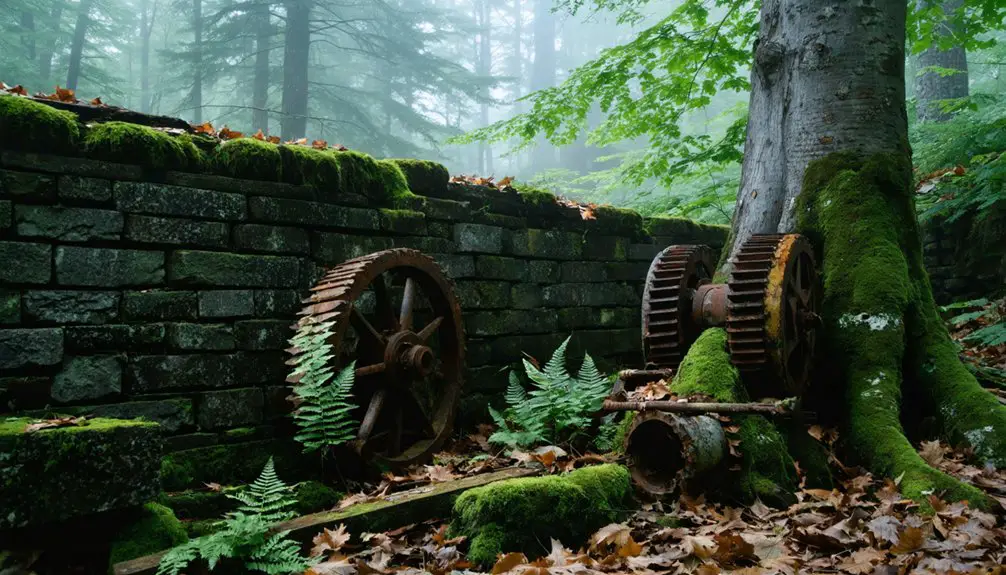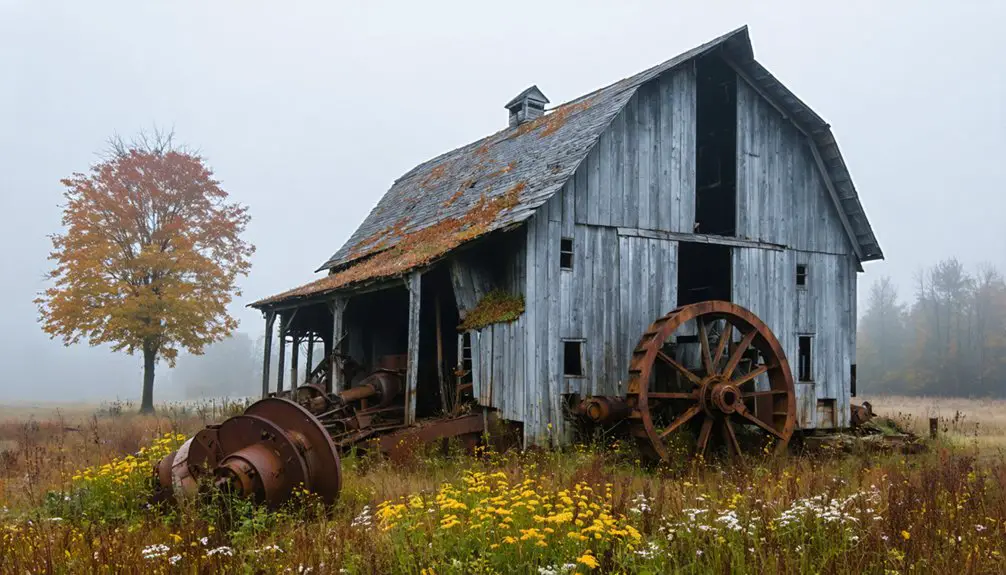
You’ll navigate 8 miles from VT 116 through progressively remote terrain, watching pavement yield to dirt as you climb 420 feet to South Lincoln’s abandoned settlement at 1,385 feet elevation. Lincoln Road follows the river for 3.4 miles before National Forest Road 54 marks your final approach into Green Mountain National Forest territory. The ghost town’s remnants—including Little Canada and Johnson’s mill sites—reveal J.E. Henry’s logging legacy that stripped these watersheds before federal intervention. Your journey continues beyond these coordinates.
Key Takeaways
- From VT 116, take Lincoln Road 3.4 miles to town center, then continue 8 miles on rural routes to National Forest Road 54.
- Pavement transitions to dirt roads as you enter Green Mountain National Forest heading toward the abandoned settlement.
- Elevation climbs from 965 feet at the valley floor to 1,385 feet at South Lincoln’s mountain-flanked ghost town site.
- Explore remnants of J.E. Henry’s logging era, including former mill town sites like Johnson Town and Little Canada.
- Visit nearby Deer Leap Mountain’s granite cliffs at 2,766 feet for panoramic views of surrounding peaks and valleys.
Getting to South Lincoln: Route 116 and Duxbury Road Access
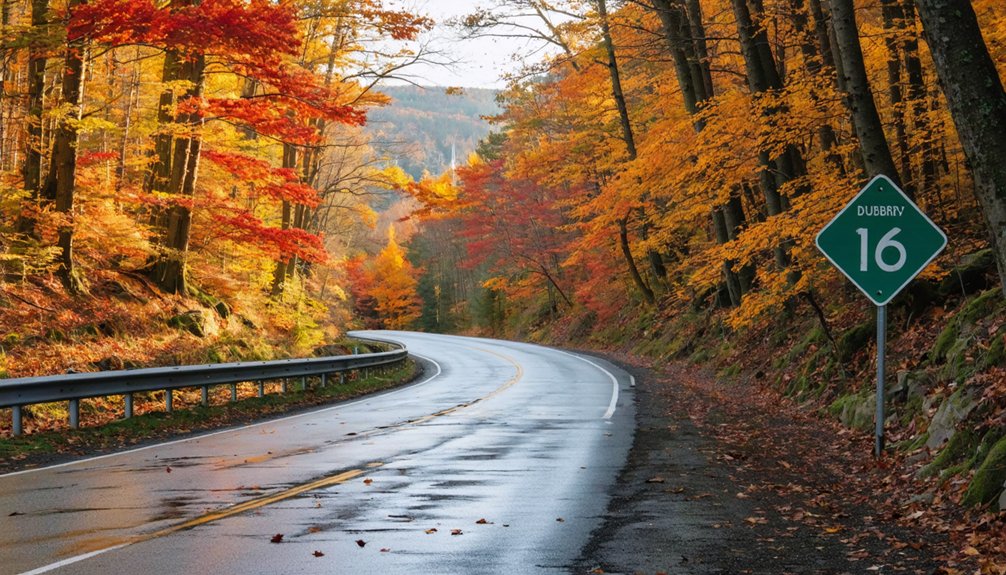
Accessing South Lincoln requires traversing a series of interconnected rural routes that shift from state highway to forest road over approximately eight miles. You’ll begin on VT 116, a two-lane rural road spanning 40.759 miles from Middlebury to South Burlington.
From the Routes 116 and 17 junction at Mary’s Restaurant, travel south 1.7 miles to Lincoln Road. This secondary route follows the river for 3.4 miles to Lincoln center. Continue past Lincoln General Store for just over one mile to National Forest Road 54, your final access point.
After one mile, you’ll encounter a fork where route terrain characteristics transform dramatically—pavement yields to dirt at the rise. The left branch delivers you to South Lincoln’s abandoned settlement, where access point options narrow to this single passage through Green Mountain National Forest.
What to Expect: Terrain, Elevation, and Valley Geography
As you climb beyond Lincoln center, the landscape shifts from pastoral valley floor at 965 feet to South Lincoln’s mountain-flanked settlement at 1,385 feet—a 420-foot elevation gain that fundamentally altered the community’s viability. USGS 7.5-minute quad maps reveal the rugged Green Mountain terrain that isolated these settlers, with Lincoln Peak and Mt. Grant dominating the skyline.
Critical terrain factors you’ll encounter:
- Contour lines on 1:24,000 scale topo maps illustrate dramatic elevation changes along Forest Service roads
- New Haven River valley hydrology carved the accessible lowlands, leaving highland settlements stranded
- GPS coordinates (44.1058928°N, -72.9970612°W) place South Lincoln firmly in Addison County’s unforgiving backcountry
The 3DEP elevation data confirms what drove residents away: vertical geography demands horizontal freedom.
The Logging Legacy of J.E. Henry and 19th Century Operations
Between 1872 and 1912, timber baron J.E. Henry transformed New Hampshire’s White Mountains through relentless logging operations. You’ll find his timber baron legacy evident in today’s wilderness trails, which follow his railroad grades. Henry shipped dimension lumber throughout New England—23 cents per foot for pine, 15 cents for spruce—while building two major railroads to feed his sawmills.
The Zealand Valley Railroad (1886-1897) and East Branch & Lincoln Railroad (1892-1948) enabled accelerated deforestation across remote valleys. Henry’s “cut it all” philosophy stripped worthwhile timber from entire watersheds. His operations ultimately proved so devastating they catalyzed federal intervention, contributing directly to White Mountain National Forest acquisition.
You’re now free to explore these reclaimed landscapes, where nature’s recovered from industrial-scale extraction that once defined these mountains.
Exploring Little Canada and Johnson: Vermont’s Abandoned Mill Towns
J.E. Henry’s logging empire spawned two distinct settlements you’ll find fascinating. Johnson Town, established by George Johnson and Harry Stebbins in 1905, featured exhaustive mill town infrastructure including a sawmill, powerhouse, boarding house, and school. By 1912, thirty buildings housed workers before the 1915 mill fire triggered complete abandonment.
Little Canada, Matson’s settlement near Bog Brook Road, exemplified cross border migrant labor patterns. French Canadian loggers fled Quebec’s poverty to work Vermont’s mills, creating tight-knit enclaves throughout New England.
These ghost towns reveal three critical lessons:
- Resource depletion ended boom cycles permanently
- Immigrant communities built industrial America despite resentment
- Remote settlements vanished when economic purpose disappeared
You’ll find Johnson’s name still marking empty forest on modern maps—a cartographic ghost.
Deer Leap Mountain Cliffs and Granite Formations
You’ll encounter Deer Leap Mountain‘s granite cliffs towering 1,825 feet above Route 116, where exposed rock formations create dramatic vertical walls integral to Bristol’s landscape. The craggy ledges face west toward the Champlain Valley, their geological composition supporting both top-rope and traditional climbing routes developed along the main cliff face.
From overlook platforms accessed via boardwalk trail, you’ll observe these ancient granite outcrops framing expansive views across the Winooski River Valley toward distant peaks.
Towering 1,825-Foot Elevation Peak
The granite escarpments of Deer Leap Mountain rise to a documented summit elevation between 2,766 and 2,783 feet within Vermont’s Green Mountains, with USGS survey data recording 843 meters (2,766 feet) as the official measurement.
You’ll find challenging hike routes spanning from a compact 3.4-mile trail gaining 713 feet to an extensive 17.4-mile traverse ascending 4,469 feet. The mountain’s diverse geological features display prominence measurements ranging from 543 to 630 feet.
Access Routes to Summit:
- Deer Leap Trail (Blue) – 3.4 miles, averaging 2 hours 9 minutes
- Extended route – 17.4 miles requiring 7 hours 47 minutes
- Appalachian Trail intersections providing thru-hiker connections
The peak maintains Vermont ranking #132-287, offering preserved wilderness corridors for independent exploration.
Exposed Granite Wall Formations
Ancient geological forces shaped Deer Leap Mountain‘s most striking feature: exposed granite walls that rise dramatically above Sherburne Pass and the narrow valley along Route 116. These cold, craggy formations retain winter moisture and snow runoff, creating microenvironments that support specialized wildlife habitat. You’ll find granite ledges interwoven with verdant forests, where boulder-strewn terrain demands careful navigation.
The rock outcropping features steep drop-offs on multiple sides—visible from Bristol village below—that’ll test your comfort with heights.
Historical silver mining operations left their mark here, with old shafts still visible beneath massive boulders. The rough terrain, marked by roots and exposed stone, preserves this landscape’s wild character. These geological formations stand as evidence, proof, or testimony to natural forces that shaped Vermont’s backcountry, offering adventurers unmediated access to raw mountain terrain.
Winooski River Valley Views
From Deer Leap Mountain‘s 2,782-foot granite outcropping, you’ll witness sweeping vistas that extend across Sherburne Pass to Pico Peak’s slopes and Killington’s north face. The Coolidge Range dominates eastern sightlines while New York’s Adirondacks punctuate western horizons. These scenic overlooks provide unmatched opportunities for mountain lake photography during ideal visibility conditions.
Three Essential Viewing Perspectives:
- Eastern Exposure: Track the Coolidge Range’s ridge-line contours where morning light illuminates Vermont’s backcountry wilderness
- Western Corridor: Document Adirondack peaks across state boundaries, capturing cross-regional mountain ecosystems
- Summit Rock Formation: Navigate boulder scrambles to access elevated positions where sunset compositions reveal layered mountain architecture
Trail conditions directly impact photographic success—dry days yield clear atmospheric conditions while post-rain periods introduce visibility limitations across valley systems.
Historical Context: Civil War Era Population Decline
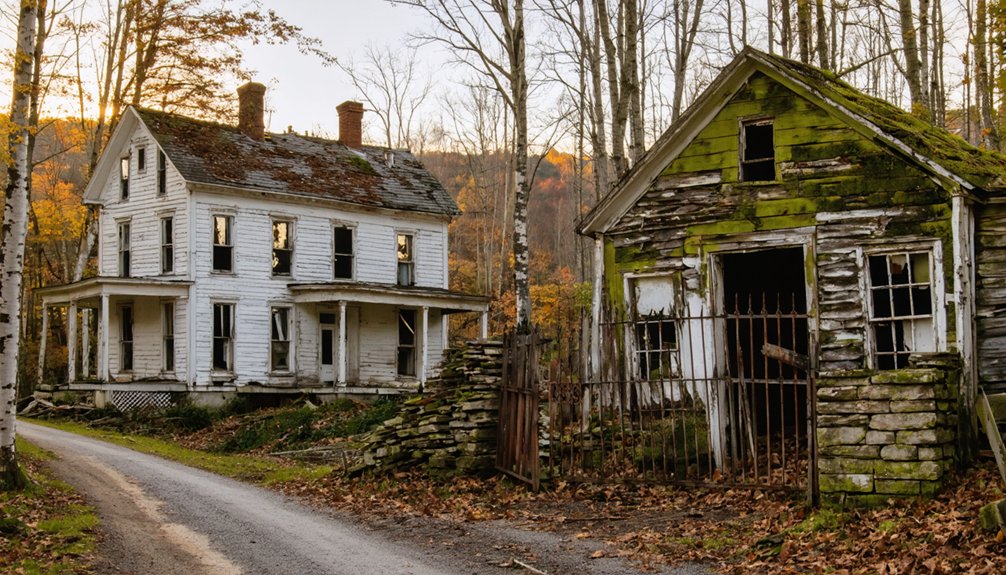
When Vermont’s sons marched off to fight in the Civil War, approximately one-tenth of the state’s entire population left for battlefields that would claim 5,194 lives through combat, disease, and imprisonment. This staggering sacrifice triggered population depletion effects that devastated rural communities like South Lincoln for generations.
You’ll understand why these hillsides emptied when you consider the demographic decline factors: entire farms abandoned after all sons perished in battle, young survivors fleeing for employment elsewhere, and economic malaise that prevented recovery for decades. Between 1880 and 1890, Vermont’s population grew by merely 136 residents while America’s surged 25 percent.
The cellar holes you’ll discover weren’t just abandoned—they’re monuments to families erased by war, their lands consolidated by wealthier operators who reshaped Vermont’s agricultural landscape.
Nearby Ghost Towns Worth Adding to Your Journey
- Visible stone walls and undiscovered cellar holes mark former farmstead locations
- Established trails minimize native wildlife interactions while providing historical access
- Park infrastructure eliminates trespassing concerns plaguing privately-owned sites
Somerset’s logging-era remnants and Graniteville’s quarry infrastructure provide industrial heritage perspectives, while West Castleton integrates settlement remains within Bomoseen State Park’s developed facilities.
Supernatural Stories and Local Haunted Legends
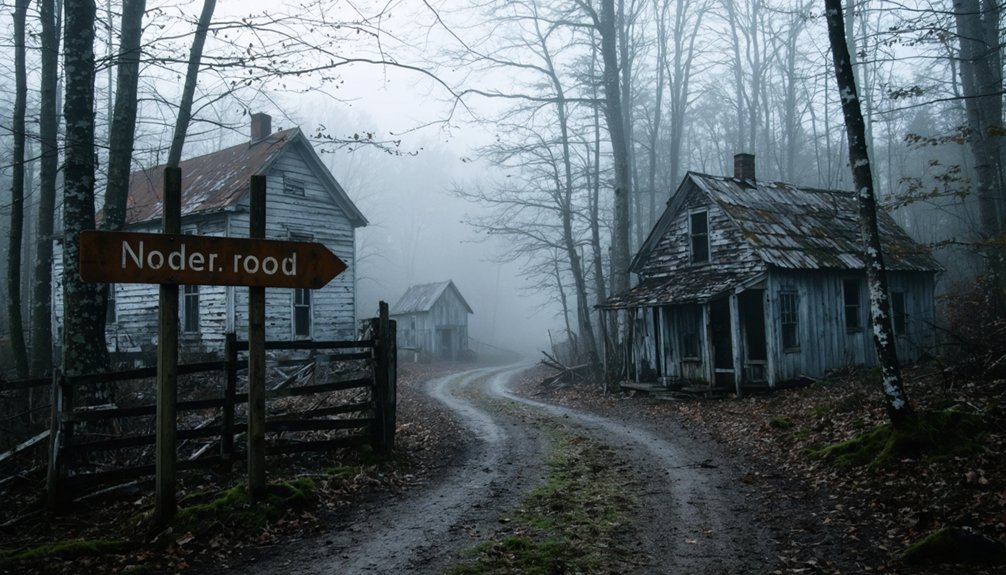
Vermont’s documented paranormal phenomena extends beyond South Lincoln’s abandoned homesteads into surrounding regions where historical tragedy intersects with unexplained phenomena. You’ll find Emily’s Bridge in Stowe, where visitors report unexplained car scratches and nocturnal weeping sounds.
The Equinox Resort hosts Mary Todd Lincoln’s apparition, documented through guest encounters with cold drafts and mirror reflections. Smugglers’ Notch’s criminal history during Prohibition fuels reports of eerie cliff echoes and surveillance sensations along isolated trails.
The Bennington Triangle‘s 1945-1950 disappearances remain unresolved, with hikers experiencing disorientation near Glastenbury Mountain. Lincoln area haunted landmarks include Robbers Cave‘s outlaw spirits and Deer Leap Mountain’s ghostly mists. Chittenden’s 19th-century spirit conjuring sites complete this network of authenticated supernatural accounts. These locations offer freedom-seekers tangible connections to Vermont’s unexplained historical record.
The haunted history of Brookside, Vermont adds another layer of intrigue to the region’s already rich tapestry of lore. Tales of spectral encounters and eerie happenings draw both thrill-seekers and history buffs alike, eager to uncover the mysteries that linger in the shadows. As visitors explore Brookside’s haunted sites, they become part of a living narrative that continues to evolve with each retelling.
Best Time to Visit and Road Conditions
Planning your ghost town expedition requires strategic timing, as South Lincoln’s remote location demands careful consideration of seasonal accessibility patterns. Summer months (June-August) provide ideal conditions with 70-80°F temperatures and 15-hour daylight windows, though mid-July crowds may impact rural highway flow.
Strategic summer planning maximizes South Lincoln accessibility, balancing optimal weather conditions against seasonal visitor patterns on remote Vermont routes.
Fall’s September-October window offers spectacular foliage and lower humidity, but late-season snow threatens Route 125 access.
Monitor these essential resources before departure:
- 511 map system – Delivers real-time weather updates and road hazard notifications for Route 116, Vermont’s primary South Lincoln artery
- VTransparency interactive platform – Tracks current closures and plow operations on mountain segments
- WeatherBug traffic cameras – Provides live Lincoln road surveillance unavailable through standard state channels
Winter travel (November-April) faces 80+ inch snowfall totals and frequent closures, requiring advance verification through town offices for unmonitored local roads.
Essential Supplies and Safety Tips for Remote Mountain Roads
Before venturing into South Lincoln’s backcountry, you’ll need to transform your vehicle into a self-sufficient expedition unit capable of handling Vermont’s unforgiving mountain terrain. Schedule exhaustive emergency maintenance checks covering brakes, tires, fluid levels, and battery systems.
Pack alternate fuel sources—extra canisters prove essential where gas stations vanish for fifty-mile stretches. Your toolkit should include jumper cables, portable air compressor, recovery boards, and tow strap for self-extraction scenarios. Equip with paper maps since GPS signals fail consistently in these valleys.
Weather shifts rapidly in Green Mountain passes; monitor forecasts and identify escape routes. Use lower gears on descents to prevent brake fade, pulling over when they smell acrid. Keep blankets, flashlight, and fire extinguisher accessible. Stack three days’ worth of supplies beyond your planned duration—independence demands preparation.
Frequently Asked Questions
Are There Any Restaurants or Lodging Options Near South Lincoln?
Like discovering a hidden trail, you’ll find dining establishments near South Lincoln including Two Brothers Tavern and Starry Night Cafe. For overnight accommodations, Lincoln Inn & Restaurant at Covered Bridge offers lodging with exceptional farm-to-table cuisine.
Can I Hike to the Old Mill Ruins in Little Canada?
Yes, you’ll access Little Canada’s ghost town history via Mill Trail—conserved by Stowe Land Trust in 2001. Local conservation efforts preserved these 1840s mill ruins and cabin remains, offering you unrestricted exploration through Vermont’s mountain heritage.
Is Camping Allowed Near the Abandoned Settlements?
Carefully consider camping regulations before settling near settlements. You’ll find Green Mountain National Forest permits dispersed camping 200+ feet from trails, but private property concerns complicate abandoned sites. Always verify land ownership and secure necessary permissions beforehand.
Do I Need a 4WD Vehicle for Duxbury Road?
You don’t need 4WD for Duxbury Road under normal conditions, though high clearance required during spring thaw when mud conditions variable. Standard vehicles suffice most seasons, but you’ll want real-time verification through Vermont 511 before departing.
Are There Guided Tours of the Ghost Towns Available?
No formal guided tours operate in this remote area. You’ll navigate these abandoned settlements through self-guided tours, exploring at your own pace. Audio tours aren’t available, so you’re free to document and interpret these historical sites independently.