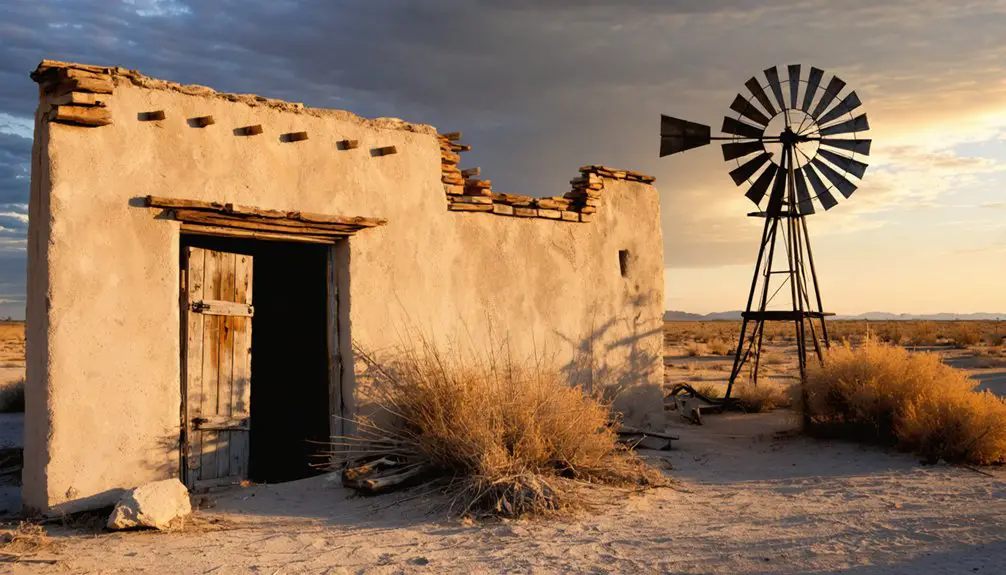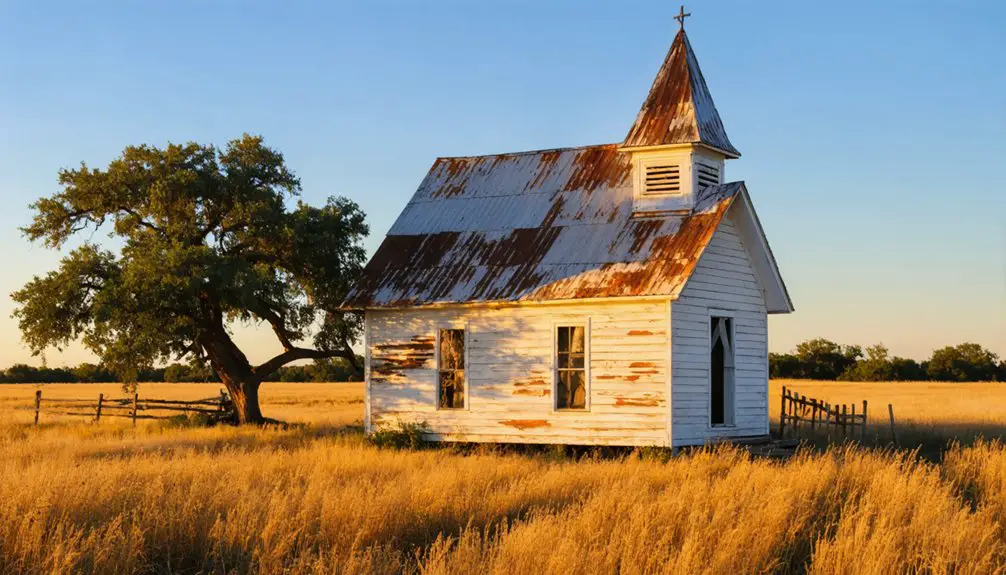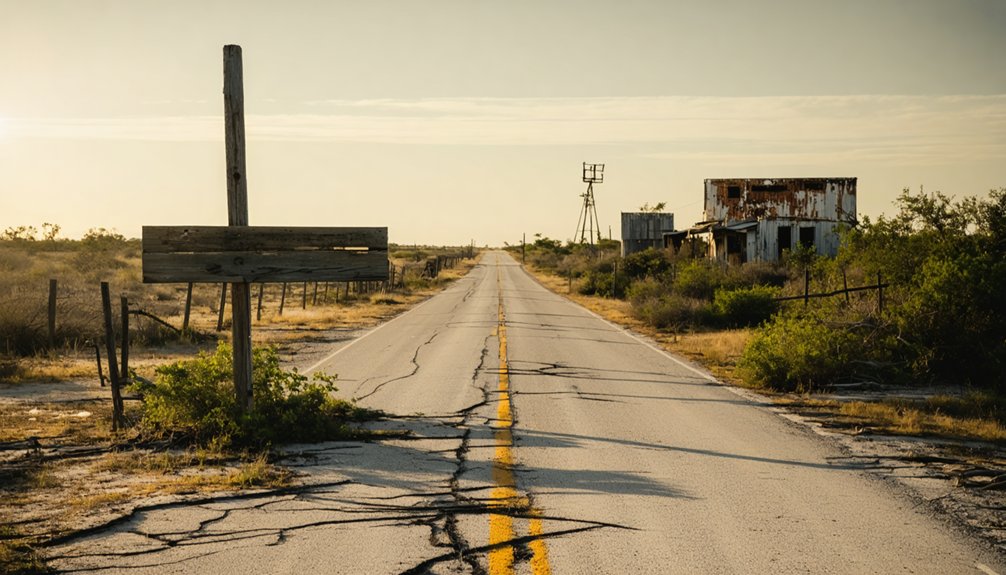
Start your ghost town road trip in Bayside, using it as your base camp before heading toward Copano Bay’s shoreline. You’ll explore the weathered Wood Mansion, walk among storm survivors’ graves at St. Mary’s Cemetery, and stand at the birthplace of the “Savior of the Alamo.” This once-thriving port town that rivaled Galveston was silenced by hurricanes, bypassed by railroads, and finally abandoned by 1907. Everything you need to plan your journey through Texas coastal history lies just ahead.
Key Takeaways
- Start your road trip in Bayside, Refugio County, using it as a base to access St. Marys of Aransas along Copano Bay’s shoreline.
- Explore the Wood Mansion, a two-story structure built in 1875 by Major John Howland Wood, offering rich historical atmosphere.
- Visit St. Mary’s Cemetery to discover gravestones of survivors from the devastating hurricanes of 1866 and 1887.
- Stop at the Clara Driscoll Monument, marking the birthplace of the famed “Savior of the Alamo” and her family’s legacy.
- Extend your trip by visiting nearby ghost towns like Aransas City, Lamar, and Copano for a fuller coastal Texas experience.
What Made St. Marys of Aransas a Ghost Town?
Once a thriving port town rivaling Galveston as the busiest harbor in Texas, St. Marys of Aransas carried enormous historical significance throughout the mid-1800s.
You can trace its town decline through a brutal sequence of setbacks: federal warships captured it unopposed during the Civil War, hurricanes hammered its wharves in 1866 and 1887, and the San Antonio and Aransas Pass Railway bypassed it entirely, choosing Rockport instead.
Morgan Lines steamships briefly connected it to broader markets, but shallow reefs ended that lifeline by 1875. With no railroad and no reliable shipping, residents scattered.
The post office and general store closed permanently in 1907. What once housed 5,000 people fell silent, eventually absorbed by neighboring Bayside, leaving only ruins, monuments, and stories for adventurous travelers like you to uncover.
How To Reach St. Marys of Aransas From Bayside
Reaching St. Marys of Aransas from Bayside is straightforward once you know the lay of the land. The ghost town sits just outside this small Refugio County community, which developers E.O. Burton and A.H. Danforth shaped after acquiring the land in 1909.
For navigational tips, head toward Copano Bay’s shoreline from Bayside’s main roads — the remnants aren’t hidden, just forgotten. Scenic routes along the bay offer stunning coastal views that mirror what 19th-century travelers experienced on wagon trains bound for San Antonio and Goliad.
Keep shallow reefs and storm-battered terrain in mind as you navigate. The freedom of exploring a place time abandoned is yours the moment Bayside’s modern streets fade and St. Marys’ weathered silhouettes emerge on the horizon.
Which St. Marys Historic Sites Are Still Accessible Today?
Arriving at St. Marys, you’ll discover several historic landmarks still standing amid this hauntingly beautiful ghost town. Each site tells a raw, unfiltered chapter of Texas coastal history:
- Wood Mansion – Built in 1875, you can step inside Major John Howland Wood’s former second home.
- St. Mary’s Cemetery – Walk among graves of survivors who endured late 19th-century devastating storms.
- Clara Driscoll Monument – Stand at the birthplace of the “Savior of the Alamo” on her family’s former homestead.
- Catholic Church & Presidio Mill Remnants – Explore the abandoned church and ore reduction mill ruins for authentic ghost town atmosphere.
These surviving structures reward your adventurous spirit with tangible connections to a once-thriving port that rivaled Galveston itself.
What To Expect Inside St. Marys’ Wood Mansion
Stepping through the door of the Wood Mansion, you’re immediately transported back to 1875, when Major John Howland Wood commissioned this two-story structure as his second home along Copano Bay.
Unlike most ghost town remnants, this mansion’s architecture remains accessible from the inside, letting you walk the same floors that once hosted one of St. Mary’s most prominent figures.
Rare among ghost town ruins, this mansion still welcomes visitors inside to walk floors steeped in St. Mary’s storied past.
You’ll notice the historical significance embedded in every weathered beam and aging wall — this wasn’t just a wealthy man’s retreat, it was a statement of confidence in a thriving coastal port town.
Explore the rooms freely, absorb the silence, and imagine the bustling 5,000-resident community that once surrounded these walls before storms, railways, and time conspired to erase nearly everything else.
How To Plan a St. Marys Ghost Town Road Trip Along Copano Bay
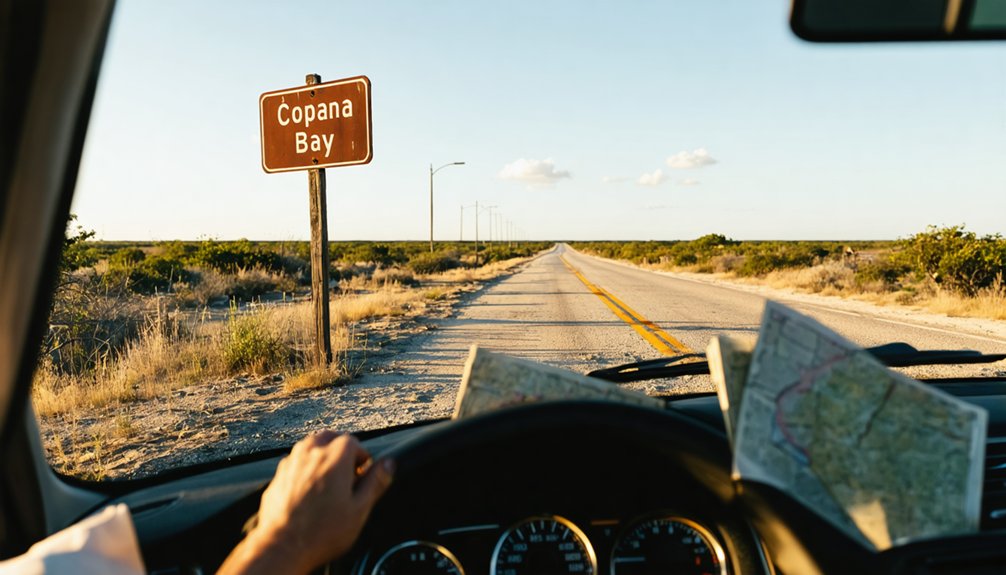
Planning your road trip to St. Marys means embracing ghost town history along Refugio County’s windswept coast.
You’re tracing a town that once rivaled Galveston, now swallowed by time and storms. Access through Bayside keeps things simple while the coastal attractions reward every curious traveler.
Follow this focused itinerary:
- Drive into Bayside via Refugio County roads, using it as your modern base camp.
- Explore the Wood Mansion, built 1875, where history walks beside you.
- Visit St. Mary’s Cemetery, reading gravestones of storm survivors from the 1800s.
- Stop at the Clara Driscoll monument, honoring the Alamo’s savior at her family’s former homesite.
Combine nearby Copano Bay ghost towns — Aransas City, Lamar, Copano — for a full coastal expedition worth every mile.
Before You Go: Safety at Abandoned Sites
Ghost town structures have stood without maintenance for decades. Floors, stairs and roof timbers fail without warning, and a building that looks solid from outside may not hold your weight. Stay out of standing structures unless the site is actively maintained and open to visitors.
Mine workings are the more serious hazard. Vertical shafts can be hundreds of feet deep, are often unfenced, and may be hidden by brush or capped with rotted boards. Never enter an adit, tunnel or shaft: abandoned workings can hold oxygen-poor or toxic air that gives no warning before you lose consciousness.
Enclosed spaces with rodent droppings carry a risk of hantavirus, which is contracted by breathing contaminated dust. Do not sweep or stir up dust inside old cabins and outbuildings.
Cell coverage at these sites is usually poor or absent. Tell someone your route and expected return time, and carry more water than you think you need.
Frequently Asked Questions
Was St. Marys of Aransas Ever the Refugio County Seat?
Yes, St. Mary’s of Aransas once blazed with historical significance as Refugio County’s county seat! You’d have witnessed a thriving empire before it surrendered that powerful title, fading into the ghost town you’ll adventure through today.
What Newspaper Was First Published in South Texas at St. Marys?
You’ll discover that “Vaquero” pioneered newspaper history and local journalism in South Texas, launched right in St. Mary’s. That adventurous press gave early Texans a free, bold voice before the town’s remarkable rise faded into legend.
How Did Federal Warships Capture St. Marys During the Civil War?
Federal warships claimed St. Mary’s without firing a shot during the Civil War — a bold Naval Strategy made possible because the town’s men had left for battle, leaving you defenseless against two unopposed ships seizing your harbor.
Who Were the Developers That Acquired St. Marys Land in 1909?
Two bold dreamers sealed St. Mary’s fate: in 1909, you’d find E.O. Burton and A.H. Danforth dominating the land acquisition story. These developer profiles reshaped a ghost town’s legacy into Bayside’s free-spirited future.
Why Did Morgan Lines Steamships Stop Serving St. Marys in 1875?
Shallow reefs forced the steamship decline you’d uncover on this journey — Morgan Lines couldn’t navigate St. Mary’s tricky waters, triggering transportation changes that severed the town’s lifeline and accelerated its haunting, inevitable fade into ghostly silence.
References
- https://texashighways.com/travel-news/four-texas-ghost-towns/
- http://www.stxmaps.com/go/st-marys-ghost-town.html
- https://portaransasmuseum.org/pam-wheat-stranahan-ghost-towns-of-copano-bay/
- https://www.tshaonline.org/handbook/entries/st-marys-of-aransas-tx