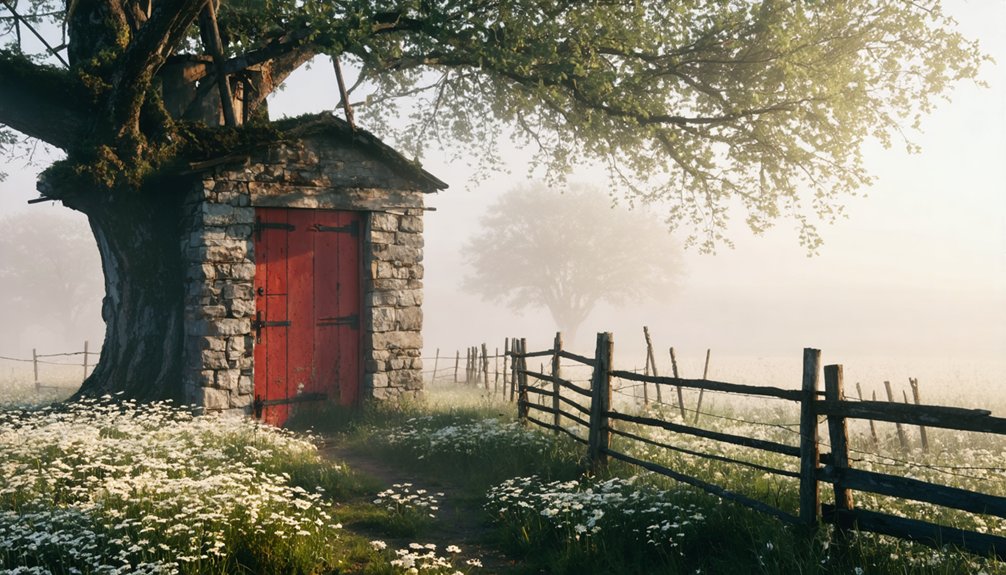
You’ll find Stumptown (not Stumpville) tucked along Van Buren County’s gravel roads, where Gene and Connie Waltz-Zdrazil transformed 1850s ruins into a living museum. The ghost town that George Stump founded in 1851 sits along the Des Moines River, offering restored storefronts, historic buildings, and the famous Stumptown Shooters fireworks displays. Time your visit around community events like Trek Fest to experience the pyrotechnic spectacles. Below, you’ll discover the settlement’s dramatic rise, mysterious decline, and remarkable resurrection story.
Key Takeaways
- Stumptown (not Stumpville) is a restored ghost town along the Des Moines River, founded in 1851 and revived in 1990.
- The Zdrazil family purchased and restored historic buildings, with major structures scheduled to reopen in 2026 as an interpretive center.
- Community events and fireworks displays by the Stumptown Shooters attract visitors exploring the town’s colorful pioneer history and nickname origins.
- Original settlement declined due to river flooding, bypassed railway routes, and absorption into nearby Selma during the late 1800s.
- Visit restored commercial structures including the old grocery store and post office on the original George Stump townsite.
From River Junction to Stumptown: The Town’s Colorful Past
In the fall of 1851, George Stump laid out a pioneer village along the Des Moines River that would bear his name for generations—though officially, surveyors recorded it as “Independent.” You’ll find references to Stumptown in Van Buren County records alongside early settlers like Captain Miller, the Sommerlot and Black families, and William McHue, men who cleared timber and built their lives near the water’s edge.
The village’s colorful local lore reveals why small frontier settlements earned reputations beyond their size. Job Carter drowned swimming to his distillery during spring floods in 1851—environmental hardships that tested every resident. Three years later, Mary Washington‘s unexplained suicide shocked the community. Seth Richards’ store and A.J. Perviance’s hotel served settlers who’d chosen this remote junction, where the river dictated fortune and tragedy alike.
Why This Thriving Settlement Became a Ghost Town
Why did a settlement bustling with merchants, travelers, and ambitious pioneers fade into memory while neighboring towns flourished? You’ll find Stumptown’s demise mirrors a pattern repeated across Iowa’s frontier—factors leading to town’s decline that stripped communities of their independence.
The changing transportation challenges sealed Stumptown’s fate:
- River flooding claimed lives like Job Carter’s 1851 drowning, making settlement increasingly dangerous
- Railway route selections bypassed the original townsite, shifting commerce elsewhere
- Absorption into Selma erased Stumptown’s identity as larger corporations swallowed smaller settlements
- Trade route evolution rendered George Stump’s original location obsolete
- Business closures throughout the late 1800s left only remnants—a hotel, church, and depot
Stumptown became one of Iowa’s 2,807 abandoned sites, its freedom-loving pioneers scattered to more promising horizons.
The Zdrazils Bring Stumptown Back to Life
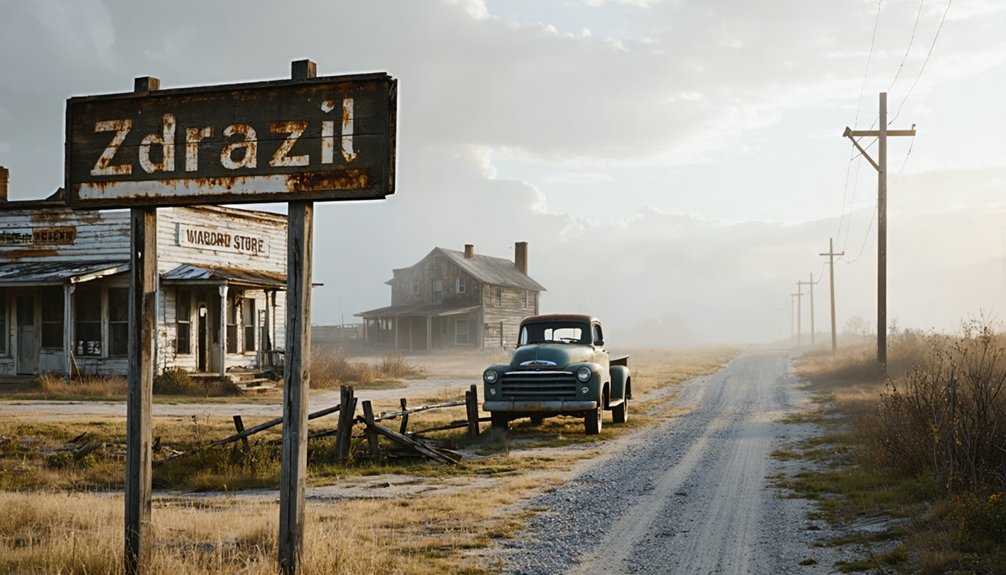
You’ll find Gene and Connie Waltz-Zdrazil’s fingerprints all over Stumptown’s resurrection, starting with their 1990 purchase of the old grocery store and post office buildings that stood weathered and empty.
They rolled up their sleeves, restored those crumbling commercial structures, and seven years later moved Gene’s chiropractic practice from West Branch right into the heart of the ghost town.
That single business decision pushed River Junction’s population over 25—the magic number that put this vanished dot back on Iowa’s official maps.
1990s Renovation Project
When the Zdrazil family first surveyed the overgrown remnants of Stumptown in Van Buren County, they saw past the tangled brush and crumbling foundations to something worth saving. Their historic preservation efforts launched in the early 2020s, transforming forgotten ruins into authentic experiences you can explore.
The Zdrazil family initiatives brought structure to the revival:
- Foundation repairs completed by 2023 stabilized original 1851 structures
- Roof restorations in 2024 used period-appropriate materials
- Interpretive center transformed the old depot area
- Connecting pathways link visitors to nearby Selma railway station
- Historical markers detail pioneer settlers like George Stump and Captain Miller
Through community grants and private donations, they’re reconstructing the original hotel, store, and church buildings. You’ll walk these grounds when they reopen in 2026.
Modern Business and Community
After decades of silence broken only by wind through empty doorframes, the Zdrazil family planted their entrepreneurial roots in Stumptown’s stubborn soil. Where George Stump’s 1851 store once served settlers, modern enterprises now thrive on land north of Farmington’s crumbled foundations. You’ll find businesses echoing that original spirit—stores built on lessons learned from 1861’s mass exodus.
The family’s investment dwarfs O.H.P. Scott’s historic $15,000 venture, generating employment where vacancy reigned. Community events draw visitors curious about the Stumptown nickname’s origins, while economic incentives fuel sustainable growth absent from failed 19th-century attempts. Unlike Iowa’s 352 discarded settlements, this revival avoids ghost town permanence. The Zdrazils transformed abandonment into opportunity, proving stubborn determination trumps historical inevitability when you’re willing to stake everything on forgotten ground.
What You’ll Find in Stumptown Today
Though time has reduced Stumptown to little more than a memory on faded county maps, the landscape still tells its story in fragments. You’ll discover remnants scattered across working farmland, where rural residents maintain their independence despite economic pressures.
Faded maps preserve Stumptown’s name, but the land itself holds the real story—fragments of independence scattered across working fields.
The area occasionally hosts musical performances that draw communities together, celebrating resilience through sound.
What remains includes:
- Crumbling foundation stones hidden beneath overgrown vegetation
- A weathered cemetery marking generations who built lives here
- Dirt roads leading nowhere, once crucial arteries of commerce
- Agricultural fields stretching endlessly where homes once stood
- Local gathering spots preserving stories through oral tradition
The surrounding tri-state region keeps Stumptown’s spirit alive through cultural events, reminding visitors that ghost towns aren’t just abandoned places—they’re records of adaptation, survival, and the freedom to forge new paths forward.
The Famous Stumptown Shooters Fireworks Display
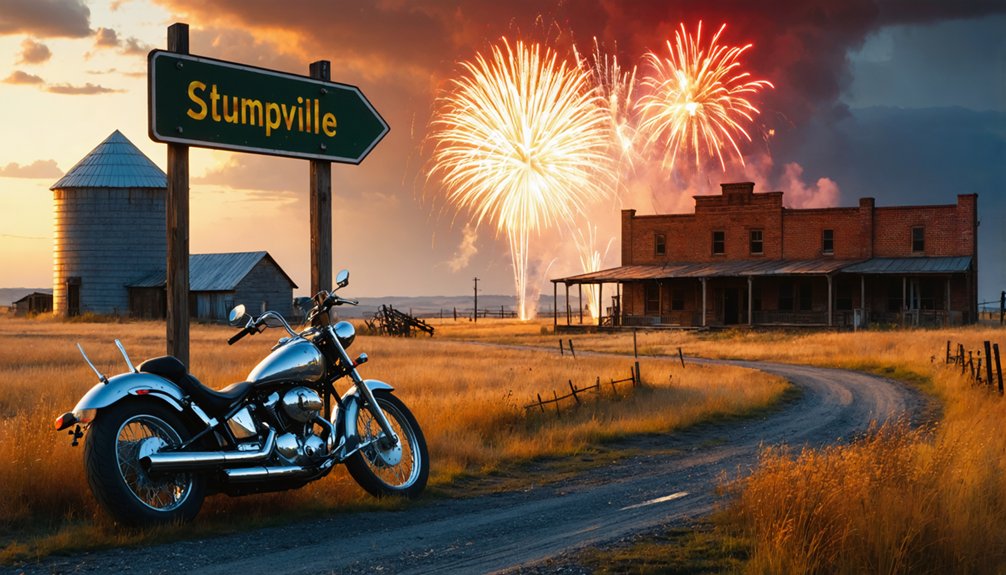
If you time your visit right, you’ll witness the Stumptown Shooters light up the night sky above River Junction—a fireworks spectacle that’s been drawing crowds since Gene Zdrazil and Connie Waltz-Zdrazil started this quirky group as hobbyists back in 1991.
What began with a simple Class C consumer permit has evolved into a professionally certified outfit that now teaches fireworks safety and performs at everything from the Johnson County Fair to Trek Fest.
I’ve watched their September displays from the field at 1472 240th St., where the explosions echo across the empty prairie where downtown Stumptown once stood.
Annual Display Schedule
The crack and boom of professional pyrotechnics echo across Iowa’s summer sky five times a year when the Stumptown Shooters take center stage. You’ll catch their expertise at these cornerstone events:
- Trek Fest’s explosive finale
- Johnson County Fair’s nighttime spectacular
- Lone Tree’s Fall Fest celebration
- The prestigious Pyrotechnics Guild Convention showcase
- River Junction’s community gathering
Want to join their ranks? Saturday certification class schedule sessions in Hills immerse you in fireworks safety protocols, followed by hands-on experience. You’ll break bread at a potluck supper, enjoy New Tribe Band’s live music, then witness darkness transform into cascading light. Each class counts toward your mandatory five-show requirement—turning spectator into pyrotechnician.
It’s freedom expressed through controlled chaos, where chemistry meets artistry above Iowa’s endless horizon.
Group History and Leadership
Behind every light show lies a band of obsessed souls who’d rather smell sulfur than fresh-cut grass. The Stumptown Shooters emerged organically in the mid-1990s when pyrotechnic enthusiasts from Iowa and neighboring states started gathering in River Junction. No founding documents, no formal ceremonies—just smoke-smellers who craved fireworks artistry when Iowa’s ban still gripped the state.
Mark Woodburn became a key contact as leadership evolution happened naturally among the crew. They focused on safety education and pushing for legalization, connecting through community networks that stretched across state lines. Their mission? Teaching the public, media, and legislators that fireworks aren’t just chaos—they’re controlled art.
You’ll find their displays reflect decades of underground passion that finally went legitimate in 2017.
Other Iowa Ghost Towns Worth Exploring
Beyond Stumpville’s weathered foundations, Iowa harbors dozens of abandoned settlements waiting for curious explorers. You’ll find these forgotten places scattered across the state, each preserving fragments of pioneer dreams and local folklore surrounding ghost towns.
Exploring these historical sites in Iowa can be both a haunting and enlightening experience for those willing to venture off the beaten path. Each site tells a unique story, offering a window into the past and allowing visitors to engage with the history of the land. Whether you’re a history buff or simply seeking adventure, these locations promise to captivate your imagination.
Iowa’s abandoned settlements stand as silent witnesses to pioneer ambitions, their weathered remains beckoning modern explorers into forgotten chapters of history.
- Rockville (Sherburne County) – Creepy remnants of old structures draw urban explorers
- Elkport (Clayton County) – Minimal remains but accessible for wanderers
- Buckhorn (Jackson County, Highway 64) – Abandoned church and creamery ruins beside an old cemetery
- Carrollton (Carroll County) – Former county seat that withered after the 1867 railroad bypassed it
- Sunbury (Cedar County) – Railroad boomtown famous for its 1895-1964 dance hall
These sites showcase community preservation efforts while offering you unrestricted exploration. Pack your camera, respect the land, and chase these ghostly destinations on your own terms.
Planning Your Visit: Best Times and Access Points

After exploring Iowa’s scattered ghost towns, you’ll want to time your Stumpville expedition right. Spring’s 50-70°F temps offer comfortable exploration of 1850s depot remnants, while fall’s foliage enhances scenic drives with minimal crowds. Summer grants extended daylight for photographing original dwellings, though humidity hits 80%. Skip winter—snow buries access roads and freezes Des Moines River crossings.
For accessibility considerations, enter via the former railroad depot in Village Township, south of the river. The southwest corner of section 7 brings you closest to George Stump’s 1851 plat. You’ll find surviving structures along the original rail line: hotel, store, church. Highway 92 connects to broader Marion County routes, while 216 Place north provides marker signage. Watch spring rainfall—35 inches annually creates flooding risks near those historic trestle-work sites.
Making the Most of Your Ghost Town Adventure
While Stumpville’s crumbling foundations anchor your exploration, the surrounding Marion County landscape holds a dozen more ghost towns waiting to be discovered on a single weekend trip.
You’ll maximize your adventure by understanding each site’s historical significance before arrival. Pack these essentials:
- Cemetery maps for locating original settler graveyards
- Railroad timeline charts showing bypass routes that doomed towns
- Camera gear for capturing deteriorating structures at golden hour
- Topographic maps marking old stage line paths
- Field notes documenting community preservation efforts
Connect with local historians who’ve maintained sites like Jim Newton’s work preserving Knowlton’s original shop building. You’ll find most ghost town enthusiasts avid to share stories about vanished communities. These weekend expeditions offer unmatched freedom—no crowds, no admission fees, just raw history beneath your boots.
Frequently Asked Questions
Are There Any Accommodations or Lodging Options Available in or Near Stumptown?
You won’t find lodging in abandoned Stumpville itself, but nearby towns offer local bed and breakfasts within 20 miles. For adventurous souls, nearby camping options let you sleep under Iowa’s stars, embracing true freedom on your ghost town exploration.
What Safety Precautions Should Visitors Take When Exploring the Old Structures?
You’ll want to avoid unstable structures with crumbling foundations and rotted floors. Wear protective gear like sturdy boots and helmets against falling debris. Travel in groups, carry flashlights, and inform someone of your exploration plans before venturing inside.
Is the Cemetery Open to the Public for Genealogy Research?
Cemetery access isn’t well-documented, so you’ll need to contact local historical societies directly. Graveyard access hours vary seasonally, and genealogical resources available depend on preservation efforts. Always respect boundaries—freedom comes with responsibility when exploring abandoned places.
Does the Chiropractic Office Accept Walk-In Appointments From Road Trip Visitors?
I can’t confirm walk-in availability since Stumpville’s chiropractic office details aren’t accessible. You’ll need to check their hours of operation and appointment scheduling policies directly before hitting the road. Call ahead to avoid disappointment on your freedom-seeking adventure.
Are There Fees Required to Access Stumptown or Its Remaining Buildings?
You’ll find no admission fees at Stumptown—it’s freely accessible public land. However, preservation concerns limit building entry due to structural dangers. You’re welcome to explore the historical significance from outside, respecting these abandoned structures’ fragile state.