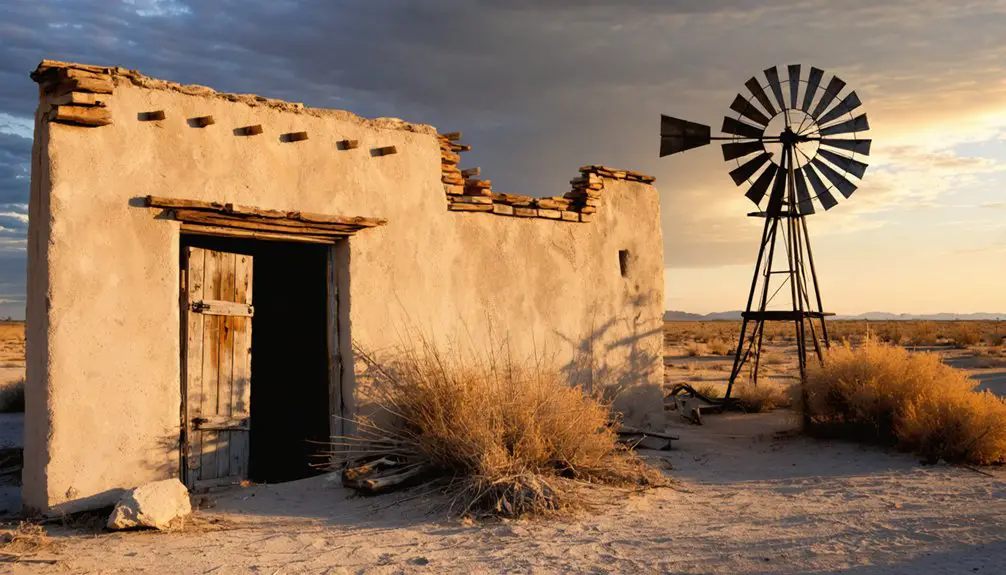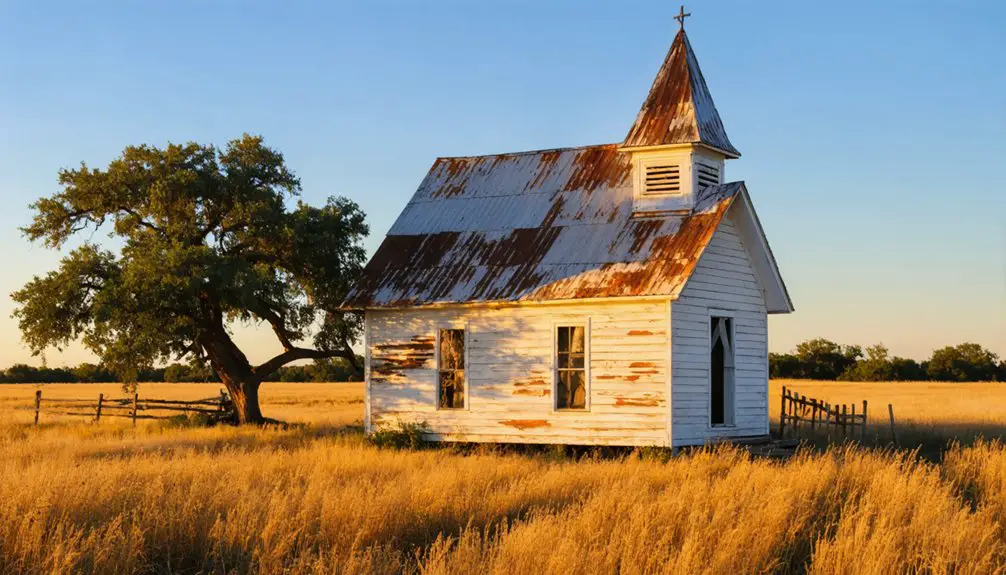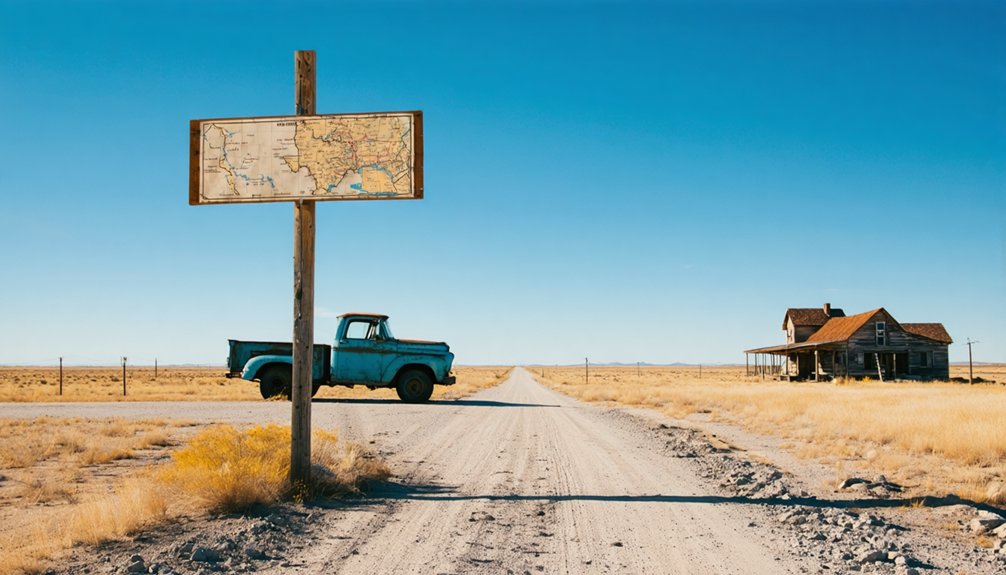
You’ll find Port Sullivan one mile northeast of Farm Road 485 in eastern Milam County, where limestone bluffs once sheltered 680 residents and bustling cotton warehouses along the Brazos River. Navigate to coordinates 30.88352°N, 96.70331°W, though you’ll discover the terrain has reverted to anonymous grassland with no visible remnants of the 1860s trading hub. Pack sturdy boots, GPS with offline maps, and sun protection for exploring the consecrated 5-acre cemetery that preserves this vanished community’s legacy through 173 memorials and crumbling headstones.
Key Takeaways
- Port Sullivan sits on a Brazos River bluff in eastern Milam County, one mile northeast of Farm Road 485.
- Visit late autumn for mild 70°F temperatures, clear skies, and fewer tourists at this completely erased ghost town.
- Pack sturdy boots, GPS device, water, sun protection, and camera as terrain is undeveloped with unreliable cell service.
- Explore Port Sullivan Cemetery northeast of County Road 259A, featuring 173 memorials and Historical Texas Cemetery Marker No. 14570.
- Combine your visit with nearby Cameron’s 1892 courthouse, Brazos River activities, and regional cemetery trail tours in Rockdale.
Getting to Port Sullivan: Directions and Access Points
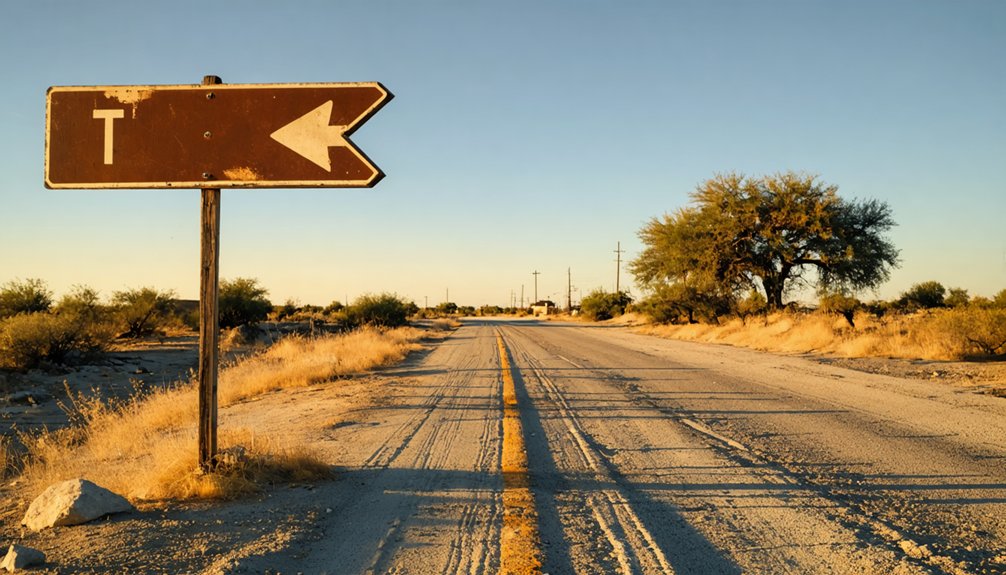
Tucked away in the rolling prairie of eastern Milam County, Port Sullivan sits one mile northeast of Farm Road 485, perched on a low bluff that once welcomed steamboats churning up the Brazos River. You’ll find this ghost town at coordinates 30.88352°N, 96.70331°W, straddling the border with Robertson County.
The settlement origins trace back to 1851 when developers subdivided this strategic bluff into town lots, capitalizing on its flood-free elevation above a limestone boulder shoal. Today, you can explore river access points at the put-in (30.88972, -96.69223) and take-out (30.86638, -96.69528) for paddling adventures.
Look for the Port Sullivan Church and cemetery marking this unincorporated community, where merely fifteen souls now inhabit what was once a bustling riverboat landing. The town was established in 1835, making it one of the earliest settlements in the region. At the site, you’ll encounter a stone marker that erroneously refers to the location as “Fort Sullivan”.
The Rise and Fall of a Texas River Town
On a December day in 1835, August W. Sullivan claimed a bluff that’d become Texas’s most vibrant river port. You’d have witnessed remarkable growth—from empty land to 680 residents by 1860.
The trading economy thrived as steamboats hauled cotton, hides, and pecans between Galveston and this limestone-sheltered landing. Four stores, warehouses, and even a college emerged from the wilderness.
The town’s elevated position kept floodwaters at bay while booming business attracted merchants ordering goods from New York. Doctors and lawyers hung their shingles along streets buzzing with commercial activity.
Then railroads changed everything. Steel tracks bypassed river towns, strangling Port Sullivan’s lifeline. Businesses fled to rail-served communities. The steamboats stopped coming.
Today, you’ll find just fifteen souls and a cemetery where hundreds once chased prosperity along the Brazos. Not far away in Hidalgo County, another Sullivan City was formally opened in 1908, named after World War veteran Captain Ed Sullivan.
What Remains: Exploring the Ghost Town Today
While Port Sullivan once commanded the Brazos River bluffs in Milam County, its namesake ghost town in Guadalupe County tells a different story of complete erasure. You’ll find no crumbling facades or weathered foundations here—nature’s landscape restoration has been absolute. The vanished infrastructure left no trace: no roads, no building remnants, no rusted fence posts marking property lines.
When you arrive, you’re confronting open fields where a community once thrived. The terrain’s reverted to undeveloped land, accessible through general county routes without designated markers or trails. You’ll need to determine whether you’re on private property before exploring these anonymous grasslands.
This complete disappearance sets Sullivan apart from Texas’s partially-preserved ghost towns, offering something rawer: absolute freedom from preservation efforts and tourist infrastructure. Unlike nearby Sweet Home, which maintained a population of 80 persons in the year-2000 census, Sullivan left no demographic footprint. While Sullivan vanished generations ago, 75 Texas counties experienced population losses from 2022-2023, showing how depopulation continues reshaping the state’s landscape today.
Port Sullivan Cemetery and the Anderson Monument
Unlike Sullivan’s vanished landscape in Guadalupe County, Port Sullivan’s legacy clings to existence through five acres of consecrated ground northeast of County Road 259A. You’ll find St. Paul’s Masonic Lodge No. 177’s 1867 purchase transformed this plot into something more than earth and markers—it became a memorial to Masonic burial practices that honored brotherhood beyond death.
The cemetery’s crown jewel stands in Thomas J.H. Anderson’s monument. Anderson’s life history reads like Texas itself: born November 26, 1828, in Alabama’s Pike County, he rose to Grand Master of the Grand Lodge of Texas before his Houston death on August 29, 1871. His interment here wasn’t accidental—it was deliberate, meaningful. The site holds designation as Historical Texas Cemetery Marker No. 14570. Today, San Andres Masonic Lodge No. 170 maintains these grounds, preserving what merchants and sawmills couldn’t: memory.
Within this historic burial ground rest 173 memorials, with over 80% documented through headstone photographs that capture the stories of Port Sullivan’s pioneers and their descendants.
Robert E. Lee’s Connection to Port Sullivan
The Second Cavalry’s deployment to Texas frontier defense brought Robert E. Lee to Port Sullivan during the 1850s, tasked with quelling Indian uprisings that threatened central Texas settlements. You’ll find his presence here particularly significant—lee’s frontier operations included commanding just 2,886 troops to defend 1,200 miles against 30,000 dispersed raiders.
He led grueling 40-day expeditions through scorching valleys and canyons, scouting the Brazos region where Port Sullivan thrived as a 200-resident river port. Port Sullivan Cemetery serves as the final resting place of Thomas J. Anderson, grand master of Masons of Texas, whose grave is marked with a 9-foot marble monument. The town’s economy relied heavily on Brazos bottom planters who cultivated their lands with slave labor throughout the antebellum period. Lee’s impact on texas extended beyond military campaigns; he pursued Cortina to the Rio Grande, negotiated with Mexican officials, and even contributed to building San Antonio’s Episcopal church. This posting preceded his fateful decision to resign his commission when Virginia seceded in 1861, forever changing American history.
Best Time to Visit and What to Bring
You’ll find Sullivan’s crumbling limestone buildings and weathered gravestones most photogenic during late autumn’s golden light, when October and November deliver mild 70°F days and crystal-clear skies. Pack layered clothing to move from cool morning fog over the Brazos bottomlands to warm afternoon explorations through collapsed storefronts and overgrown foundations.
Your camera equipment, sturdy hiking boots, and sun protection are essential companions for documenting this vanished river town before the brutal Texas summer reclaims its ruins. Fewer tourists visit during the shoulder season months of November, resulting in lower prices on nearby accommodations and a more solitary experience among the abandoned structures.
Ideal Seasonal Conditions
When planning your ghost town adventure to Sullivan, timing becomes everything in this remote corner of Texas where the elements dictate your experience. Local weather variations swing dramatically from winter’s crisp 48°F mornings to summer’s brutal 99°F peaks, while seasonal precipitation fluctuations deliver 22 inches of rain year-round across windswept plains.
Prime visiting windows:
- November through March – Comfortable 70-85°F highs let you explore Sullivan’s ruins without battling oppressive heat
- Wind considerations – Expect 11 mph gusts during winter months, dropping to 8 mph by summer
- Storm preparation – Rain strikes unpredictably throughout the year across this exposed terrain
- Avoid July-August – Sweltering temperatures near 98°F make outdoor exploration dangerously uncomfortable
You’ll find February and March particularly ideal when cool, dry conditions meet minimal crowds.
Essential Exploration Gear
Abandoned structures and crumbling headstones demand respect and preparation as you venture into Sullivan’s weathered landscape. Your packing essentials should include sturdy hiking boots for traversing overgrown cemetery paths and uneven terrain where roads once bustled with riverside commerce.
Bring a wide-brimmed hat and sunscreen—Central Texas sun shows no mercy across these exposed grasslands. Your recommended exploration gear must include a GPS device or offline maps, as cell service proves unreliable in remote Milam County.
Pack plenty of water, a first-aid kit, and a camera to document Sullivan’s haunting remnants. Leather gloves protect hands when examining weathered tombstones, while long pants and sleeves shield against brush and insects that’ve reclaimed this 1835 settlement’s forgotten ground.
Photography Equipment Recommendations
The golden hour transforms Sullivan’s skeletal buildings into dramatic silhouettes, casting long shadows across limestone foundations that once supported a thriving river community. You’ll want gear that captures this abandoned settlement’s raw character without weighing down your exploration.
Essential photography kit for Sullivan:
- Wide-angle lens (16-35mm) – Frame entire deteriorating structures against Texas skies
- Polarizing filter – Cut glare from weathered metal and enhance cloud drama
- Sturdy tripod – Essential for low-light interior shots where camera settings demand longer exposures
- Reflector – Bounce natural light into shadowed doorways and collapsed rooms
Visit during spring or fall when lighting considerations favor mid-morning shoots—harsh summer sun bleaches details you’re seeking. Winter offers crystalline air but unpredictable weather. Pack extra batteries; cold drains power fast.
Nearby Attractions in Milam County
After exploring Sullivan’s weathered remains, you’ll find Cameron’s 1892 Renaissance Revival courthouse rises just miles away, its restored clock tower piercing the sky above brick-lined streets where two museums preserve railroad heritage and frontier justice.
The Brazos River curves through bottomland forests to the east, offering secluded banks for fishing and wildlife watching beneath centuries-old pecan trees. Follow the winding back roads to discover iron truss bridges spanning Brushy Creek and Little River, each structure a portal to Milam County’s past, while historic cemeteries dot the landscape with limestone markers dating to Texas’s earliest settlements.
Historic Cameron County Seat
Cameron’s fighting spirit shines through:
Defeated Rockdale twice (1874, 1880) in county seat relocation battles
Secured multiple railroad lines when competitors gained the first tracks
Transformed isolation into strategic advantage at Highway 77 and 190 intersection
Preserved its 1892 Renaissance Revival courthouse through $3.794 million restoration
You’ll find authentic Texas determination etched into every restored brick.
Brazos River Recreation Areas
Beyond Sullivan’s silent streets, the Brazos River carves through 10,340 square miles of Milam County terrain, creating a water-based playground that’s transformed this corner of Central Texas into an outdoor enthusiast’s destination. You’ll find Mother Neff State Park operating within the study area, while Lake Somerville‘s sprawling 2,365-acre Birch Creek Unit beckons just beyond county lines.
The river faces ecological challenges—overgrazing’s left its mark, soil erosion reshapes banks, and water tables continue dropping. Yet conservation efforts persist. White bass still make their spawning runs up the Paluxy River section, where TPWD maintains collection operations. Whether you’re launching a canoe, casting for bass, or hiking trails that wind through recovering terrain, these waters offer authentic Texas wilderness without the crowds.
Regional Cemetery Trail Tours
Milam County’s 216 cemeteries tell stories the Brazos River can’t—tales etched in weathered limestone and wrought iron, where Tennessee-born pioneers rest beside Hebrew merchants who shaped Rockdale’s boom years. You’ll discover history’s backbone along these cemetery trails, where prominent Rockdale families like the Perrys and Baxters built empires from frontier dust.
Start your self-guided tour at these essential stops:
- Old Rockdale City Cemetery (1874) – Over 40 veterans and founding businessmen under Texas oaks
- Rockdale Jewish Cemetery (1878) – Hebrew headstones honoring Jewish community contributions within ornate iron fencing
- Gilleland Family Cemetery (1848) – Daniel and Precilla’s pioneer legacy predates statehood
- Hobson Cemetery – John Hobson’s Tennessee roots planted deep in Cameron soil
The Historical Commission’s Preservation Grant Fund supports your exploration of these unmarked backroads to freedom.
Frequently Asked Questions
Are There Any Guided Tours Available for Port Sullivan Ghost Town?
You’ll find guided tours availability through the Port Sullivan Museum by calling (254) 697-8963. Former Director Charles King leads knowledgeable expeditions Tuesday-Friday, 9-4. Self-guided tour options let you explore the three cemeteries independently at your own pace.
Is Camping Allowed Near the Port Sullivan Historical Site?
There aren’t designated camping facilities at Port Sullivan’s historical site. You’ll need to seek nearby accommodation options or established campgrounds in Milam County. Always verify local regulations before setting up camp on public land in Texas.
What Safety Precautions Should Visitors Take When Exploring Port Sullivan?
Time-worn ruins whisper danger—watch for loose debris and be cautious of structural instability in crumbling buildings. You’ll need vigilance monitoring river levels, packing essential supplies, and respecting boundaries. Freedom requires responsibility in remote, untamed places.
Are There Any Local Legends or Ghost Stories About Port Sullivan?
Port Sullivan itself lacks documented ghost stories, though haunted structures like the relocated Foster Cabin carry its legacy. You’ll find unexplained phenomena—lilac perfume, phantom footsteps, cold spots—tied to Jane Holt’s spirit at Fort Worth’s Log Cabin Village.
Can Visitors Access Private Property Around the Ghost Town Area?
No, you can’t access the private property without owner permission required. The area’s fenced with barbed wire and gates, and liability concerns keep landowners from granting entry. You’ll face trespassing charges if you venture beyond public roads.
References
- https://en.wikipedia.org/wiki/Port_Sullivan
- https://www.deseret.com/2010/5/17/20382310/early-mormons-settled-central-texas-village/
- https://kids.kiddle.co/Port_Sullivan
- https://www.texasalmanac.com/places/port-sullivan
- https://www.texasescapes.com/CentralTexasTownsSouth/Sullivan-Texas.htm
- https://www.allacrosstexas.com/texas-ghost-town.php?city=Sullivan
- http://www.milamcountyhistoricalcommission.org/info_sought_158.php
- https://www.tshaonline.org/handbook/entries/port-sullivan-tx
- https://www.forttumbleweed.net/portsullivan.html
- https://topoquest.com/place/texas/church/port-sullivan-church/1365596