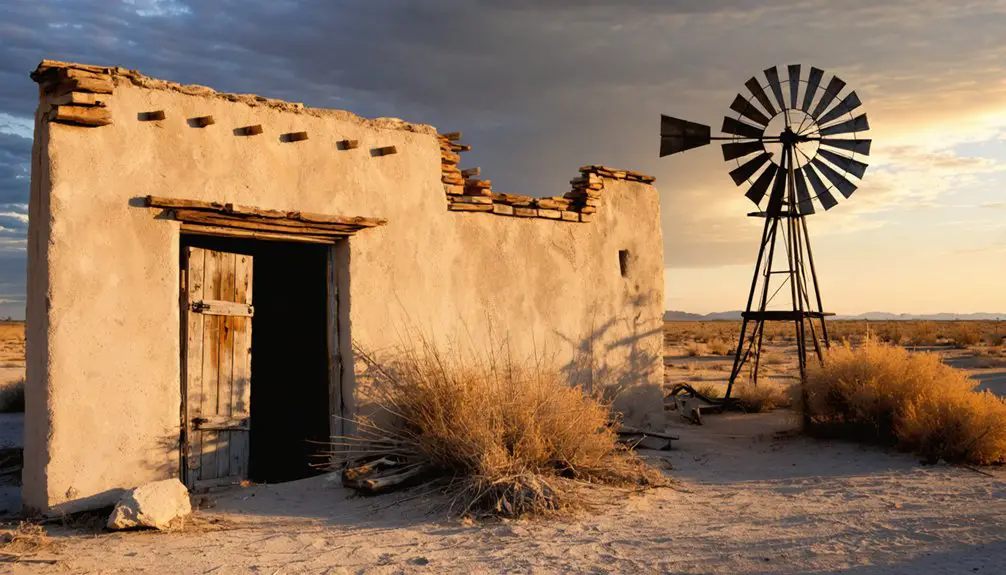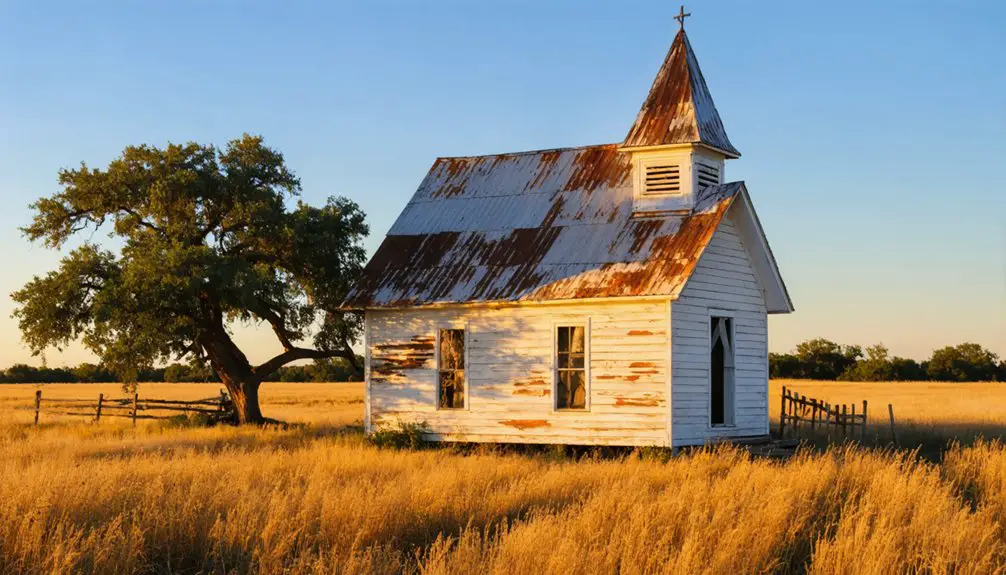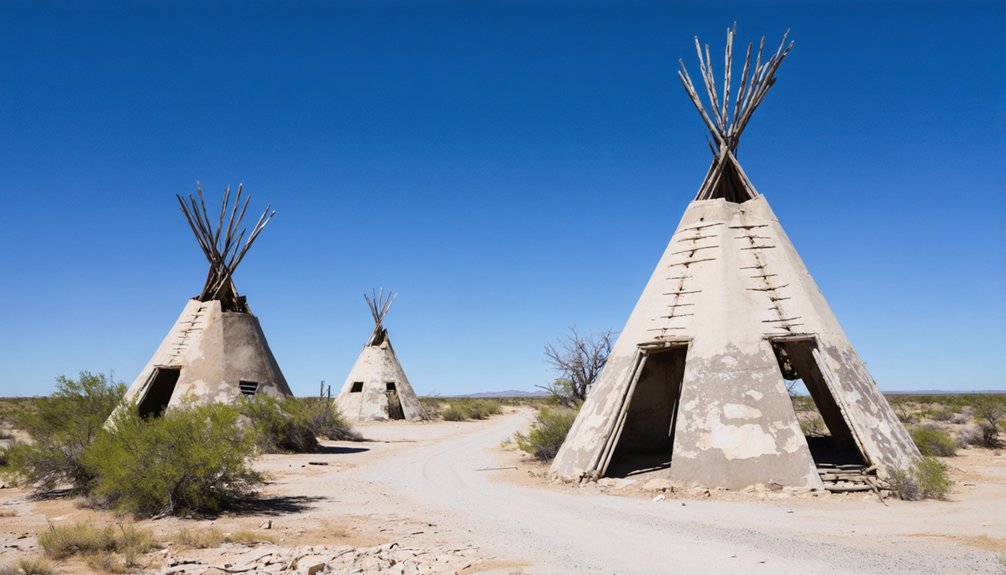
Planning a ghost town road trip to Tee Pee City, Texas means heading about 10 miles east of Matador on US 62/70 into Motley County’s windswept Rolling Plains. You’ll find a roadside park near Tee Pee Creek where buffalo hunters and Texas Rangers once lived lawlessly in the 1870s and ’80s. Visit in spring or fall, pack plenty of water, and download offline maps before you go. There’s far more to this vanished frontier outpost than meets the eye.
Key Takeaways
- Tee Pee City, established in 1875, is located 10 miles east of Matador, Texas, accessible via US 62/70 near County Road 247.
- No structures remain, but a 1936 historical marker and small cemetery with four graves highlight the site’s preserved history.
- Visit during spring or fall for the best weather, avoiding summer heat extremes and potential winter ice storms.
- Pack at least one gallon of water per person, sturdy boots, sun protection, a paper map, and a fully charged phone.
- Use offline maps before arriving, as cell service is poor and rural roads can shift from caliche to impassable dirt after rain.
What Was Tee Pee City, Texas?
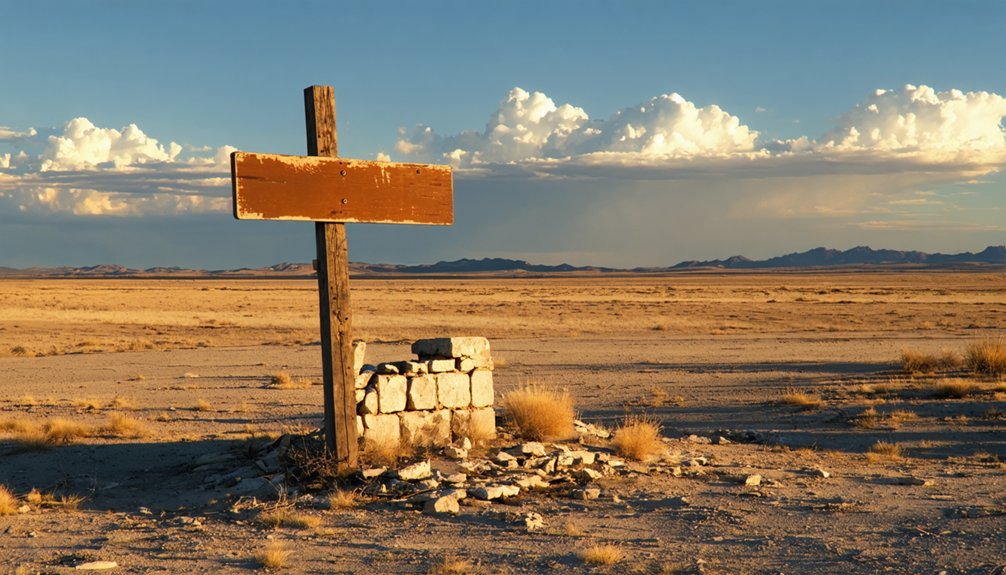
Before Motley County had a courthouse, a school, or even a proper town, it had Tee Pee City — a rough-and-tumble trading post that sprang up along Tee Pee Creek near the Middle Pease River in eastern Texas around 1875.
Buffalo hide traders Charles Rath and Lee Reynolds established it as a lifeline for hunters and surveyors pushing into open frontier country. You’d have found crude dugouts carved into creek banks, picket houses plastered with mud, and a dance hall stocked with equipment hauled in from Dodge City.
It was the only settlement for hundreds of miles in every direction.
Today, this ghost town is little more than a historical marker and a small cemetery — but its story is anything but forgotten.
Where Tee Pee City Sits in Motley County
If you’re planning a road trip to this forgotten frontier outpost, you’ll find Tee Pee City tucked into the eastern corner of Motley County, just 10 miles east of Matador, Texas.
The site rests near the confluence of Tee Pee Creek and the Middle Pease River, where the landscape still carries the quiet character of the Texas Rolling Plains.
You can reach it off US 62/70, where a roadside park east of County Road 247 marks the spot at an elevation of 2,165 feet.
Eastern Motley County Location
Tucked into the eastern edge of Motley County, Tee Pee City once stood near the confluence of Tee Pee Creek and the Middle Pease River, roughly 10 miles east of present-day Matador, Texas. Its coordinates place it at 34°0′17.77″N, 100°38′22.58″W, sitting at an elevation of 2,165 feet above sea level.
You’ll find the historical marker at a roadside park just east of County Road 247 along US 62/70. That marker tells the story of Tee Pee City’s remarkable historical significance as the only settlement west of Henrietta, north of Fort Griffin, and south of Fort Elliott between 1875 and 1880.
For five essential years, this remote Tee Pee location served as a lifeline for buffalo hunters, traders, and surveyors pushing into untamed West Texas territory.
Near Matador, Texas
Matador, Texas serves as your jumping-off point for reaching Tee Pee City, sitting just 10 miles to the west along US 62/70. This small county seat gives you everything you need before venturing out to explore Tee Pee City history and its ghost town legends.
Grab fuel, water, and supplies in Matador before heading east on US 62/70 toward County Road 247. You’ll find the roadside park and historical marker near the confluence of Tee Pee Creek and the Middle Pease River, resting at 2,165 feet elevation.
The surrounding landscape still carries that raw, open character that once drew buffalo hunters and traders here in 1875. Matador keeps you grounded in the present while Tee Pee City pulls you straight into the past.
Tee Pee Creek Confluence
Where Tee Pee Creek meets the Middle Pease River, you’ll find the exact spot where Tee Pee City once thrived in eastern Motley County. This confluence carries deep tee pee history and geological significance, shaping everything from early Comanche camps to buffalo hunter settlements.
Standing here, you’re absorbing a landscape that tells its own story:
- Creek banks once held crude dugout homes carved directly into the earth
- Elevation sits at 2,165 feet, giving the terrain a raw, open character
- Comanche teepee poles originally named this creek
- Buffalo hunters used the waterway as a natural landmark
- The confluence guided traders, Rangers, and settlers toward this remote outpost
This geography wasn’t accidental — it made Tee Pee City possible, then watched it disappear.
The Buffalo Hunters and Traders Who Built It
Before ranchers and fences carved up the Texas Panhandle, buffalo hunters and hide traders ran the show, and Tee Pee City was their hub.
In 1875, Charles Rath and Lee Reynolds established a buffalo trading post here, supplying hunters and surveyors pushing into untamed territory.
You’re standing where men traded hides for ammunition and food, living in crude dugouts carved into the creek bank and rough picket houses plastered with mud.
Frontier life here wasn’t romantic — it was raw, practical, and dangerous.
The buffalo trading economy moved fast, and so did the people driving it.
Texas Rangers, Shootouts, and Frontier Justice
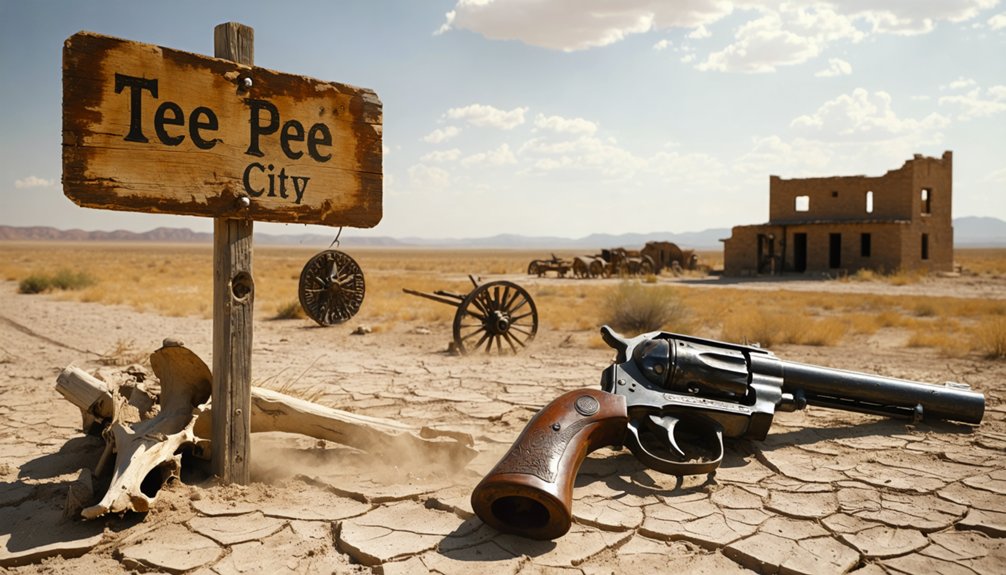
Tee Pee City earned its reputation fast — dance halls, gambling dens, street brawls, and shootings made it one of the rougher corners of the Texas frontier.
Frontier lawlessness ran deep here until Texas Rangers under Captain G.W. Arrington stepped in.
Ranger patrols operated out of Tee Pee City between 1879 and 1881, using it as an interval headquarters to restore order across the region.
Here’s what shaped that volatile era:
- Dance-hall equipment shipped directly from Dodge City
- Street brawls and shootings occurred regularly
- Rangers headquartered here at multiple intervals
- Captain Arrington led enforcement efforts personally
- Order was hard-won and never fully guaranteed
When you visit today, that wild energy feels embedded in the silence itself.
How Tee Pee City Collapsed and Disappeared
Once the buffalo herds vanished in the early 1880s, Tee Pee City lost its entire economic reason for existing.
The Matador Ranch then seized control of the surrounding land and banned cowboys from the site, cutting off what little commerce remained.
Buffalo Herds Disappear
As the buffalo herds vanished from the Texas Panhandle in the early 1880s, Tee Pee City‘s reason for existing vanished with them. The town’s entire economy hinged on buffalo ecology, and once hunters stripped the plains bare, the economic impact hit fast and hard. You can almost feel the silence that replaced the thunder of hooves.
Consider what disappeared practically overnight:
- Buffalo hide trading, the town’s financial backbone
- Hunters and surveyors who kept merchants busy
- The ammunition and food exchange system
- Traveling traders passing through the settlement
- Any reason for newcomers to arrive
Without the herds, Tee Pee City couldn’t sustain itself. The free-ranging economy that had built this wild settlement simply collapsed, leaving empty dugouts and fading memories behind.
Matador Ranch Takes Over
The Matador Ranch delivered the final blow to Tee Pee City‘s already struggling existence. Once the buffalo herds vanished, the ranch banned cowboys from visiting the site, cutting off what little economic lifeline remained.
You can imagine how quickly that decision emptied the streets. By 1886, residents had abandoned the settlement entirely.
Then in 1904, the Matador Ranch completed its matador ranch takeover by purchasing the land and permanently closing it to outsiders. No negotiations, no compromise — just gone.
That’s the harsh reality of frontier economics: when powerful interests move in, small communities disappear.
Yet the ghost town legacy of Tee Pee City endures through its 1936 historical marker and small cemetery, reminding you that freedom on the frontier always came with an expiration date.
Final Abandonment Follows
By 1886, Tee Pee City had breathed its last. The frontier life that once fueled this wild settlement had simply vanished, leaving ghost town legends in its wake. Several forces drove its collapse:
- Buffalo herds disappeared, eliminating the town’s economic backbone
- The Matador Ranch banned cowboys from visiting the site
- Merchants and families relocated to growing nearby towns
- Dance halls, gambling dens, and rough saloons shuttered permanently
- The Matador Ranch purchased and officially closed the land in 1904
You can almost feel the silence when you visit today. No structures remain standing. The open Texas plains reclaimed everything.
Only a small cemetery and a 1936 historical marker remind you that real people once carved out their freedom here, against impossible odds.
What Still Stands at the Tee Pee City Site Today
When you pull off the highway near Matador and step out at the Tee Pee City site, you’ll find almost nothing left of the once-rowdy frontier settlement. No structures survive, but two meaningful remnants anchor the site’s historical significance.
The State of Texas erected a 1936 historical marker that tells the story of buffalo hunters, Texas Rangers, and the wild years that defined this place. Local legends of shootouts and dance halls feel tangible when you’re standing on the actual ground.
A 1936 marker stands where buffalo hunters and Texas Rangers once made history feel dangerous and alive.
A small cemetery holds four marked graves, including those of Isaac Armstrong and three Cooper family members. These quiet headstones connect you directly to the pioneers who carved a life here.
It’s a stripped-down, honest piece of Texas freedom worth the detour.
How to Get to Tee Pee City From Matador

Getting to Tee Pee City is a straightforward drive from Matador — just head east on US 62/70 for about 10 miles.
You’ll want to watch for the roadside park near County Road 247, where the 1936 historical marker signals you’ve reached the site.
The rural roads are manageable, but check local conditions before you go, since unpaved stretches in Motley County can get rough after rain.
Driving Directions From Matador
Reaching Tee Pee City from Matador is a straightforward 10-mile drive east along US 62/70.
You’ll find the roadside park sitting just east of CR 247, where ghost town legends and Texas history come alive through a single 1936 marker.
Follow these simple steps:
- Start in downtown Matador, heading east on US 62/70
- Drive approximately 10 miles along the open highway
- Watch for the roadside park sign on your right
- Turn in just east of CR 247
- Park and walk the grounds near Tee Pee Creek
The landscape hasn’t changed much since buffalo hunters roamed here in the 1870s.
You’re fundamentally driving through living history, where the flat, windswept terrain tells the story better than any guidebook ever could.
Once you’ve pulled off US 62/70 into the roadside park, you’ll notice CR 247 cutting south across the flat Motley County terrain — but the real navigation challenge begins if you attempt to explore the surrounding backcountry roads that web through this remote stretch of eastern Motley County.
Rural navigation here demands preparation. Download offline maps before leaving Matador, because cell service disappears fast once you push east toward Tee Pee Creek. The roads shift from caliche to dirt without warning, and recent rain turns them treacherous.
For serious ghost town exploration, bring a physical county map and note your mileage at CR 247. The site sits roughly 10 miles east of Matador — straightforward on paper, but unforgiving if you’re unprepared for the isolation that defines this high plains landscape.
What’s the Best Time of Year to Visit Tee Pee City?
The best time to visit Tee Pee City is during spring (March through May) or fall (September through November), when West Texas temperatures stay comfortable and the high plains landscape shows its most dramatic colors.
These best seasons offer ideal weather considerations for exploring the roadside marker and cemetery freely.
Plan your visit around these conditions:
- Spring: Wildflowers bloom across the plains, creating stunning backdrops
- Fall: Golden grasses and crisp air make exploration enjoyable
- Avoid summer: Triple-digit heat makes outdoor stops brutal
- Winter: Occasional ice storms can make rural county roads dangerous
- Weekdays: Less traffic means you’ll own the solitude completely
Whatever season you choose, pack water, wear sturdy boots, and embrace the raw, windswept emptiness that defines this forgotten corner of Motley County.
What to Pack for a Remote West Texas Ghost Town Visit?
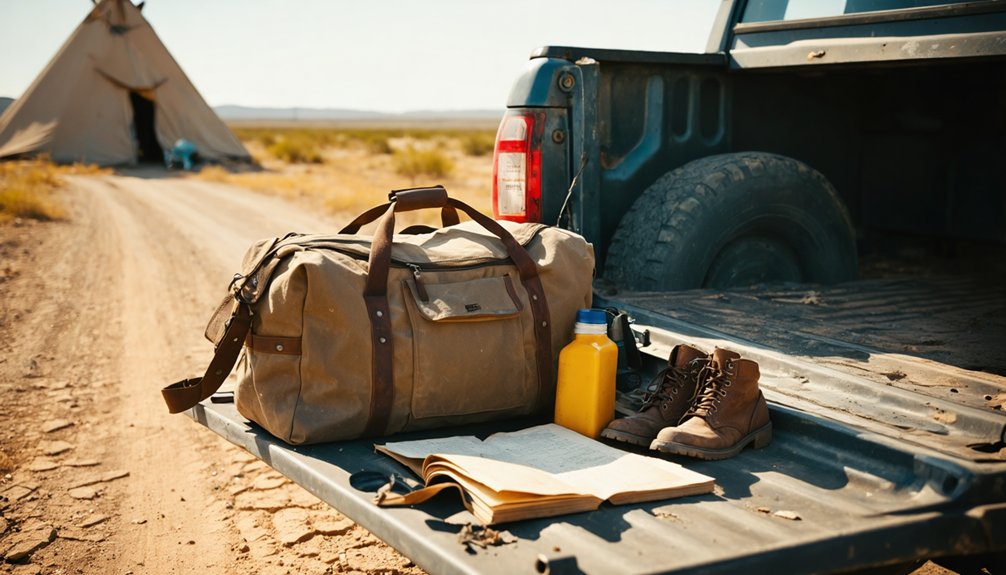
Packing smart for a remote ghost town like Tee Pee City can mean the difference between a memorable adventure and a miserable ordeal.
You’re heading into open West Texas terrain with no services nearby, so carry extra water — at least a gallon per person. Bring sun protection, sturdy boots, and a first aid kit. A camera helps you document historical artifacts and the small cemetery still marking this forgotten settlement.
Pack snacks, a paper map, and a charged phone since cell coverage is unreliable. Binoculars let you scan the surrounding landscape where ghost town legends say buffalo hunters once roamed freely.
Don’t forget insect repellent during warmer months. Your self-sufficiency out here isn’t just practical — it’s the spirit this wild, independent frontier always demanded.
Other Historic Sites Worth Visiting Near Tee Pee City
While Tee Pee City stands as a compelling ghost town destination, the surrounding region rewards curious travelers with several other historically rich stops.
Tee Pee City is just the beginning — the surrounding region holds even more historically rich discoveries waiting to be explored.
You’ll find that historical preservation runs deep across Motley County and beyond.
Nearby sites worth adding to your route include:
- Matador, Texas – The county seat offering local history museums and pioneer heritage
- Fort Griffin State Historic Site – A frontier military post tied to the same buffalo-hunting era
- Fort Elliott – Another Texas Ranger–connected landmark north of the region
- Henrietta, Texas – An early settlement marking the eastern boundary of this ghost towns corridor
- Pease River Battlefield – Where Cynthia Ann Parker was recaptured in 1860
Each stop deepens your understanding of West Texas’s untamed, freedom-forged past.
Frequently Asked Questions
Can You Drive Directly to the Tee Pee City Marker by Car?
Yes, you can drive directly to the marker! Sitting 10 miles east of Matador on US 62/70, this ghost town attraction’s historical significance dates back 150 years, making it an accessible, freedom-fueling roadside discovery.
Is There an Admission Fee to Visit the Tee Pee City Site?
You don’t pay any admission fee to visit Tee Pee City! You’re free to explore its historical significance and discover local legends at this open roadside site, where adventure and Texas frontier history await you.
Are Pets Allowed at the Tee Pee City Roadside Park Area?
Ironically, the pet policies for roadside attractions like Tee Pee City aren’t documented in available records, but you’ll likely find the wide-open Texas plains welcoming your furry companions as you roam freely through this historic ghost town site.
Is the Tee Pee City Cemetery Open to the Public for Visits?
You can visit the small Tee Pee City cemetery, where local legends and ghost stories linger among the graves of Isaac Armstrong and the Cooper family. It’s an open, accessible slice of wild frontier history waiting for you!
Does Matador, Texas Offer Overnight Lodging for Ghost Town Visitors?
You’ll find overnight lodging in Matador, Texas, making it your perfect base for exploring ghost town history and local attractions. Stay nearby, then venture out to discover Tee Pee City’s fascinating, freedom-filled frontier past!
References
- https://en.wikipedia.org/wiki/Tee_Pee_City
- https://digging-history.com/2015/04/22/ghost-town-wednesday-tee-pee-city-texas/
- https://www.texasescapes.com/TexasPanhandleTowns/Tee-Pee-City-Texas.htm
- https://kids.kiddle.co/Tee_Pee_City
- https://www.hmdb.org/m.asp?m=104860
- https://atlas.thc.texas.gov/Details/5345012939
- https://freedomanwhisky.com/blogs/news/tee-pee-city-the-last-round-up