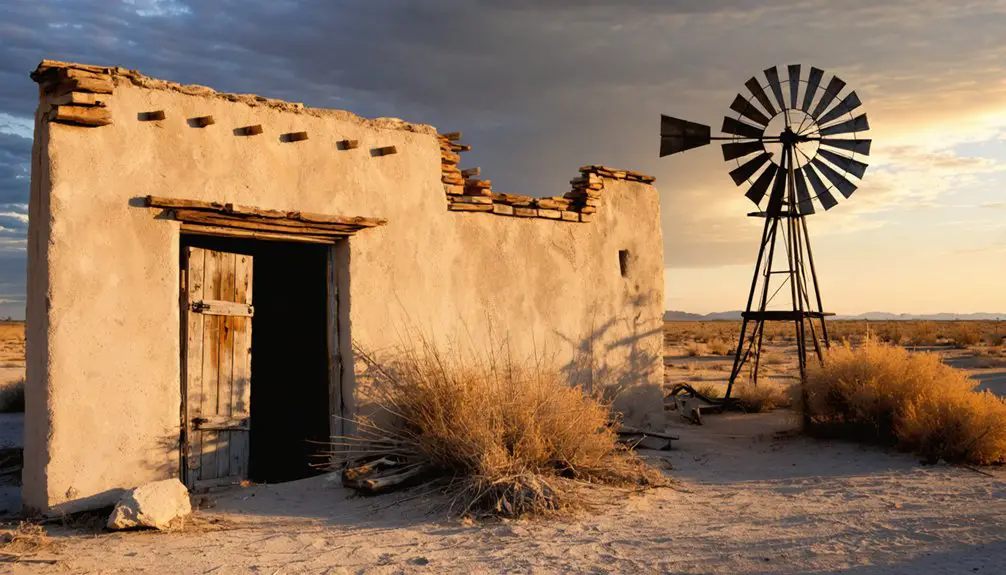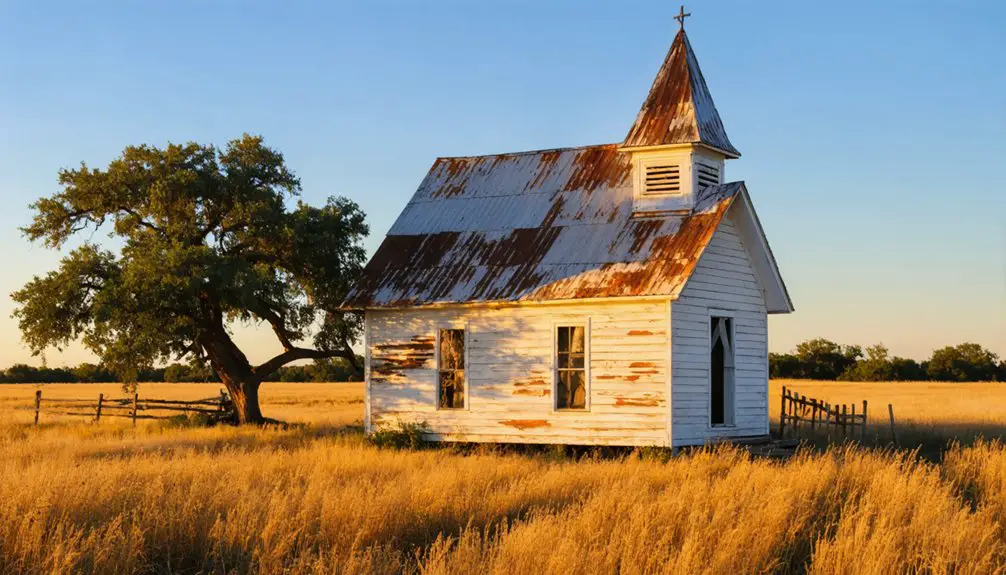
From Post, Texas, you’ll head 10 miles east on Highway 380, then turn north onto Farm Road 2008 for 4.4 miles to reach Verbena’s windswept remnants. Pack a gallon of water per person, satellite communication, and a high-clearance vehicle for the gravel stretch. Spring’s bluebonnet season (late March through April) offers ideal conditions, while golden hour light transforms the sparse landscape into haunting photographic compositions. Combine your visit with nearby ghost towns like Justiceburg and Close City for a complete exploration of Garza County’s forgotten frontier settlements.
Key Takeaways
- Travel 10 miles east on Highway 380, then turn north onto Farm Road 2008 for 4.4 miles to reach Verbena.
- Bring one gallon of water per person daily, satellite communication, offline navigation, and snakebite kits for remote conditions.
- Visit during mild spring (mid-60s to mid-80s) or October through early November to avoid summer heat and winter cold.
- Combine Verbena with nearby ghost towns Justiceburg, Litwalton, Close City, and Southland for a full-day exploration circuit.
- Use high-clearance vehicles for the 11-mile gravel stretch and respect active ranchland with minimal preserved structures remaining.
The History and Origins of Verbena Settlement
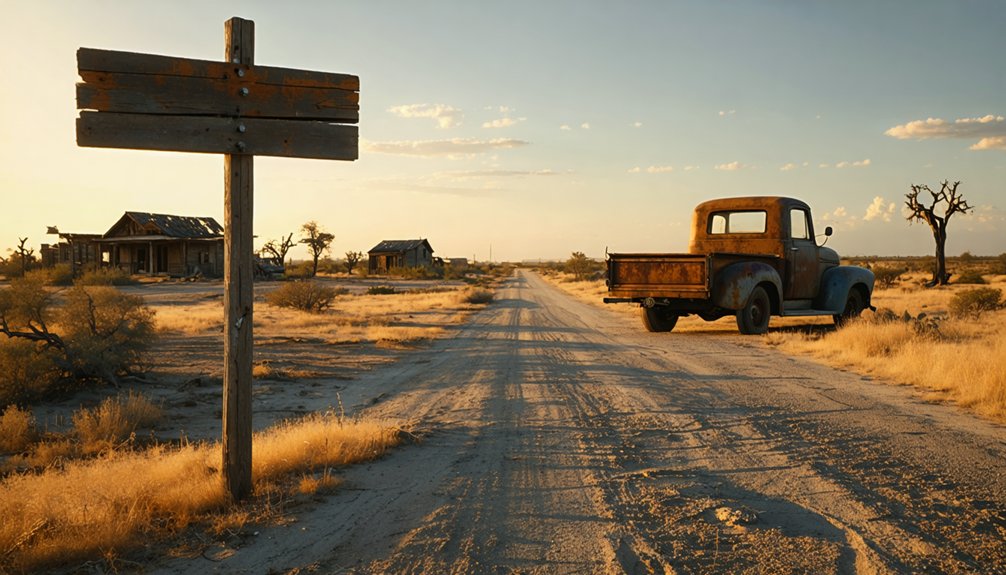
In the sprawling ranching country of northeast Garza County, a small community took root when dispersed settlers recognized their need for spiritual and social connection. You’ll find Verbena’s origins along Farm Road 2008, twelve miles northeast of Post, where ranching families first gathered in the early 1900s.
The settlement earned its name from Verbena Cotton, wife of founding postmaster J. B. Cotton, who opened the post office in his home on December 16, 1901. Geographic isolation demanded community self-sufficiency, and residents answered by establishing the Verbena Baptist Church in August 1902—reportedly Garza County’s first church.
Families like the Barrows, Askins, Kennedys, and Lindseys built something remarkable: a tight-knit hamlet where faith and fellowship conquered the loneliness of frontier life.
Getting to Verbena: Directions and Access Routes
Reaching this remote ranching outpost requires traversing the wide-open spaces of northeast Garza County, where Farm Road 2008 cuts through mesquite-dotted plains twelve miles from Post. You’ll head east on Highway 380 for roughly ten miles before turning north onto FM 2008. The coordinates—latitude 33° 16′ 37.848″ N, longitude 101° 11′ 44.5812″ W—mark your destination 4.4 miles from the highway junction.
Despite Verbena’s ghost town classification, ranch access remains unobstructed. Four active operations, including Rafter M Ranch and Medlock Land & Cattle, keep the road maintained and passable. Standard GPS navigation works reliably here, though you’ll find the historical marker near remnants of the old brush arbor church. No closures impede your journey to this windswept settlement where Texas’s ranching heritage persists.
What Remains at the Verbena Ghost Town Site Today
Very little marks the Verbena townsite beyond windswept grasslands and the occasional barbed-wire fence line. You won’t find standing buildings, foundations, or ruins—just flat, open terrain where the town once thrived. The lack of historic remains makes this a true vanishing act, with surrounding cattle ranches now dominating the landscape. Don’t expect interpretive signs or marked boundaries to guide your exploration.
The minimal visitor amenities reflect Verbena’s complete return to working ranchland. Scattered infrastructure belongs to active operations like Rafter M Ranch and Medlock Land & Cattle, not the ghost town itself. You’ll encounter quiet solitude here, with occasional ranch vehicles passing along FM 2008. It’s a place for those who appreciate emptiness and unobstructed horizons rather than preserved historical structures.
The Story of Verbena Baptist Church and Its Role in the Community
Long before Verbena faded into the windswept grasslands, the First Baptist Church anchored this frontier community as Garza County‘s earliest house of worship. Rev. J.V. Billberry led its organization on August 24, 1902, establishing what the cornerstone still proclaims as the county’s first church. You’ll find this inscribed stone among the ghost town remnants—a weathered memorial to the church’s role in community life when settlers gathered for Sunday services and weekday fellowship.
The structure served as Verbena’s spiritual and social hub, working alongside the local school to forge bonds among isolated pioneer families. Though the congregation eventually dissolved as Verbena declined, historical preservation efforts have documented this significant site through photographs and records. Today, it’s being considered for Texas Historical marker designation.
Pioneer Families Who Shaped Verbena’s Early Days
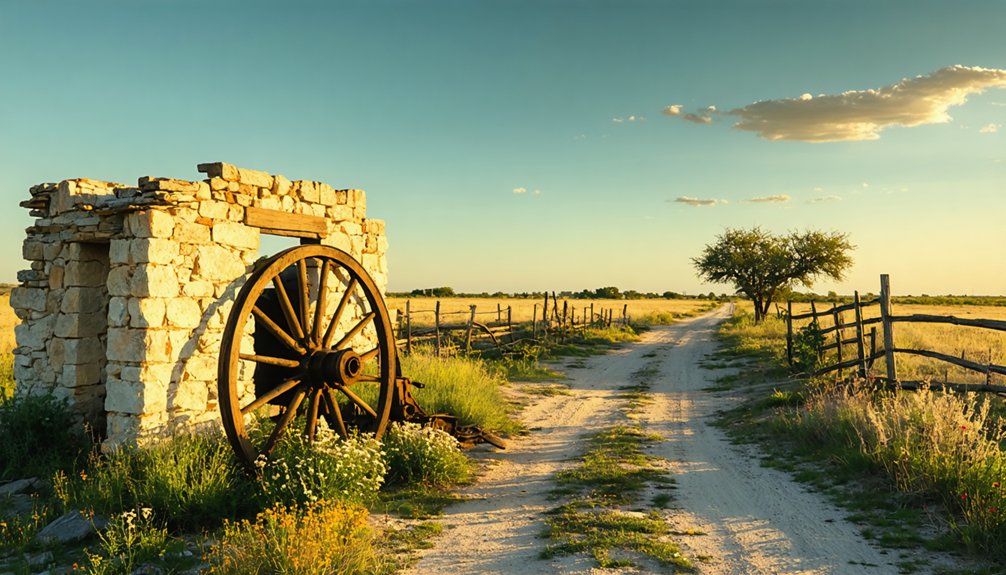
When J.B. Cotton opened the post office in his home on December 16, 1901, he set in motion a legacy that would define Verbena’s character. He named the settlement after his wife Verbena, establishing their family as cornerstone pioneers.
Cotton descendants’ perspectives reveal how the Barrow, Askins, Nichols, Kennedy, Cravy, Faulkner, and Lindsey families transformed raw rangeland into community. These families understood early 20th century ranching dynamics, gathering at the Cotton home for church meetings before the Baptist congregation’s 1902 founding.
You’ll find their collective vision materialized in Verbena’s infrastructure—from the 1903 brush arbor to the 1904 church building. By the 1960s, their descendants had dispersed, but their pioneering spirit remains etched in this ghost town’s story.
Best Time to Visit Northeast Garza County Ghost Towns
When you’re planning your ghost town road trip to Verbena, timing transforms a good adventure into an unforgettable one. Northeast Garza County’s mild spring weather—with temperatures ranging from the mid-60s to mid-80s—offers ideal hiking conditions to abandoned structures, while late March through April ignites nearby prairies with bluebonnet blooms that frame crumbling ruins in vivid color.
Summer’s brutal heat and humidity from mid-May through early September make exploration uncomfortable, so you’ll want to target the cooler months when both the weather and the whispers of history feel most welcoming.
Seasonal Weather Considerations
Planning your ghost town exploration requires understanding the dramatic temperature swings that define northeast Garza County’s climate. March brings scorching 91.9°F highs alongside afternoon thunderstorms, while November offers ideal conditions with 76°F days and crisp 41°F nights.
Microclimatic influences create stark contrasts—spring mornings start partly cloudy before shifting to turbulent weather, demanding constant storm preparedness for your journey.
You’ll find the freeze-free period averaging 197 days, with autumn providing exceptional visibility under clear skies and moderate UV exposure. Winter’s driest months feature mostly clear conditions, though gusty winds can hit 37 mph.
Avoid peak monsoon intensity when convective thunderstorms dominate—instead, target spring’s pleasant mornings or autumn’s stable weather patterns when exploring these abandoned settlements offers maximum freedom and minimal weather-related constraints.
Avoiding Extreme Heat Months
June’s arrival transforms northeast Garza County into a furnace that’ll test your endurance far beyond any ghost town’s mysterious allure. Mid-90s temperatures plague the region through August, with humidity clinging to your skin from mid-May into September. Those mesquite-dotted plains offer zero shade along FM 2008, making ideal travel timing absolutely critical for your exploration freedom.
August compounds misery with back-to-school schedules and relentless heat that sends locals fleeing indoors. Your landscape adaptation strategies should prioritize October through early November when 70s-80s temps let you roam freely, or late February through March’s peaceful 60s-80s windows.
Winter’s cold clarity from December through February rewards you with empty horizons and starlit skies—far better than summer’s brutal scorch that transforms adventure into mere survival.
Spring Wildflower Viewing Season
Late March through mid-May blankets northeast Garza County’s rolling plains in waves of bluebonnets, Indian paintbrush, and prairie verbena—creating an ironic backdrop for your Verbena ghost town exploration. You’ll find these wildflower bloom periods transform abandoned homesteads and crumbling church ruins into unexpected gardens, where nature reclaims what settlers left behind.
The unpaved roads leading to Verbena become ideal viewing locations during this window—dusty tracks flanked by spectacular color that stretches toward endless horizons. You’re free to wander beyond the beaten path, discovering fields where wildflowers push through foundations of forgotten buildings.
Morning light offers the best photography conditions, with cooler temperatures making your off-grid adventure more comfortable. Pack water and embrace the solitude these remote landscapes provide during peak bloom season.
Combining Verbena With Other Nearby Abandoned Sites
You can maximize your ghost town exploration by linking Verbena with Justiceburg and Litwalton, all marked on the historic 1907 Garza County postal map. These three abandoned settlements sit within a manageable circuit of rural roads northeast of Post, allowing you to trace the rise and fall of early 20th-century West Texas communities in a single afternoon.
Plan your route along FM 2008 and connecting county roads to visit multiple sites where windswept prairie has reclaimed what settlers once built.
Other Garza County Ghosts
While Verbena itself offers limited physical remnants, Garza County’s constellation of ghost towns transforms a single-site visit into a compelling day-long exploration of West Texas’s vanished communities.
You’ll discover forgotten settlements scattered across windswept plains, each marking where pioneers once built dreams:
- Close City – Navigate to this ghost town northwest of Verbena, where sparse remnants whisper of failed ambitions
- Litwalton – Trace the 1907 postal map southeast of Post to locate this completely vanished community near Justiceburg
- Southland – Search for Bresford’s original site, now erased from everything except vintage county maps
Justiceburg, fifteen miles southeast of Post and once called Leforest, anchors your route with the most substantial remains. FM 2008 connects these sites through ranch country where wide-open roads satisfy wanderlust without permission slips or crowded tourist traps.
Multi-Site Route Planning
Verbena’s isolated location on FM 2008 positions it perfectly as the anchor point for a sprawling ghost town circuit through the South Plains and beyond.
You’ll find Belle Plain 90 miles southeast near Abilene, where ghost town preservation efforts have maintained crumbling foundations from its 1870s college days. Hagerman in Grayson County offers stark contrast—a barren site where local oral histories replace physical remnants.
For ambitious explorers, Shafter’s mining ruins in the Chinati Mountains lie 400 miles west via I-20, while St. Mary’s of Aransas commands Copano Bay 350 miles southeast. Start at Post’s museum to view Verbena‘s church marker, then plot your course based on time and fuel. Each site reveals different facets of Texas’s abandoned settlements.
Essential Supplies and Preparations for Your Trip
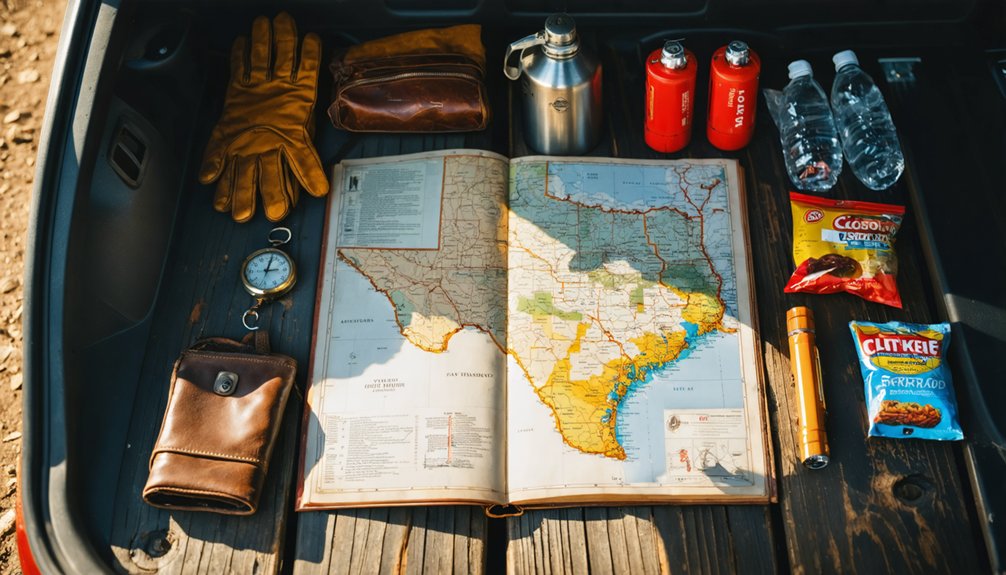
How should you prepare for a journey to one of West Texas’s most isolated ghost towns? Verbena demands respect for its remote location twelve miles from Post. Road conditions on FM 2008’s eleven-mile gravel stretch require high-clearance vehicles and properly inspected brakes. The cactus-studded terrain and local wildlife—particularly rattlesnakes threading through mesquite—necessitate serious precautions.
Exploring ghost towns to visit in Texas offers a glimpse into the state’s rich history and the stories left behind. With each dilapidated building and abandoned street, you can feel the echoes of the past. Don’t forget to bring enough water and a reliable map to navigate these forgotten places safely.
Verbena’s isolation twelve miles from Post demands high-clearance vehicles, working brakes, and serious respect for rattlesnake-inhabited terrain.
Essential supplies include:
- Water and emergency gear: One gallon per person daily, plus satellite communication beyond cell coverage
- Navigation tools: GPS coordinates (33° 16′ 37.848″ N, 101° 11′ 44.5812″ W) and offline maps, since Verbena won’t appear on standard devices
- Weather protection: Layered clothing for extreme temperature swings and sturdy boots for rocky ground
Pack snakebite kits, first-aid supplies, and multi-day provisions before venturing into Garza County’s unforgiving backcountry.
Photography Tips for Capturing Ghost Town Landscapes
Capturing Verbena’s haunting beauty requires mastering the interplay between light and decay. You’ll want to arrive during golden hour when low sun angles cast elongated shadows across weathered structures, transforming ordinary buildings into mysterious silhouettes.
Pack a sturdy tripod and wide-angle lens to frame the town’s crumbling architecture against the vast Texas sky, ensuring you’re equipped to handle the remote location’s challenging lighting conditions.
Golden Hour Lighting Techniques
When golden hour bathes Verbena’s abandoned structures in amber light, photographers discover their most powerful ally in visual storytelling. Arrive before sunrise to claim undisturbed vantage points where dawn’s directional beams transform decay into art. The low-angle illumination highlights textures in weathered wood and rusted metal, revealing stories invisible under harsh midday sun.
Position yourself to capture these dramatic effects:
- Side-lighting that carves dimensional depth into crumbling facades
- Window-filtered shafts creating natural spotlights on forgotten interiors
- Ghostly silhouettes formed when structures eclipse the brilliant sky
Plan for 20-minute intervals during each golden hour phase—dusk and dawn offer distinct moods. Strategic angles amplify contrast between illuminated surfaces and shadowed recesses, infusing your compositions with mystery. Weather patterns become your collaborator, as clouds sculpt light into ever-changing narratives across Verbena’s forsaken landscape.
Composition and Framing Strategies
Your lens becomes a deliberate storytelling tool the moment you apply foundational composition techniques to Verbena’s decaying architecture. Position weathered structures at grid intersections using the rule of thirds, placing crumbling rooflines along the upper horizontal line.
Draw viewers through collapsed doorways with leading lines formed by sagging fence posts and dirt roads converging toward abandoned storefronts. Frame architectural silhouettes through broken windows or empty doorframes, ensuring each view contains compelling interior details.
Minimalist framing techniques work brilliantly here—isolate a single structure against vast Texas sky, filling two-thirds with negative space to emphasize desolation. Layer your shots with foreground cacti, midground buildings, and distant horizons. These strategies transform forgotten remnants into powerful visual narratives that capture Verbena’s haunting essence without artificial manipulation.
Equipment for Remote Locations
Since Verbena’s isolation means you won’t find camera shops within a hundred miles, packing the right equipment becomes critical before you leave civilization. Your mirrorless body like Sony’s alpha series delivers DSLR-quality images without weighing down your pack. Master manual mode settings beforehand—Verbena’s dramatic light shifts demand quick ISO and aperture adjustments.
Essential gear includes:
- Lightweight tripod (Manfrotto or Peak Design) for golden-hour stability
- High-capacity battery packs (Anker PowerCore) ensuring battery life optimization through multiple shooting days
- Multiple memory cards in protective cases preventing catastrophic data loss
Don’t forget solar chargers for sustainable power and weather-resistant bags protecting against Texas dust storms. Pack backup batteries, lens cleaning kits, and a compact gimbal stabilizer for exploring crumbling structures on uneven terrain.
Post, Texas: Your Base Camp for Exploring the Area
The small town of Post sits along the dramatic Caprock escarpment in West Texas, perfectly positioned as your launching pad for ghost town adventures across the region. Founded in 1906 as C.W. Post’s agricultural utopia, this Garza County seat offers affordable lodging options in renovated historic buildings where ranching heritage meets modern comfort.
You’ll find local dining experiences that fuel multi-day expeditions to destinations like Terlingua Ghost Town, 400 miles south, or Route 66 relics like Glenrio, 100 miles east. Between explorations, you can immerse yourself in exhibits at the OS Ranch Museum and Garza County Museum, both housed in carefully preserved landmarks.
The town’s strategic location on U.S. Highway 84 puts you within striking distance of West Texas’s most compelling abandoned sites.
Frequently Asked Questions
Are There Any Safety Concerns When Visiting Remote Ghost Town Sites?
You’ll face trespassing risks and liability concerns that coincidentally mirror the town’s own forgotten boundaries. Remote locations mean delayed emergency response, extreme weather exposure, unstable structures, and potential confrontations with ranchers protecting their land.
Do I Need Permission to Access the Verbena Site on Private Land?
Yes, you’ll need permission since Verbena sits on private property behind padlocked gates. Access restrictions are strictly enforced, and trespassing creates potential legal issues. The landowner’s concerns about liability make unauthorized visits both disrespectful and risky.
What Wildlife Might I Encounter in Northeast Garza County Ranching Areas?
You’ll encounter white-tailed deer, raccoons, and coyotes traveling riparian corridors, while native bird species like red-tailed hawks soar overhead. Texas spiny lizards inhabit rocky terrain, and seasonal wildflowers attract diverse wildlife across these untamed ranchlands.
Can I Camp Overnight Near the Verbena Ghost Town Location?
You can’t camp overnight at Verbena itself—there’s no designated camping. The surrounding ranchland lacks nearby camping options, and historical preservation efforts haven’t included visitor facilities. You’ll need to stay in Post or explore distant alternatives for your ghost town adventure.
Are There Any Local Guides Available for Garza County Ghost Town Tours?
No local guides operate in Garza County for ghost town tours. You’ll explore independently, discovering the cultural significance of ghost towns and local history preservation efforts through your own adventure, embracing the freedom of unguided exploration across this historic landscape.