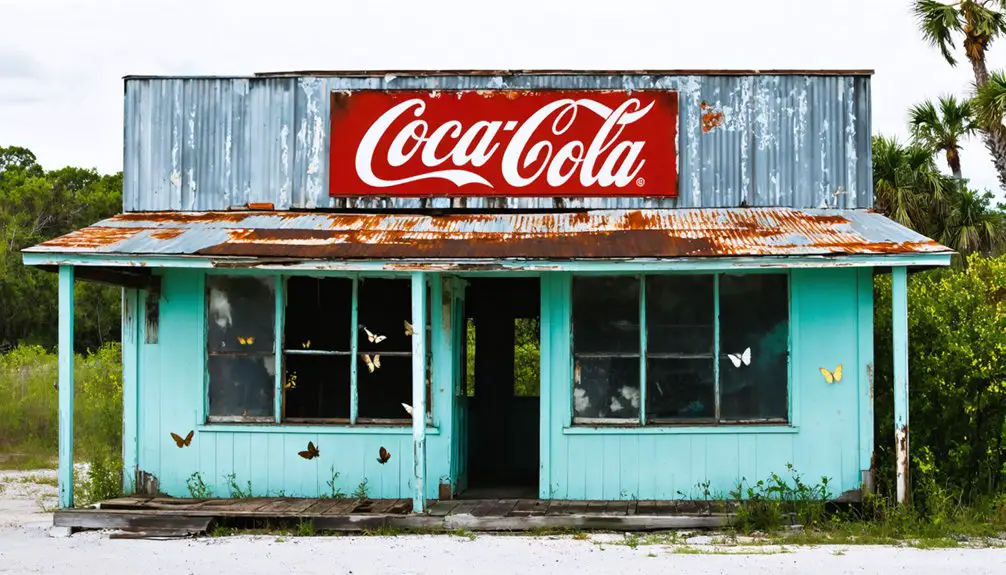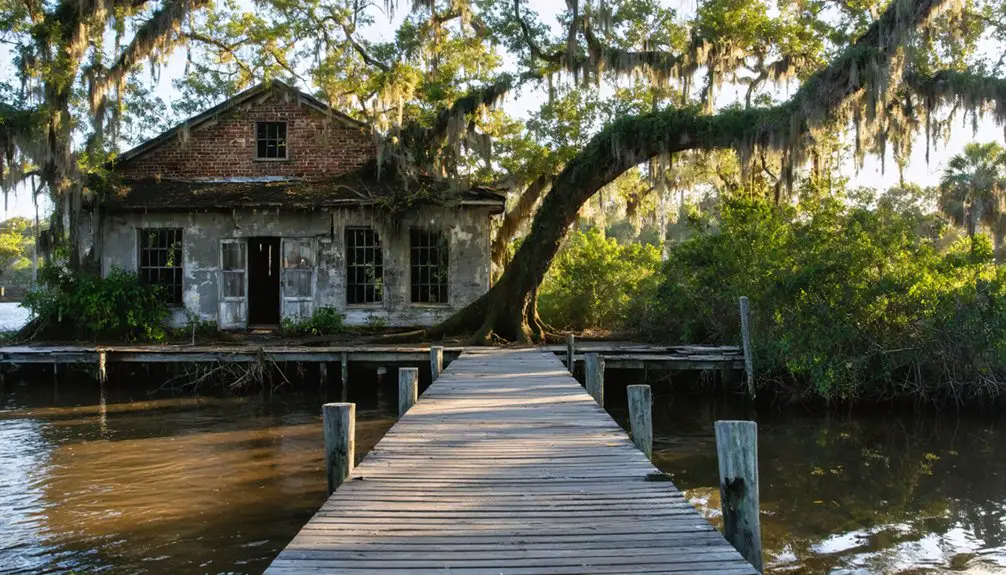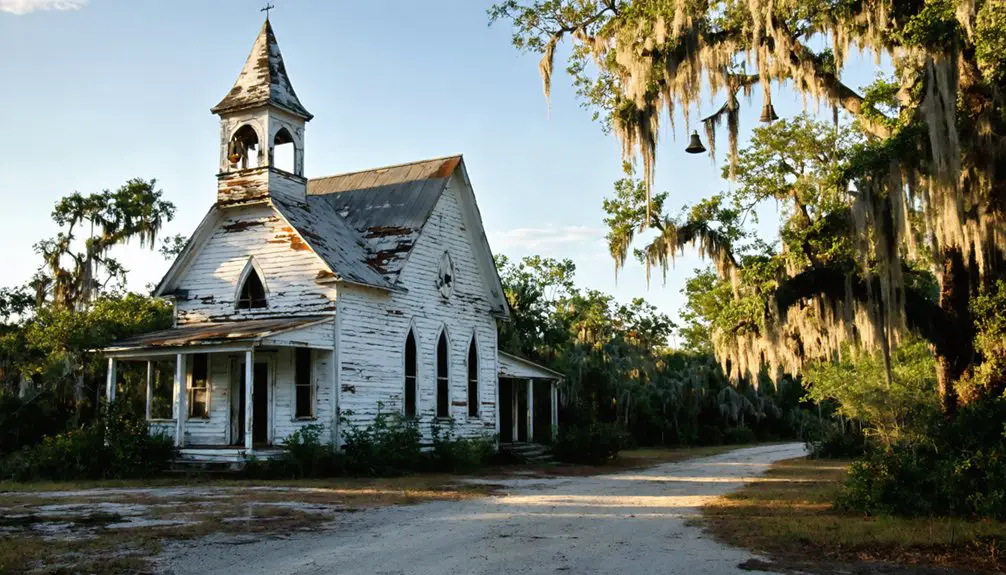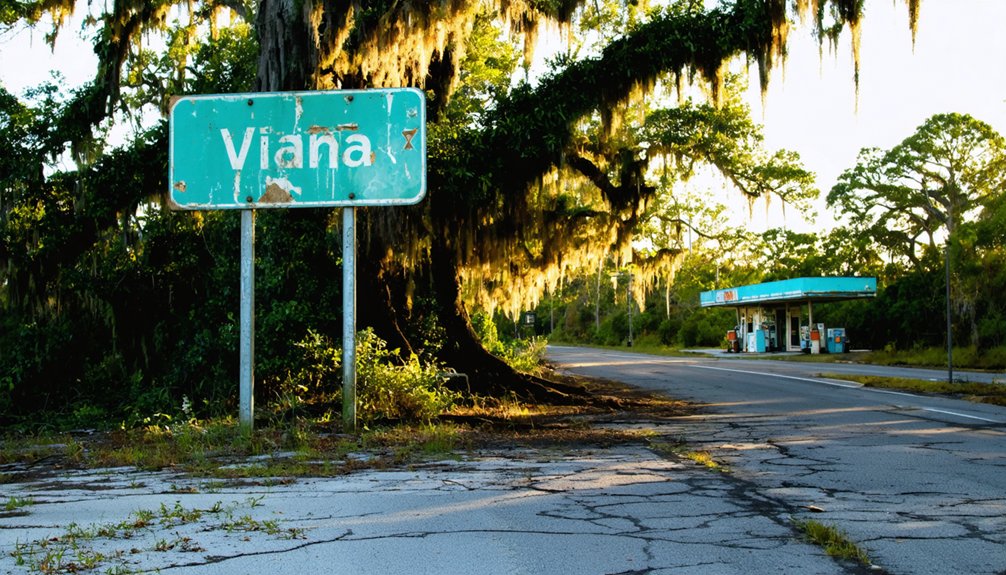
You’ll find Viana’s ghost hiding in Citrus County’s scrubland at coordinates 28°54’N 82°27’W, but reaching this Grid 3-rated settlement demands a 4WD vehicle and determination. Navigate unmarked county roads during the dry season (November-April), respecting private property barricades along sandy turnoffs. Pack offline maps, water, and sturdy boots—GPS signals flicker unreliably here. The cemetery and weathered building foundations reward those who brave the rutted limestone tracks, while nearby ghost towns like Island Grove offer more substantial ruins to complete your expedition.
Key Takeaways
- Viana requires 4WD to navigate treacherous unpaved roads; use GPS coordinates 28°54’N 82°27’W with offline maps as backup.
- Visit November through April during dry season, preferably early mornings midweek to avoid heat, storms, and crowds.
- Explore the cemetery, weathered building foundations, and crumbling stone markers hidden among reclaimed wilderness and modern development.
- Pack essential gear including water, sturdy boots, insect repellent, navigation tools, safety equipment, and weather-appropriate clothing.
- Combine your trip with nearby ghost towns like Island Grove, Etna, Orleans, and Arlington for extended exploration.
The Rise and Fall of Viana: A Brief History
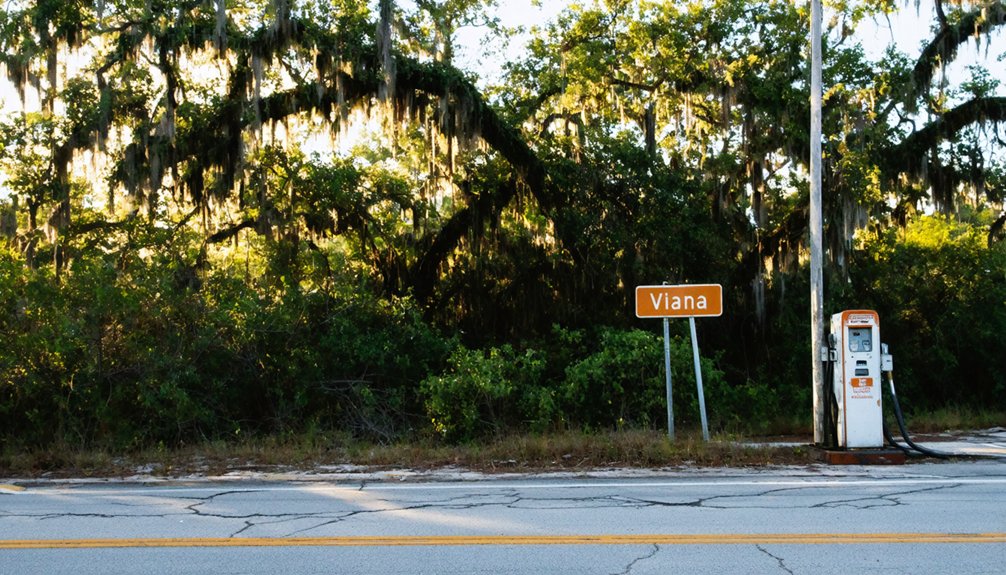
Picture a time when citrus groves stretched across central Florida like a sea of green and gold, drawing dreamers and farmers to carve out new lives in the wilderness. That’s exactly what Reverend Young found in 1885 when he established Viana, naming it after Austria’s elegant capital. Original land ownership came cheap—just $15 per acre—and settlers seized the opportunity.
The community thrived quickly, reaching 100 residents by 1895 with its own post office, school, and railroad station.
Then disaster struck. The devastating freeze of 1894-95 obliterated those promising groves overnight, triggering a citrus industry decline that destroyed Viana’s economic foundation. Without viable agriculture, families abandoned their dreams. By 1900, the town had vanished completely, leaving only whispers of what once was. During this era, Florida’s early economy relied heavily on natural resource exploitation, including logging, fishing, and cattle ranching alongside agricultural ventures like citrus cultivation. Today, the former settlement rests on private property near Skyland Meadows, with no physical remains to mark its existence.
What Remains of Viana Today
Today, you’ll find almost nothing of Viana’s original settlement—just scattered clues hidden among modern development and reclaimed wilderness. The site’s limited accessibility makes exploration challenging, requiring determination to reach areas where foundations once stood.
Few traces survive of Viana’s original settlement—only scattered remnants concealed beneath wilderness and modern development await determined explorers.
Sparse vegetation now covers what remains, with native palmettos and pines reclaiming the land their ancestors occupied before settlement.
When I visited, I discovered only fragments: a crumbling stone marker, depressions where buildings sat, overgrown paths leading nowhere. You’ll need sturdy boots and patience traversing the unmarked terrain. Bring water and download offline maps—cell service disappears quickly here.
The emptiness itself tells Viana’s story. Nature’s erasure reminds you how quickly civilization vanishes when abandoned. It’s this raw authenticity that draws adventurers seeking places untouched by tourist infrastructure.
Getting to Viana: Directions and Access Points
Finding Viana requires traversing a maze of unmarked county roads where GPS signals flicker and pavement gives way to sand. From Inverness Courthouse Square, head west on SR 44, then turn south onto County Route 581 for three miles.
Navigate to CR 486’s north side near Skyland Meadows, positioning yourself between CR 491 and Lake Tsala Apopka. You’ll need 4WD for the final approach—unpaved road conditions turn treacherous after storms, and seasonal accessibility challenges intensify during Florida’s rainy months.
Private property barricades block some sandy turnoffs, so respect boundaries. The site earned its Grid 3 rating honestly; nothing visible remains of the settlement that vanished post-1900. Like other inhabited ghost towns scattered throughout Florida’s counties, some settlements maintain small populations despite their historical abandonment status. Pack water, download offline maps, and embrace the adventure of roads less traveled. If you’re searching for parking available in front, you’ll find limited options near the historical site markers.
Best Time to Visit This Citrus County Ghost Town
While ghost town enthusiasts can technically reach Viana year-round, the sweet spot for exploration stretches from November through April when Florida’s dry season transforms those treacherous sandy access roads into manageable trails. You’ll dodge potential storm disruptions that plague hurricane season, plus temperatures hover between 60-80°F—perfect for scrambling through overgrown foundations without heat exhaustion.
Prime visiting windows:
- Early mornings (sunrise to 10 AM) beat afternoon thunderstorms and heat
- Midweek trips eliminate weekend crowds seeking rural escapes
- December through February offers lowest tourist traffic and increased seasonal wildlife activity
- Post-rain waits (48 hours) prevent mud-stuck vehicles and obscured terrain
Summer’s 90°F humidity will drain your energy fast, while spring break masses compromise that solitary ghost-town atmosphere you’re craving. Like Cedar Key’s abandoned docks that saw decline when railways bypassed the town in the early 1900s, Viana’s remnants require careful timing to appreciate their historical significance. Many ghost towns throughout West Florida cluster near reliable water sources such as springs and rivers, making hydration planning essential for your visit. Plan accordingly.
What to Look For: Cemetery and Building Foundations
Once you’ve picked your perfect exploration date, you’ll want to know what’s actually left standing in Viana—and honestly, “standing” might be generous. The cemetery remains your primary destination, offering grave site details that connect you to Rev. Young’s 1885 settlement. Though records don’t specify individual markers, the standard period layouts tell stories of those citrus pioneers.
Northeast toward Hernando, you’ll find weathered building foundations fighting through overgrowth—remnants of the general store and sawmill that served 100 residents by 1895. These crumbling bases offer serious architectural dig potential for anyone documenting Florida’s pre-freeze boom. Similar to Ellaville’s fate after its mill burned in 1898, many Florida timber towns saw their industries vanish when local resources were exhausted. The vegetation constantly reclaiming these sites makes documentation increasingly urgent with each passing season. Bring a camera and sturdy boots. The Citrus County Historical Society values documentation of these railroad-era structures before vegetation reclaims them completely.
The Big Freeze That Changed Everything
The cemetery foundations you’re walking through today exist because of two brutal weeks that obliterated Florida’s citrus empire. December 29, 1894, brought the first strike—15 degrees that stripped leaves and froze fruit solid. February 8, 1895, delivered the death blow at 16 degrees, splitting tree bark and killing roots.
The citrus production impact tells the story:
- Production crashed from 6 million boxes to 100,000
- Fish floated dead in rivers while bees starved
- English settlers fled, abandoning dishes mid-meal
- The environmental destruction legacy pushed Florida’s citrus belt 100 miles south
You’re standing where people once believed they’d built something permanent. The devastation was so complete that nearby Astor became nearly a ghost town, its residents abandoning what had been a thriving community. Between the two killer freezes, January 1895 brought unusually warm weather that fooled surviving trees into budding again—only to have those new shoots destroyed by February’s second assault. Nature had different plans. That’s the lesson Viana teaches—freedom includes accepting you can’t control everything.
Nearby Ghost Towns Worth Exploring
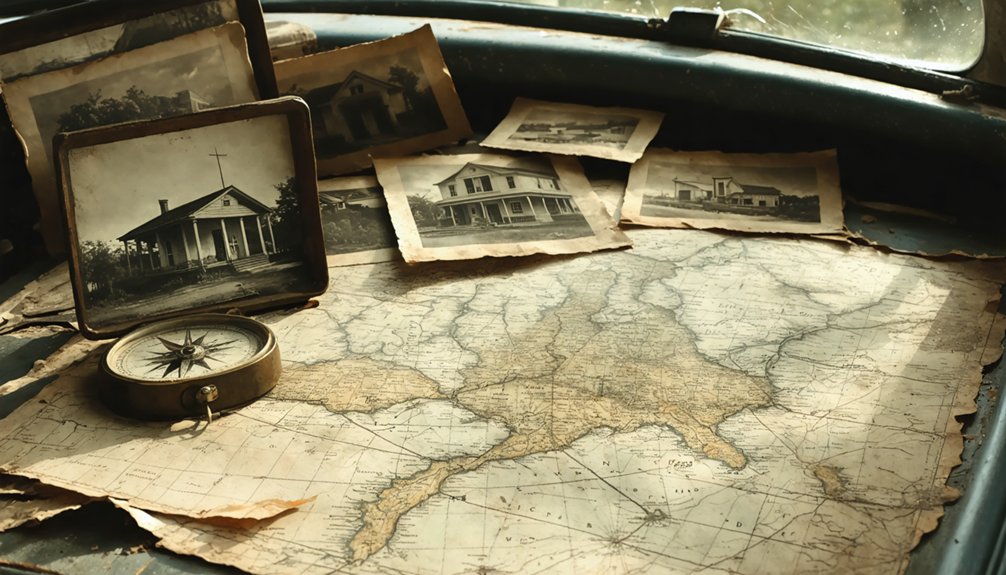
Viana’s story of collapse and abandonment echoes across central Florida’s backroads, where dozens of forgotten settlements met similar fates.
You’ll find Etna two miles from Mannfield, where 200 souls once worked the turpentine industry‘s impact into these pines from 1898 to 1915. Nothing remains but forest now.
Orleans, settled in 1885, lost its 100 residents to the great freezes and influenza epidemic’s effects—you can still wander its grounds in Withlacoochee State Forest.
Arlington’s gone completely, though it once boasted a church, school, and sawmill serving 50 people.
Head east to Island Grove in Alachua County for the most substantial ruins—this 400-person town had two churches and a massive railroad packing plant before winter’s killing frost arrived.
Essential Gear and Supplies for Your Trip
Before you turn off SR486 onto that rutted limestone track leading to Viana’s vanished crossroads, you’ll want your 4WD stocked with more than curiosity. I learned this the hard way on my first trip—standing knee-deep in saw palmetto at dusk with a dead phone and no compass, I swore I’d never underestimate Citrus County’s backcountry again.
Pack your navigation tools, safety gear, and weather-proof clothing as carefully as a prospector packing supplies, because out here where the 1890s still whisper through slash pine shadows, self-reliance isn’t optional.
Since Viana sits tucked away on unmarked sandy paths north of SR 486, you’ll need to punch GPS coordinates 28°54’N 82°27’W into your device before leaving civilization behind. Your GPS setup should include paper maps as backup—cell towers don’t reach these forgotten corners. I’ve learned the hard way that electronic screens go black when you need them most.
Pack these essentials for perimeter security and self-reliance:
- Flashlight with extra batteries for exploring dark ruins and traversing after sunset
- Whistle or personal locator beacon for emergency signals in remote terrain
- Multi-tool for vehicle repairs and clearing trail debris
- Weather radio to monitor approaching storms
Sturdy boots, long pants, and insect repellent complete your kit for this off-grid adventure into Florida’s abandoned past.
Photography and Documentation Tools
Capturing Viana’s crumbling structures demands equipment that handles Florida’s punishing humidity and the extreme contrast between blazing midday sun and shadow-filled interiors. Your full-frame body—whether Canon 5D Mark IV or Sony A7 II—paired with a 16-35mm f/2.8L lens will capture those haunting wide-angle scenes.
Tripod recommendations start with something sturdy yet portable like a Benro travel tripod with ball head, essential for 20-30 second exposures inside darkened buildings. Pack camera accessories including a circular polarizer for those impossibly blue Florida skies and a sensor cleaning kit—Viana’s dust infiltrates everything. Don’t forget your headlamp for traversing pitch-black interiors.
Shoot manual exposure in RAW format, and bring external flashes with wireless triggers to illuminate foreground details against dramatic backgrounds.
Weather-Appropriate Clothing Essentials
Your camera bag’s zipped and ready, but Viana’s weather will test you as much as your equipment. Florida’s ghost town throws curveballs—93°F afternoons colliding with 40°F January mornings. I’ve learned the hard way that seasonal layering essentials mean survival here.
Pack these versatile weather accessories for maximum mobility:
- Moisture-wicking base layers that move from predawn coolness to oppressive midday humidity
- Zip-up hoodies you’ll shed by noon and crave again by sunset
- Lightweight rain jackets for those sudden downpours averaging 50+ inches annually
- Quick-dry convertible pants that adapt faster than you can say “weather app lied”
Throw waterproof boots with drainage and UV-blocking sunglasses into your pack. Viana’s elements won’t cage your exploration—they’ll just demand respect and smart preparation.
Photography Tips for Capturing Historic Remnants
When golden hour light filters through Spanish moss and pine branches at abandoned sites like Viana, you’ll discover the sweet spot for photographing ghost town remnants. Position yourself low to emphasize weathered textures on crumbling school foundations and sawmill debris—Maximizing architectural textures reveals stories etched into every brick and beam.
Wide-angle lenses capture the vast reclamation, while macro shots expose rust patterns on century-old bolts and hardware, Conveying the passage of time through intimate decay details. Bracket your exposures where sunlight meets shadow, especially around citrus grove ruins.
Frame forgotten structures with overgrown foreground elements, using nature’s leading lines to guide viewers’ eyes. On misty mornings, fog softens the boundary between wilderness and human history. In post-processing, selective sharpening on historic edges maintains authenticity while celebrating these liberated landscapes.
Respecting the Site: Preservation and Safety Guidelines
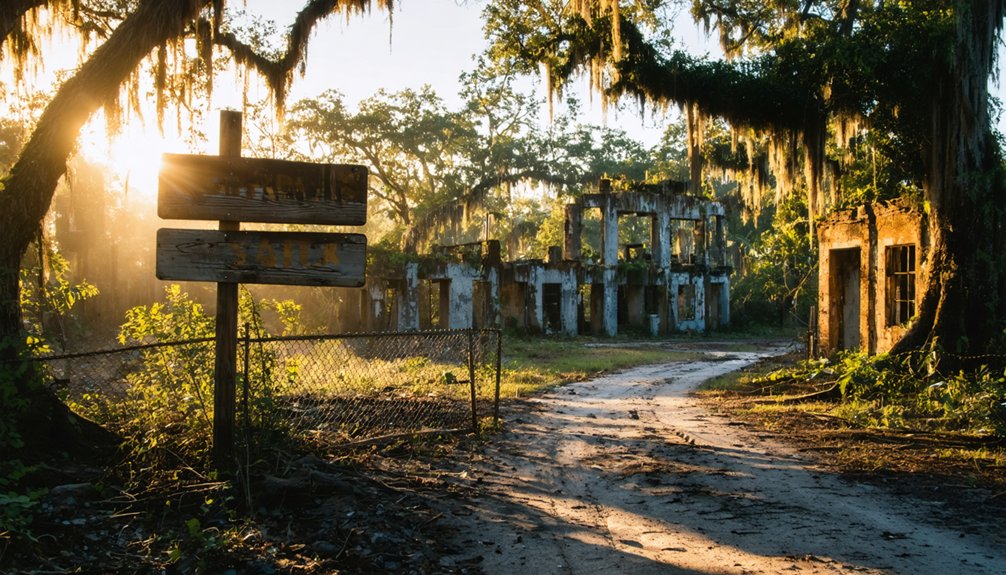
Before you step onto Viana’s weathered ground, understand that every footprint carries responsibility. Respecting local guidelines isn’t about restriction—it’s about preserving this freedom for future explorers.
Your footsteps at Viana echo through time—respect the ground beneath you so others may walk here tomorrow.
Essential preservation practices:
- Leave artifacts untouched—preserving archaeological artifacts means photographing, not pocketing. That rusted bottle tells Viana’s story.
- Stay on established paths—ground disturbances can destroy buried historical evidence beneath your boots.
- Document, don’t disturb—structures fifty years or older fall under Florida’s Division of Historical Resources protection.
- Report significant finds—sharing discoveries with proper authorities protects these treasures legally.
I’ve watched careless visitors compromise sites I’ll never see restored. Your restraint today means someone else gets tomorrow’s discovery. Pack out everything you bring in. Tread lightly through history’s shadows.
Frequently Asked Questions
Are Pets Allowed When Visiting the Viana Ghost Town Site?
There aren’t specific pet friendly policies for Viana’s ghost town ruins, so you’ll want to verify visiting hours and restrictions beforehand. Keep your furry companion leashed while exploring—I’ve found it’s safest when wandering abandoned sites freely.
Is Camping Permitted Near the Viana Cemetery and Building Foundations?
Camping isn’t permitted near Viana’s cemetery without the landowner’s permission, as it’s private property. You’ll need to secure consent first, then enjoy scenic views while exploring local history. Respect the site and practice Leave No Trace principles always.
Do I Need Special Permits to Explore Viana’s Ghost Town Area?
You won’t need special permits to explore Viana’s trails—just follow tourist etiquette guidelines and responsible exploration practices. Stay on designated paths, respect historical remnants, and leave no trace while discovering this forgotten settlement’s haunting beauty.
Are There Any Guided Tours Available for Viana Ghost Town Visits?
No guided tours availability exists for Viana ghost town—you’ll need to forge your own path. Private tour companies haven’t discovered this hidden gem yet, leaving you free to explore independently and create your own adventure without crowds or schedules.
What Cell Phone Coverage Can I Expect in the Viana Area?
Picture your phone bars flickering like fireflies at dusk—you’ll face spotty signal strength in remote Viana. Verizon offers the most reliable data coverage on rural Panhandle backroads, though you’ll likely encounter dead zones throughout this isolated ghost town area.
References
- https://floridatrailblazer.com/2018/01/25/centralia-ghost-town-in-hernando-county/
- https://historicarchaeology.weebly.com/journal/venus-in-florida-ghost-town-101
- https://scholarspace.manoa.hawaii.edu/bitstreams/edfc9fea-ceaa-45dd-bd8d-0cb945047dbc/download
- https://cccourthouse.org/wp-content/uploads/2023/12/Ghost-towns-and-Cemeteries-of-Citrus-County.pdf
- https://www.youtube.com/watch?v=q3Ku9qga-H4
- https://en.wikipedia.org/wiki/List_of_ghost_towns_in_Florida
- https://www.ghosttowns.com/states/fl/viana.html
- https://www.youtube.com/watch?v=0kzAaaal1X0
- https://en.wikipedia.org/wiki/History_of_Florida
- https://podcasts.apple.com/za/podcast/the-haunted-bunker-paranormal-mysteries-the-unexplained/id1659727745