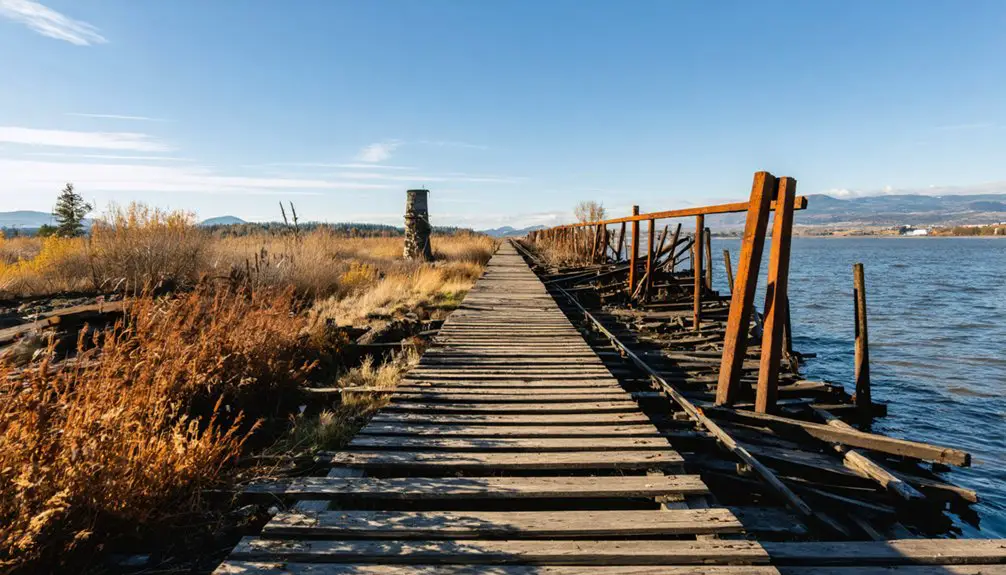
White Bluffs isn’t your typical ghost town road trip — you’ll need formal DOE permission to access this restricted Columbia River site, frozen in 1943 when the government seized it for Manhattan Project plutonium production. Chalk-white bluffs still rise 170 meters above the river, and the last surviving structures carry the silence of 2,000 displaced lives. If you’re ready to plan your visit, there’s far more to uncover about this haunting slice of American history.
Key Takeaways
- White Bluffs is located within the restricted Hanford Nuclear Reservation, requiring formal DOE permission and advance registration before visiting.
- DOE-guided tours provide access to historic landmarks, including the First Bank of White Bluffs and the Allard Pumphouse.
- Visitors are transported exclusively via DOE vehicles along reservation roads, so personal driving through the site is not permitted.
- Spring and fall offer ideal visiting conditions, with wildflowers in bloom or crisp air enhancing the ghost town atmosphere.
- Dress in light layers, as the desert environment experiences significant temperature fluctuations throughout the day.
What Is White Bluffs and Why Was It Abandoned?
Before the Manhattan Project erased it from the map, White Bluffs was a thriving agricultural community on the east bank of Washington’s Columbia River — one of the state’s oldest towns, settled in 1861 and named for the striking chalky bluffs that still tower 50 to 170 meters above the river today.
Its abandonment reasons weren’t natural decline or economic collapse — the U.S. government simply seized it. Starting March 1943, roughly 2,000 residents across White Bluffs, Hanford, and Richland received as little as three days’ notice to vacate their farms, orchards, and vineyards.
The federal government had identified the site as ideal for plutonium production. That historical significance runs deep — what you’d be visiting today is ground zero of America’s most consequential wartime scientific endeavor.
Can You Visit White Bluffs Without Special Permission?
But the actual townsite sits deep inside restricted areas on the Hanford Nuclear Reservation — federal land that’s locked down hard.
Ghost town access requires formal DOE tour permission, and there’s no sneaking around it. Those tours do reward the effort, putting you face-to-face with the First Bank of White Bluffs and the Allard Pumphouse — two quiet survivors of a community erased in 1943.
How to Request Access to the Restricted White Bluffs Site
Getting access to the restricted White Bluffs townsite runs through the U.S. Department of Energy. You’ll need to contact the DOE’s Hanford Site directly to request the permissions required for entry.
Their pre-war historic sites tours offer your best legitimate path in, covering landmarks like the First Bank of White Bluffs and the Allard Pumphouse.
Start by visiting the DOE’s official Hanford Site website, where you’ll find current access procedures and tour schedules. Tours typically require advance registration, identity verification, and adherence to strict site rules.
You won’t drive your own vehicle — DOE transports visitors along reservation roads.
It’s a bureaucratic process, yes, but walking those silent, wind-swept grounds makes every form worth completing.
What You Can Still See at the White Bluffs Ghost Town
Once you’ve secured access, you’ll find the First Bank of White Bluffs standing as the town’s most intact survivor, its weathered facade a stubborn symbol of the community that once thrived here.
The Allard Pumphouse also remains on the Pre-War Historic Sites Tour, a rusting reminder of the agricultural irrigation networks that sustained orchards and vineyards before the government claimed everything in 1943.
What you won’t find, however, is the original cemetery — the U.S. government relocated 177 sets of remains to East Prosser Cemetery on May 6, 1943, erasing even the dead from ground deemed essential to the Manhattan Project.
First Bank Standing Tall
Standing quietly against the arid Washington skyline, the First Bank of White Bluffs is one of the few original structures you’ll still find intact at this vanished Columbia River town.
Its bank architecture carries real historical significance — this building witnessed a thriving agricultural community’s final days before the Manhattan Project erased everything around it.
When the government seized homes in March 1943, most structures didn’t survive. This one did.
Standing before it, you’re looking at something the federal machinery couldn’t quite bring itself to demolish.
You’ll need special permission to access the Hanford Reservation roads that lead here, but if you secure it, you’ll stand where depositors once lined up, completely unaware that plutonium production would soon claim their entire world.
Historic Pumphouse Remains
Not far from the bank, another survivor waits — the Allard Pumphouse, a weathered remnant of the agricultural infrastructure that once kept White Bluffs’ orchards and fields alive along the Columbia.
Its pumphouse history runs deep, tied directly to the farming economy the government erased in 1943.
You’ll need special access to reach it, but the effort rewards you with rare, unfiltered contact with that vanished world.
Its architectural significance lies not in grandeur but in honesty — bare bones, utilitarian, stubbornly standing where thousands once worked freely.
The DOE’s Pre-War Historic Sites Tour includes it alongside the First Bank, giving you a connected narrative of what this community built before the Manhattan Project claimed everything.
Walk around it slowly. Let the silence do its work.
Cemetery Relocation Story
Few details capture the violence of White Bluffs’ erasure more starkly than what happened to its dead. The government didn’t just displace the living — it uprooted the buried.
On May 6, 1943, officials relocated 177 cemetery remains to East Prosser Cemetery, a forced migration that underscores the relocation challenges families faced throughout this ordeal.
This cemetery history reveals what total displacement truly means:
- 177 remains exhumed and transferred within weeks
- East Prosser Cemetery became the permanent, government-designated resting place
- Families received little say in where their loved ones landed
- March 1943 began the broader forced removal, graves included
You’re walking through ground where grief itself was relocated. That weight lingers in the silence here.
What Do the Department of Energy Tours Cover at White Bluffs?
If you’re hoping to step beyond the overlook and into the ghost town itself, the Department of Energy’s organized tours are your best shot. These carefully curated experiences bring you face-to-face with history that’s otherwise locked behind restricted gates.
The tour highlights include the iconic B Reactor—the world’s first full-scale plutonium production reactor—alongside Pre-War Historic Sites like the First Bank of White Bluffs and the Allard Pumphouse.
Walking these grounds transforms an educational experience into something visceral and deeply human.
You’ll move through spaces where families once built ordinary lives before the government erased everything in 1943.
Special permission grants access that most Americans never get—rare freedom to witness one of WWII’s most consequential and quietly devastating chapters firsthand.
When to Visit White Bluffs
Once you’ve secured your DOE tour spot or planned your overlook visit, timing your trip smartly makes all the difference. White Bluffs rewards year-round access, but weather considerations shape your experience greatly.
The best seasons break down like this:
- Spring (April–May): Wildflowers bloom across the arid plateau, wildlife stirs, and temperatures stay comfortable for hiking overlook trails.
- Summer (June–August): Long daylight hours maximize exploration, though intense heat demands extra water and sun protection.
- Fall (September–October): Crisp air, golden light on the chalky bluffs, and thinning crowds create ideal atmospheric conditions.
- Winter (November–March): Cold but accessible with 2WD; stark, haunting landscapes amplify the ghost town feeling significantly.
Pack light layers regardless of season—desert temperatures shift dramatically between dawn and afternoon.
Frequently Asked Questions
What Happened to White Bluffs Residents After the Government Forced Them Out?
You’d have faced residential displacement with just days to leave your home. The historical impact was devastating—around 2,000 people lost their farms, orchards, and roots forever, sacrificed for Manhattan Project’s plutonium production in 1943.
Are There Any Descendant Communities or Groups Preserving White Bluffs History?
You’ll find historical preservation alive through DOE-organized tours and community engagement efforts that connect descendants to White Bluffs’ haunting legacy—letting you walk where families once thrived before Manhattan Project’s shadow erased their world forever.
Was Any Compensation Provided to White Bluffs Residents Displaced in 1943?
Displaced, dispossessed, and denied fair compensation—you’ll find the compensation debate still stings. The displacement impact left roughly 2,000 residents with rushed, below-market government seizures, their livelihoods sacrificed for plutonium production with little recourse or recognition.
How Does White Bluffs Compare to Other Manhattan Project Ghost Towns?
White Bluffs stands apart—you’ll find its historical significance uniquely tied to plutonium production’s birth. Unlike other Manhattan Project ghost towns, it’s retained atmospheric architectural remnants like the First Bank, evoking a community’s sudden, haunting erasure of freedom.
What Wildlife Species Can Be Spotted Near the White Bluffs Overlook Area?
While wildlife sightings aren’t specifically documented in available records, White Bluffs’ local ecosystems—shaped by Columbia River corridors—likely support diverse birds, deer, and raptors. You’ll discover nature thriving where history’s shadows linger freely.
References
- https://www.ghosttownsofwashington.com/post/white-bluffs-benton-county-wa
- https://en.wikipedia.org/wiki/White_Bluffs
- https://www.visittri-cities.com/heritage/town-of-white-bluffs/
- https://www.ghosttowns.com/states/wa/whitebluffs.html
- https://iafi.org/white-bluffs-at-hanford-reach/
- https://stateofwatourism.com/ghost-towns-of-washington-state/
- http://www.hanfordhistory.com/collections/show/40
- https://www.nps.gov/places/000/white-bluffs-overlook.htm