To plan your ghost town road trip to Winhall, Vermont, base yourself in Bondville along Route 30 and spend a full day exploring crumbling foundations, overgrown logging roads, and weathered stone walls. Visit the Winhall Museum on River Road, wander Old Town Road, and detour through nearby ghost towns Sunderland and South Glastenbury. Fall’s golden light makes everything hauntingly beautiful. There’s far more to this forgotten corner of Bennington County than first meets the eye.
Key Takeaways
- Base your trip in Bondville along Vermont Route 30, visiting Winhall Museum, Winhall Hollow, and Old Town Road for a full day of exploration.
- Extend your journey to nearby ghost towns Sunderland and South Glastenbury, featuring crumbling foundations, weathered stone walls, and overgrown logging roads.
- Visit during fall foliage season, exploring at golden hour or early morning for the most atmospheric and scenic experience.
- Pack layered clothing, waterproof boots, trail maps, a flashlight, first aid kit, extra water, and high-energy snacks for remote terrain.
- Book accommodations early in Bondville, choosing from ski lodges, rustic cabins, or Bennington Triangle-themed bed-and-breakfasts during peak fall season.
Why Winhall, Vermont Is Worth a Ghost Town Road Trip?
Tucked into the northeastern corner of Bennington County, Winhall, Vermont carries the quiet weight of a town that once thrived and slowly faded — making it a compelling stop on any ghost town road trip.
Winhall, Vermont — a town that once thrived, now whispers its forgotten history to those who wander.
You’ll find a place where mid-1800s forestry prosperity gave way to near-silence, leaving behind stories worth chasing. The surrounding region pulses with local legends, including the eerie Bennington Triangle, where five people vanished between 1945 and 1950.
Urban legends tie the area to Abenaki mythology, where four winds allegedly converge on the mountain. Nearby ghost towns like Sunderland and South Glastenbury deepen the intrigue.
Winhall isn’t just a forgotten dot on the map — it’s a doorway into Vermont’s raw, untamed history that rewards the curious and the free-spirited traveler.
The Bennington Triangle: What Actually Happened There?
Few legends pull a road tripper off the highway quite like the Bennington Triangle. Between 1945 and 1950, five people vanished without explanation in this mountainous Vermont region. No bodies, no clear answers, just unsettling silence.
Local folklore ties the strangeness to Glastenbury Mountain, where the Abenaki believed the Four Winds converge. They considered it cursed ground and avoided it entirely. It’s hard to dismiss that warning when you’re standing among the fog-draped ridges yourself.
Paranormal sightings, strange sounds, and unexplained disappearances have kept the Triangle alive in regional legend for decades. One case even predates the cluster — Melvin Hills vanished from Bennington on October 11, 1942, at just 13 years old. You won’t find easy explanations here, only questions worth chasing.
How to Plan Your Winhall Ghost Town Road Trip Route
To get the most out of your Winhall ghost town road trip, you’ll want to map a scenic loop that connects Bondville’s town center on Vermont Route 30 with key stops like the Winhall Museum on River Road.
Make sure to include visits to the eerie remnants of nearby ghost towns Sunderland and South Glastenbury. Pack your itinerary with visits to Taylor Hill, Winhall Hollow, and Old Town Road, where the town’s earliest settlers first broke ground around 1780.
Time your trip for fall, when the mountain foliage peaks and the atmosphere around the Bennington Triangle feels especially charged.
Mapping Your Scenic Route
Winhall sits in northeastern Bennington County, making it a natural anchor for a ghost town road trip through Vermont’s most legend-soaked landscape. You’ll want to trace Vermont Route 30 through Bondville as your central corridor, then branch outward toward Sunderland and South Glastenbury, where local legends and abandoned historical architecture reward curious explorers.
Plot your stops deliberately. The Bennington Triangle‘s eerie reputation makes the surrounding roads worth driving slowly, with windows down and eyes open. You’re connecting living history to vanished communities, so give yourself flexibility to detour onto unpaved roads like Old Town Road, where Winhall‘s earliest settlers once built their lives.
A paper map or offline GPS keeps you moving freely through areas where cell service disappears as reliably as the ghost towns themselves.
Key Stops Along The Way
Starting your route at 115 Vermont Route 30 in Bondville grounds you in Winhall’s only surviving village before you push outward into the region’s emptier corners. From here, you’ll trace historic landmarks tied to both prosperity and mystery, following roads where urban legends still breathe.
- Winhall Memorial Library on Lower Taylor Hill Road, where local history waits on quiet shelves
- The Winhall Museum on River Road, housing artifacts from the town’s forestry-driven past
- Taylor Hill, where the first settlers broke ground around 1780
- Winhall Hollow and Old Town Road, now eerily silent stretches of forgotten settlement
- The Bennington Triangle boundary, where five people vanished between 1945 and 1950
Each stop layers the landscape with meaning, turning your drive into something far more than sightseeing.
Timing Your Road Trip
When you time this route right, the landscape does half the storytelling for you. Hit the road during early fall, and you’ll catch the Green Mountains ablaze with color, making every scenic viewpoint worth a long pause.
Morning departures reward you with wildlife sightings — deer and fox move freely before midday traffic disturbs the quiet.
Avoid peak ski season if you want solitude around Bondville; the crowds thin dramatically in late September and early October.
Spring thaw opens up muddy back roads with raw, unfiltered atmosphere perfect for ghost town exploration.
Golden hour light transforms Winhall Hollow and Taylor Hill into something cinematic.
You’re chasing history here, so let the seasons work with you — not against you.
Ghost Towns Near Winhall You Can Still Explore
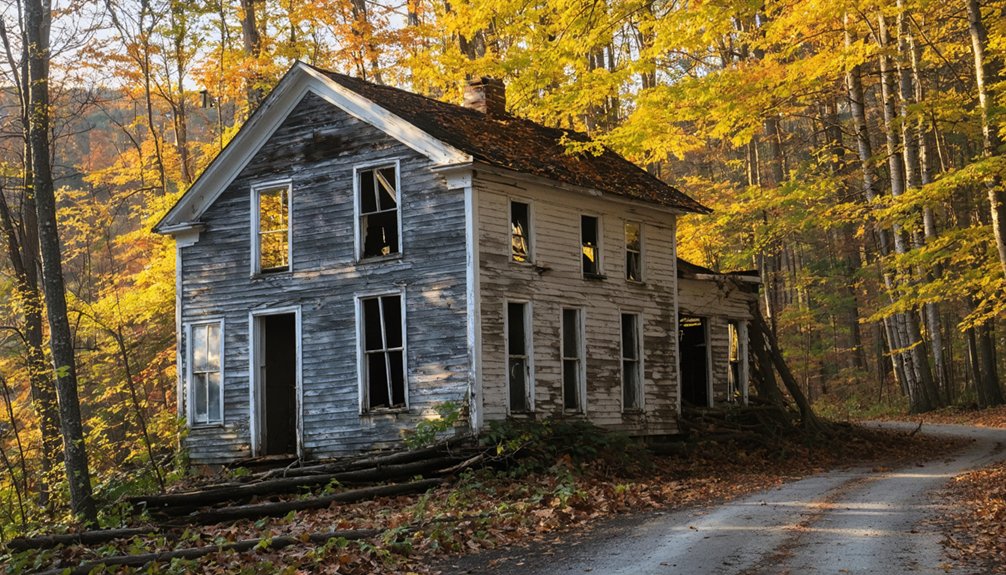
If you’re looking to expand your road trip beyond Winhall, the nearby ghost towns of Sunderland and South Glastenbury offer similarly haunting histories worth exploring. These haunted locations pulse with urban legends rooted in Vermont’s mysterious Bennington Triangle, where five people vanished between 1945 and 1950.
- Crumbling foundations swallowed by dense forest undergrowth
- Overgrown logging roads that once bustled with 19th-century industry
- Eerie silence broken only by wind cutting through abandoned clearings
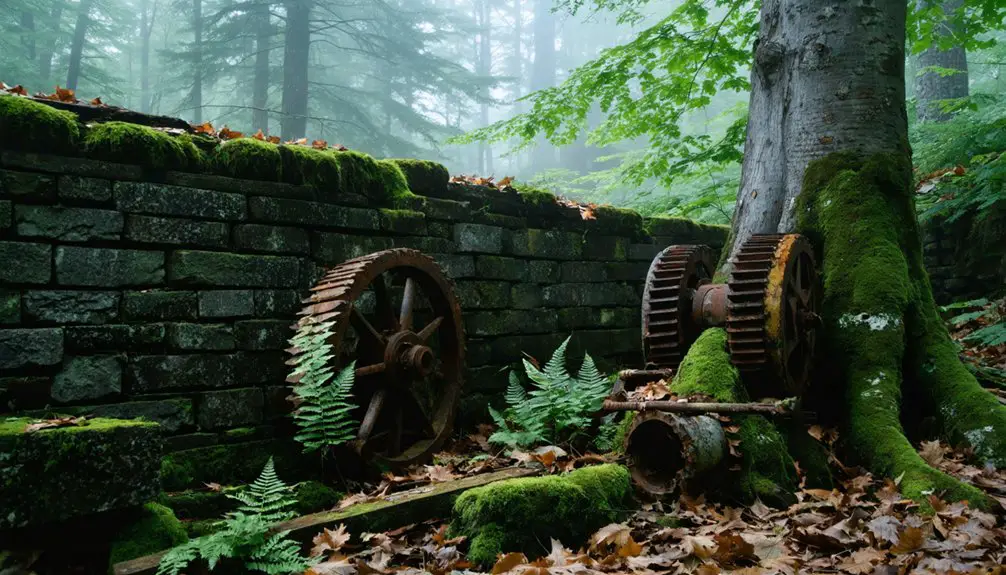
- Weathered stone walls marking farmsteads long reclaimed by nature
- Faded trail markers leading deeper into Vermont’s untamed wilderness
Both towns share Winhall’s arc of frontier prosperity followed by quiet abandonment. Pack sturdy boots, download offline maps, and give yourself a full day to wander freely through these forgotten corners of Vermont history.
What the Winhall Museum Reveals About Bondville’s Lost Past
When you step into the Winhall Museum on River Road, you’re walking straight into Bondville’s layered past.
The museum’s artifacts pull forgotten stories out of the shadows, connecting you to the settlers, industries, and everyday lives that shaped this mountain community.
You’ll leave with a sharper sense of what Bondville once was — and a deeper appreciation for what time has quietly erased.
Museum’s Historical Artifacts Displayed
Tucked along River Road in Bondville, the Winhall Museum holds the tangible remnants of a community that once thrived on timber and trade. Preservation efforts here keep ancient artifacts alive for those who refuse to let history fade quietly.
Step inside and you’ll encounter:
- Hand-forged logging tools worn smooth by generations of working hands
- Faded ledgers recording trades between early settlers and traveling merchants
- Photographs capturing Taylor Hill farms before the forest reclaimed them
- Handmade household items revealing daily life in Vermont’s mountain isolation
- Maps outlining the original 6-mile square township boundary chartered in 1761
Each piece connects you directly to Winhall’s mid-1800s prosperity. You’re not just viewing objects — you’re reading a community’s unfiltered story on your own terms.
Bondville’s Forgotten Heritage Uncovered
Beyond the artifacts sitting under glass, the Winhall Museum tells a sharper, more localized story — one that’s specifically about Bondville, the sole village within Winhall’s township.
You’ll discover how this small settlement evolved from a farming outpost into a functioning community with its own identity, shaped by the forestry boom of the mid-1800s.
The museum connects you directly to Bondville’s historical landmarks, tracing the roads, mills, and family names that defined daily life here.
You’ll also encounter local legends woven into the town’s fabric — including whispers tied to the surrounding mountains and the Bennington Triangle‘s unsettling history nearby.
Walking through this collection, you’re not just observing artifacts — you’re actively reclaiming a forgotten heritage that mainstream history rarely spotlights.
Bondville’s past belongs to those willing to seek it.
Where to Stay Near Winhall for a Ghost Town Weekend
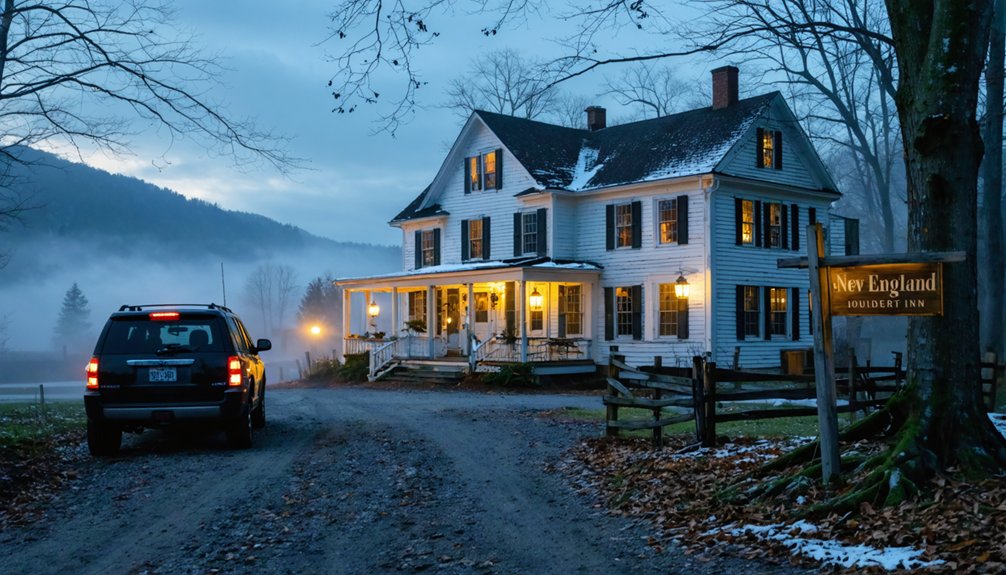
Bondville serves as your home base for exploring Winhall’s ghost town history, and you’ll find several lodging options within a short drive of the town center on Vermont Route 30. Cozy inns and rustic rentals put you close to haunted legends and abandoned structures waiting to be discovered.
- Ski lodges offering mountain views and fireside evenings after long exploration days
- Vacation rentals tucked into wooded hillsides along winding back roads
- Bed-and-breakfasts where locals share firsthand stories about Bennington Triangle lore
- Rustic cabins near river corridors perfect for early morning ghost town walks
- Boutique inns within driving distance of Glastenbury’s eerie, overgrown remains
Book early, especially during fall foliage season, when the region’s atmospheric beauty draws curious travelers from across New England.
What to Pack for a Winhall Ghost Town Road Trip?
Exploring Winhall’s ghost town terrain means preparing for rugged, unpredictable conditions across wooded hillsides, hollow roads, and overgrown trails near sites like Old Town Road and Winhall Hollow.
Pack layered clothing, waterproof boots, and a reliable flashlight — the forest doesn’t care about your comfort.
Bring a detailed trail map since cell service is unreliable in these remote pockets of Bennington County.
Carry a first aid kit, extra water, and high-energy snacks for longer explorations.
If you’re drawn by haunted legends surrounding the Bennington Triangle or the medieval legends woven into Abenaki lore about the Four Winds mountain, a journal helps you document what you discover.
A fully charged camera captures what words sometimes can’t.
Respect the land, stay aware, and move freely.
Before You Go: Safety at Abandoned Sites
Ghost town structures have stood without maintenance for decades. Floors, stairs and roof timbers fail without warning, and a building that looks solid from outside may not hold your weight. Stay out of standing structures unless the site is actively maintained and open to visitors.
Mine workings are the more serious hazard. Vertical shafts can be hundreds of feet deep, are often unfenced, and may be hidden by brush or capped with rotted boards. Never enter an adit, tunnel or shaft: abandoned workings can hold oxygen-poor or toxic air that gives no warning before you lose consciousness.
Enclosed spaces with rodent droppings carry a risk of hantavirus, which is contracted by breathing contaminated dust. Do not sweep or stir up dust inside old cabins and outbuildings.
Cell coverage at these sites is usually poor or absent. Tell someone your route and expected return time, and carry more water than you think you need.
Frequently Asked Questions
When Was Winhall, Vermont Officially Chartered as a Township?
Like a seed planted in fertile soil, Winhall’s township was officially chartered on September 15, 1761. You’ll discover ghost town attractions and abandoned buildings rooted in this bold, freedom-seeking history dating back centuries.
How Many People Lived in Winhall According to the 2020 Census?
You’ll find that only 1,182 residents called Winhall home in the 2020 census, making it an intimately small mountain town where Winhall ghost stories and Winhall local legends echo freely through its quiet, mysterious streets.
Can I Access Historical Winhall Birth and Death Records Online?
You can access Winhall’s historical birth and death records online through FamilySearch! These digitized documents, spanning 1857–1976, make genealogical research effortless, giving you the freedom to explore online record access from anywhere you choose.
What County Does Winhall, Vermont Belong To?
With 1,182 residents, you’ll find Winhall belongs to Bennington County, Vermont! You’ll love exploring its local attractions and outdoor activities while discovering this charming mountain town’s rich ghost town history and breathtaking freedom.
How Did the Town of Winhall Get Its Unique Name?
You’ll love discovering that Winhall’s unique name blends two proprietors’ surnames—Mr. Winn and Mr. Hall. Beyond town naming myths and local legends, this straightforward origin story gives the charming Vermont mountain community its distinctively memorable identity.
References
- https://www.burlingtonfreepress.com/story/news/2018/10/29/history-space-tale-two-vt-ghost-towns/38202243/
- https://www.winhall.org/
- https://www.youtube.com/watch?v=ScW-H7A8yL8
- https://sites.rootsweb.com/~vtwindha/vhg1/0245_winhall.htm
- https://en.wikipedia.org/wiki/Winhall
- https://www.familysearch.org/en/wiki/Winhall
- https://winhall.org/pdf/TownPlanRevised051716.pdf