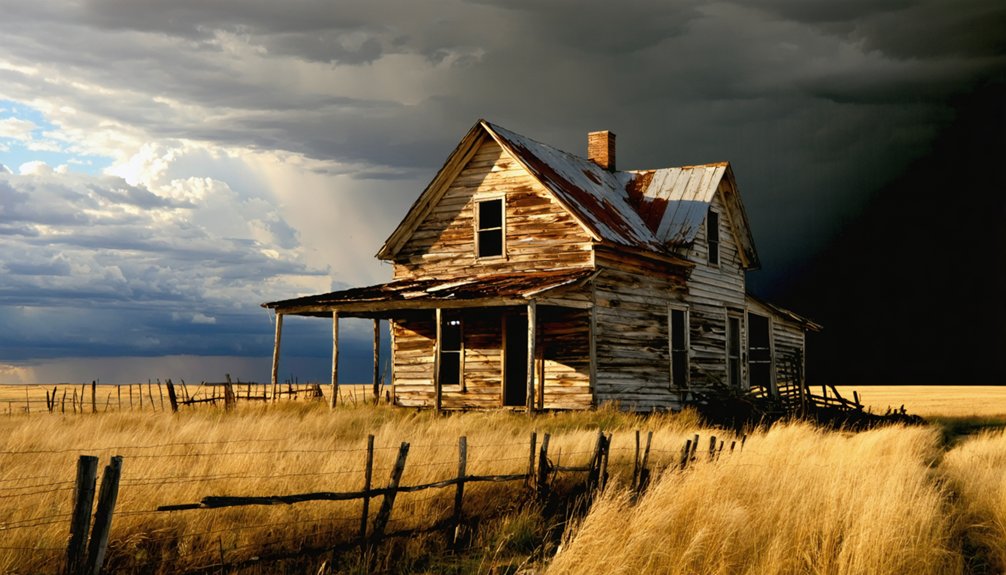
You’ll find Winship 25 miles northwest of Aberdeen via US-12 and US-281, then onto Brown County’s gravel roads to coordinates 45.922751° N, 98.518711° W. This vanished Milwaukee Road shipping point offers a haunting experience—almost nothing remains except subtle earth depressions and scattered rubble fragments. There’s no signage, no weathered buildings, just whispers of grain elevators that once stood as wooden sentinels. Avoid spring thaw and heavy winter when roads become impassable, and discover what lies beneath this Dakota landscape’s quiet secrets.
Key Takeaways
- Winship is located 25 miles northwest of Aberdeen, accessed via US-12, US-281, and Brown County gravel roads.
- At 45.922751° N, 98.518711° W, the site sits at 1,437 feet elevation in flat Dakota landscape.
- Spring thaw and heavy winter snowfall create seasonal accessibility challenges; plan visits accordingly.
- Almost no structures remain—expect subtle ground depressions and rubble fragments rather than buildings.
- No interpretive signs or preserved features exist; bring GPS coordinates and research historical context beforehand.
Getting to Winship: Route and Directions
Nestled in the rolling agricultural plains of northeastern South Dakota, Winship sits quietly at coordinates 45.922751° N, 98.518711° W—a ghost town that requires deliberate navigation to find. You’ll start from Aberdeen, the Brown County seat twenty-five miles southeast, accessing the site via state highways and local routes. US-12 and US-281 serve as your arterial connections before you shift onto Brown County’s road network.
Expect gravel road conditions as you venture northwest through farmland that slopes gently south and east. Load your GPS with the exact waypoint—there’s no signage to guide you. The site sits at an elevation of 1437 feet, a modest rise in the otherwise flat Dakota landscape. Before setting out, consider consulting the Ellendale South USGS topo map, which displays Winship and the surrounding terrain features. Seasonal accessibility challenges arise during spring thaw and heavy winter snowfall, when unpaved roads become impassable. Time your journey for summer or fall when the routes remain firm beneath your wheels.
What Remains at Winship Today
Time has erased nearly every trace of Winship’s existence, leaving you to search across windswept fields for hints that a community once gathered here. The extent of decay surpasses most ghost towns—you won’t find weathered facades or crumbling walls marking the spot where that 1889 schoolhouse once stood. Instead, you’ll encounter empty prairie, perhaps scattered foundation stones buried in tall grass if you’re persistent.
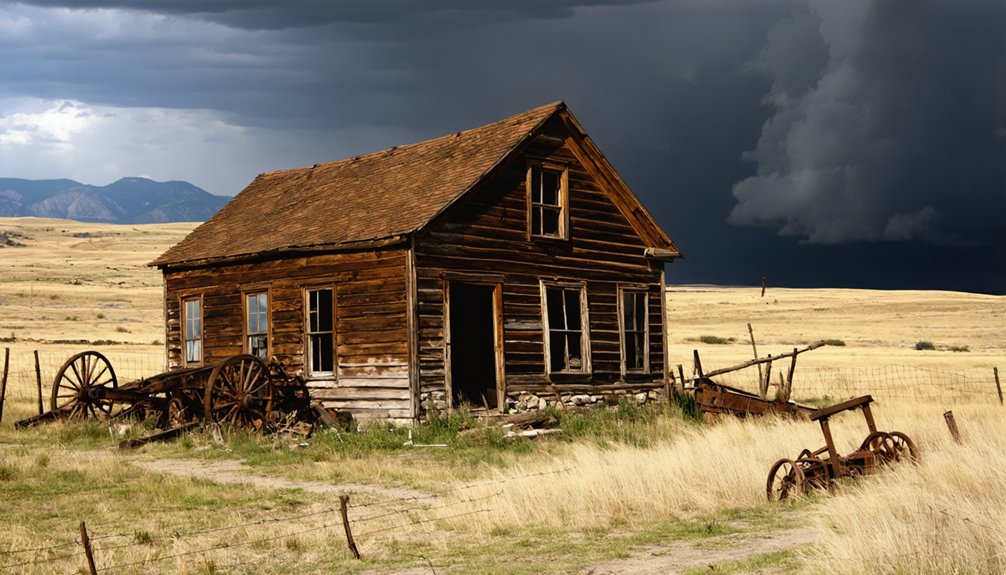
The visible remnants amount to little more than subtle depressions in the earth and occasional rubble fragments. This barren landscape offers no interpretive signs or preserved structures to guide your exploration. You’re free to wander these forgotten grounds, imagining homesteaders who briefly called this place home before the plains reclaimed their ambitions and erased their footprints completely. Like Barren, Winship represents a ghost town with no remaining structures to explore. The slowly collapsing, empty buildings you’ll find at other South Dakota ghost towns provide a striking, rustic backdrop that Winship simply cannot match.
exploring the history of winship can lead to a deeper understanding of the challenges faced by those who settled in this harsh environment. The stories of resilience and hope linger in the whispers of the wind, inviting curiosity and reflection. While there may be little to see, the spirit of its past remains an intriguing mystery waiting to be uncovered.
The Railroad Legacy of Winship
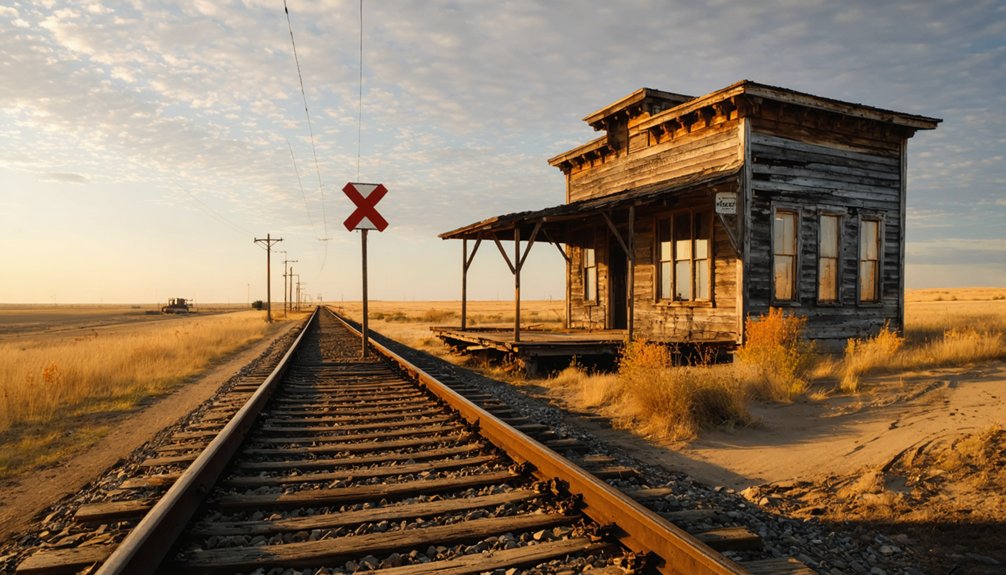
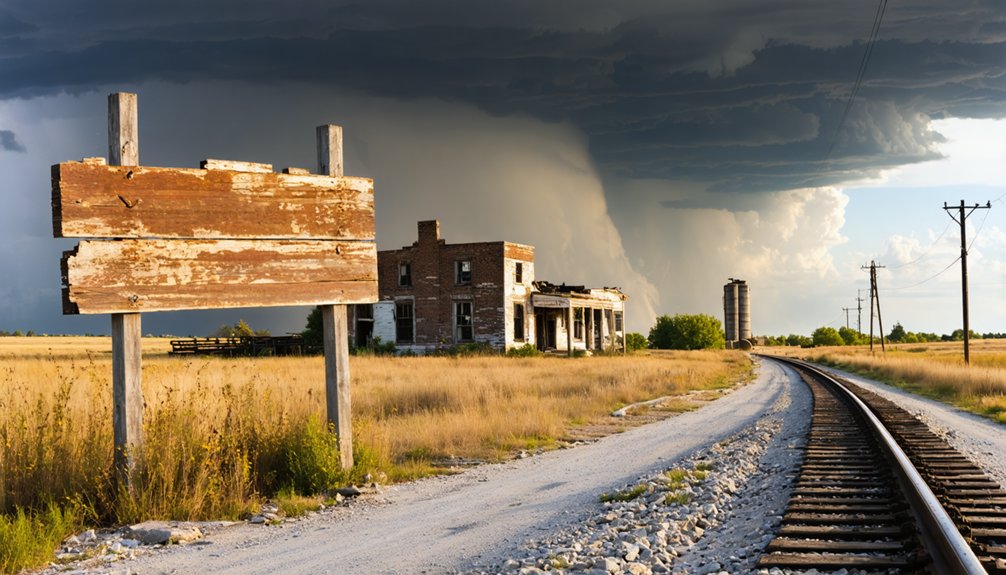
You’ll find Winship’s entire existence tied to the Milwaukee Road’s north branch line that stretched from Aberdeen toward the North Dakota border. The station served as a pivotal agricultural shipping point, complete with grain elevators that channeled Brown County’s wheat harvests onto waiting railcars bound for distant markets.
Remarkably, despite its railroad operations, Winship never established a post office—a rare distinction that marked it as purely a commercial waypoint rather than a settled community. Like many Dakota Territory settlements, Winship’s fate hinged on railroad route decisions that determined which communities would thrive and which would fade into obscurity. By the mid-20th century, changes in agricultural economy rendered many spur lines like the one serving Winship unprofitable, leading to their eventual abandonment.
Chicago Milwaukee Rail Connection
The Chicago, Milwaukee, St. Paul & Pacific Railroad carved its path through Brown County’s prairie, establishing Winship as a crucial junction on its north branch. You’ll discover how this rail company influence transformed isolated homesteads into connected communities by 1881.
The Milwaukee Road’s aggressive expansion during the Great Dakota Boom brought more than passengers—it revolutionized freight transportation improvements across the territory. Steel rails replaced wagon ruts, slashing delivery times from weeks to days. Grain elevators sprouted alongside tracks, and settlers gained access to eastern markets that made their ventures viable. The railroad’s Chicago headquarters, incorporated in 1837, managed these far-reaching operations that extended across the northern plains. The company’s West Milwaukee Shops constructed nearly 700 steam locomotives between 1880 and 1938, supplying the engines that powered western expansion.
Though fierce competition with Chicago & North Western shaped regional development, Milwaukee Road’s strategic routing through stations like Winship proved indispensable for northern South Dakota’s growth. Today, abandoned grades whisper tales of this transformative era.
Agricultural Elevator Operations
Where steel rails met prairie soil, grain elevators rose as wooden sentinels of prosperity, their crib-style construction resembling oversized log cabins stacked skyward. You’ll discover Winship once supported two elevators during its peak—monuments to agricultural independence where farmers controlled their destiny through board-of-directors meetings held long after sunset.
By 1930, only one elevator remained standing, mirroring the town’s population decline to eight hardy souls. The economic impact was undeniable: these structures determined whether communities thrived or vanished into prairie dust.
Wood’s moisture-absorbing properties made these elevators superior to metal alternatives, though time threatens their survival. Insurance actuaries now classify these structures as fire hazards due to explosive grain dust accumulation within their aging walls. The dangers proved real—moving machinery caused numerous accidents that led to injury lawsuits against elevator companies throughout the early 1900s. Preservation efforts now race against decay, documenting these architectural chronicles before they collapse into memory—fragile reminders of self-reliant pioneers who built empires from wheat and determination.
Station Without Post Office
Steel ribbons of the Milwaukee Road’s north branch stretched across Brown County’s grasslands, binding Winship to the wider world through iron rather than ink. Unlike neighboring stations along the main line—Groton, James, Bath—Winship never received post office designation, marking it as a rail depot serving freight and passenger needs without full postal operations. This distinction reflected unrealized development plans that characterized many boom-era townsites.
The depot handled telegrams and packages, but limited community services meant settlers rode elsewhere for mail. The railroad’s Western Town Lot Company platted the site expecting prosperity, yet Winship remained a whistle-stop rather than a thriving hub. Today, that unfulfilled promise lingers across empty prairie, where steel once promised connection but delivered only passage.
White Rock: Another Ghost Town Worth Visiting
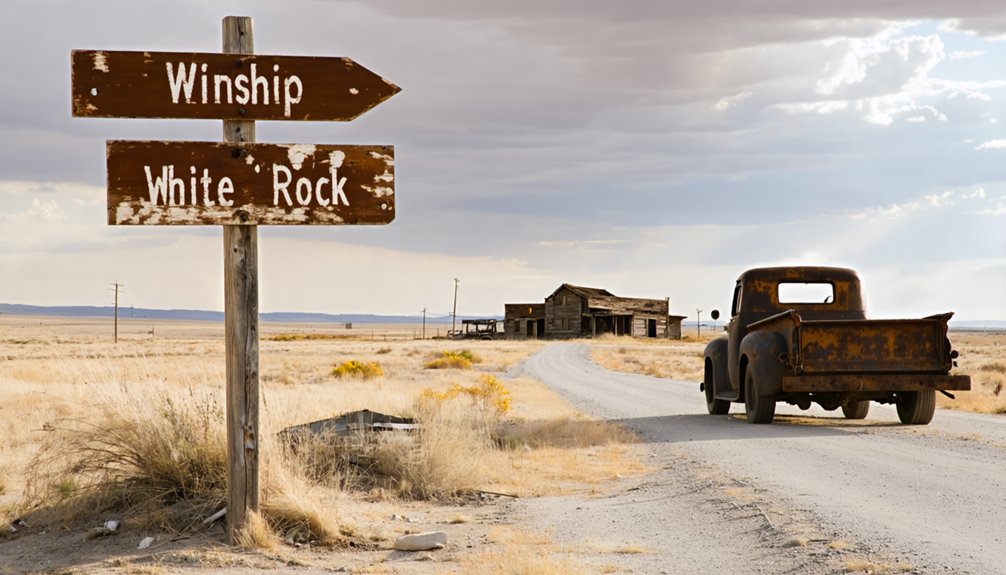
Tucked away in Roberts County at South Dakota’s extreme northeast corner, White Rock stands as one of the state’s most haunting ghost towns. You’ll find this abandoned settlement just one mile south of North Dakota, along Minnesota’s border, where the Bois de Sioux River flows toward Hudson Bay. The town’s significance peaked in 1910 with 368 residents, seven grain elevators bustling with activity. Today, only six people remain among the remnants.
A historical marker at Haggert Avenue and 2nd Street details the town’s origins, named after a white granite boulder—ironically destroyed to build a grain elevator. Notable landmarks include this same elevator standing where the namesake rock once marked the original town site. You’ll discover why this remote 1.57-square-mile settlement captivates ghost town enthusiasts seeking authentic frontier history.
Black Hills Mining Ghost Towns Near Your Route
Several forgotten mining camps scatter across the Black Hills, offering a striking contrast to Winship’s prairie solitude. You’ll discover Garnetiferous, where garnet extraction challenges defeated miners who’d avoided the gold rush chaos. Its subtle ruin field tells a niche mining history most travelers miss.
Spokane beckons with stone walls and a crumbling schoolhouse, authentically reclaimed by forest since the mine closed in 1940. Mystic‘s quiet remains mark a railroad and logging hub that couldn’t compete with boomtown neighbors. Galena preserves an intact schoolhouse along Vanocker Canyon, while Silver City maintained a post office until 1964. Each camp reveals different facets of Black Hills mining—from garnet to silver—giving you freedom to explore beyond conventional ghost town narratives.
Best Time to Visit South Dakota Ghost Towns

Winter drastically limits off season accessibility—snow blankets routes to remote sites, forcing you toward indoor experiences like 1880 Town. Yet this isolation rewards adventurous travelers with solitary encounters at haunted Deadwood locations.
Spring’s unpredictable weather carries risk, but post-Memorial Day offerings include operational services without summer’s congestion along Wildlife Loop Road and Iron Mountain Road.
What to Bring on Your Ghost Town Adventure
Your timing sorted, now focus on what fills your backpack for this journey into South Dakota’s abandoned landscapes. Breaking free from civilization demands thoughtful preparation.
Pack emergency preparedness supplies—first aid kit, flashlight, extra batteries, and water—because help won’t find you quickly out here. Roadside mapping tools prove essential when GPS signals fade among windswept prairies.
Essential gear includes:
- Sturdy boots for traversing crumbling foundations and prairie terrain
- Camera with extra memory cards to capture weathered structures and untold stories
- Detailed maps showing both maintained roads and forgotten trails to ghost settlements
- Weather-appropriate layers since South Dakota’s conditions shift rapidly from scorching sun to sudden storms
This abandoned terrain rewards those who arrive prepared, letting you explore Winship’s remnants without constraint or concern.
Safety Tips for Exploring Abandoned Sites
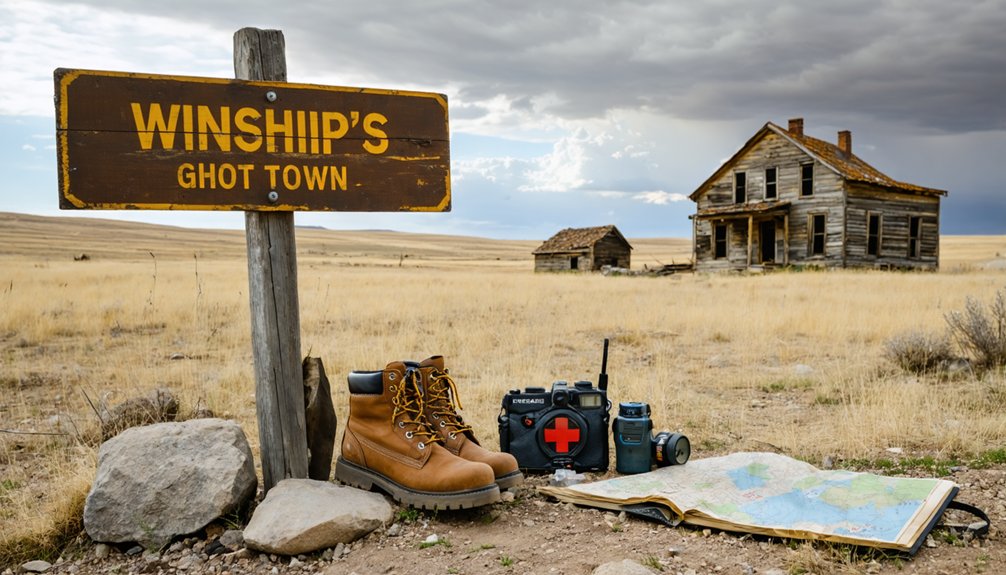
Before you step through the weathered doorframe of any Winship structure, understand that ghost towns don’t forgive careless explorers. Personal risk mitigation starts with bringing at least two companions—if you’re injured, one stays while another gets help. Tell someone your location and return time before heading out.
Test every floorboard before trusting your weight to it. Stay near walls where structural supports exist, avoiding rotted centers. Your respirator protects against decades of accumulated asbestos and mold spores. Scout the building’s exterior first, identifying exits and collapse zones.
Group safety protocols mean everyone carries flashlights, first-aid supplies, and proper identification. These crumbling buildings won’t wait for rescuers—your preparation determines whether you walk out sharing stories or being carried out.
Capturing the Perfect Ghost Town Photography
You’ll need a camera with manual controls and a sturdy tripod to capture Winship’s weathered storefronts and empty streets during those magical dawn and dusk hours when natural light bathes crumbling facades in golden warmth.
Pack a remote shutter release for exposures beyond 30 seconds, plus a flashgun or LED panel to paint light across dark interiors where abandoned tools and forgotten artifacts wait in shadow.
Position your light sources at 45-degree angles to reveal texture in peeling wallpaper and splintered wood, then experiment with wide-angle lenses that amplify the haunting emptiness of main street’s silent buildings.
Essential Camera Gear Tips
When the golden hour light pierces through broken windows of Winship’s abandoned buildings, you’ll need the right camera gear to capture those hauntingly beautiful moments. Your mirrorless or DSLR body will capture shadow subtleties that make ghost towns mesmerizing. Master these camera settings for success: manual mode at f/4, 15 seconds, ISO 1600 in dark interiors.
Essential gear for your Winship expedition:
- Wide-angle lens (16-35mm) to frame vast abandonment scenes
- Sturdy tripod for 2-30 second exposures in low light
- Flashlight and headlamp for traversing electricity-free buildings
- Circular polarizer to deepen prairie skies against weathered structures
Pack lighting techniques like off-camera flash with gels to highlight architectural details. A reliable backpack and cleaning kit protect your equipment from South Dakota’s dust and debris.
Best Lighting and Angles
Everything changes when light strikes Winship’s crumbling facades at the right angle. You’ll discover golden hour transforms ordinary decay into theatrical beauty—low sun emphasizes textures while backlighting separates subjects from backgrounds. Scout locations beforehand to anticipate how shadows will waltz across weathered timber and broken glass.
Strategic light placement becomes your creative weapon after dark. Position flashlights 90 degrees from structures during 15-30 second exposures, revealing forgotten corners that daylight misses. Avoid aiming directly behind your camera—you’ll flatten dimension and lose detail.
Dramatic silhouette composition emerges when you frame architectural remnants against twilight skies. These ghostly outlines capture Winship’s mystery without excessive manipulation. For extended exposures beyond 260 seconds, lock your focus and let star trails dance above the silent town, adding surreal beauty to your visual story.
Frequently Asked Questions
Are There Any Hotels or Camping Options Near Winship?
You’ll find Winner, just 15 miles away, offers hotels starting at $76 nightly. Days End Campground welcomes your RV park campgrounds adventure, while bed and breakfast lodging options dot the region, giving you freedom to explore Winship’s ghostly ruins.
Can I Find Food and Gas Stations Close to These Ghost Towns?
You’ll find gas stations and nearby dining options in Frederick, just 7 miles from Winship. Availability of convenience stores varies by location—Hill City, Keystone, and Deadwood serve Black Hills ghost towns with fuel and restaurants for your adventure.
Is Cell Phone Service Available in the Winship Area?
While you’ll crave off-grid solitude, reality check: cell phone coverage limitations plague Winship’s remote terrain. Expect intermittent connectivity at best—Verizon and AT&T offer your strongest signals, but download offline maps before venturing into this vanished prairie settlement.
Do I Need Permission to Visit Winship or Other Ghost Towns?
You’ll need to verify land ownership before exploring. Obtaining landowner permission protects you legally, while exploring accessibility guidelines guarantees safe passage. Most ghost towns sit on private property, so respectful inquiry grants you legitimate freedom to wander.
What Other Historical Attractions Exist Near Frederick, South Dakota?
Picture weathered wooden frames dissolving into prairie grass—you’ll discover abandoned homesteads dotting the landscape, plus Savo Hall celebrating Finnish heritage. The Dacotah Prairie Museum showcases Native American cultural sites and prehistoric treasures from Brown County’s fascinating past.
References
- https://www.youtube.com/watch?v=yVWWqwcGTt0
- https://www.blackhillsbadlands.com/blog/post/old-west-legends-mines-ghost-towns-route-reimagined/
- https://en.wikipedia.org/wiki/List_of_ghost_towns_in_South_Dakota
- https://www.powderhouselodge.com/black-hills-attractions/fun-attractions/ghost-towns-of-western-south-dakota/?2021_TAG
- http://files.usgwarchives.net/sd/brown/ehbc/ehbc-fulltext.txt
- https://blackhillsvisitor.com/learn/maitland/
- https://bchsofsd.com/winship/
- https://www.ghosttowns.com/states/sd/winship.html
- https://repository.si.edu/bitstream/handle/10088/15470/bulletin1761960smit.pdf
- https://topoquest.com/place/south-dakota/populated-place/winship/1261081