You’ll find Yegua’s ghost town corridor one mile southeast of Somerville along State Highway 36, where Stephen F. Austin’s 1822 settlement vanished so completely that not a single foundation stone marks where John P. Coles built his mill or where the post office served cotton farmers from 1859 to 1867. Base yourself at Yegua Creek Park’s 82 campsites with 50-amp hookups, where off-season rates drop to $18 and you’re positioned perfectly to explore what nature reclaimed from Washington County’s prairie bottomlands.
Key Takeaways
- Yegua’s ghost town site sits one mile southeast of Somerville along SH 36 at coordinates 30°17’22″N 96°41’02″W.
- No physical remnants remain of the 1850s settlement; nature has completely reclaimed the abandoned town’s original location.
- Access the area via Farm Road 696 southwest from Caldwell or county roads near Longpoint connecting to the creek.
- Base camp at Yegua Creek Park offers 82 campsites with hookups, rates from $18-$30, booked through Recreation.gov.
- The park provides boat ramps, hiking trails, showers, and lake access for fishing while exploring the historic territory.
Historical Background of Yegua Settlement and Post Office Era
When Stephen F. Austin renamed this Spanish territory “Yegua” in 1822, he watched mustang mares grazing the timbered creek banks where Indians once camped. You’ll find this ghost town’s roots in Washington County’s colonization era, where John P. Coles established his mill in 1826.
The settlement thrived during the 1850s, supporting early cotton production and nearby ranching operations that defined frontier life.
Your journey traces a post office that opened in January 1859, serving isolated homesteaders until June 1867. Sam Houston’s 1837 measure designated Yegua Creek as a county boundary, marking this area’s strategic importance. After the Civil War, the post office closed and settlers abandoned their claims. Devastating floods plagued the region until Lake Somerville’s creation in 1967, leaving no structures behind. The name Yegua, meaning royal palm in Spanish, shares its origins with the Yagua people of the Amazon basin. The settlement sat on a low ridge between Brushy and Yegua Creeks, sharing geographical features with nearby Post Oak Island.
Finding Yegua in Northern Washington County
Twelve miles north and slightly east of Brenham, you’ll trace your way along the northern boundary of Washington County where Yegua Creek cuts through rolling prairie and timber country. Post oak and blackjack forests mark the landscape where early native inhabitants roamed these geological formations for 9,000 years before European settlement.
You’ll find springs with salt and soda mineral deposits along the hills—natural markers that guided settlers to this vanished community. The Spanish road once connected mission settlements through this territory, and from 1859 to 1867, Yegua’s post office anchored the scattered farming families.
Today, no structures remain. Yegua no longer exists, classified among Washington County’s communities that have completely vanished from the Texas landscape. You’re traversing pure history, reading the land itself where prairie swells meet creek bottoms thick with pin oak and walnut timber. Beneath your feet lies the Clay Creek salt dome, a geological formation discovered in this area that once produced oil and gas from ancient sedimentary layers.
What Remains of the Abandoned Settlement Today
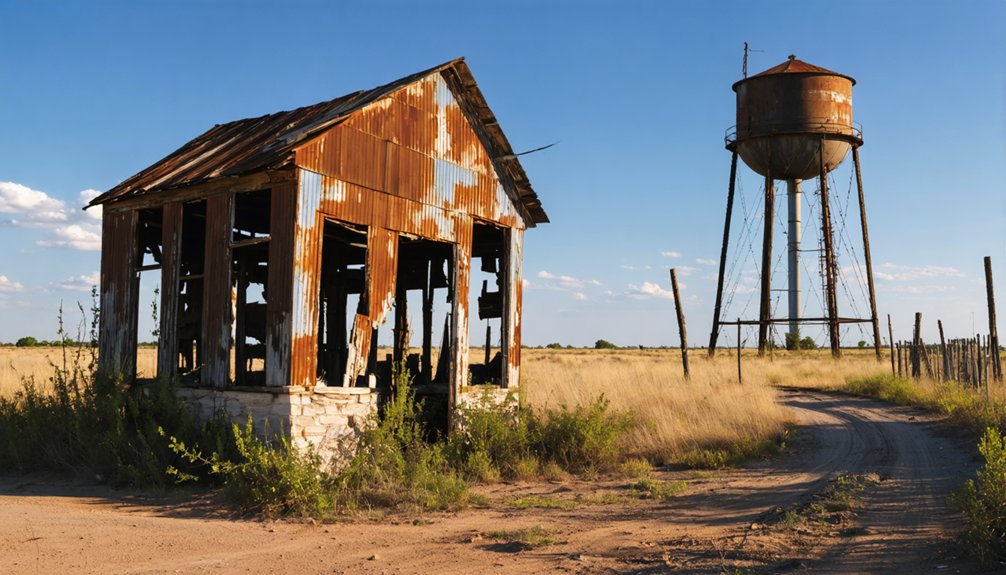
You’ll search in vain for any trace of Yegua’s built environment. The settlement that thrived briefly in the 1850s and 1860s has left no residential remnants behind—no foundations, no weathered boards, no crumbling chimneys marking former homesteads. The absence of infrastructure is absolute.
Unlike ghost towns where you can wander through skeletal buildings or photograph rusted machinery, Yegua offers only untamed landscape. Nature has completely reclaimed this territory near Yegua Creek, erasing every human footprint from its brief existence. You won’t find historical markers or commemorative plaques directing you to specific sites. The land itself becomes your only witness, rolling terrain and creek waters flowing where mail carriers once delivered correspondence between 1859 and 1867. It’s pure wilderness now—freedom from civilization in its rawest form.
This contrasts sharply with modern Texas developments where entire neighborhoods stand built for tens of thousands who never arrived, their infrastructure intact but populations missing—a different kind of abandonment altogether. In places like Snyder, vacancy rates approach 16% as blight spreads through communities that once thrived with economic activity.
Best Routes and Access Points for Ghost Town Explorers
You’ll find Yegua’s ghost town site one mile southeast of Somerville along State Highway 36’s west side, where a hilltop roadside park marks your gateway to the abandoned settlement near Yegua Creek.
From Caldwell, take Farm Road 696 southwest for 10 miles to reach the creek’s east bank, cutting through the heart of where this 1859-1867 community once stood.
The coordinates 30°17′22″N 96°41′02″W place you in northern Washington County’s ghost town corridor, accessible through Lake Somerville’s trail system or the direct highway approach that drops into the old creek bottom. Texas’s numerous ghost towns became abandoned for various reasons including economic decline, natural disasters, or being bypassed by major transportation routes.
Primary Highway Approaches
How do you reach a ghost town that vanished over 150 years ago? You’ll navigate Yegua’s territory where nearby county roads intersect with era transportation routes along Yegua Creek’s banks.
Your primary highway approaches include:
- SH 36 from Somerville – Head one mile southeast to the hilltop roadside park near 30°17′22″N 96°41′02″W, where the old settlement once thrived in northern Washington County.
- Farm Road 696 – Access the creek’s east bank ten miles southwest of Caldwell through western Burleson County’s farming landscape.
- Old San Antonio Road traces – Follow historical paths through the redland prairie bottomlands where Yegua’s post office operated from 1859-1867.
- Longpoint area county roads – Wind through unmarked routes connecting to Lake Somerville’s Yegua Creek Park entrance.
No GPS coordinates remain—only the waterway guides you. The 62-mile tributary of the Brazos River once drew Stephen F. Austin’s colonists to build mills and settlements along its timbered banks in the 1820s.
Modern explorers face unique challenges when seeking Yegua’s scattered remnants across Washington County’s rural expanse. You’ll navigate unmarked access roads branching off SH 36, where abandoned settlement ruins hide beyond modern sight lines.
Farm Road 696 provides your most reliable approach, cutting through terrain where the original community once thrived near Yegua Creek’s eastern bank.
The creek itself serves as your natural landmark—follow it from the 1976 historical marker one mile southeast of Somerville. You’ll discover that many original pathways have vanished beneath decades of overgrowth, requiring careful observation of subtle terrain changes.
The Old San Antonio Road traces near the creek bottom, offering clues to former routes. Your best strategy combines modern GPS coordinates (30°17′22″N 96°41′02″W) with ground-level intuition when traditional markers fail.
Yegua Creek Park as Your Base Camp

Nestled along the wooded shores of Somerville Lake, Yegua Creek Park offers an ideal staging point for your ghost town explorations. You’ll find genuine freedom here—82 campsites where you can pitch your basecamp without rigid constraints. The US Army Corps of Engineers operates this year-round facility with practical amenities that won’t break your budget.
Essential basecamp features:
- 50-amp hookups accommodate big rigs at sites fitting two camping units
- Off season discounts drop rates to $18-$26 when crowds thin out
- Family friendly amenities include flush toilets, showers, and interpretive trails
- Direct lake access via two boat ramps for dawn fishing expeditions
Reserve through Recreation.gov, though walk-up availability exists for spontaneous adventurers. Check-in starts at 3:00pm—no early arrivals allowed. The gate house complex operates daily from 6:00 AM to 10:00 PM for controlled park access. Watch for pelicans and waterfowl gliding along the shoreline during your morning coffee routine.
Combining Lake Somerville Recreation With Historical Exploration
You’ll find Yegua Creek Park serves as the perfect staging ground for your dual adventure—chase ghost town history by day, then return to a waterfront campsite with picnic tables, grills, and restrooms as twilight settles over Lake Somerville’s 11,000 acres.
The park’s boat ramps put you minutes from hybrid striped bass and largemouth bass fishing, while hiking trails through post-oak forests and native prairie grasses offer morning wildlife encounters with deer, foxes, and songbirds before you head out to explore abandoned settlements.
This rhythm of historical exploration followed by lakeside recreation lets you experience two distinct Texas landscapes without sacrificing comfort or breaking camp.
Yegua Creek Park Camping
Just a few miles from the historical site of Yegua, the Yegua Creek Campground at Lake Somerville offers an ideal basecamp for ghost town explorers who want modern comfort alongside their historical pursuits. You’ll find 82 sites ranging from rustic tent sites nestled under shady oaks to full-hookup spots accommodating massive RVs.
Essential camping details:
- Reserve through Recreation.gov ($18-$30 nightly depending on season)
- 65 sites feature 50-amp electrical and water hookups
- Group camping amenities include hot showers, boat ramps, and interpretive trails
- Check-in starts at 3:00 PM; no early arrivals permitted
The Corps-managed facility lets you wake to lakefront views, fish for trophy bass, then disappear into history. It’s the perfect blend of adventure and autonomy.
Balancing History and Outdoors
Lake Somerville transforms your ghost town expedition into a dual-purpose adventure where morning history walks give way to afternoon paddling sessions across 11,630 acres of open water. You’ll trace abandoned homesteads along the 40-mile trail system before launching your kayak from multiple access points at Birch Creek and Nails Creek units.
The park’s 1960s dam construction submerged Yegua Creek Basin settlements, creating fishing grounds where hybrid striped bass now swim over forgotten entrepreneurial ventures. Your days split naturally between exploring post-oak forests concealing remnants of frontier life and casting lines for 10-pound largemouth bass.
With 143 campsites providing basecamp flexibility, you’re free to design each day around discovery—whether tracking wildlife through prairie grasses or water skiing across history-soaked waters where communities once thrived.
Other Washington County Ghost Towns to Add to Your Itinerary
While Yegua anchors your ghost town adventure, Washington County harbors several other abandoned settlements that’ll transform your day trip into a full weekend exploration. You’ll discover forgotten communities connected by scenic roadways, each with its own distinct character. Exploring the history of yegua, texas ghost town reveals fascinating tales of its past inhabitants and the reasons behind its decline. As you wander through the remnants of old buildings and cracked roads, you’ll feel the echoes of history come alive. This captivating experience invites you to reflect on the transient nature of life and community, making your visit truly unforgettable.
Washington County’s network of ghost towns offers weekend explorers multiple destinations within a single scenic road trip through forgotten Texas history.
Essential stops for your Washington County ghost town circuit:
- Independence – Sam Houston’s former hometown, featuring historical markers near Baylor University’s original campus site, twelve miles northeast of Brenham
- Gay Hill – Weathered structures still stand near Lake Somerville, offering photo opportunities and quiet contemplation
- William Penn – Remote coordinates (30°18’55″N, 96°16’56″W) lead you to another vanished settlement
- Britain – Just minutes from Gay Hill, completing your circuit through Central Texas’s forgotten past
These destinations reward those seeking unmarked trails and unrestricted exploration through Washington County’s temporal landscape.
Frequently Asked Questions
Are Private Property Permissions Required to Explore Yegua Ghost Town?
Yes, you’ll need permission since Yegua sits on private land. No entry fees required at nearby Yegua Knobbs Preserve, though gates need opening. You’ll find limited nearby amenities availability, so pack supplies before exploring these windswept, forgotten ruins responsibly.
What Cell Phone Coverage Exists Near Yegua and Lake Somerville?
You’ll find decent Verizon and AT&T coverage near Lake Somerville, with cell tower locations concentrated around populated areas. Internet connectivity weakens as you approach Yegua’s remote terrain, so download maps beforehand for your off-grid adventure.
Can You Visit Yegua Year-Round or Only Certain Seasons?
You’ll find year-round freedom at Yegua Creek Park near the ghost town. Peak season visitation runs March-September with warmer rates, while off season accessibility October-February offers cooler探 prices and uncrowded trails for your adventure.
Are Guided Ghost Town Tours Available in Washington County?
No guided ghost town tours exist in Washington County, though Texas boasts 511 ghost towns total. You’ll need to explore independently, joining local ghost town enthusiasts on self-guided drives while historical preservation efforts continue protecting these vanishing sites.
What Supplies Should Visitors Bring When Exploring Remote Yegua?
You’ll need essential water supplies since remote areas lack facilities, plus safety equipment like first-aid kits, flashlights, and navigation tools. Sturdy boots, sun protection, and emergency communication devices guarantee you’re prepared for unexpected situations in this isolated terrain.
References
- https://en.wikipedia.org/wiki/Yegua
- https://en.wikipedia.org/wiki/List_of_ghost_towns_in_Texas
- https://www.texasalmanac.com/places/yegua-1
- https://texashighways.com/travel/the-quest-to-resurrect-a-ghost-town/
- https://www.youtube.com/watch?v=LEPjXs8afr4
- https://thc.texas.gov/sites/default/files/2024-10/THC_Quarterly_AAB_Oct2024.pdf
- https://www.wilcotx.gov/1636/1850-to-1859-Part-II
- https://txarchives.org/tslac/finding_aids/30183.xml
- https://www.forttours.com/pages/hmburleson.asp
- https://texaswendish.org/2009/01/01/wendish-communities-fedor-part-i/