You’ll find Yeso along U.S. Route 60 in De Baca County, where the two-story Hotel Mesa and misspelled “Frontier Musem” stand as weathered monuments to 300 families who once thrived here. Drive 30 miles west from Fort Sumner to explore the 1906 depot, abandoned water tanks, and crumbling stone homes that mark this railroad ghost town‘s stubborn persistence. Respect the operating post office and scattered residents, bring your camera for architectural details, and discover what lies beneath Yeso’s dramatic emptiness.
Key Takeaways
- Yeso sits along U.S. Route 60 in De Baca County, 30 miles west of Fort Sumner at 4,770 feet elevation.
- The abandoned 1906 depot, Hotel Mesa, misspelled “Frontier Musem,” and yellow Super Service Drive-In remain as primary landmarks.
- A functioning post office and three to five occupied houses persist among the ruins of this former 300-family railroad town.
- Photograph ghost signs, architectural details, and decaying interiors while respecting no-trespassing signs and private property boundaries.
- Winter travel requires caution for occasional snow; nearby Fort Sumner and Santa Rosa offer lodging and services 30-38 miles away.
The Rise and Fall of a Railroad Town
When the Atchison, Topeka & Santa Fe Railway carved its Belen Cutoff through east-central New Mexico in 1906, Yeso sprang to life along the tracks as a critical water stop for steam locomotives. You’ll discover unique town origins tied to the railroad’s need for accessible groundwater—despite Yeso Creek’s undrinkable, gypsum-laden flow.
Yeso emerged from railroad necessity in 1906, thriving as a steam locomotive water stop despite the creek’s gypsum-poisoned waters.
By 1909, the post office opened, and the settlement became a trading hub for ranchers traversing this harsh landscape.
The town’s sustainable economic challenges proved insurmountable. Poor soil, persistent drought, and limited agricultural potential couldn’t support the 300 families who once called Yeso home. When diesel locomotives eliminated water stops after WWII, the town’s lifeline severed.
The depot shuttered in 1968, residents scattered to Fort Sumner, and today only a functioning post office marks this railroad ghost town’s stubborn persistence.
Getting to Yeso: Location and Directions
You’ll find Yeso along the lonely stretch of U.S. Route 60 in eastern New Mexico’s De Baca County, where the desert opens wide and the pavement cuts straight through sun-bleached terrain.
The tiny settlement sits west of Fort Sumner at coordinates 34°26’21″N, 104°36’36″W, perched at 4,770 feet elevation near the creek that gave it its name. With only a handful of houses and a post office marking civilization, this vanishing community emerges from the heat shimmer like a mirage you can actually reach.
Route Options and Highways
Getting to Yeso requires traversing the sparse network of highways that crisscross New Mexico’s High Plains, where U.S. Route 60 serves as your primary corridor of freedom. This east-west artery cuts through De Baca County’s desert terrain, delivering you directly to the ghost town’s scattered remnants west of Fort Sumner.
You’ll find the paved infrastructure maintains reliable year-round access, though highway conditions demand attention during winter months when occasional snow sweeps across the exposed plateau. The route’s straightforward nature eliminates complicated navigation—simply follow Route 60 westward from Fort Sumner into increasingly remote territory.
Seasonal travel concerns remain minimal thanks to the highway’s elevation at 4,770 feet, though summer heat and spring winds characterize the high desert experience you’ll encounter on this solitary stretch of asphalt.
Nearby Towns and Landmarks
The ghost town sits in remarkable isolation, with Fort Sumner claiming the position as your closest substantial community at 30.4 miles to the east. You’ll find Santa Rosa 37.8 miles away, while Corona lies 38.9 miles distant. These settlements once supported historical agriculture and livestock operations that defined the region’s economy.
Your journey reveals De Baca County’s dramatic emptiness—627 square miles of high desert plateau where ranching persists against harsh odds. The abandoned 1906 railroad depot marks where steam engines once stopped along the Belen Cutoff, serving livestock operations shipping cattle east. Yeso Creek, named for local gypsum deposits, cuts through terrain that defeated permanent habitation. What remains—a weathered church, stone house, and rusting water tanks—stands as evidence to those who challenged this unforgiving landscape and ultimately conceded.
What Remains: Exploring the Abandoned Structures
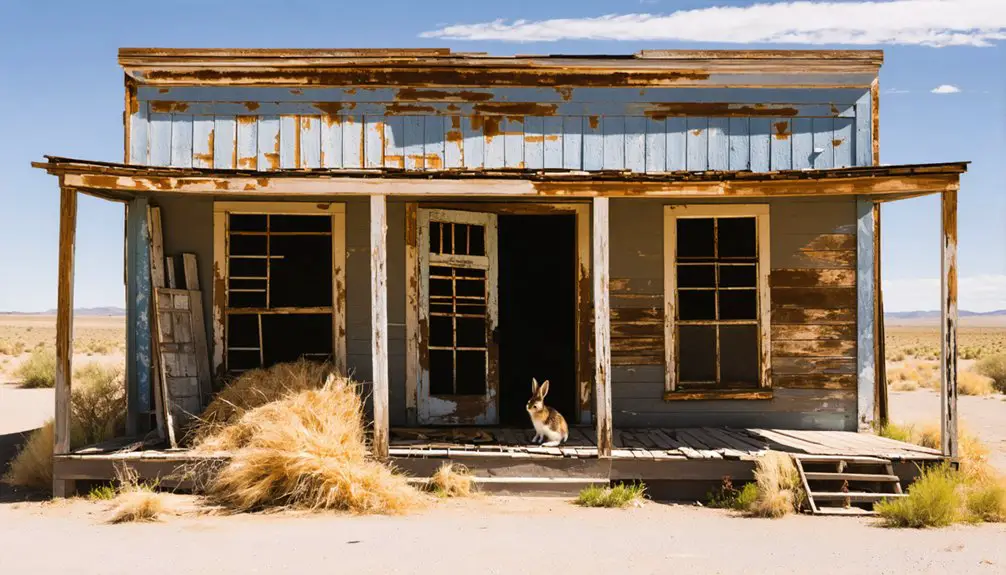
The two-story Hotel Mesa commands attention with its peeling exterior and faded sign advertising “Rooms 75 cents to a Dollar,” while across the way, a misspelled “Frontier Musem & Trading Post” promises guns and antiques that vanished decades ago.
You’ll find the hotel’s wide-open door inviting exploration, though the shabby staircase appears too weak to support your weight as you peer into the gloom. These skeletal structures stand as Yeso’s most prominent landmarks, their weathered facades telling stories of travelers who once needed a meal, a bed, or a tank of gas along this forgotten stretch of highway.
Notable Historic Buildings Standing
Weathered sentinels of Yeso’s past rise from the windswept prairie like architectural ghosts, each structure whispering stories of the boom-and-bust cycle that defined this railroad town. You’ll spot the 1906 frame depot—a survivor of forgotten restoration efforts—standing monument to the Belen Cutoff’s glory days until its 1968 closure.
The white WPA schoolhouse dominates the center, its 1940 construction representing the town’s final infrastructure investment before decline set in. Architectural oddities abound: stone homes crafted from expertly fitted prairie rocks, massive water tanks punctuating the horizon, and the yellow Super Service Drive-In Garage shell visible from US 60.
The two-story hotel-motel complex looms largest, its caved-in front wall exposing dining rooms frozen in time, peeling paint revealing decades of prairie punishment.
Frontier Museum Ghost Sign
Among these crumbling structures, one faded advertisement clings to the two-story hotel’s peeling exterior like a stubborn memory refusing to die. This ghost sign, positioned perfectly for highway visibility, represents Yeso’s disregarded past through natural weathering and disappearing architectural accents. You’ll find the door wide open—no barriers between you and history.
Inside reveals four harsh truths:
- The shabby staircase can’t support your weight—second floor remains forever inaccessible
- Decay’s distinct smell permeates peeling walls—time’s unstoppable assault
- Trash accumulates from countless explorers—each leaving their careless mark
- Structural bones stand exposed—raw honesty in abandonment
Twenty miles west of Fort Sumner, this windswept relic offers unrestricted exploration. You’re free to photograph these remnants without destruction, wandering through what railroad prosperity built and abandonment claimed.
The Last Remnants of Community Life
Persistence defines Yeso’s modern reality—a handful of structures clinging to existence along a lonely stretch of highway where 300 families once carved out lives from unforgiving soil. You’ll find the post office still operating in its new building, defiant against abandonment’s tide. Across the road sits its predecessor, weathered and empty.
Three to five occupied houses remain scattered among the ruins—families who refused to follow the exodus to Fort Sumner.
Historic preservation efforts here exist only in memory and photographs. The real archive lives in community oral histories gathered from former residents, their recollections painting vivid pictures of a thriving trading center now reduced to skeletal frames. These stories, preserved through Fort Sumner’s library and WPA records, breathe life into collapsed roofs and silent ruins.
Photography and Exploration Guidelines
Before you point your camera at Yeso’s crumbling facades, you’ll need to master the delicate balance between artistic ambition and ethical restraint.
Essential Capture Techniques:
- Frame wide-angle historic snapshots of Hotel Mesa’s misspelled “Frontier Musem” ghost sign and the Super Service Drive-In’s yellow shell
- Experiment with photo angles through broken windows, capturing latticing patterns and reflections that tell decay’s story
- Use tripods inside accessible structures for sharp interior shots of peeling walls and retro details
- Shoot close-ups of door handles, ornaments, and architectural elements before they disappear
Respect no-trespassing signs religiously. The operating post office and maintained homes prove people still call Yeso home. Park off US 60’s shoulder, photograph freely from public spaces, but never remove artifacts. These structures collapse daily—your restraint preserves what remains.
Understanding Yeso’s Historical Significance
When the Atchison, Topeka & Santa Fe Railway carved its Belen Cutoff through east-central New Mexico in 1906, engineers didn’t anticipate that a chalky creek would birth a town. Yet Yeso’s frame depot became more than a water stop—it sparked a desert community that defied its harsh landscape.
You’ll discover a settlement built on necessity rather than promise. The railroad’s demand for steam locomotive refueling created an economic base for ranchers and sheepherders working land too mineral-laden for farming.
Despite cramped quarters where families of fifteen shared tiny homes, residents forged genuine community culture through shared struggle. This wasn’t romanticized frontier living—it was survival. When diesel engines eliminated water stops in the 1930s, Yeso’s purpose evaporated, revealing how quickly railroad towns could vanish once their utility expired.
Best Time to Visit This Eastern New Mexico Ghost Town
Unlike New Mexico’s mountain ghost towns where snowdrifts seal access for months, Yeso’s eastern plains location keeps its crumbling structures reachable year-round—though you’ll pay for that convenience in climatic extremes.
Seasonal weather considerations shape your exploration dramatically:
- Spring (April-May) delivers mild mid-60s temperatures and blooming wildflowers with minimal crowds—perfect for photographing weathered buildings against fresh landscapes.
- Summer punishes visitors with 90°F+ heat and afternoon monsoon thunderstorms, though 300+ sunshine days guarantee clear shots.
- Fall (September-November) offers ideal visit windows: 50s-70s temperatures, autumn colors, and harvest scenery enhance the ghost town atmosphere.
- Winter brings freezing nights but milder conditions than northern regions, with fewer visitors respecting solitude.
Check road conditions before venturing to this remote outpost, and honor posted no-trespassing signs protecting remaining structures.
Nearby Attractions and Extended Road Trip Options
Your Yeso exploration doesn’t need to end at crumbling adobe walls and rusted water tanks—the surrounding eastern New Mexico plains harbor enough ghost towns, natural attractions, and quirky roadside stops to fill a multi-day adventure.
Head north on US Highway 54 to White Oaks, where gold mining ruins provide exceptional ghost town photography opportunities among weathered frontier structures. The Turquoise Trail links you to Cerrillos’ mining museum and undiscovered local history along the Ortiz Mountains.
East toward Fort Sumner, you’ll find Sumner Lake State Park’s reservoir breaking up the arid landscape with boating and camping options. Stretch farther to explore Loma Parda’s saloon remnants or detour south to Dripping Springs’ resort ruins nestled in the Organ Mountains, where hiking trails reward you with sweeping desert vistas.
Respecting Private Property and Current Residents
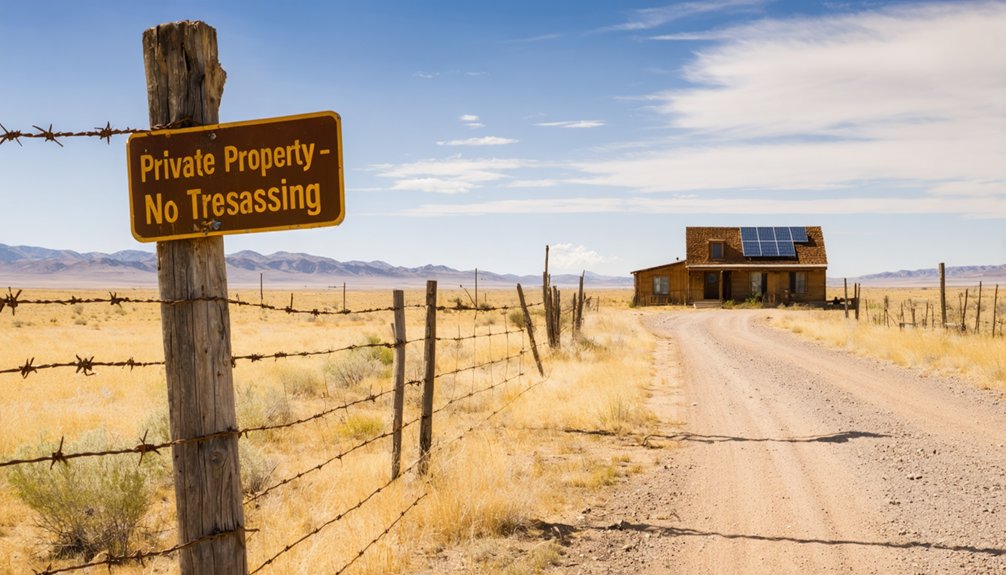
Though Yeso’s sun-bleached buildings beckon with their photographic appeal, you’ll need to navigate a patchwork of property rights that complicates exploration. Despite its ghost town reputation, Yeso isn’t entirely abandoned—four families’ descendants may still call those weathered homes along U.S. 60 theirs, and an active post office confirms it. Trespassing laws apply strictly here, with many structures sitting on private land.
Yeso’s crumbling facades hide a complication—private property lines cut through the ghost town, demanding respect before exploration.
Before you venture out, respect these boundaries:
- Research land ownership using DeLorme, BLM, or U.S. Forest Service maps
- Obey all no trespassing signs you encounter
- Never photograph occupied homes without permission
- Keep friendly distance from current residents unless they approach you
Resident privacy concerns aren’t just courtesies—they’re legal requirements. The freedom to explore ends where private property begins.
Frequently Asked Questions
Are There Any Restaurants or Gas Stations Available in Yeso?
You won’t find any available amenities in Yeso—it’s a true ghost town. You’ll need to stock up beforehand and consider nearby lodging options in Fort Sumner or Vaughn, where you’ll discover gas stations and restaurants for your adventure.
Can I Camp Overnight Near the Abandoned Buildings in Yeso?
You can’t camp directly among Yeso’s ruins due to private ownership—avoid trespassing on posted land. Instead, seek nearby BLM dispersed camping where campfires are permitted. You’ll experience desert solitude while respecting boundaries and staying within legal limits.
Is Cell Phone Service Available in Yeso and Surrounding Areas?
You’ll find surprisingly strong cell phone coverage quality in Yeso—T-Mobile reaches 94.1% of the area. AT&T’s close behind at 93.8%. While nearby wireless hotspot locations remain scarce, you’re surprisingly connected in this ghost town wilderness.
Do I Need a 4WD Vehicle to Access Yeso?
You won’t strictly need 4WD during dry conditions, though high-clearance vehicles navigate Yeso’s gravel roads more confidently. Road conditions shift dramatically after rain, making 4WD essential. Your accessibility options expand considerably with rugged wheels beneath you.
Are Guided Tours of Yeso’s Historic Sites Available for Visitors?
No guided tours exist—you’re on your own in this weathered outpost. Local tour guides haven’t discovered Yeso, and historic preservation efforts remain minimal. You’ll explore freely, wandering crumbling streets where silence replaces storytelling and adventure unfolds at your own pace.