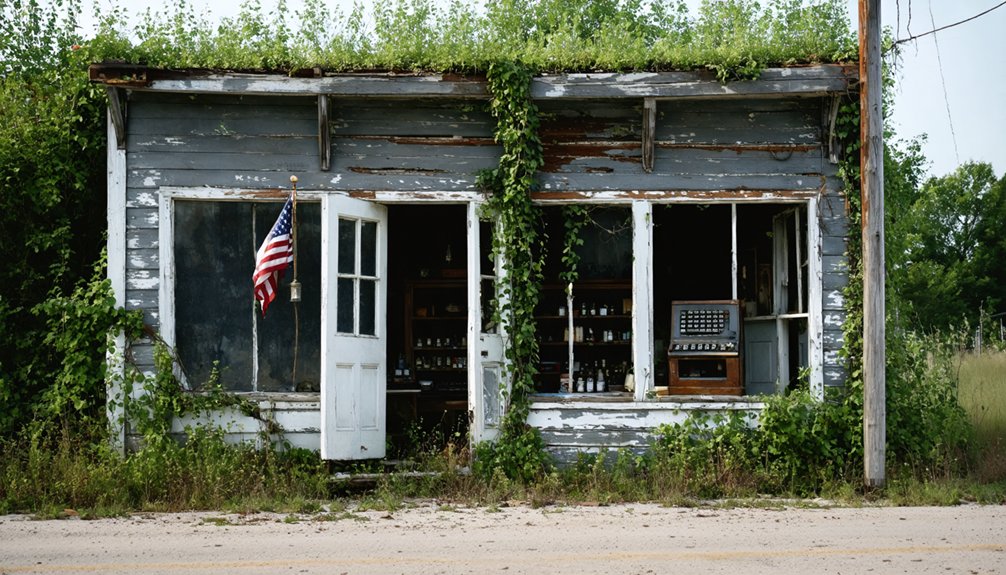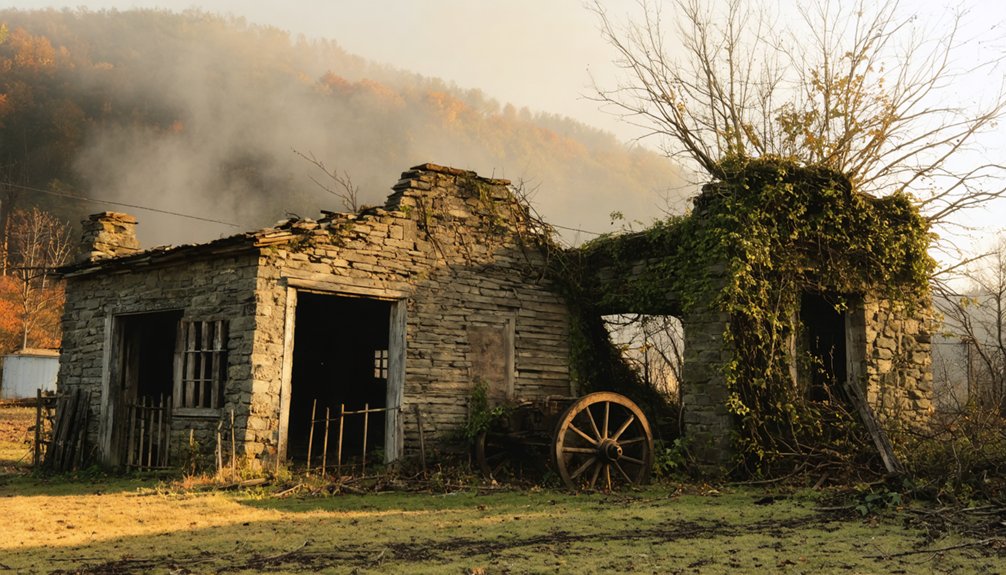
Preserving Civil War ghost towns requires a multi-faceted approach. You’ll need thorough documentation with measured drawings and photos before restoration begins. Use period-appropriate materials like lime-based mortars and traditional joinery techniques. Secure funding through public-private partnerships and diversified grant sources. Balance historical authenticity with accessibility by implementing limited-impact designs. Protect landscapes with native buffers and establish clear archaeological protocols for artifact management. These foundational practices form just the beginning of effective historic preservation strategy.
Key Takeaways
- Document historic structures thoroughly with photographs and measured drawings before beginning any restoration work.
- Use period-appropriate materials like native stone, hand-hewn timber, and lime-based mortars for authentic stabilization techniques.
- Create diversified funding through federal grants, state-level resources, and public-private partnerships for sustainable preservation.
- Implement limited-impact design with designated circulation routes while incorporating necessary accessibility features.
- Establish native landscape buffers and professional artifact management protocols to protect the site’s historical integrity.
Documenting Architectural Features Before Restoration
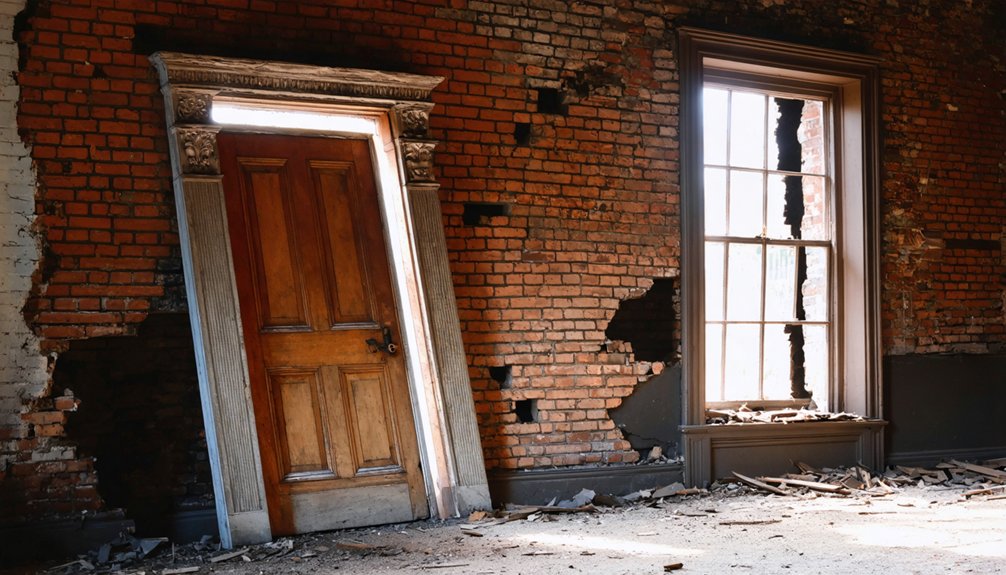
Before undertaking any restoration work on Civil War ghost town structures, thorough documentation of architectural features provides the essential foundation for historically accurate preservation.
Preserving our Civil War heritage demands meticulous architectural documentation before restoration begins.
You’ll need to employ professional photographic techniques from multiple angles under varied lighting conditions to capture exterior facades, interiors, and decorative elements as baseline records.
Create detailed measured drawings including floor plans, elevations, and cross-sections that reveal construction methods and material composition. These technical specifications will guide your material sourcing decisions during restoration.
Conduct material analysis to distinguish original brick masonry, timber framing, and infill from later modifications. Many historic sites display similarities to towns like Bodie, California, where approximately 110 structures remain standing despite decades of abandonment.
Document damage patterns systematically—record cannonball strikes, fire damage, and structural compromises. This exhaustive assessment establishes preservation priorities and guarantees your restoration work maintains historical integrity while creating permanent records independent of physical deterioration.
Pay special attention to documenting historically significant artillery damage like the embedded cannonball in Rodney’s Presbyterian Church from the USS Rattler’s attack.
Developing Sustainable Funding Models for Long-Term Preservation
To develop sustainable funding for Civil War ghost town preservation, you’ll need to forge strategic private-public partnerships with entities like land conservancies, historical societies, and corporate sponsors who can provide matching funds and in-kind services.
You can strengthen your financial foundation by diversifying revenue streams through a combination of federal programs like the American Battlefield Protection Program’s grants ($20,000-$200,000) and specialized funds such as the African American Cultural Heritage Action Fund ($50 million).
These complementary funding approaches will guarantee your preservation project maintains financial stability during multi-year restoration efforts while maximizing competitiveness for limited grant resources. Consider applying for the National Trust Preservation Funds which offer seed money for preservation projects with multiple deadlines throughout the year. State-specific resources like the Kentucky Civil War Sites Preservation Program and Community Foundation of Grant County offer local funding opportunities that can supplement national preservation initiatives.
Private-Public Partnership Opportunities
While numerous ghost towns from the Civil War era face preservation challenges, innovative private-public partnerships have emerged as critical funding mechanisms that guarantee their long-term sustainability.
You’ll find maximum stakeholder engagement through perpetual easement structures that balance private ownership with public protection—currently safeguarding over 17,150 battlefield acres in Virginia alone.
To secure preservation funding, pursue tiered grant opportunities ranging from $20,000 planning grants to $500,000 implementation awards.
Most federal programs require 50% matching funds, creating funding collaboration opportunities with regional land trusts and conservation organizations.
Consider three-party easement arrangements that combine fee-simple acquisitions with tax-incentivized conservation easements.
When applying for competitive merit-based awards, emphasize your site’s historical significance, proximity to protected lands, and potential for heritage tourism to strengthen your application against other preservation projects. Organizations like the American Battlefield Trust have successfully secured significant funding for multiple battlefield preservation projects across various counties.
Diversifying Revenue Streams
Sustainable preservation of Civil War ghost towns requires diversified revenue streams that extend beyond traditional funding mechanisms.
You’ll need to strategically combine federal programs like the American Battlefield Protection Program’s matching grants ($30,000-$500,000) with state-level funding opportunities tailored to your site’s specific needs.
Pursue grant opportunities through private foundations such as the National Trust’s Battlefield Preservation Fund ($2,500-$10,000) while simultaneously leveraging tax incentives through the Historic Preservation Tax Credits Program.
Don’t overlook smaller funding strategies from local roundtables and trusts that can serve as seed money for larger initiatives.
Taking inspiration from the African American Cultural Heritage Action Fund, consider establishing a dedicated preservation initiative that can raise substantial funding—they’ve successfully raised $50 million since inception for landmark preservation.
The most successful preservation efforts blend multiple revenue sources: federal and state grants, private foundation support, tax incentives, and community-based funding—creating a sustainable financial foundation that preserves these irreplaceable historical assets for future generations.
Balancing Historical Authenticity With Visitor Accessibility
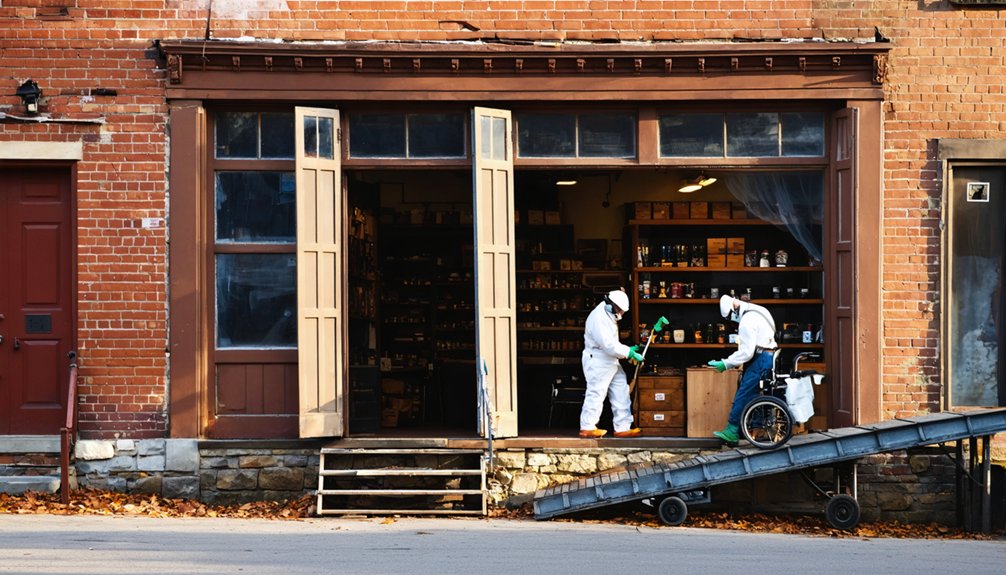
When you visit Civil War ghost towns, you’ll encounter the fundamental tension between maintaining period authenticity and providing necessary accessibility features such as ADA-compliant pathways constructed of stabilized decomposed granite rather than original uneven surfaces.
You’ll notice strategically positioned viewing platforms and reinforced observation areas that limit physical impact on fragile structures while still offering thorough visual access to historically significant features.
Your experience has been carefully engineered through limited-impact design principles that create designated circulation routes, which prevent dispersed foot traffic damage while maintaining the site’s historical integrity and atmospheric qualities. Many preservation sites now follow the practice of leaving earthworks undisturbed when they are located in wooded areas, as forest cover naturally helps stabilize these historic features. Many preservation sites incorporate ecological conservation efforts that protect unique ecosystems while simultaneously preserving historical landmarks.
Authentic vs. Modern Needs
The delicate balance between preserving historical authenticity and accommodating modern visitor needs presents one of the most significant challenges in Civil War ghost town conservation.
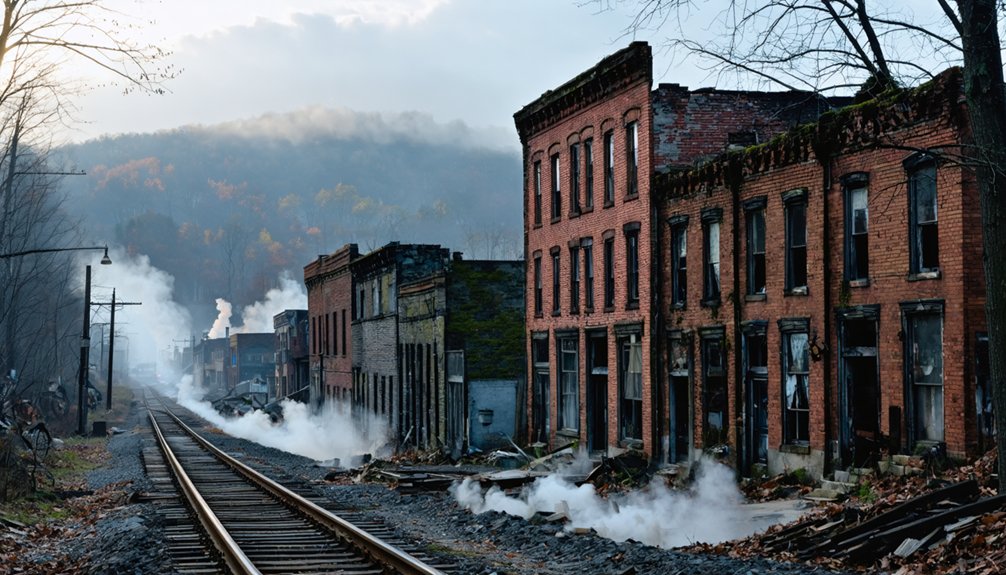
Exploring abandoned towns in the Appalachian Mountains reveals stories of resilience and loss, captured in the remnants of once-thriving communities. Each structure tells a tale of its inhabitants, showcasing the intersection of nature’s reclamation and human history. As conservation efforts continue, these sites can become platforms for education and reflection, allowing visitors to connect with the past in meaningful ways.
You’ll need to implement discreet safety features that blend with the historical environment while maintaining historical accuracy. Consider using augmented reality technology to enhance visitor engagement without altering physical structures.
Position modern amenities like restrooms and parking outside core historic zones to preserve the site’s integrity.
When interpreting these spaces, avoid sanitized narratives by contextualizing sites within broader social history, including slavery and postwar impacts. Initial monuments erected on battlefields were often politically motivated in their narratives, reflecting the tensions between Northern and Southern perspectives. Many sites like Cahawba, Alabama transitioned to ghost towns following devastating post-war floods and economic collapse. Use archaeological research and historic maps to guide restoration efforts rather than speculative alterations.
Offer guided tours and informational signage to offset extensive physical modifications while still providing educational value that satisfies modern expectations.
ADA-Compliant Historic Pathways
- Create at least one accessible route connecting site entry points to all public spaces at accessible entry level.
- Install directional signage at inaccessible public entries pointing to nearest accessible entrance.
- Maintain maximum 44-inch display height for exhibits to accommodate seated visitors.
- Consider paved pathways similar to Gettysburg’s approach, which allows both vehicle and mobility device navigation.
- Select historically accurate plant species that existed during the Civil War era
- Establish root systems that stabilize soil without disturbing potential archaeological deposits
- Create natural barriers that direct visitor traffic away from sensitive areas
- Implement seasonal maintenance protocols that protect both the landscape and artifacts during changing weather conditions
- Join scheduled workdays where you’ll learn historic restoration techniques while repairing structures, roofing, or painting
- Participate in landscape restoration by removing invasive species and replanting native vegetation
- Assist with archaeological site surveys and artifact documentation under professional guidance
- Help create interpretive materials or support educational events that bring history to life
- Choose marine-grade aluminum or high-density polyethylene composite materials with UV-resistant coatings that withstand temperature fluctuations
- Incorporate QR technology linking to expanded digital archives while maintaining minimal visual footprint on the historical landscape
- Design modular signage systems that allow for cost-effective replacement of individual components rather than entire installations
- Position interpretive markers at strategic elevations to prevent submersion during seasonal flooding events
- Use AR technology to reconstruct destroyed buildings on their original sites, allowing visitors to experience lost structures in their authentic context.
- Implement high-resolution imaging to document architectural details, inscriptions, and graffiti before they’re lost to time.
- Create searchable photograph repositories organized by location and historical significance.
- Develop web-based platforms that enable remote access to microfilmed records and digitized historical documents.
- https://www.battlefields.org/learn/articles/nature-of-history/fighting-our-battlefields-and-our-planet
- https://en.wikipedia.org/wiki/Ghost_town
- https://www.npshistory.com/publications/pilgrim-places.pdf
- https://www.nps.gov/subjects/battlefields/battlefield-preservation.htm
- https://www.geotab.com/ghost-towns/
- https://www.legendsofamerica.com/gt-ghosttownethics/
- https://www.npca.org/articles/1935-spooky-beautiful-photos-of-abandoned-park-towns
- https://www.britannica.com/topic/ghost-town
- https://npshistory.com/brochures/hidden-battlefields.pdf
- https://sethparker.net/rodney-mississippi-the-ghost-town-youve-probably-never-heard-of/
Limited Impact Viewing Areas
Balancing visitor access with historical preservation remains one of the most challenging aspects of Civil War ghost town management.
You’ll find designated viewing platforms strategically positioned to offer panoramic vistas while preventing ground disturbance to fragile foundations and archaeological layers.
Control visitor flow through timed entry permits and guided tours in controlled access zones, protecting vulnerable ruins from excessive foot traffic.
When physical access isn’t possible, engage with interactive exhibits through VR headsets and AR applications that digitally reconstruct original town layouts.
Navigate the site using interpretive signage featuring QR codes linking to extensive digital archives.
For ideal visitor engagement, take advantage of seasonal viewing schedules that rotate accessible areas, allowing sites time to recover while providing fresh perspectives each visit.
These rotational systems guarantee both preservation and meaningful connection with these irreplaceable historical treasures.
Creating Native Landscape Buffers to Protect Site Integrity
While preserving the physical structures of Civil War ghost towns remains paramount, establishing native landscape buffers around these historical sites serves as a critical preservation strategy that’s often overlooked.
Native plant restoration not only creates authentic period aesthetics but implements ecological erosion control that protects fragile ruins from deterioration.
When designing these protective zones, you’ll need to:
These buffer zones function as both preservation tools and educational opportunities, allowing visitors to experience these hallowed grounds in their historical ecological context.
Implementing Archaeological Protocols for Artifact Protection
Archaeological protocols form the foundation of effective artifact protection in Civil War ghost towns, where each object tells an essential part of America’s divided past.
Every artifact in these ghostly remnants of division tells a crucial story worth protecting.
You’ll need professional excavation oversight for all digging activities—this isn’t optional but legally mandated to preserve historical context.
When exploring these sites, remember that removal of artifacts without permits violates state laws, potentially resulting in fines or imprisonment. Instead, document your findings through detailed photography and mapping, leaving items in their original positions.
If you discover significant artifacts, report them to proper authorities for professional artifact curation in museums where they’ll benefit public education.
Always stick to designated paths when visiting ghost towns, as even footsteps can damage fragile surface artifacts that haven’t yet been documented.
Engaging Local Communities as Preservation Partners
You’ll find that volunteer restoration programs provide critical hands-on support for Civil War ghost towns while simultaneously building community investment in preservation outcomes.
These citizen-led initiatives often partner with professional conservators, creating structured opportunities for local participants to learn historically accurate techniques for building stabilization, artifact handling, and landscape maintenance.
Public-private funding coalitions further strengthen these community partnerships by leveraging matching grants, business sponsorships, and municipal resources to expand the financial foundation of preservation efforts beyond what government funding alone could accomplish.
Volunteer Restoration Programs
Dedicated volunteers across the nation serve as essential partners in the preservation of Civil War ghost towns, working hand-in-hand with nonprofit organizations, historical societies, and government agencies to save these vanishing pieces of American history.
Through structured volunteer restoration programs, you’ll find opportunities for community outreach and hands-on participation regardless of your experience level. Volunteer training guarantees you’re equipped with necessary skills before tackling preservation projects.
Public-Private Funding Coalitions
The formation of public-private funding coalitions has emerged as a critical strategy for preserving America’s Civil War ghost towns, combining resources from government agencies, private foundations, and community stakeholders.
To maximize preservation efforts, you’ll need to develop robust coalition strategies that leverage multiple funding sources.
Seek battlefield preservation grants ranging from $2,500 through the National Trust to $500,000 through NPS implementation programs. You’ll find these require 50% matching funds—perfect for funding collaboration between your local nonprofit and government partners. When applying, commit to installing interpretive signs and creating public access trails.
Remember that successful projects typically involve multi-stakeholder participation including historical societies, educational institutions, and local governments.
In Virginia, organizations have secured over $6.1 million to protect 423 acres by employing such collaborative approaches.
Establishing Weather-Resistant Signage for Self-Guided Tours
When preserving Civil War ghost towns for future generations, establishing weather-resistant signage represents one of the most critical infrastructure investments preservationists must make.
Your selection of signage materials must balance historical authenticity with durability against diverse environmental challenges. Effective tour design should create intuitive pathways that tell compelling narratives while respecting the site’s original layout.
Preserving history demands signage that honors the past while standing resilient against nature’s persistent forces.
Adopting Period-Appropriate Stabilization Techniques
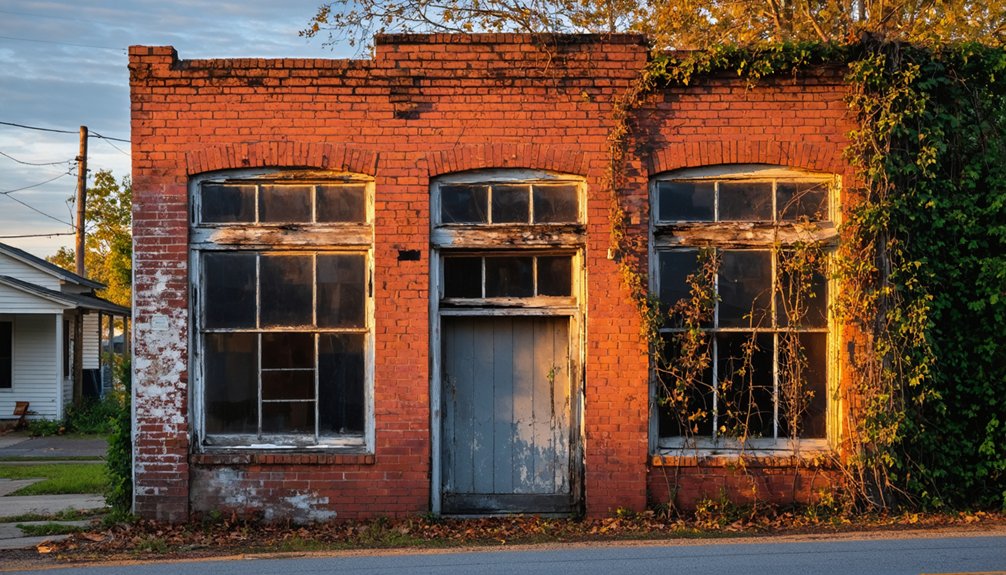
Preserving the structural integrity of Civil War ghost towns requires meticulous attention to period-appropriate stabilization techniques that honor both historical accuracy and conservation science.
You’ll need to employ only period materials like native stone, hand-hewn timber, and lime-based mortars, avoiding modern substitutes that compromise authenticity.
For earthworks, stabilize using historically present vegetation and hand tools rather than heavy machinery.
When repairing timber structures, use historical craftsmanship methods—mortise-and-tenon joints and traditional wood species—to maintain authenticity.
For masonry, repoint with lime-based mortars matching original composition.
Always coordinate with archaeologists during stabilization efforts, ensuring that your preservation work doesn’t disturb hidden artifacts or compromise the site’s historical narrative.
This careful balance of stabilization and authenticity will protect these irreplaceable historical assets.
Incorporating Digital Archives for Virtual Preservation
Beyond physical conservation efforts, digital archiving represents a revolutionary frontier in ghost town preservation.
You’ll find that virtual preservation techniques can immortalize historical sites without invasive physical interventions. By implementing thorough digital archives, you’re creating permanent records that transcend the limitations of deteriorating physical structures.
These digital preservation methods guarantee freedom from the constraints of physical access while maintaining historical integrity.
Developing Seasonal Maintenance Schedules for Historic Structures
Establishing effective seasonal maintenance schedules stands as the cornerstone of successful long-term preservation for Civil War ghost town structures.
You’ll need to prioritize your maintenance priorities based on severity of existing problems and the unique challenges these historic buildings face.
Develop seasonal checklists that align with ideal weather conditions—inspect roofs and chimneys in spring and fall, check drainage systems before wet seasons, and examine exterior walls when painting conditions are favorable.
Follow manufacturer recommendations for period-appropriate materials while respecting historical integrity.
Document all work meticulously with before and after photographs, ensuring compliance with preservation regulations.
Remember that your inspection frequency should follow established guidelines: annual roof inspections, biannual drainage checks, and thorough structural evaluations after severe weather events.
This methodical approach protects these irreplaceable historical treasures for future generations.
Frequently Asked Questions
How Were Civil War Ghost Towns Initially Abandoned?
You’ll find towns were vacated through forced civilian evacuations during military occupation, followed by catastrophic economic downturns when war destroyed infrastructure, commerce networks, and agricultural systems that couldn’t recover after natural disasters struck.
Can Private Individuals Purchase Property Within Preserved Ghost Towns?
You can purchase ghost town property only when it’s privately held and not subject to preservation laws. Check county records to verify ownership status before attempting acquisition.
What Wildlife Hazards Should Visitors Be Aware Of?
Beware battling bears, rabid raccoons, disease-carrying ticks, and venomous snakes. During wildlife encounters, you’ll need safety precautions: maintain distance, carry bear spray, wear tick-repellent clothing, and watch for structural collapses housing animals.
Are Paranormal Investigations Permitted at These Historical Sites?
You’ll need investigation permits at most sites, as paranormal regulations vary widely. Some locations like Fort Delaware officially allow ghost hunting, while others strictly prohibit unauthorized paranormal activities after hours.
How Did Civilian Life Continue During Battles Near These Towns?
While cannons roared nearby, you’d adapt with remarkable civilian resilience—hiding in cellars, maintaining small farms, and leveraging community solidarity through resource-sharing networks that sustained families through the terrifying rhythms of nearby conflict.