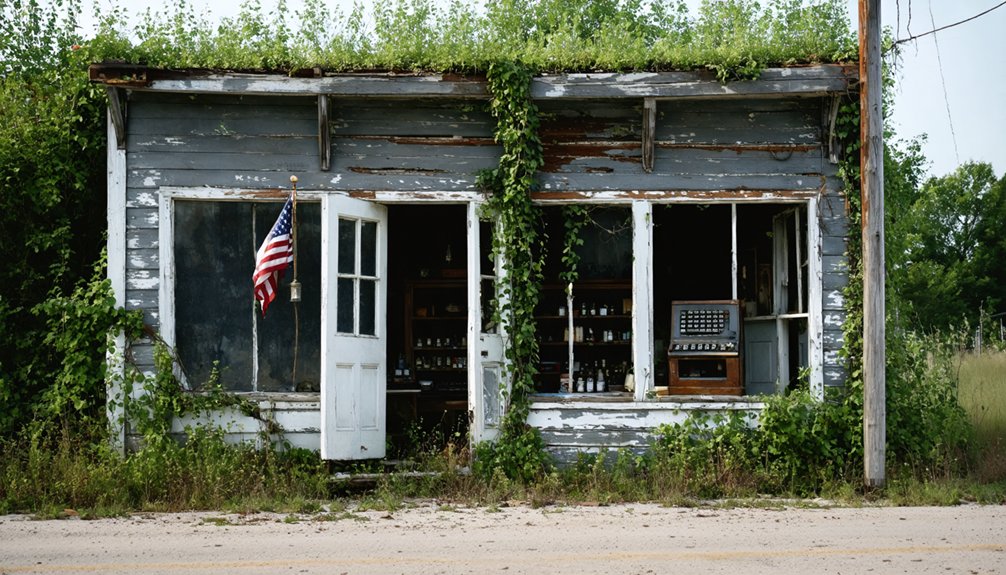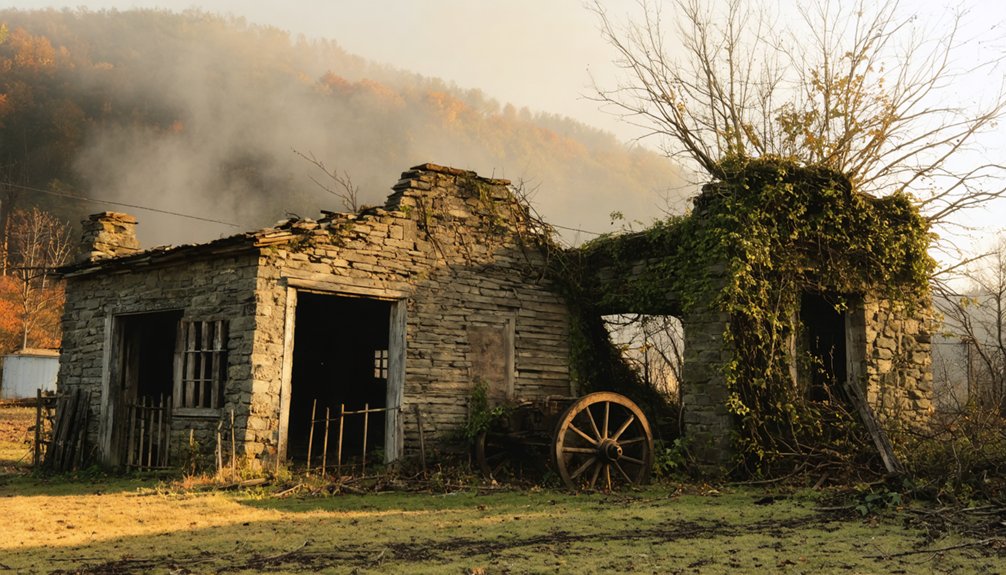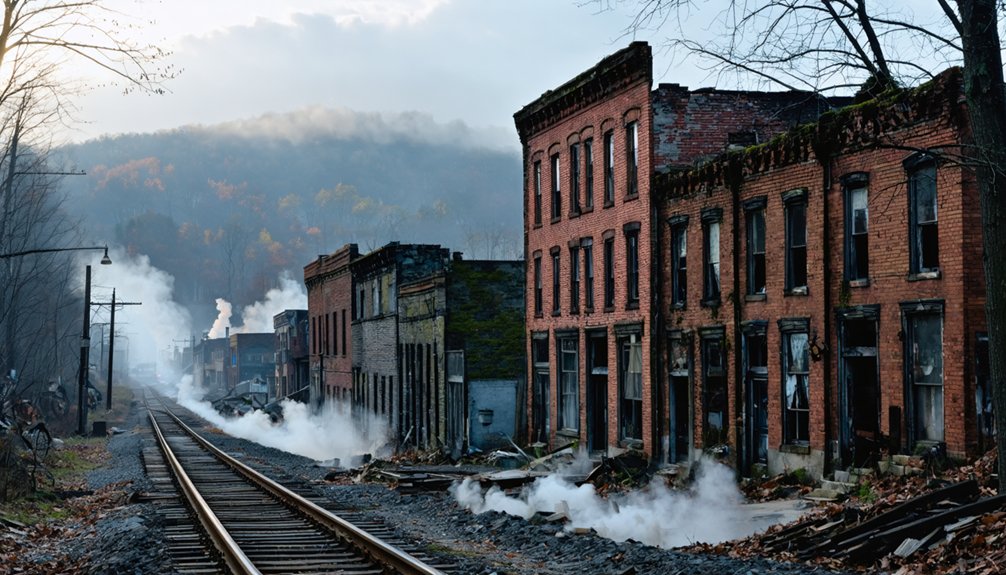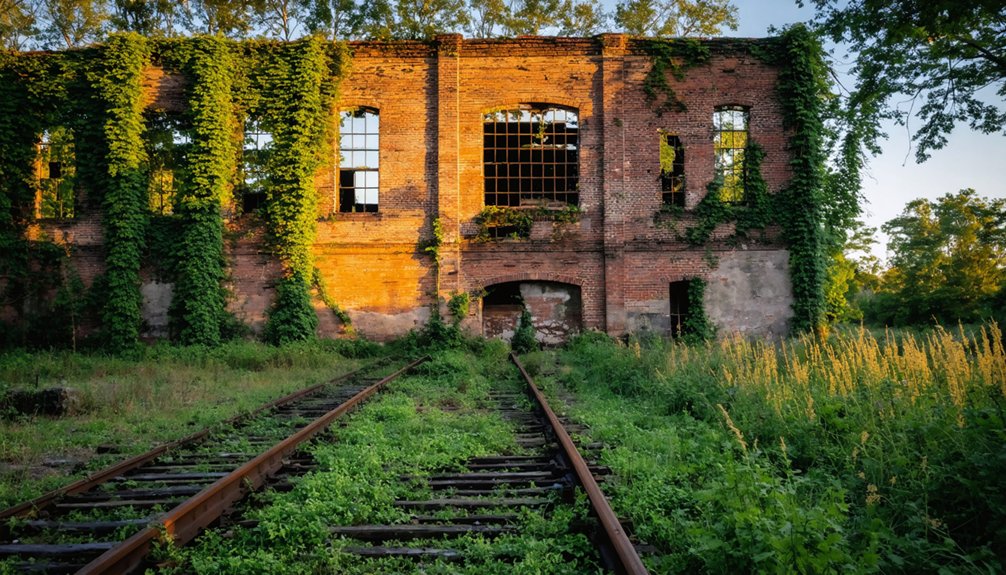
When you explore forgotten Civil War cities today, you’ll find submerged supply depots like Johnsonville, Tennessee, and ghost towns like Andersonville. Union veteran colonies established in the West after 1871 preserved military traditions while forging new communities. Modern development threatens these historic sites, with nearly 20% of battlefield lands already lost to urban sprawl. Archaeological discoveries continue to reveal personal artifacts and structural remains, connecting us to these vanished landscapes despite time’s passage.
Key Takeaways
- Submerged cities like Johnsonville hold valuable Civil War artifacts accessible through archaeological techniques such as ground-penetrating radar.
- Economic devastation transformed thriving Civil War sites into ghost towns, with abandoned structures preserving historical evidence of the conflict’s impact.
- Veterans established new communities after the war, creating settlements that preserved military traditions and reshaped the American landscape.
- Nearly 20% of battlefield land has been permanently lost to development, requiring innovative preservation methods and community advocacy.
- Archaeological discoveries continue to reveal significant historical evidence about immigrant soldiers and military operations at forgotten Civil War sites.
The Sunken Remains of Johnsonville: Tennessee’s Submerged Supply Hub
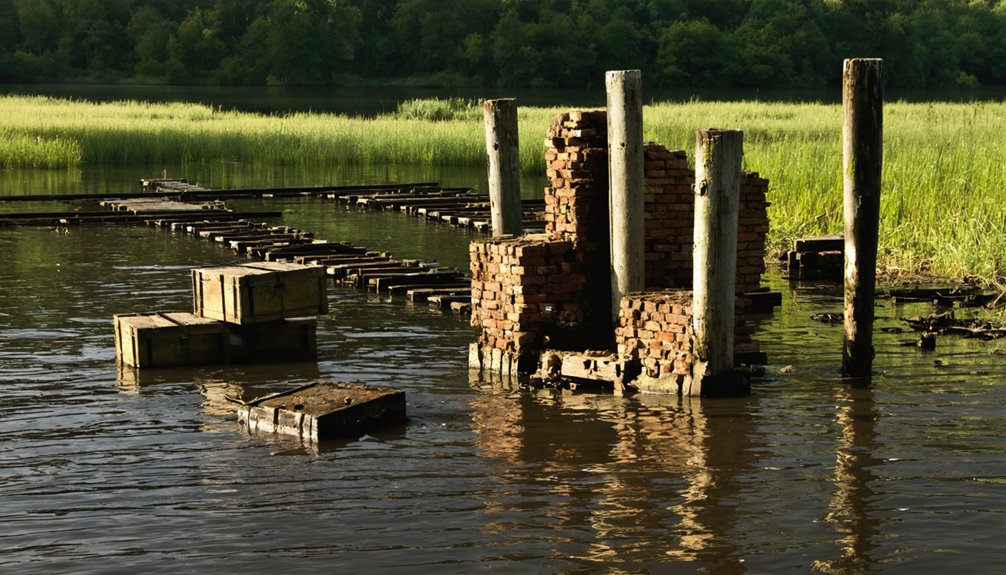
Beneath the waters of Tennessee River lies what was once a thriving Civil War supply hub—Johnsonville, established in 1863 as a strategic Union depot during the American Civil War.
Named after Tennessee’s military governor Andrew Johnson, this sunken history represents the second largest Union supply base in the state.
You’d find it difficult to imagine today, but this submerged location once buzzed with activity as steamboats delivered supplies that were transferred to Nashville via the Nashville & Northwestern Railroad.
Its strategic position made it essential for sustaining General Sherman’s Georgia campaign and the Army of the Cumberland.
In November 1864, Confederate General Nathan Bedford Forrest‘s devastating raid destroyed millions in supplies and numerous vessels, creating submerged artifacts that silently testify to a pivotal moment in America’s struggle for unity. Though the raid caused an estimated government property loss of $1.5 million, it came too late to significantly impact Sherman’s campaign in Georgia. The offensive was executed with similar tactical brilliance that Forrest demonstrated during his Fort Pillow assault earlier that same year.
Andersonville: Beyond the Prison to a Ghost Town
As the Andersonville prison complex devastated both prisoners inside and communities outside, you’ll find the surrounding town effectively collapsed after the war, with abandoned homes and businesses marking the landscape.
You can trace how the prison’s operation consumed local resources and created lasting physical and psychological scars that prevented regional recovery for decades.
Recent archaeological excavations have uncovered everyday artifacts from both the prison and ghost town, revealing connections between the infamous camp and the forgotten civilian settlement that couldn’t survive in its shadow. The prison’s high mortality rate of over 12,000 Union soldiers due to disease, malnutrition, and inadequate supplies further damaged the region’s ability to recover economically and socially. Under the command of Captain Henry Wirz, who was later executed for war crimes, the prison became known for some of the most inhumane conditions of the Civil War.
Prison’s Devastating Regional Impact
While the horrors inside Andersonville Prison captured most historical attention, the facility’s establishment and operation devastated the surrounding region in ways that would persist long after the war ended.
The small Georgia town became forever linked with suffering and death, creating a lasting stigma that hampered its development.
You’ll find that Andersonville’s prison legacy led to severe economic decline as the area struggled under the weight of its notorious history.
When Captain Wirz was executed as a war criminal in 1865, the town itself seemed condemned alongside him.
The prison camp initially designed for 10,000 prisoners eventually held 32,000 Union soldiers, creating a massive strain on local resources and infrastructure.
The Confederate defeat, coupled with the prison’s reputation, created dire circumstances for local residents as resources remained scarce throughout Reconstruction.
What was once a rural community became fundamentally a ghost town, its identity permanently altered by the 13,000 Union soldiers who perished on its soil.
As the years passed, remnants of the past became the haunting reminders of life that once thrived in what are now known as ghost towns in the American West. These deserted settlements stand as silent witnesses to the tumultuous events that shaped the region, inviting exploration and reflection from those who venture into their desolate landscapes. Each structure tells a story of aspiration and despair, encapsulating the dreams of a bygone era that still linger in the arid air.
The prison’s original stockade was constructed with hewed pine logs that towered nearly 17 feet high, creating an imposing barrier between the prisoners and the outside world.
Abandoned Homes, Lasting Memories
The tiny village of Andersonville transformed into a genuine ghost town once Camp Sumter closed in May 1865. The prison’s closure halted the influx of Union prisoners and left behind abandoned structures—both village homes and prisoner-built “shebang” shanties deteriorated rapidly with no one to maintain them.
You’ll find haunting memories embedded in the landscape, from concrete markers indicating escape tunnels to the National Cemetery containing almost 13,000 prisoners’ remains.
Families of guards and locals moved away, leaving residential areas deserted as economic opportunities vanished. The site’s stigma discouraged settlement and investment. Visitors today can learn about how prisoners faced immediate shooting for crossing the established dead-line within the camp. Captain Henry Wirz enforced brutal punishments against prisoners who violated camp rules, contributing to the high mortality rate.
Few structures survived intact, and the rural location offered little incentive for repairs. Today, the ghost town exists primarily as a place of reflection, with the Park Service preserving its somber legacy rather than pursuing redevelopment.
Archaeological Finds Today
Beneath the quiet, abandoned landscape of Andersonville lies a treasure trove of historical evidence waiting to be uncovered.
The Southeast Archaeological Center‘s investigations have revealed the prison’s North Gate as a 10.6 x 8.4 meter enclosure with dual gateways approximately 3 meters wide, providing vital historical context for the site’s original construction.
Beyond the stockade walls, archaeologists have unearthed a remarkable array of personal artifacts – German coins, silver jewelry, uniform buttons, and pipes – connecting you directly to the immigrant Union soldiers who suffered here. Archeologists also recovered two ax heads during their pre-reconstructive investigations at the site. The extraordinary preservation of these artifacts can be attributed to the site being undisturbed for decades, unlike other Civil War prison camps.
Using ground-penetrating radar guided by POW maps, researchers discovered postholes from the 42-acre stockade beneath six feet of fill.
These findings hold tremendous archaeological significance, proving that despite landscape changes, evidence of Andersonville’s past – both as a notorious prison and forgotten town – remains preserved underground.
Towns Consumed by Flame: Castville and Chambersburg’s Vanishing
Among the most devastating chapters of the Civil War, Chambersburg’s fiery destruction in 1864 stands as a harrowing proof of warfare’s extension beyond battlefields into civilian life.
When Confederate forces demanded $500,000 ransom, the town’s inability to pay triggered merciless town destruction, leaving 2,000 residents homeless with losses exceeding $750,000.
Nearby Castville and other Pennsylvania towns faced similar, if less documented, fates.
These devastated communities faced enormous challenges:
- Displacement of thousands of citizens from homes reduced to ashes
- Collapse of regional commerce and transportation networks
- Destruction of critical infrastructure including bridges and factories
- Years of painful economic recovery efforts requiring substantial investment
You can still see this scorched history in archaeological remains and community commemorations, tributes to civilian sacrifice during America’s bloodiest conflict.
Mexican War Namesakes: How Battle Names Shaped Civil War Communities
You’ll find dozens of American towns named after Mexican-American War battles scattered across Civil War battleground states, particularly in Tennessee, Indiana, and Georgia.
These place names—Buena Vista, Cerro Gordo, Monterrey, Saltillo, and Contreras—emerged as veterans settled in new communities, bringing their battlefield memories to reshape the American landscape.
The naming patterns reveal how military experience from one conflict literally mapped onto the terrain where the next war would unfold, creating an interconnected geography of American military commemoration.
Battlefield Naming Patterns
The map of America’s smaller cities and towns reveals a fascinating pattern of nomenclature directly tied to the Mexican-American War of 1846-1848.
You’ll find this naming significance particularly prevalent throughout the Midwest and South, where communities proudly adopted battlefield names as their identities took shape within the historical context of America’s expanding borders.
- Buena Vista, Cerro Gordo, Monterrey, and Saltillo became popular town names across multiple states
- Community founders often debated between several war-related names before making final selections
- The Midwest and South saw the highest concentration of these Mexican War namesakes
- This naming convention declined after the Civil War redirected national attention
These battlefield naming patterns weren’t merely geographic labels—they represented civic pride and a deliberate connection to national military achievements that resonated with newly established communities seeking identity.
Veteran Settlement Impact
While battlefield names adorned the map of America following the Mexican-American War, the men who fought in these conflicts profoundly shaped the physical landscape itself.
After the Civil War, Union veterans moved westward, establishing veteran colonies that transformed frontier development. The 1871 Homestead Act incentivized this migration by counting military service toward residency requirements.
You’d find these settlements especially concentrated in Minnesota, Nebraska, and Kansas, where veterans created communities offering collective benefits like negotiated rail rates and shared resources.
These enclaves, often coordinated through the Grand Army of the Republic, fostered community cohesion through shared military experiences. Veterans brought leadership skills to new territories, establishing civic institutions and local economies.
Their influence extended beyond geography—they preserved military traditions while creating spaces for mutual support and reintegration into civilian society, leaving an enduring legacy on America’s western development.
Nature’s Reclamation: Small Communities Lost to History and Wilderness
As time reclaims the remnants of Civil War history, abandoned military sites and small communities have gradually surrendered to nature’s persistent advance.
These forgotten landscapes reveal nature’s resurgence across once-contested territories. You’ll discover how time transforms battlefields into unrecognizable terrain:
- Vicksburg’s killing fields, once barren during the 1863 siege, now hide beneath lush hardwood forests that began regenerating immediately after battles.
- Fort Carroll, designed by Robert E. Lee, stands abandoned in Chesapeake Bay since 1864, its military purpose long forgotten.
- Franklin’s Crossing, despite being the most illustrated Civil War site, remains virtually unvisited since veterans explored it a century ago.
- Fort Totten’s massive stone structures peek through dense vegetation, now home to eagles and foxes in an urban setting.
Overlooked Coastal Fortifications: The Maritime Front of the Civil War
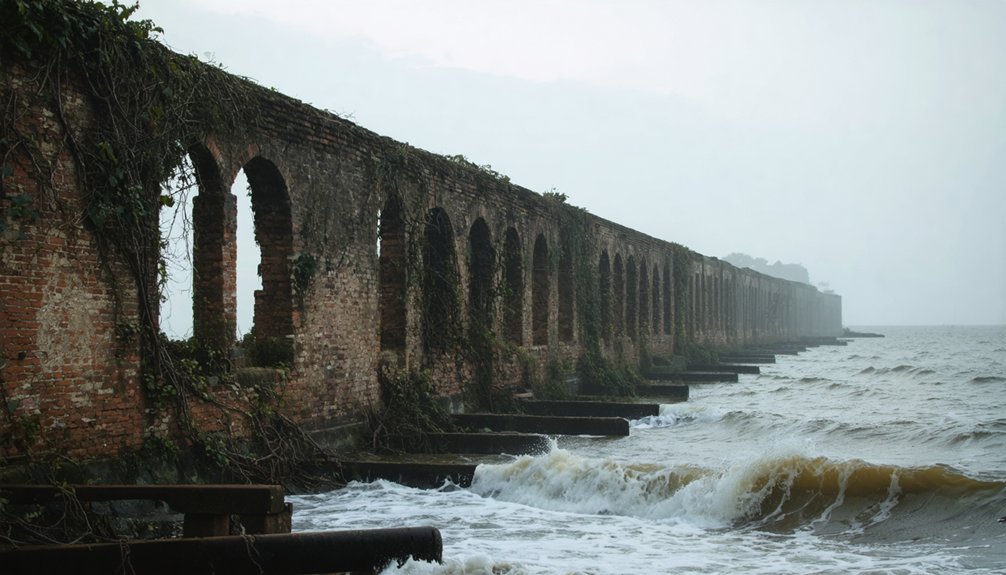
Many Americans overlook coastal fortifications when studying the Civil War, focusing instead on famous land battles like Gettysburg and Antietam. Yet these coastal defenses played essential roles in the conflict’s trajectory. The war began at Fort Sumter in Charleston Harbor, setting the stage for four years of bloodshed.
Third System fortifications—massive brick structures built after the War of 1812—formed the backbone of these maritime battlegrounds. You’ll find their stories in places like Fort Pulaski, where Union rifled artillery proved masonry walls obsolete, and Fort Morgan, which defended Mobile Bay during critical naval engagements.
Fort Monroe remained a Union stronghold throughout the war, while Confederate forces utilized submarine mines and nets to protect significant harbors from blockades. These coastal installations represented technological turning points, ultimately revealing how warfare was evolving beyond traditional defenses.
St. Albans: The Northernmost Reach of Confederate Operations
Civil War operations extended far beyond coastal fortifications and major battlefield sites, reaching as far north as the quiet streets of St. Albans, Vermont. This October 1864 raid, led by Bennett Henderson Young, demonstrated Confederate strategies of unconventional warfare during a desperate phase of the conflict.
You’ll find St. Albans’ significance in four key aspects:
- Marked the northernmost land action of the entire war
- Exploited Canadian territory as a base for Confederate operations
- Netted approximately $200,000 from three banks to finance the Confederate cause
- Created diplomatic tensions between the U.S. and British-controlled Canada
The raiders’ daring tactics—arriving gradually as “tourists,” declaring Confederate control, and escaping across the border—showed the Confederacy’s reach despite weakening positions on traditional battlefields.
This often-overlooked event forced Union resources northward, exactly as Confederate strategists intended.
Atlanta’s Vanished Battlegrounds: Urban Growth Over Historic Fields
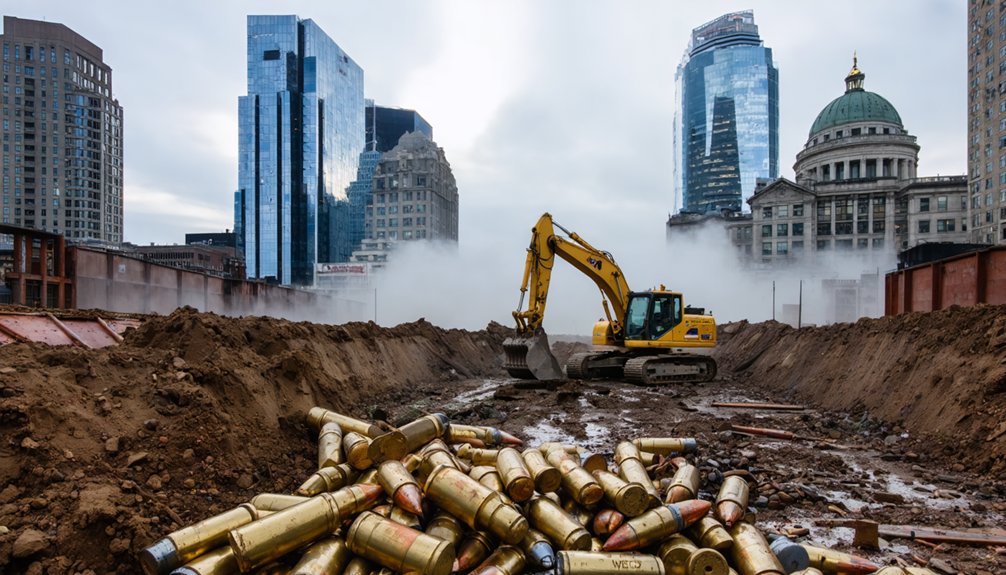
While the Battle of Atlanta played a pivotal role in determining the Civil War’s outcome in 1864, you’ll find almost none of its original landscape remains today.
The city’s explosive growth from 10,000 residents in 1860 to nearly 500,000 by 2020 has transformed battlefields into highways and high-rises.
As concrete and steel rise from former trenches, Atlanta’s urban sprawl devours the echoes of cannon fire.
Urban expansion has consumed over 90% of Atlanta’s battlefield landscape. I-20 and I-75 now run directly over former combat zones. The death sites of Generals McPherson and Walker are marked only by upturned cannons near busy intersections.
Battlefield preservation efforts include the Atlanta Cyclorama at the History Center and scattered historical markers throughout the city.
These remnants offer glimpses into Atlanta’s wartime past, but the physical disconnection between modern Atlanta and its Civil War identity continues to widen as development advances.
The Final Shots: Brownsville and the Forgotten Last Battle
Long after Robert E. Lee surrendered at Appomattox, the guns of war still echoed along the Rio Grande.
You’ll find that Brownsville, Texas harbored the Civil War’s true final chapter at Palmito Ranch on May 12-13, 1865. This battlefield significance remains largely overlooked in mainstream historical accounts.
The last combatants faced off in a contest with real consequences:
- Colonel Theodore Barrett led Union forces including the 62nd U.S. Colored Infantry against Confederate Colonel “Rip” Ford
- Hispanic Confederate soldiers played vital roles under Col. Santos Benavides
- Union troops initially captured White’s Ranch before advancing to Palmito Ranch
- Confederate artillery and cavalry tactics ultimately forced Union withdrawal with over 100 captured
Private John Jefferson Williams fell here—the final battlefield casualty in America’s bloodiest conflict.
Preservation Challenges: Finding Lost Cities Among Modern Development
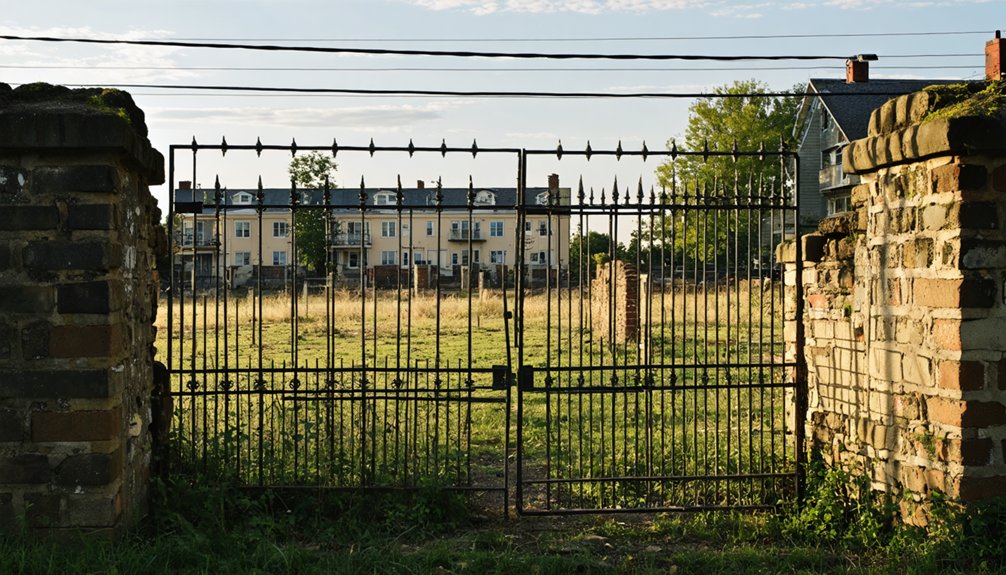
As modern America expands with concrete and steel, the physical remnants of our Civil War heritage rapidly disappear beneath shopping centers and suburban developments. Nearly 20% of battlefield land has already been permanently lost to urban encroachment, with historic sites bulldozed for highways and parking lots.
You’ll find the struggle for historic preservation intensifying in places like Fairfax County, Virginia, where residential sprawl overtakes battlefield landscapes without local government intervention.
Preservationists now employ ground-penetrating radar to locate forgotten structures beneath modern surfaces, while fighting economic odds that favor development over conservation.
The path forward requires innovative approaches: tax incentives for landowners, transfer of development rights, and community vigilance.
These tools offer your best chance to rescue what remains of Civil War cities before they vanish completely beneath America’s expanding urban footprint.
Frequently Asked Questions
Can Visitors Dive to Explore the Remains of Johnsonville Today?
No, you can’t dive to explore Johnsonville’s remains today. Underwater archaeology expeditions require specific permits through Tennessee authorities due to sediment coverage and professional diving challenges at Kentucky Lake.
How Did Residents Evacuate Towns Facing Destruction During the War?
Nearly 70% of civilians fled with minimal possessions. You’d gather family, load wagons with essentials, and follow evacuation strategies determined by military warnings or advancing armies—civilian experiences varied dramatically by location and timing.
What Artifacts Are Commonly Found at These Forgotten Civil War Sites?
You’ll find battlefield projectiles, uniform buttons, buckles, personal possessions like coins and watches, and structural remains. Civil War artifacts require careful historical preservation to maintain our connection with this pivotal freedom struggle.
Were Any Ghost Towns Successfully Resettled After the War Ended?
Nearly 40% of abandoned settlements faced resettlement challenges. You’ll find Grafton, Utah Territory, exemplifies ghost town revival, as settlers returned by 1868 once threats diminished, though it later declined permanently due to limited resources.
How Did Local Native American Tribes Interact With These Civil War Communities?
You’ll find Native tribes formed strategic military alliances with both Union and Confederate forces, while maintaining limited cultural exchanges with Civil War communities due to geographic displacement and tribal divisions.
References
- https://www.youtube.com/watch?v=v8WGpuFEuqU
- https://www.nps.gov/articles/000/wartowns.htm
- https://we3travel.com/once-crowded-now-forgotten-17-civil-war-sites-americans-no-longer-visit/
- https://www.southernpartisan.com/33-civil-war-forts-you-can-still-visit/
- https://blueandgrayeducation.org/2019/03/time-travel-five-nearly-forgotten-civil-war-sites/
- https://www.battlefields.org/learn/articles/lost-battlefields-atlanta
- https://cwba.blogspot.com/2020/02/review-johnsonville-union-supply.html
- https://www.tcwpa.org/battle-site/johnsonville/
- https://en.wikipedia.org/wiki/Battle_of_Johnsonville
- https://emergingcivilwar.com/2019/11/04/book-review-johnsonville-union-supply-operations-on-the-tennessee-river-and-the-battle-of-johnsonville-november-4-5-1864/