Civil War era ghost towns dot America’s landscape, remnants of communities devastated by military conflict, economic collapse, and natural disasters. You’ll find places like Cahaba, Alabama’s first capital, and Bannack, Montana’s gold rush settlement, where preserved architectural elements and artifacts tell stories of 19th-century life. These 4,500+ abandoned settlements showcase infrastructure destruction, population exodus, and environmental challenges that forced residents to flee. These outdoor museums reveal powerful connections to one of history’s most turbulent periods.
Key Takeaways
- Cahaba, Alabama’s first capital, was abandoned after serving as a Civil War prison and experiencing devastating floods in 1865.
- Over 35,000 ghost towns resulted from the Civil War, with many Southern regions experiencing population declines exceeding 50%.
- Military conflict destroyed critical infrastructure like bridges and railroads, cutting towns off from essential supplies and economic networks.
- Preservation techniques maintain original structures through “arrested decay” methods, allowing visitors to see authentic Civil War-era buildings.
- Archaeological excavations at former towns like Cahawba reveal daily life through artifacts including household items, ceramics, and agricultural implements.
The Wartime Abandonment: How Conflict Created Empty Towns

When military conflict erupted across America during the Civil War, it created a perfect storm of conditions that forced the abandonment of countless towns and settlements.
You’d find communities emptied by direct combat, with infrastructure systematically destroyed—bridges collapsed, railroads torn up, and buildings burned to prevent their use by opposing forces.
Military occupation transformed civilian spaces into strategic assets, displacing residents indefinitely.
Towns near prison camps like Castle Morgan in Cahawba experienced profound disruption to social structures and economic systems.
Wartime fear drove many to flee preemptively, leaving behind generations of history and investment.
The statistics are sobering: southern regions experienced population declines exceeding 50%, contributing considerably to America’s estimated 35,000 ghost towns.
These abandoned places stand as silent markers to how quickly established communities can dissolve when caught in conflict’s crossfire.
Similar to how Lambert Florin described ghost towns as shadowy semblances of their former selves, many Civil War-era settlements became hollow reflections of once-thriving communities.
Many of these abandoned towns now serve as heritage tourism sites, attracting visitors interested in American history and Civil War education.
Cahaba: From Alabama’s Capital to Forgotten Ruins
Though its ruins now lie half-forgotten along Alabama’s riverbanks, Cahaba once stood as the ambitious first capital of a nascent state, embodying frontier optimism and political aspiration.
Cahaba’s crumbling remains whisper of a forgotten frontier capital’s bold dreams and unfulfilled promise.
Cahaba history reveals a remarkable trajectory from wilderness outpost to bustling commercial center before its dramatic Civil War impacts. After losing capital status in 1826, the town reinvented itself as a thriving cotton distribution hub until Confederate authorities repurposed warehouses into prisoner-of-war facilities. The area experienced such economic prosperity during the 1840s and 1850s that it became the wealthiest county in Alabama, driven by its booming cotton economy. Today, Cahaba serves as a disambiguation term that refers to multiple historical and geographical subjects beyond just the ghost town.
- Carved from wilderness in 1819, Cahaba hosted a state capital for just five years
- Castle Morgan prison held 3,000 Union soldiers in space designed for 500
- The 1865 flood accelerated abandonment already triggered by wartime devastation
- Within a decade of the courthouse’s relocation to Selma, residents had dismantled and relocated most buildings
Economic Forces Behind Post-War Town Collapses

The Civil War’s ravaging of essential transportation networks left many small towns cut off from critical supplies and markets, effectively strangling their economies before recovery could take hold.
Mining communities that once thrived on wartime mineral demands experienced catastrophic boom-bust cycles when military contracts evaporated and infrastructure remained damaged.
You’ll find that these post-war ghost towns often followed a predictable economic death spiral: severed supply chains led to business closures, triggering population exodus, and ultimately culminating in complete abandonment. This pattern mirrors the century-long decline seen across America where small manufacturing towns suffered as jobs moved south and overseas. The transition to post-war recovery was hindered by severe currency depreciation, which made rebuilding capital-intensive businesses nearly impossible in rural areas.
Supply Chain Disruptions
Civil War’s devastating aftermath triggered complex supply chain collapses that transformed vibrant communities into ghost towns across the American landscape.
You’d find these once-thriving towns suffered fatal disruptions when established commercial networks disintegrated. Transportation infrastructure destruction severed critical lifelines, while economic vulnerabilities of monocrop agriculture exposed communities to catastrophic market shifts. States like Virginia once had 19 thriving towns, including Matildaville, that fell into abandonment following the war’s economic upheaval. The United States now has a total of 4,531 ghost towns scattered across its landscape as remnants of various historical periods.
- Railroad destruction isolated towns from rebuilding commerce networks
- Sudden labor market restructuring eliminated workforce continuity
- Currency instability and inflation undermined local exchange systems
- Shift from slave-based to wage labor economies disrupted established supply patterns
Towns demonstrating economic resilience typically diversified their production, secured new transportation connections, or attracted Northern investment.
However, many communities—particularly those dependent on plantation economies—simply couldn’t adapt to these profound logistical challenges, leaving behind abandoned structures that still haunt the southern landscape today.
Mining Town Boom-Bust
While Union victory in 1865 brought national reunification, it simultaneously triggered profound economic recalibrations that devastated numerous mining communities across the American landscape. The wartime demand that had stimulated operations in places like Midlothian and southwestern Virginia collapsed, leaving specialized industrial infrastructure without purpose.
You can trace these boom-bust cycles through population data in mining towns like Lynch, Kentucky, which peaked at 10,000 residents before declining precipitously as coal markets contracted. This pattern was also evident in towns built around coal mining, where harsh living conditions characterized many coal-dependent communities throughout the Appalachian region. Despite advancements in mining technology, many operations couldn’t sustain profitability in peacetime economies. The transition from wartime to peacetime also affected communities that had specialized in producing mine warfare technologies, as Confederate expertise in torpedoes and submarine batteries became obsolete.
Even long-established operations like Wythe County mines eventually succumbed to market forces by 1981 after 225 years of production.
These economic pressures birthed powerful labor movements, particularly evident in West Virginia’s mine wars (1912-1921), where workers organized against exploitative company town systems that had emerged in the unstable post-war economy.
Preserved Architecture: What Remains of Civil War Settlements
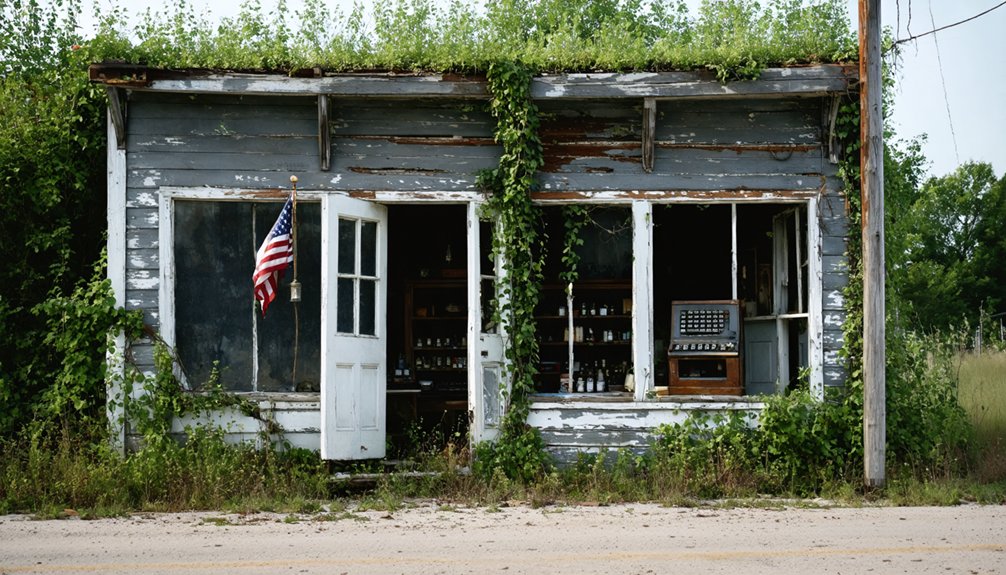
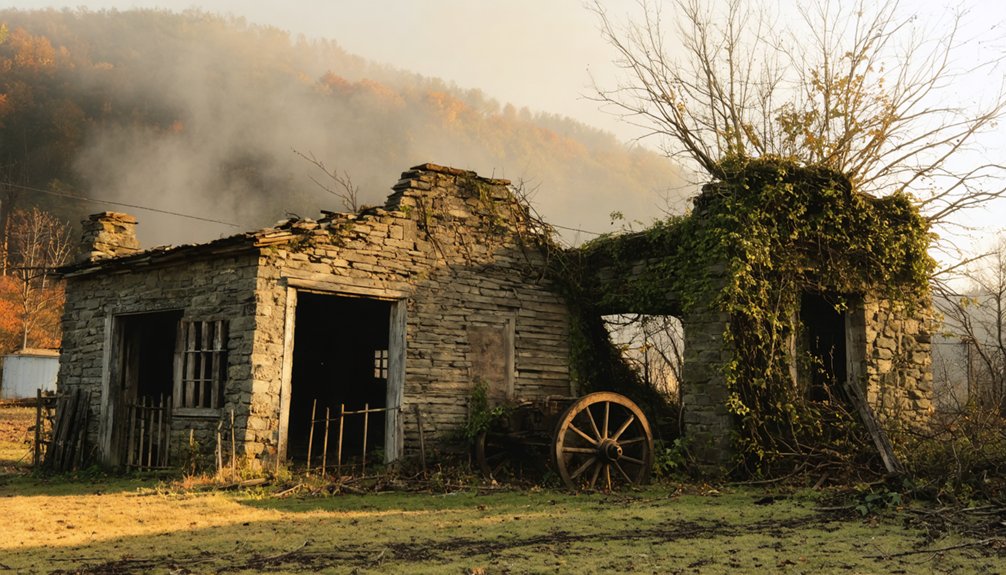
Standing as silent witnesses to a tumultuous era in American history, preserved architectural remnants of Civil War settlements offer a remarkable portal into the nation’s past.
These structures, maintained through “arrested decay” techniques, retain their architectural significance while presenting ongoing preservation challenges for historical conservationists.
When you visit these sites, you’ll find:
- Original residential structures complete with period-specific furnishings and personal artifacts
- Military facilities including Fort Jefferson—America’s largest brick structure—showcasing 1860s defensive strategies
- Commercial establishments with intact shelving and merchandise displays
- Two-story mansions reflecting the stark social hierarchies of antebellum America
The preservation methods allow you to experience authentic deterioration patterns while preventing structural collapse.
Wooden buildings from 1880s mining booms stand alongside brick constructions that have withstood 150+ years of environmental exposure.
Elko Tract: Military Strategy and Civilian Displacement

You’ll find the Elko Tract’s 1942 transformation into a decoy airfield represents one of the most elaborate military deception tactics employed on American soil during World War II.
The federal government’s seizure of approximately 2,400 acres forcibly displaced over 40 mainly Black farming families without documented fair compensation, permanently erasing an established agricultural community.
The site’s post-war abandonment following segregation-era resistance to mental health facilities created a peculiar ghost town not of Civil War origin but with similar patterns of community erasure and forgotten histories.
Military Deception Tactics
Three critical elements defined the Elko Tract’s function as a military deception site during World War II: strategic planning, physical mimicry, and operational authenticity.
You’ll find this elaborate wartime strategy included positioning the decoy just four miles from Richmond Army Air Base to intercept potential Luftwaffe raids. The 936th Camouflage Battalion constructed an impressively detailed installation designed to withstand enemy scrutiny.
- Blackout procedures for Richmond contrasted with activated lights at Elko to misdirect enemy bombers
- Plywood aircraft and replica structures duplicated Richmond’s military facilities
- The 1896th Engineer Aviation Battalion maintained the facade by constantly repositioning props
- Strategic military deception required partial concealment attempts to appear authentic against enemy reconnaissance
This military deception consumed 2,400 acres of seized farmland, permanently altering eastern Henrico County.
Postwar Community Erasure
After the war ended, Elko Tract’s military purpose evaporated, leaving a complex legacy of community displacement and failed redevelopment that persists to this day.
The federal government’s seizure of 2,400 acres displaced over 40 mainly Black farming families, permanently erasing generational agricultural communities with minimal compensation.
Virginia’s postwar plans to build an African American mental health facility faced fierce opposition from white Henrico County residents, reflecting the region’s entrenched segregationist attitudes.
The 1954 Brown decision intensified this resistance, with Governor Stanley halting construction by 1957 amid the state’s massive resistance movement.
What remains today—overgrown streets, abandoned infrastructure, and concrete fragments—stands as physical evidence of racial displacement and community erasure.
The site embodies how military necessity, postwar politics, and systemic racism converged to permanently alter both landscapes and lives.
Natural Disasters and Their Role in Town Abandonment
While military conflict directly consumed many towns during the Civil War era, natural disasters played an equally significant role in the abandonment of once-thriving communities across the American landscape.
The unforgiving power of nature sealed the fate of settlements weakened by war’s devastation.
As armies retreated, nature advanced—finishing what bullets and cannons had begun against vulnerable towns.
- Mississippi River flood impacts devastated Hopefield, Arkansas, with a violent inundation in 1865 submerging nearly the entire town.
- Ben Ficklin, Texas vanished when the 1882 Concho River flood killed over 60 residents and obliterated its structures.
- Earthquake consequences permanently altered Port Royal, South Carolina after the catastrophic 1886 seismic event.
- Coastal erosion transformed Port Royal into an underwater museum, with docks and foundations submerged beneath advancing waters.
These natural forces, coming at vulnerable moments in post-war recovery, often delivered the final blow to communities already struggling.
Underground Fires: Centralia’s Slow-Motion Catastrophe

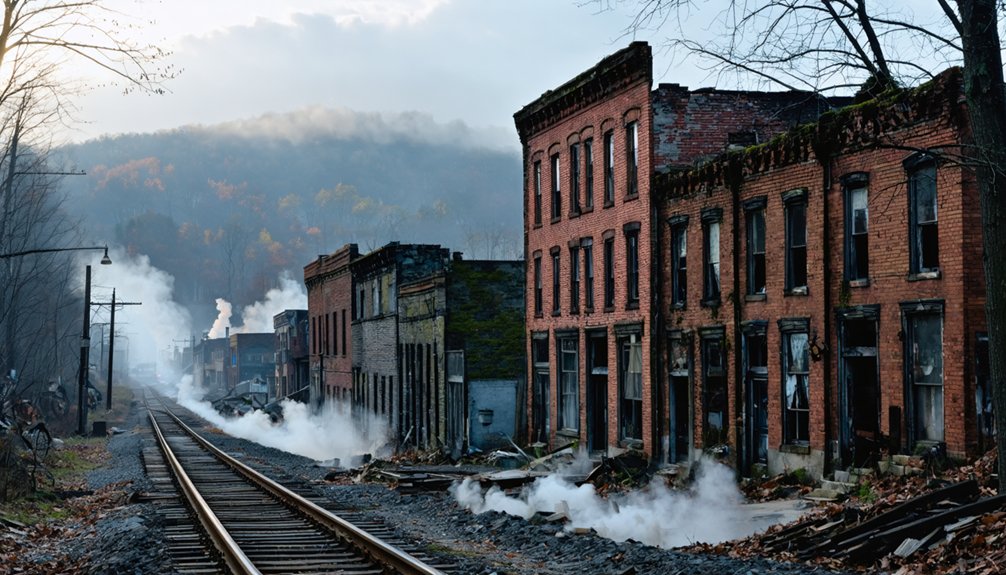
You’re witnessing one of America’s most haunting environmental disasters in Centralia, where an underground coal seam fire has burned continuously since 1962, transforming a once-thriving mining town into an apocalyptic landscape.
The fire’s monitoring presents unique challenges as it spreads beneath the surface at roughly 75 feet annually across four branches, with temperatures reaching 350°F and emitting deadly carbon monoxide and sulfurous fumes that forced nearly all 1,500 residents to evacuate.
As the abandoned town crumbles, infrastructure collapses into sinkholes up to 150 feet deep, creating a hazardous indication of how human error—a poorly managed garbage dump fire—can devastate an entire community for generations.
The Decades-Long Inferno
Beneath the abandoned streets of Centralia, Pennsylvania, a catastrophic underground fire has smoldered continuously since 1962, transforming a once-thriving mining community into one of America’s most haunting ghost towns.
The fire history began when burning trash in the town landfill ignited a coal seam due to the borough’s failure to install a required clay barrier—a critical oversight with devastating environmental impact.
You’ll find the inferno’s scale almost incomprehensible:
- Burning at depths up to 300 feet across nearly 3,700 acres
- Advancing steadily at 75 feet annually along four branches
- Releasing toxic gases that make the air hazardous to breathe
- Expected to continue burning for another 250 years despite multiple extinguishment attempts
The population plummeted from 2,700 to just five residents by 2020, leaving behind a scientific curiosity and stark warning about industrial negligence.
Environmental Monitoring Challenges
Monitoring the environmental impact of Centralia’s underground inferno presents extraordinary scientific and practical challenges that have frustrated researchers for decades.
You’ll notice how environmental degradation continues unabated while monitoring technology struggles against multiple obstacles. Ground instability creates sinkholes that swallow equipment, while gas emissions fluctuate wildly, evading fixed detection systems.
Your understanding of fire progression is limited by unreliable thermal imaging and incomplete mine maps.
When researchers attempt data collection, they face hazardous conditions—toxic gas plumes shift unpredictably, and surface access points frequently collapse. The fire’s advance through multiple coal seams (3-7 meters yearly) defies predictive modeling due to complex subsurface dynamics.
Remote sensing technologies falter against vegetation cover, leaving significant knowledge gaps about this slow-motion catastrophe and its long-term ecological impacts.
Abandoned Infrastructure Collapse
As Centralia’s underground coal fire progressed through abandoned mine workings, it systematically destroyed the town’s structural integrity through a process of subterranean combustion and subsequent infrastructure collapse.
You’d find the town’s once-stable ground compromised as coal pillars burned away, creating dangerous subsidence that rendered buildings unsafe and roads impassable.
- Route 61 buckled and cracked, eventually requiring permanent closure and rerouting
- Local businesses, including Coddington’s gas station, succumbed to demolition as the ground beneath them destabilized
- The post office held out until 2002 before closing permanently
- Most abandoned buildings throughout Centralia have been methodically razed as infrastructure decay made them hazardous
This slow-motion catastrophe transformed a thriving community into a ghost town, with fewer than six residents remaining amid a landscape of empty lots and crumbling foundations.
Gold Rush to Ghost Town: Bannack’s Boom and Bust Cycle

The discovery of gold at Grasshopper Creek on July 28, 1862, by John White and his fellow Colorado prospectors triggered one of the most dramatic boom and bust cycles in American frontier history.
When fortune strikes wilderness, history pivots on the glint of precious metal in a prospector’s pan.
What began with exceptionally pure gold (99-99.5%) quickly transformed Bannack’s history from barren landscape to bustling boomtown of 3,000 residents within a year.
You’d have witnessed mining techniques evolve from simple placer operations to advanced technologies including six-stamp mills and electrified operations.
Despite becoming Montana’s first territorial capital in 1864, Bannack couldn’t sustain its prosperity.
When deposits exhausted by 1902, the town that had produced approximately $12 million in gold began its inexorable decline.
The last residents departed in the 1970s, leaving behind well-preserved structures—silent monuments to freedom’s pursuit and the ephemeral nature of frontier prosperity.
Haunted History: Paranormal Claims From Abandoned Battlegrounds
Beyond their abandoned buildings and crumbling infrastructure, Civil War ghost towns harbor darker legacies that transcend physical remains—paranormal phenomena reported with surprising consistency across these historical sites.
exploring abandoned towns of Appalachia can often reveal tales of resilience and despair etched into the very walls of forgotten homes. The eerie silence that blankets these places amplifies the sense of history, inviting intrepid explorers to uncover stories of the past that linger in the air. As echoes of bygone eras resonate, visitors might find themselves questioning the spirits that still roam these once-vibrant communities.
From Andersonville’s prison camp to Fort Delaware’s Confederate prisoner quarters, spectral sightings create a secondary historical narrative embraced by paranormal investigations.
- At Chambersburg, you’ll encounter phantom smoke and ghostly lamps where Confederate forces razed over 500 buildings.
- Andersonville’s 13,000 deceased Union soldiers manifest as apparitions, unexplained footsteps, and cold spots.
- Kentucky Lake’s submerged Johnsonville reveals underwater ruins while locals report ghostly lights rising from the depths.
- Cahawba, Alabama’s first capital turned prison camp, hosts shadowy figures of former prisoners, slaves, and children.
Archaeological Discoveries Revealing Daily Life in Lost Communities
Unearthing the physical remains of Civil War ghost towns through meticulous archaeological excavations has revealed intricate details of 19th-century American life that written records alone couldn’t preserve.
At Cahawba, Alabama, artifact analysis has uncovered foundations of homes, barns, and the notorious Castle Morgan prison, mapping the layout of this once-thriving river community that dwindled to just 300 residents by 1870.
Domestic routines emerge through household items like ceramics and personal effects—combs, buttons, and jewelry—while agricultural implements and animal bones illuminate farming practices.
The Ashokan Reservoir site, where 500 homes and numerous community buildings were destroyed, yields similar insights. Cemetery records document demographic patterns, with 725 graves relocated during reservoir construction.
These discoveries paint a vivid picture of communities torn apart by war and displacement.
Frequently Asked Questions
How Did Racial Tensions Influence Abandonment in Civil War Ghost Towns?
You’ll find racial segregation sparked violent expulsions, like in Oscarville, creating ghost towns as communities fled persecution. Economic instability followed when racist policies deterred investment, as demonstrated in Cairo’s systematic decline.
Can Visitors Legally Collect Artifacts From These Abandoned Settlements?
No, you can’t legally collect artifacts. Federal and state legal regulations prohibit removal of items, regardless of abandonment status. Artifact preservation laws protect these sites as cultural heritage resources, not free souvenirs.
What Diseases Contributed to Population Decline in These Communities?
Typhoid, smallpox, measles, dysentery, malaria, and yellow fever had devastating disease impact on these communities. You’ll observe how these health crises decimated populations, creating lasting demographic consequences you’re free to study.
How Were Children’s Lives Documented in These Abandoned Towns?
You’d find children’s lives documented through orphanage records, institutional archives, and survivor testimonies that revealed family dynamics, education circumstances, and treatment conditions—often preserved in museums converted from these abandoned structures.
Which Ghost Towns Have Potential for Future Resettlement?
Like phoenix candidates awaiting resurrection, you’ll find future resettlement potential in Virginia City and Bodie with their intact infrastructure, while Batsto Village offers strong ghost town revitalization possibilities through preserved historical structures.
References
- https://www.blueridgeoutdoors.com/go-outside/southern-ghost-towns/
- https://www.wideopencountry.com/the-10-eeriest-ghost-towns-in-america/
- https://www.visittheusa.com/experience/5-us-ghost-towns-you-must-see
- https://www.loveexploring.com/gallerylist/131658/abandoned-in-the-usa-92-places-left-to-rot
- https://www.christywanders.com/2024/08/top-ghost-towns-for-history-buffs.html
- https://www.geotab.com/ghost-towns/
- https://www.mentalfloss.com/geography/american-ghost-towns-can-still-walk-through
- https://en.wikipedia.org/wiki/Lists_of_ghost_towns_in_the_United_States
- https://www.youtube.com/watch?v=inRD6vYBy8M
- https://en.wikipedia.org/wiki/Ghost_town