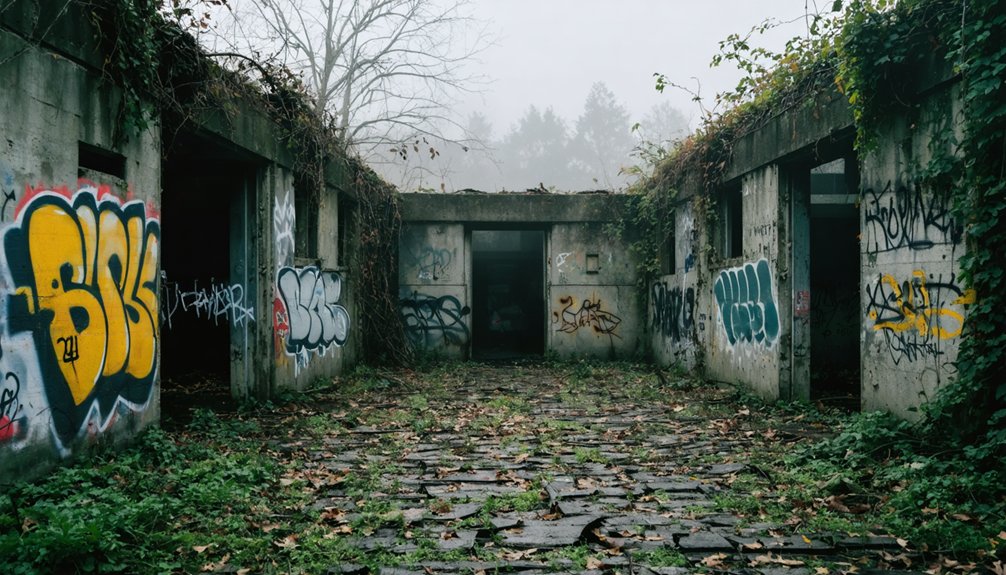
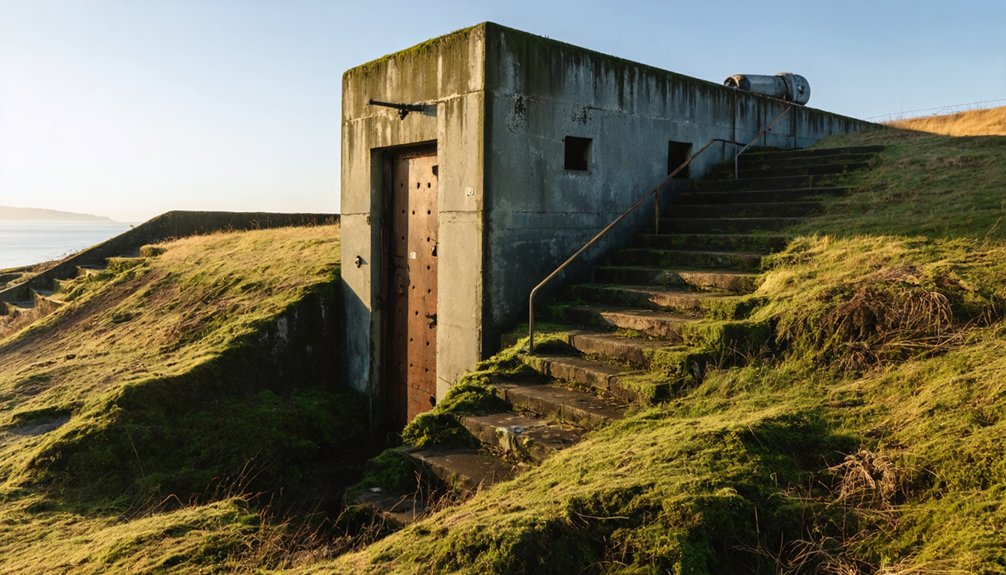
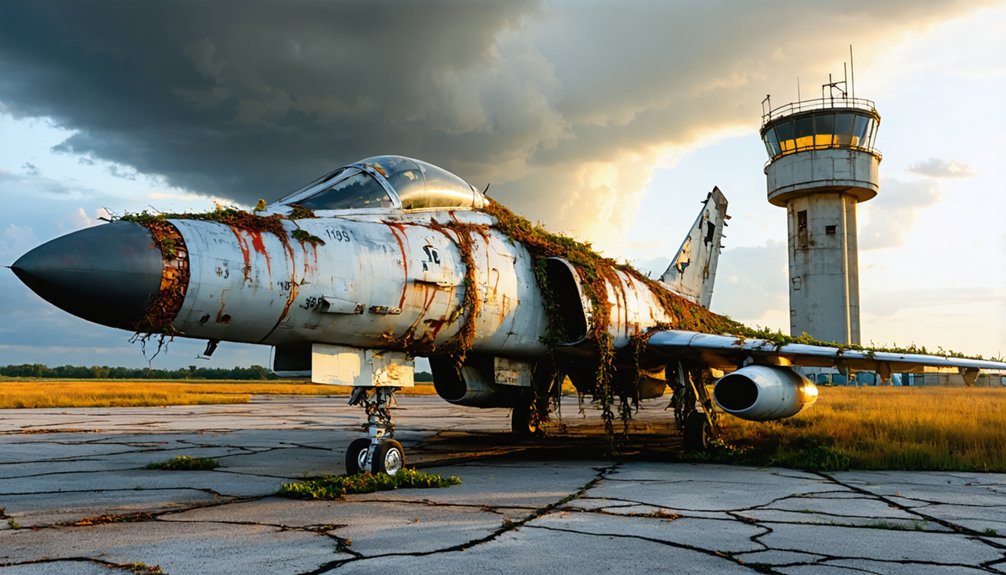
America’s military ruins harbor numerous paranormal hotspots worth exploring. You’ll find extensive ghostly activity at Fort Leavenworth, where German POWs haunt Building 65, and Fort Delaware, with its Confederate prisoner apparitions. Cold War remnants like North Truro Air Force Station and Fort Ord offer decaying structures filled with eerie phenomena. Bring EMF meters and digital voice recorders to capture evidence of spectral soldiers. These crumbling fortifications reveal their secrets to those properly equipped for investigation.
Key Takeaways
- Fort Leavenworth, America’s oldest western military installation, contains haunted sites including Building 65’s elevator shaft and the former Disciplinary Barracks.
- Fort Delaware housed Confederate prisoners with high mortality rates, resulting in paranormal activity like disembodied footsteps and shadowy figures near the Delaware River.
- Abandoned Cold War structures like North Truro Air Force Station feature decaying military buildings, hazardous materials, and paranormal activity attracting ghost hunters.
- Paranormal investigators use EMF meters, digital voice recorders, and thermal imaging to document spectral evidence often linked to historical military traumas.
- Military ruins face preservation challenges due to deteriorating structures, climate impacts, and insufficient conservation funding from programs like the Historic Preservation Fund.
The Spectral Soldiers of Fort Leavenworth: America’s Most Haunted Army Base
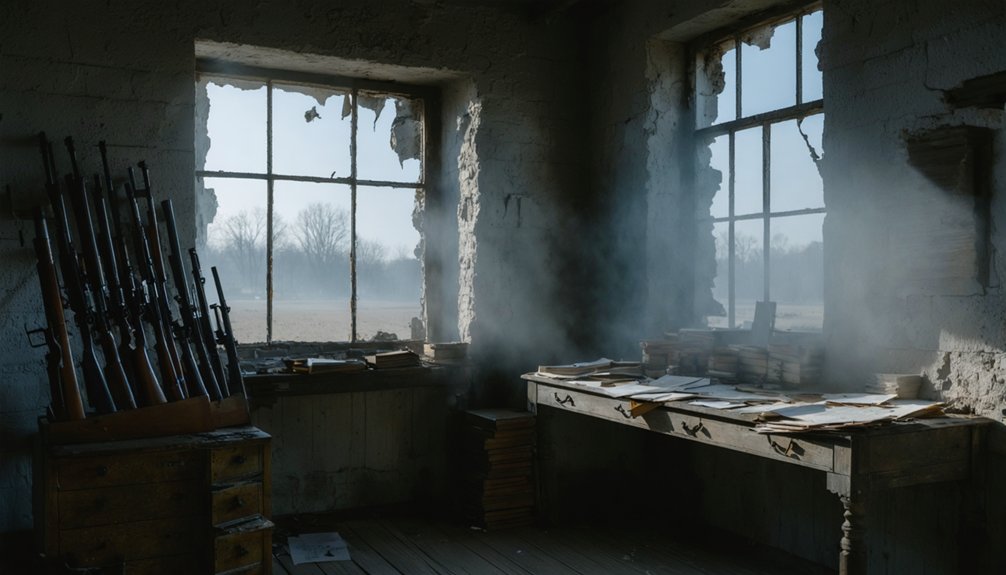
Among the countless military installations dotting the American landscape, Fort Leavenworth stands as a bastion of both historical significance and paranormal intrigue.
As the oldest continuously operated military installation west of the Mississippi, this historic outpost harbors spectral soldiers from nearly two centuries of service.
Building 65’s abandoned elevator shaft, where fourteen German POWs met their end during World War II, echoes with unexplained screams.
The haunted barracks of the former Disciplinary Barracks, operational from 1875 to 2002, feature ghostly figures pushing wheelchairs through storage areas.
At Tower 8, MPs report receiving calls from a guard who committed suicide years ago.
The ghost of Catherine Rich, forever searching for her lost children Ethan and Mary while wearing her distinctive black woolen shawl, is frequently spotted wandering through the National Cemetery.
The historic Rookery at 14 Sumner Place, built in 1827, houses the spirit of Major Edmund Ogden who has been identified by residents through his distinctive appearance.
With over 30 buildings hosting paranormal activity, Fort Leavenworth has rightfully earned its designation as the U.S. Army’s most haunted post.
Civil War Ghosts and Prison Hauntings at Fort Delaware
Rising from the marshy waters of Pea Patch Island in the Delaware River, Fort Delaware stands as a grim monument to Civil War suffering and paranormal activity.
Once housing over 30,000 Confederate prisoners with a 7.6% mortality rate, this fortress-turned-prison camp has cultivated numerous prison hauntings.
You’ll find spectral soldiers still occupying the fort’s casemates, powder magazines, and infamous “bull pen” barracks where disease claimed thousands of lives.
- Disembodied footsteps echo through sealed casemates where prisoners once languished in overcrowded conditions
- Shadowy figures appear near the Delaware River banks, possibly the spirits of failed escapees who drowned in swift currents
- Phantom moans emanate from the former hospital area where smallpox and pneumonia claimed countless lives
- Apparitions in Confederate uniforms materialize near Finn’s Point Cemetery, where 2,500 prisoners were buried in pine boxes
One desperate prisoner reportedly escaped by hiding in a coffin, showcasing the extreme measures taken to flee the deplorable conditions of the fort.
Visitors report chilling encounters near the wooden grillage foundation, where 4,911 piles were driven deep into the marshy soil to support the massive stone structure that would become a place of suffering.
Fort Monroe’s Famous Phantoms: Jefferson Davis and Edgar Allan Poe

Fort Monroe harbors the troubled spirit of Jefferson Davis, whose ghost paces the ramparts at night following his imprisonment after Lincoln’s assassination.
You’ll encounter Edgar Allan Poe’s distinctive apparition wearing his trademark top hat near the Chamberlin Hotel, where he appears despite his brief military career at the fort.
These famous phantoms are accompanied by substantial paranormal evidence, including EVP recordings of disembodied voices, mysterious temperature drops, and full-bodied apparitions throughout the Casemate Museum and surrounding grounds. Visitors have reported hearing a little girl’s voice calling for her cat named Greta in various locations around the fortress. The fort’s continued reputation for paranormal activity has led many current residents to accept the ghostly presences as part of everyday life.
Poe’s Spectral Patrols
While many forts claim paranormal activity, Fort Monroe stands apart with its documented connection to one of America’s literary giants.
Edgar Allan Poe’s brief military service here in 1830 has seemingly extended beyond his mortal life, with his spectral presence regularly reported by staff and visitors alike. One boy even claimed to see a man in his closet who was later identified as a ghostly sketch of Poe. Poe’s literary legacy continues through these ghostly encounters, particularly near the casemates where he once wrote. The fort’s reputation is further enhanced by reports of cold spots and sensations of being watched throughout the historic structure.
- A solemn figure in military uniform wandering through the historic grounds after sunset
- A top-hatted apparition frequently spotted on the Chamberlin Hotel’s veranda, 0.5 miles from the fort
- EVP recordings capturing unexplained voices during paranormal investigations
- Children pointing to Poe’s portraits, claiming to have seen the figure in their rooms
Davis’ Restless Imprisonment
Long after his controversial two-year confinement at Fort Monroe ended in 1867, Jefferson Davis’s spectral presence reportedly lingers within the casemate walls that once held him prisoner.
You’ll find evidence of his harsh treatment—ankle fetters, constant surveillance, and initially sparse accommodations—reflected in unexplained cold spots and shadowy manifestations.
The Davis’s Disguise Myth, falsely claiming he fled wearing women’s clothing, continues to haunt his legacy despite historical records confirming otherwise.
His capture near Irwinville followed six weeks of desperate flight, motivated by family protection rather than cowardice.
Though never tried for treason despite grand jury indictments, Davis’s imprisonment legacy symbolizes the complex reconciliation process that followed the Civil War.
His $100,000 bail, posted by unlikely allies including abolitionist Horace Greeley, marked America’s reluctant movement toward healing.
Before his capture and imprisonment, Davis served as the unanimous choice for provisional president of the Confederate States in February 1861.
Initially arrested as a suspect in Lincoln’s assassination, Davis was later charged with treason when authorities failed to connect him to the president’s death.
Abandoned Cold War Remnants: The Eerie Halls of Truro Air Force Station
Standing as a stark reminder of Cold War vigilance, the decaying barracks at North Truro Air Force Station now feature warning signs that mark forbidden zones too hazardous for public entry.
You’ll encounter crumbling military family homes that once housed hundreds of personnel tasked with scanning the skies for Soviet threats.
The abandoned complex‘s eerie halls still echo with decades-old tensions, where asbestos-laden structures and concrete radar pads offer a glimpse into America’s defensive posture during the atomic age.
Decaying Cape Cod Barracks
Nestled within the windswept dunes of Cape Cod National Seashore, the deteriorating barracks of North Truro Air Force Station stand as silent sentinels of America’s Cold War vigilance.
These decaying structures once housed over 500 military and civilian personnel, forming a self-contained community dedicated to scanning the Atlantic for Soviet threats.
Today, you’ll find haunted memories lingering among the crumbling edifices, abandoned after the station’s 1985 closure.
- Concrete barracks walls slowly surrendering to coastal erosion and salt air
- Empty mess halls where radar technicians once gathered between tense monitoring shifts
- Vacant family housing units with missing windows framing the Atlantic horizon
- Hollow recreational facilities where off-duty personnel sought normalcy amid Cold War tensions
Warning-Laden Forbidden Zones
Hidden behind stern warning signs and deteriorating perimeter fencing, the forbidden zones of North Truro Air Force Station present a chilling glimpse into America’s Cold War vigilance system. Concrete radar pads and underground bunkers remain visible indicators to operations that once extended 500 miles offshore via the Georges Shoal Tower Annex.
Your forbidden explorations are limited by National Park Service restrictions, as hazardous materials and unstable structures make certain areas genuinely dangerous, not merely mysterious. The station, operational from 1951 until its 1985 deactivation, housed hundreds of military personnel monitoring for Soviet bombers approaching via Arctic routes.
Today, these spectral remnants attract paranormal enthusiasts drawn to abandoned halls where radar operators once transmitted crucial intelligence through massive communication systems.
The base’s shift from military outpost to restricted historical site preserves both its historical significance and its eerie atmosphere.
Forgotten Military Family Homes
Beyond the radar facilities and command centers lies a more intimate Cold War relic: the forgotten family housing units of North Truro Air Force Station.
These abandoned homes, once bustling with military families from 1951 until 1985, now stand as silent witnesses to a bygone era of constant vigilance.
Explorers are drawn to the intriguing stories behind the mysterious miner homes in Nevada, often uncovering remnants of a rich history intertwined with the region’s mining boom. These structures, now shrouded in dust and legend, evoke curiosity about the lives led within their walls. Each visit serves as a reminder of the past, inviting both adventure and reflection on what once was.
The haunted history of these structures reveals forgotten memories of everyday American life amidst global tensions:
- Utilitarian duplexes where children played while parents monitored Soviet threats
- Communal kitchens and laundry facilities that fostered tight-knit community bonds
- Recreation halls now filled with peeling paint and wind-scattered debris
- Prefabricated modular homes designed for rapid deployment, now slowly reclaimed by nature
Today, these weathered remnants offer glimpses into Cold War domesticity, preserved within the National Seashore as tangible artifacts of an anxious era.
Fort Ord’s Decaying Military Complex: Where Spirits Linger in California
Situated along the picturesque Monterey Bay coastline, Fort Ord stands as a decaying monument to America’s military past, where abandoned barracks and crumbling infrastructure now serve as vessels for paranormal activity.
This former infantry training ground hosted 1.5 million service members between 1917 and 1994, creating a rich haunted history that permeates its deteriorating structures.
The 45-square-mile complex contains underground bunkers extending 50 feet below ground and buildings contaminated with lead and asbestos.
Despite ongoing Superfund cleanup efforts, military folklore thrives among the overgrown ruins.
While parts have transformed into Fort Ord National Monument, approximately 785 restricted acres remain under Army control, their abandoned buildings slowly reclaimed by nature—and perhaps, by the spirits of those who once trained for war.
F.E. Warren Air Force Base: Cavalry Apparitions and “Gus” the Airman
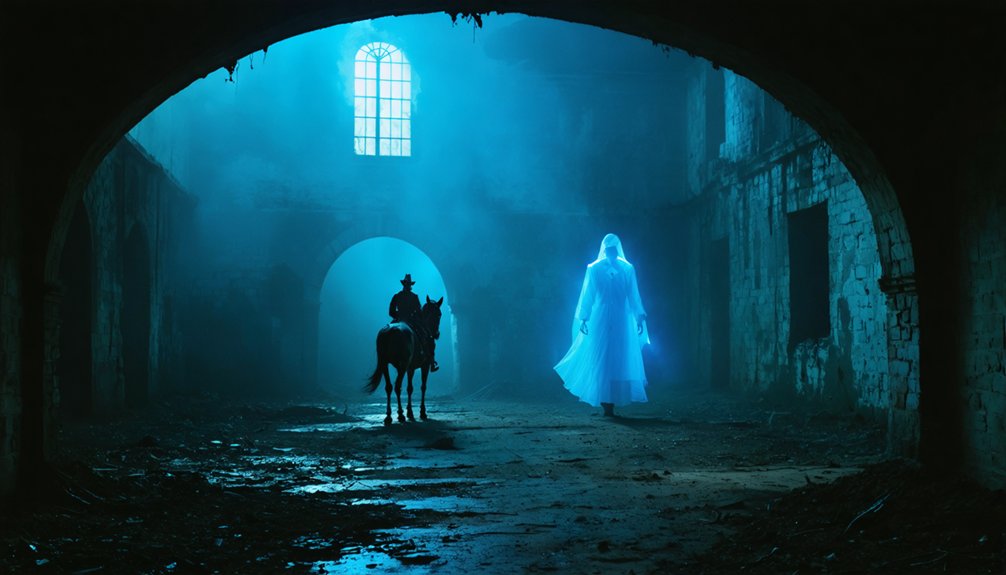
While Fort Ord harbors California’s coastal ghosts, Wyoming’s F.E. Warren Air Force Base stands as one of America’s most haunted military installations. Established in 1867 as Fort D.A. Russell, this former cavalry post now hosts numerous spectral residents.
The infamous “Gus Legend” centers on Quarters 80, where an adulterous airman met his fate on a clothesline while fleeing an officer’s wrath—now he eternally searches for his pants.
- Spectral cavalry riders thunder across parade grounds under moonlight, hoofbeats audible despite no visible horses
- Civil War-era uniformed figures drift silently across grounds, vanishing when approached
- Building 34’s former morgue emanates unexplained boot steps, whispers, and jingling spurs
- White Crow Creek echoes with a murdered indigenous woman’s screams, particularly near the modern FamCamp area
Exploring Fort Mifflin: Revolutionary War Spirits and the “Faceless Man”
Nestled along the Delaware River near Philadelphia, Fort Mifflin stands as a tribute to Revolutionary War courage and paranormal persistence. This strategic outpost, which endured the war’s heaviest bombardment with over 10,000 cannonballs fired by British forces, now harbors America’s most persistent military ghosts.
You’ll discover the fort’s infamous “Faceless Man” apparition lurking in the casemates, a tall featureless figure that triggers immediate dread. Revolutionary War apparitions abound—the “Lady in Blue” haunts the hospital area, while a headless drummer boy‘s rhythmic beats echo through empty corridors.
Fort Mifflin ghosts have sparked professional investigations and media attention, with staff regularly reporting unexplained footsteps, voices, and moving objects.
The site now capitalizes on its dual heritage, offering both historical tours and paranormal explorations.
Documenting Paranormal Phenomena in Former Military Installations
Beyond mere campfire tales, the systematic documentation of paranormal phenomena at former military installations has evolved into a methodical field combining historical research, witness testimony, and technological evidence gathering.
Investigators catalog spectral evidence across abandoned bases, revealing patterns that often correlate with historical traumas.
- Shadow figures materializing in officers’ quarters, appearing most frequently to children and animals during nightfall
- Disembodied voices and phantom footsteps echoing through former military hospitals where countless soldiers suffered
- Cold spots and unexplained tactile sensations concentrated in areas of previous executions or prisoner confinement
- Residual hauntings replaying traumatic events with precision timing, complete with period-appropriate sounds and smells
Your encounter with ghostly encounters at these sites might include full-bodied apparitions in historical uniforms or poltergeist activity – phenomena consistently reported by military personnel rather than civilians.
The Environmental and Historical Preservation of Haunted Military Ruins
You’ll find that haunted military ruins face a constant battle between natural decay and costly preservation efforts, with many historically significant sites deteriorating faster than conservation initiatives can address.
Funding shortfalls particularly impact sites with paranormal reputations, as they often receive lower priority despite their cultural significance and potential tourism value.
The dual mandate to remediate environmental contamination while preserving historical structures creates competing priorities that complicate preservation planning, especially when contaminated soil or hazardous materials are integral to the site’s original construction.
Preservation Versus Decay
While the haunted military outposts scattered across America stand as stark reminders of our nation’s complex past, they face a perpetual battle between preservation and natural decay.
These fragile structures require specialized preservation strategies tailored to their unique construction materials—whether adobe, sandstone, or hybrid designs. The challenge lies in stabilizing without reconstructing, maintaining authenticity while preventing collapse.
Effective decay mitigation must address climate change impacts that accelerate deterioration through increased moisture and temperature fluctuations.
- Earthen walls crumbling under rain’s persistent touch, revealing layers of history with each fallen piece
- Wind-carved sandstone features standing defiant against time, their surfaces etched with weather’s patient hand
- Original architectural plasters clinging desperately to walls, preserving fading messages from the past
- Iron components slowly surrendering to rust, their structural integrity compromised by invisible forces
Conservation Funding Challenges
Despite their historical significance and haunting allure, America’s military ruins face severe conservation funding challenges that threaten their very existence.
While programs like the American Battlefield Protection Program offer grants between $20,000-$200,000, these amounts rarely cover the extensive costs of preserving deteriorating structures, especially adobe and masonry ruins requiring continual maintenance.
You’ll find funding limitations particularly acute for remote sites where conservation strategies must address both accessibility issues and specialized expertise shortages.
The Historic Preservation Fund deposits $150 million annually, but this disperses across countless preservation needs nationwide.
Climate change accelerates deterioration, creating urgent demands that outpace available resources.
Though private partnerships help bridge gaps, the matching requirements often disadvantage smaller organizations and communities, leaving many historically significant military ruins vulnerable to permanent loss.
Ghost Hunting Equipment and Techniques for Abandoned Military Sites
Investigating abandoned military sites for paranormal activity requires specialized equipment and systematic methodology to document potential evidence of hauntings.
You’ll need EMF meters, digital voice recorders, thermal imaging devices, and specialized tools like REM Pods or laser grid systems for ideal ghost hunting at military ruins.
Always establish baseline readings before your investigation and use triangulation techniques to verify anomalies.
Military techniques like maintaining detailed logs with timestamps and conducting quiet periods will enhance your evidence collection.
- Your flashlight beam cutting through dusty hallways of abandoned barracks
- An EMF meter’s lights flashing unexpectedly near a former command center
- Thermal imaging revealing a cold spot shaped like a human figure in an empty bunker
- Your voice recorder capturing whispers in an area where soldiers once stood guard
Frequently Asked Questions
Are Paranormal Investigations Legally Permitted on Active Military Installations?
No, you’re not permitted to conduct paranormal investigations on active military installations without explicit commanding officer authorization. Military protocols strictly prohibit unauthorized photography, and paranormal ethics demand respecting security regulations.
Do Military Personnel Receive Official Guidance About Reporting Supernatural Encounters?
You won’t receive official military guidance for supernatural encounters. No standardized supernatural protocols exist in military reporting systems, despite widespread informal military beliefs about paranormal phenomena among personnel.
Has the Department of Defense Documented Unexplained Phenomena at These Locations?
DoD has documented unexplained phenomena, but ghost sightings aren’t officially cataloged in military archives. You’ll find UAP reports focus on physical anomalies rather than supernatural manifestations at specific locations.
Can Civilians Access Restricted Areas Where Apparitions Are Most Frequently Reported?
No, you can’t access these restricted areas. Civilian restrictions prohibit entry without explicit authorization. Access permissions are strictly controlled, with most reported haunting locations remaining off-limits to non-military personnel.
Do Hauntings Intensify During Significant Military Anniversaries or Historical Dates?
72% of paranormal enthusiasts report increased ghostly experiences during battle anniversaries. You’ll find no scientific evidence supporting this correlation, though military history commemorations may heighten your psychological expectation of encounters at these sites.
References
- https://soldiersangels.org/haunted-military-bases/
- https://www.military.com/feature/2025/10/25/haunted-military-sites-skeptics-guide-most-allegedly-haunted-military-sites.html
- https://abandonedwonders.com/2016/08/18/cold-war-ghost-town-the-abandoned-truro-air-force-station/
- https://warriorallegiance.com/ghost-stories-from-military-bases/
- http://www.gribblenation.org/2017/10/ghost-post-ruins-of-fort-ord.html
- https://www.youtube.com/watch?v=AzsexE5gJX4
- https://blog.militarybyowner.com/top-ghost-tours-near-military-bases
- https://www.youtube.com/shorts/LKUn4wVbSrM
- https://www.legendsofamerica.com/ks-fortleavenworth/
- https://www.army.mil/article/28851/family_has_unusual_experiences_living_in_a_haunted_house