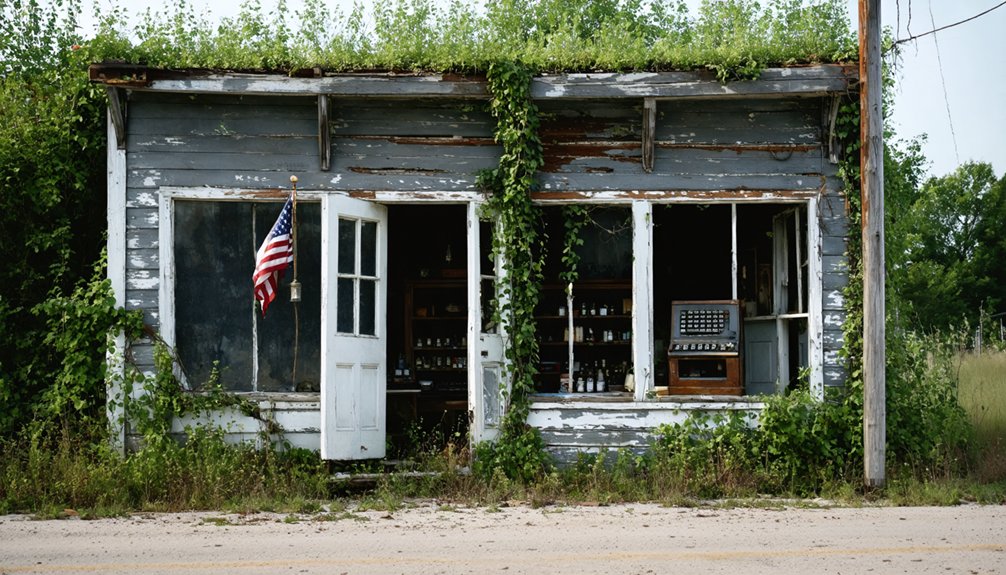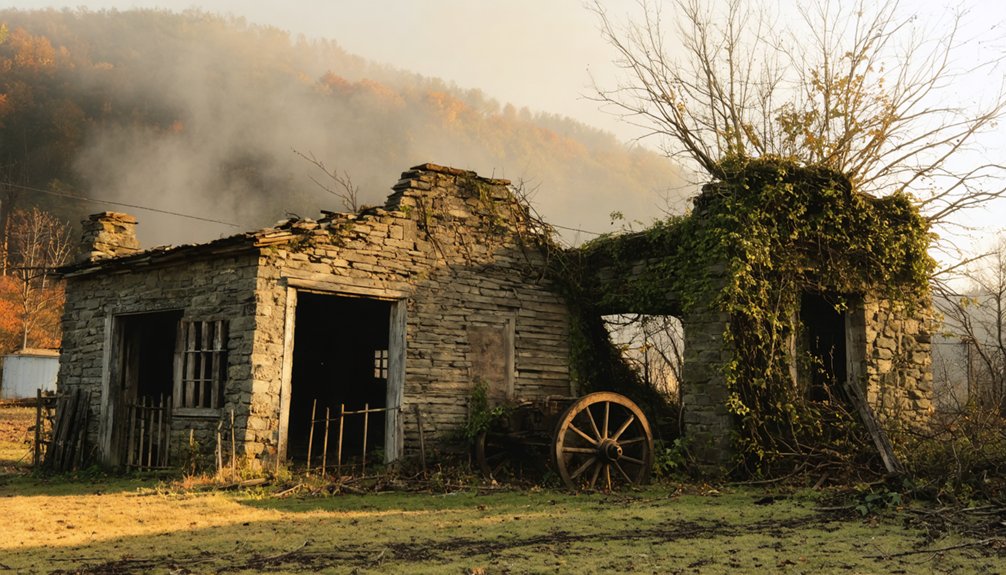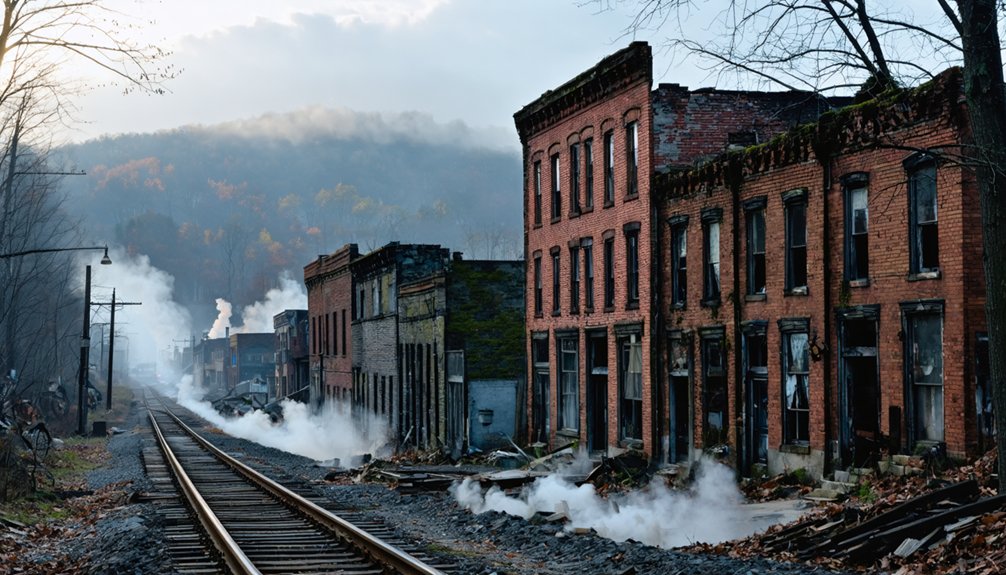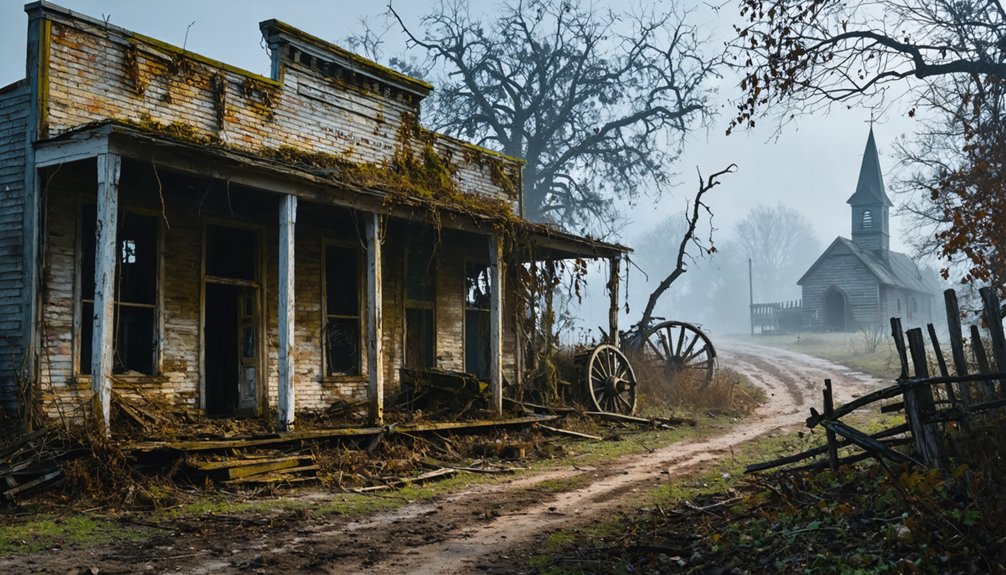
Civil War ghost towns offer glimpses into America’s traumatic past through abandoned capitals, industrial boomtowns, and prison camps. You’ll find places like Fayette, Michigan, where wartime production created temporary prosperity before rapid decline. These sites often feature documented paranormal activity, from phantom cannon fire to spectral soldier sightings. Preservation efforts have transformed many into heritage tourism destinations, allowing you to walk where history’s most defining conflict forever altered communities across the nation.
Key Takeaways
- Andersonville and Elmira Prison had devastating mortality rates, with over 56,000 prisoners dying across Civil War prison camps.
- Richmond and Danville served as final Confederate capitals before abandonment, leaving behind historical infrastructure now preserved for visitors.
- Fayette, Michigan exemplifies rapid wartime industrial growth followed by complete abandonment when military production ceased.
- Floods destroyed towns like Hopefield and Ben Ficklin, with some communities completely submerged and others permanently abandoned.
- Civil War ghost towns report paranormal activity including phantom cannon fire, spectral soldier formations, and unexplained physical sensations.
The Forgotten Capitals: From Power to Abandonment
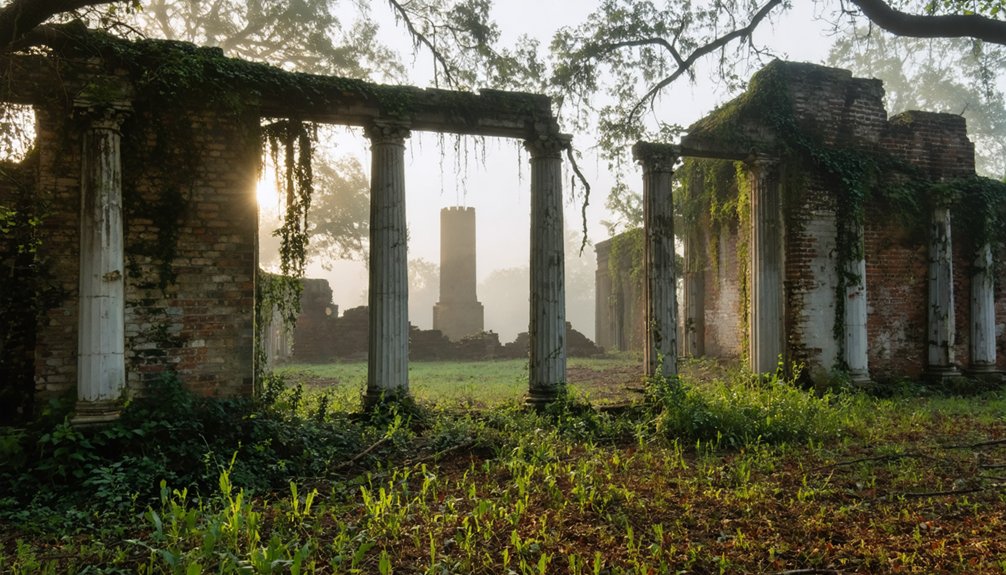
While the Union capital remained steadfast in Washington D.C. throughout the Civil War, the Confederacy experienced a nomadic governmental existence that reflected its increasingly precarious military position.
You can trace the Confederacy’s decline through its Civil War Capitals, each shift marking another step toward defeat. Montgomery’s selection initially symbolized Deep South solidarity, but Richmond’s strategic position closer to the front lines proved more practical by May 1861.
The Confederacy’s crumbling sovereignty can be mapped through its retreating capitals—from hopeful Montgomery to desperate Danville.
As Federal forces threatened, Abandoned Governance became the pattern—Richmond fell in April 1865, forcing Jefferson Davis and his cabinet to flee to Danville. This final capital lasted merely eight days before Lee’s surrender at Appomattox shattered Confederate hopes. The Confederate leadership operated from Major Sutherlin’s residence during their brief time in Danville, issuing what would be Davis’s final proclamation to the Confederacy.
The railroad connection between Richmond and Danville—once essential for supplies and coordination—ultimately served as an escape route for a government in collapse rather than an administrative link. In New Orleans, the lively French Quarter had already fallen to Union forces in 1862, removing a vital economic center from Confederate control.
Iron and Industry: How War Manufacturing Shaped Ghost Towns
The iron-smelting town of Fayette, Michigan exemplifies how Civil War-era manufacturing booms created industrial communities that later transformed into ghost towns when resources depleted.
You’ll find that these towns typically featured company-built infrastructure—including town halls, hotels, and stores—that supported immigrant workers who produced essential wartime materials such as pig iron for cannons and rifles.
When operations ceased, as happened in Fayette by 1891, these once-thriving industrial centers emptied rapidly, leaving behind furnace towers and abandoned buildings as silent witnesses to America’s industrial past. Similar to the Peters Cartridge Company Building, these facilities often manufactured bullets and cannonballs for Union forces during the Civil War.
The town once bustled with a diverse workforce of nearly 500 residents, primarily immigrants from Canada and Northern Europe who came seeking industrial employment opportunities.
Wartime Production Booms
As the Civil War erupted across America in 1861, industrial production surged to meet unprecedented military demands, transforming sleepy rural outposts into bustling manufacturing centers virtually overnight.
This wartime labor mobilization created industrial towns where iron and coal production fueled the Union’s military machine.
You can trace this dramatic shift in places like Ohio’s Vinton Furnace, where approximately 100 workers produced critical iron for Union forces. Similar to these industrial centers, Union Level experienced dramatic economic transformation through tobacco warehouses when investors pressured local farmers to sell their land following the Civil War.
The urgent need for war materials created boomtowns characterized by:
- Company-controlled housing and stores where workers were paid in tokens
- Rapid population growth from immigrant and displaced worker influxes
- Strict corporate oversight of residents’ daily lives
- Essential infrastructure built specifically for military production purposes
These industrial centers flourished during the conflict but faced decline when military demands evaporated after the war’s conclusion. Many eventually became ghost towns when their reason for existing disappeared along with the economic activities that sustained them.
Industrial Decline Aftermath
When victory bells rang in 1865, the flourishing wartime industrial centers faced an immediate economic crisis, transforming from production powerhouses to abandoned landscapes within a generation.
You’ll find these towns were victims of their own specialized success. Places like Batsto, New Jersey—once essential for military iron production—couldn’t pivot when wartime demands evaporated. Their economic resilience collapsed as factories shuttered and workers fled. Batsto Village notably supplied iron ore to the Continental Army during the Revolutionary War before experiencing similar decline.
Resource depletion compounded the problem; exhausted iron ore mines offered no future prosperity.
Community adaptation efforts often failed. Attempts to shift to glassblowing or other industries rarely succeeded in single-resource towns. The Panic of 1873 delivered the final blow to communities already struggling.
This parallels Stubenville’s experience, where the once-thriving economy built on coal and steel collapsed when Asian competition emerged in the 1980s.
Today, crumbling foundries and empty worker houses serve as silent monuments to boom-and-bust economies that couldn’t survive peacetime’s harsh economic realities.
Prison Camps to Phantoms: The Dual Legacy of Military Sites
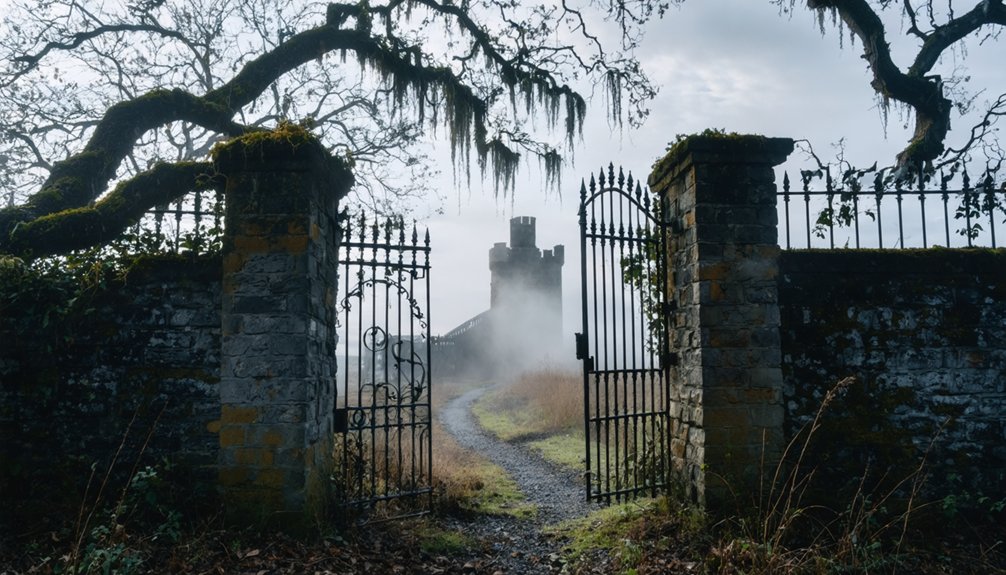
During America’s bloodiest conflict, military installations across the nation underwent a grim transformation into makeshift prisons that would forever haunt their legacy.
These repurposed structures—from coastal forts to islands and military grounds—became synonymous with suffering as prison conditions deteriorated under overwhelming numbers of captives.
Today, you can still encounter the ghostly remnants of these tragic sites where thousands perished:
- Andersonville (Camp Sumter), where nearly 13,000 Union soldiers died amid overcrowding and disease
- Fort Jefferson’s remote island location, which housed both Union soldiers and Confederate POWs
- Elmira Prison (“Hellmira”), whose Northern location didn’t spare prisoners from mortality rates rivaling Southern camps
- Belle Isle, an open-air prison camp in Richmond that primarily confined captured officers
These sites stand as silent witnesses to wartime suffering, their abandoned grounds echoing with memories of those who never returned home. Camp Lawton in Georgia, built to relieve overcrowding, enclosed 42 acres of prison grounds where thousands suffered. With approximately 56,000 deaths in prison camps, these facilities claimed more American lives than several modern wars combined.
Nature’s Wrath: How Floods and Disasters Sealed Town Fates
The devastating power of water reshaped America’s landscape during and after the Civil War, permanently erasing communities that once thrived along essential waterways.
You’ll find few traces of Hopefield, Arkansas, which Union forces burned before the Mississippi River submerged its ruins in 1865, or Johnstown, Pennsylvania, where a catastrophic dam collapse sent a 60-foot wall of water through the town at 40 mph.
The Great Flood of 1862 obliterated Champoeg and Lynn City in Oregon after nearly two months of continuous rainfall, while Ben Ficklin, Texas disappeared when the Concho River claimed both buildings and 60 lives in 1882.
Disaster recovery proved impossible for towns like Rodney, Mississippi, where flood impacts repeatedly weakened infrastructure until residents abandoned their homes, demonstrating nature’s ultimate authority over human settlement.
Economic Collapse: When the Railroads Left Town
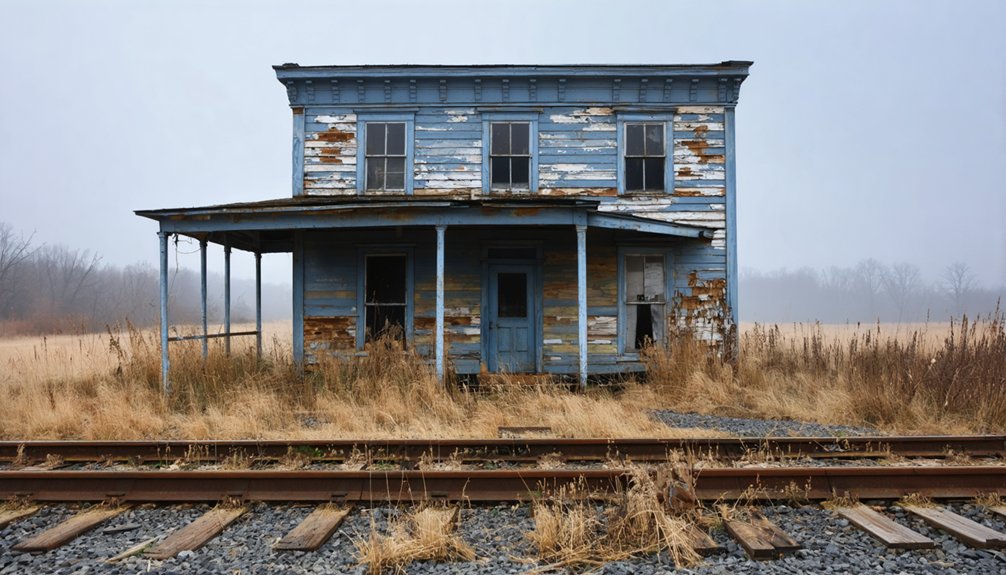
Railroad dependency defined the economic fate of countless American communities during the Civil War era and beyond.
You’ll find the economic infrastructure of towns like Thurmond, West Virginia and Union Level, Virginia completely intertwined with rail systems that brought them to life—and eventually led to their demise.
When the railroads abandoned these communities, their fate was sealed through:
- The devastating shift from coal to diesel fuel, eliminating the need for frequent stops
- The Great Depression’s knockout blow to already vulnerable economies
- Competition from the Interstate Highway System redirecting commerce
- Rapid population exodus when rail infrastructure closed, as seen in Steins, New Mexico
This transportation revolution transformed vibrant hubs into forgotten landscapes as America’s economic priorities shifted away from the rails.
Preservation Efforts: Saving America’s Civil War Ghost Towns
Despite the decline of countless Civil War-era settlements, a passionate movement to rescue these historical treasures emerged in the late 20th century. Organizations like the Association for the Preservation of Civil War Sites (founded 1987) and the Civil War Trust spearheaded battlefield acquisition at rates four times higher than government efforts.
You’ll find these preservation strategies extend beyond battlefields to ghost towns themselves. The Alabama Historical Commission maintains Cahawba as an archaeological preservation site, while the Southern Appalachian Highlands Conservancy rescued the 95-acre Lost Cove property in 2012.
Community engagement proves essential to these efforts, with local groups organizing guided hikes and fighting commercial development threats.
The preservation approach balances natural reclamation with historical documentation—maintaining foundation markers, street remnants, and key structures while honoring these sites’ unique stories of abandonment and resilience.
Haunted Histories: Documented Paranormal Activity in Abandoned Sites

While many historians focus on the tangible remnants of Civil War ghost towns, countless visitors and researchers have documented unexplained phenomena that suggest these abandoned sites harbor more than just physical ruins.
The battlefields and prisons where thousands perished have become hotspots for ghostly encounters.
When you visit these historic locations, you might experience:
- Sensory phenomena including phantom cannon fire, rifle shots, and battle cries echoing through the darkness
- Spectral soldiers appearing among boulder formations like Devil’s Den or marching across former battlegrounds
- Physical sensations such as ghostly touches reported at various sites
- Residual hauntings where traumatic events replay through apparitions, unexplained sounds, and even battlefield smells
These consistent reports span 160 years, creating a paranormal narrative that parallels the documented history of these abandoned towns.
Tourism Today: Exploring Civil War Ghost Towns in the 21st Century
The spectral encounters that draw paranormal enthusiasts to Civil War ghost towns represent just one dimension of their modern appeal.
Today, these abandoned settlements have transformed into thriving heritage tourism destinations, with places like Old Cahawba, Alabama evolving from neglected ruins to organized visitor experiences.
You’ll find carefully designed walking trails, interpretive signage, and accessible routes that allow you to explore these historical treasures while preserving their archaeological integrity.
Visitor engagement has surged dramatically, with “ghost tours near me” searches increasing 128% year-over-year. This growing interest has created economic revitalization opportunities and funded preservation efforts across former Confederate regions.
Whether you’re a history buff, international traveler, or family seeking educational experiences, these ghost towns offer powerful connections to America’s past while balancing visitor access with historical authenticity.
In these desolate settings, ghostly echoes in rural landscapes serve as a haunting reminder of lives once lived and stories waiting to be told. Each creaking floorboard and crumbling wall invites exploration and reflection, drawing visitors into a tangible connection with a bygone era. As the sun sets, the ethereal beauty of these sites becomes even more apparent, casting long shadows that intertwine the past with the present.
Strategic Deception: Towns Sacrificed for Military Advantage
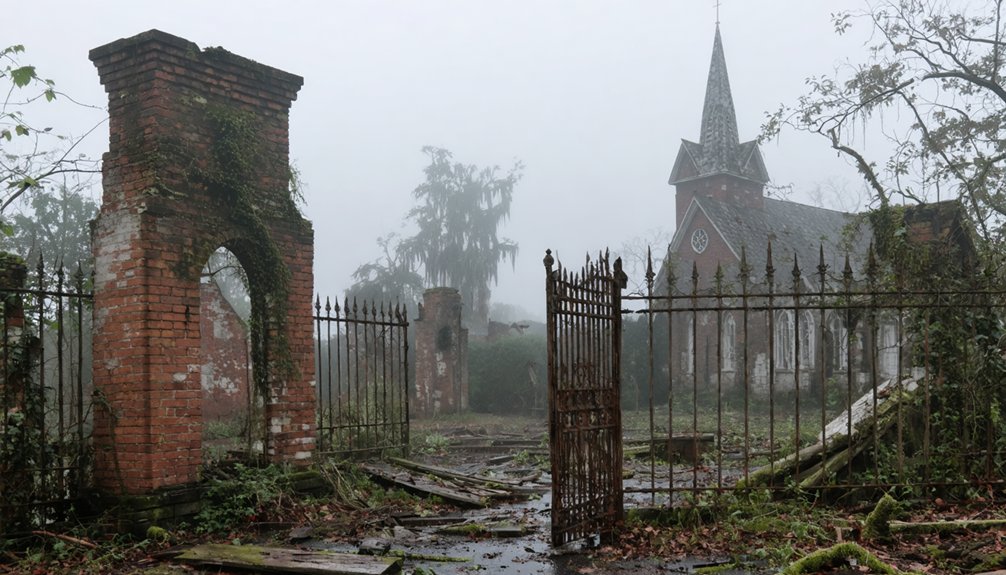
Throughout the Civil War, military commanders on both sides deliberately sacrificed entire communities as pawns in their strategic deception campaigns, creating ghost towns whose abandonment served tactical purposes rather than resulting from battles or economic collapse.
These evacuated settlements became integral components of wartime strategies, offering military advantages that transcended their civilian value:
- Towns near riverbanks provided cover for feigned crossing preparations while actual operations occurred elsewhere.
- Abandoned communities housed dummy equipment and “Quaker guns” to project false strength.
- Civilian structures served as backdrops for elaborate staging of troop movements.
- Evacuated areas allowed for the controlled release of misinformation to enemy scouts.
The deceptive tactics employed in these sacrificed towns often succeeded in diverting entire enemy corps away from genuine objectives, fundamentally altering battle outcomes while permanently changing these communities’ trajectories.
Migration Patterns: How War Displacement Created and Destroyed Communities
Civil War displacement fundamentally transformed America’s population landscape, creating demographic shifts that would echo for generations. When fighting erupted in 1861, westward migration stalled and immigration plummeted, creating a migration disruption that altered community development nationwide.
You’ll find fascinating regional distinctions in these patterns. White Southerners largely remained in the South—census data shows a 2% increase in southern-born whites staying in their region—while Kentucky’s Union veterans were more likely to migrate northward than their Confederate counterparts. These weren’t purely economic decisions; people moved to avoid communities with opposing political affiliations.
Community resilience appeared differently across regions. While many rural Southern areas experienced abandonment, Northern industrial cities flourished with immigrant labor after the war.
Southern efforts to attract immigrants largely failed as newcomers avoided conditions reminiscent of slavery.
Frequently Asked Questions
Were Any Civil War Ghost Towns Later Repopulated?
Yes, you’ll find most Civil War ghost towns remained abandoned, with only a few experiencing limited repopulation patterns through tourism and preservation efforts that highlight their historical significance.
How Did Freed Slaves Influence Ghost Town Development?
Like phoenixes from ashes, you’ll find freed slaves established self-contained communities with churches, businesses, and schools. Their economic contributions created thriving towns that later declined when residents sought opportunities elsewhere.
Did Indigenous Communities Impact Civil War Ghost Town Locations?
Yes, you’ll find that indigenous settlements directly influenced ghost town placement through raids, resistance, and competition for resources, while their cultural influences shaped these territories long before settlers arrived.
What Building Materials Typically Survived in These Ghost Towns?
Silent sentinels of the past, you’ll find brick remnants dominate these abandoned places. While wood structures typically vanished—scavenged for reuse—brick, stone foundations, metal hardware, and concrete elements stubbornly persisted through time.
How Have Climate Changes Affected Preservation of These Sites?
You’ll notice climate impact severely threatens these sites through coastal erosion, permafrost thawing, desertification, and vegetation overgrowth. These preservation challenges require urgent documentation and adaptive strategies to protect remaining historical structures.
References
- https://www.blueridgeoutdoors.com/go-outside/southern-ghost-towns/
- https://devblog.batchgeo.com/ghost-towns/
- https://www.mentalfloss.com/geography/american-ghost-towns-can-still-walk-through
- https://www.christywanders.com/2024/08/top-ghost-towns-for-history-buffs.html
- https://www.visittheusa.com/experience/5-us-ghost-towns-you-must-see
- https://www.loveexploring.com/gallerylist/131658/abandoned-in-the-usa-92-places-left-to-rot
- https://everydaywanderer.com/us-ghost-towns
- https://www.geotab.com/ghost-towns/
- https://en.wikipedia.org/wiki/Lists_of_ghost_towns_in_the_United_States
- https://www.youtube.com/watch?v=inRD6vYBy8M