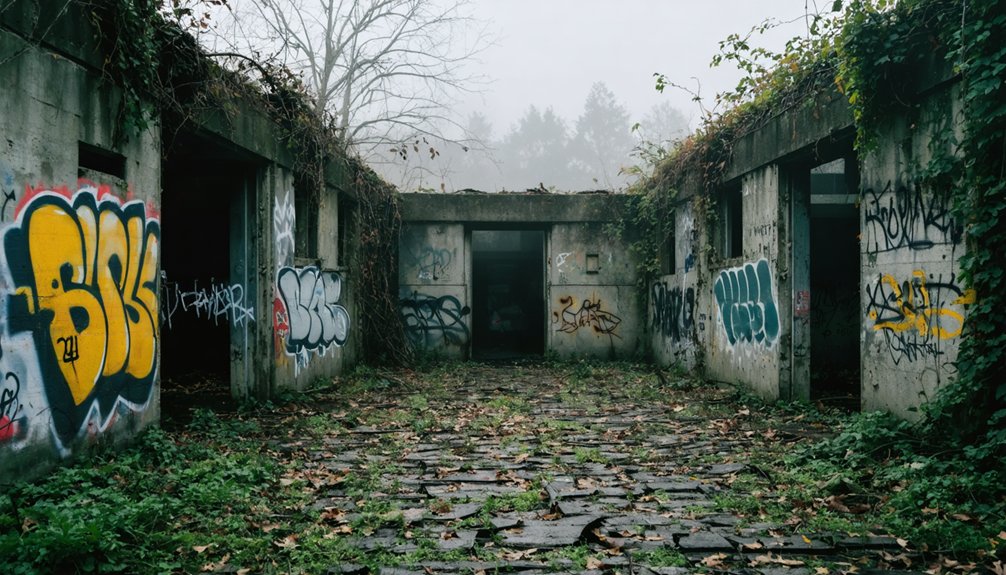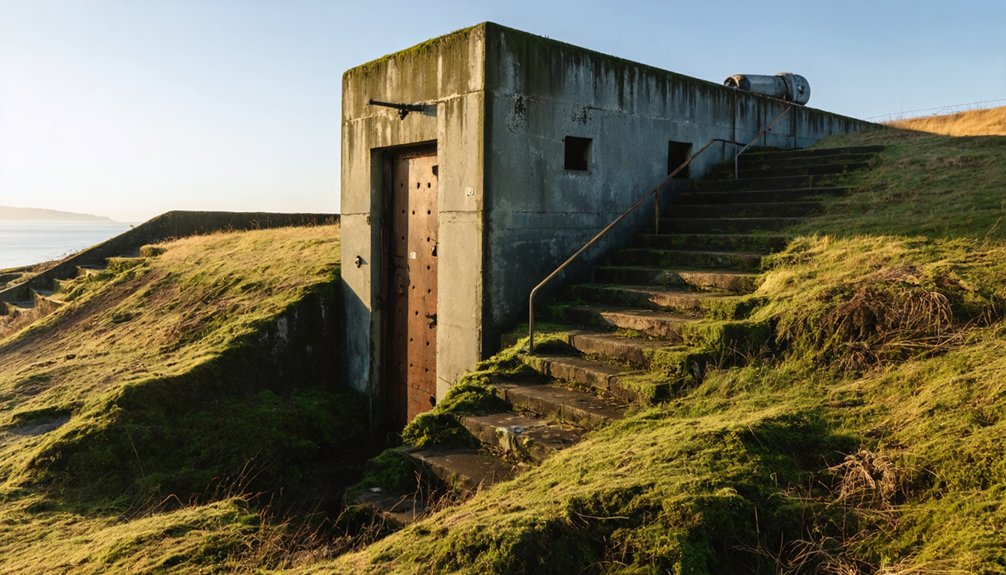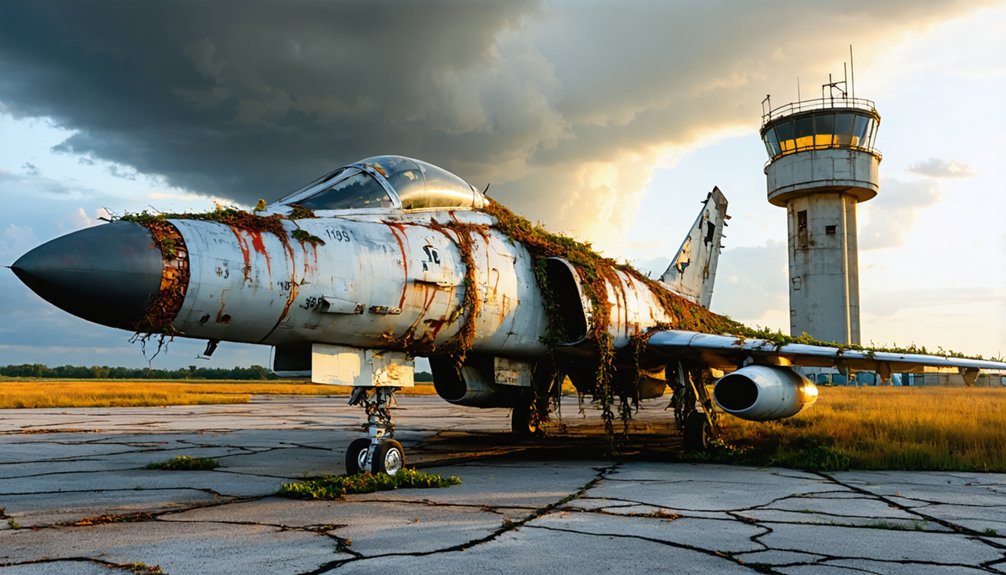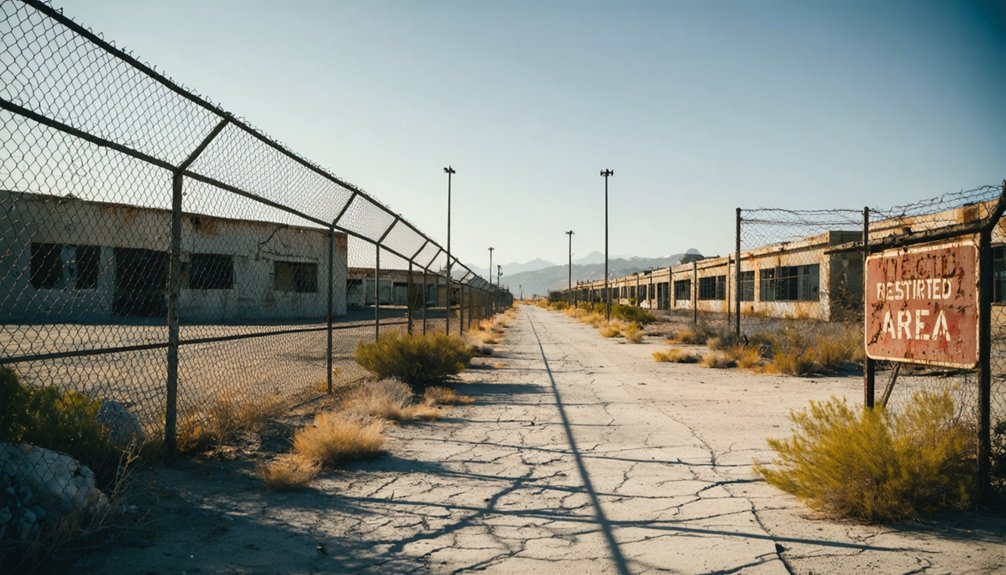
Across America, abandoned military bases tell haunting stories of national defense history. You’ll find eerie tactical ghost towns at Fort Irwin mimicking Middle Eastern villages, spectral sightings at Fort Leavenworth’s 36 documented haunted buildings, and environmental challenges at Superfund sites like Fort Ord. Former installations like Brooks City-Base demonstrate successful transformations from military wastelands to thriving commercial centers. These silent monuments harbor secrets of strategic importance, unexplained phenomena, and environmental legacies waiting to be uncovered.
Key Takeaways
- Abandoned military installations like Fort Ord contain unexplained phenomena including spectral figures, mysterious sounds, and environmental hazards.
- Fort Leavenworth, America’s most haunted military base, features 36 documented haunted buildings with ghostly Civil War soldiers and disembodied voices.
- Military ghost towns face environmental challenges with over 500 former locations requiring EPA remediation for asbestos, lead paint, and unexploded ordnance.
- Tactical ghost towns simulate Middle Eastern urban environments with realistic buildings for battlefield training across major U.S. military bases.
- Abandoned bases offer economic revitalization through historical tourism focused on military history and paranormal experiences.
The Transformation of March Air Force Base: From Military Hub to Ghost Town
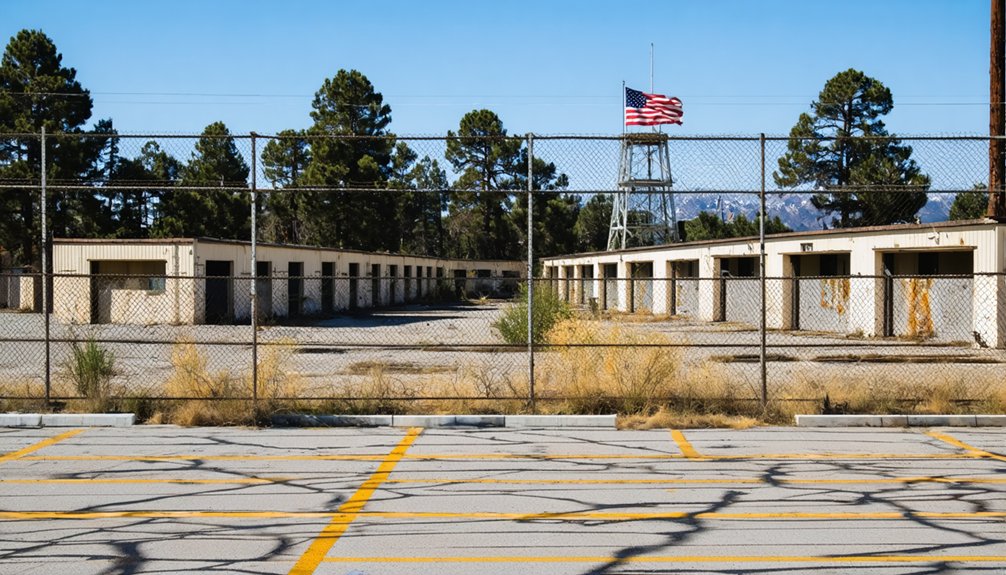
When Alessandro Flying Training Field emerged from California farmland in 1918, few could have predicted its eventual metamorphosis from a bustling military powerhouse to the scaled-down operation we see today.
This airfield evolution spans over a century—from rapid 60-day construction during WWI to becoming a strategic Cold War asset hosting America’s first operational jet fighters and later B-52 bombers.
At its peak, March AFB sprawled across 6,500 acres with thousands of personnel supporting crucial national defense missions. The base continues to maintain its heritage through biennial air shows that attract over 150,000 visitors.
The 1993 BRAC recommendations triggered the reserve shift, dramatically reducing March’s footprint by 4,400 acres and cutting thousands of jobs. The economic impact was severe, with the region losing more than 10,000 military and civilian positions following the base’s conversion to March Air Reserve Base in 1996.
America’s Most Haunted Military Installations: Fort Leavenworth and Beyond
While March Air Force Base represents the physical diminishment of military presence, another dimension of abandoned military installations exists in the sphere of the supernatural.
Fort Leavenworth stands as America’s most haunted military installation, with its haunted history dating back to 1827.
You’ll find 36 documented haunted buildings, including The Rookery—Kansas’s most notorious paranormal hotspot. The Lady in White claws at residents, while Major Ogden’s spurred boots echo through hallways he’s patrolled since 1855.
Building 65’s elevator shaft, where 14 German POWs met their end, emanates phantom screams that have driven guards to refuse solitary night patrols.
Spectral sightings across the grounds include Civil War soldiers drifting across parade grounds and ghostly prisoners dragging chains through former cell blocks.
The Frontier Army Museum acknowledges these phenomena through annual walking tours. The ghost of Catherine Rich, who died of pneumonia while searching for her lost children, is frequently spotted wandering through the National Cemetery calling for Ethan and Mary. Visitors regularly report encountering disembodied voices and unexplained footsteps throughout the Disciplinary Barracks.
The Silent Remains: Exploring Abandoned Military Complexes Across the Nation
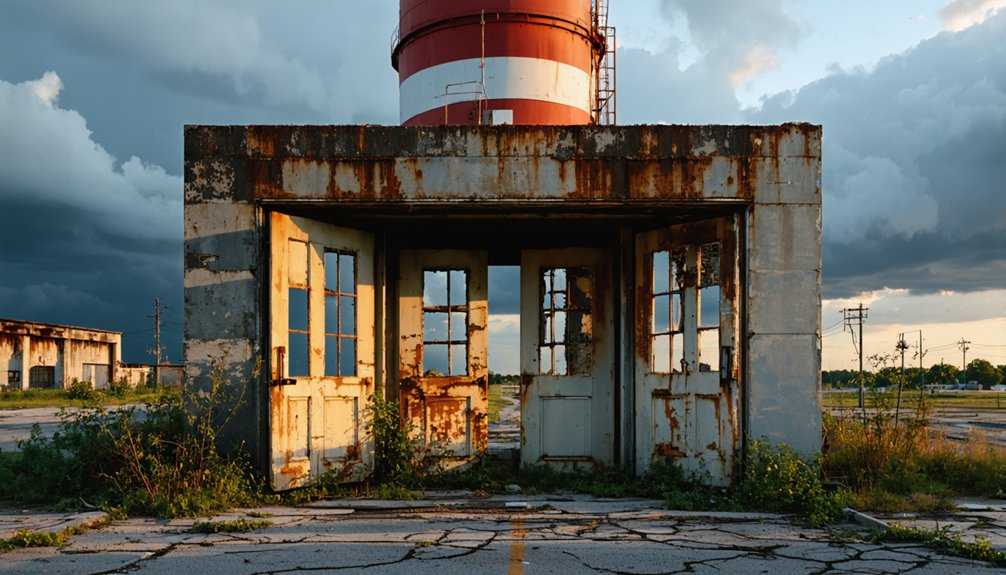
You’ll find America’s abandoned military complexes gradually reclaimed by nature, with once-bustling Fort Ord in California and the pyramid-like Nekoma Missile Base in North Dakota now standing as eerie time capsules.
These silent structures preserve hazardous histories of war preparation, from the $6 billion Cold War complexes operational for mere days to subterranean bases now hidden beneath Greenland’s ice sheet. Devils Slide Bunker in San Mateo County once served as a critical defense point for monitoring potential Japanese attacks on San Francisco harbor. The Port of Whittier in Alaska served as a crucial military installation during World War II before being largely abandoned.
Your exploration of these forgotten facilities might reveal more than architectural remains, as numerous personnel have documented unexplained phenomena, from spectral figures patrolling Bannerman Castle to mysterious sounds echoing through the flooded tunnels of decommissioned missile silos.
Remnants Reclaimed By Nature
Across the forgotten landscapes of America’s military past, nature wages a relentless campaign of reclamation, transforming once-bustling bases into hauntingly beautiful ruins.
At Fort Miley in San Francisco, you’ll witness trees erupting through concrete surfaces, while Cape May’s bunkers slowly disappear beneath advancing sand dunes. These architectural remnants—once symbols of military might—now surrender to nature’s reclamation in a profound display of temporal impermanence.
- Concrete gun batteries become unlikely habitats, with wildlife creating microecosystems within crumbling walls.
- Pine needles and brush accumulate over decades, turning hardened fortifications into woodland environments.
- Remote locations like Kalama Atoll flourish undisturbed, their military scars gradually healing beneath verdant growth.
The freedom these spaces now embody—wild, untamed, and unregulated—speaks to the inevitable return to natural order. Fort Miley’s transition from active military fort to recreational area over the past several decades perfectly exemplifies this natural progression.
Fort Jefferson’s striking contrast between its rugged brick exterior and the turquoise Gulf waters creates a visual testament to the intersection of human engineering and natural beauty.
Hazardous Histories Preserved
Beneath the serene veneer of nature’s reclamation lies a darker reality at America’s abandoned military installations. As you explore these forgotten bases, you’re walking through invisible hazards—legacies of decades of military activity.
The EPA has identified over 500 former sites requiring environmental remediation due to contamination from fuels, solvents, and munitions. Places like Fort Ord in California have earned Superfund designation because of extensive groundwater contamination. Cleanup efforts cost billions and span decades.
What you can’t see might hurt you: asbestos in crumbling buildings, lead paint flaking from walls, and unexploded ordnance hidden beneath overgrowth. Former personnel at facilities like Fort McClellan continue to report health issues from chemical exposure during their service years. Visitors to these sites often report experiencing cold spots similar to those documented by guards at Fort Monroe, where paranormal activity has been extensively reported.
These hazardous materials represent America’s complex military past—preserved in soil, water, and infrastructure. The environmental impact extends beyond base perimeters, affecting nearby communities and ecosystems long after operations ceased.
Ghostly Encounters Documented
Whispered tales of spectral encounters haunt the decaying infrastructure of America’s abandoned military installations, where decades of human drama have seemingly imprinted themselves upon brick, concrete, and soil.
You’ll find documented haunted encounters across these sites, from Fort Leavenworth’s phantom footsteps to Fort Monroe’s sorrowful apparition of Jefferson Davis with rattling chains.
Among these eerie locations, there are also tales of abandoned mines near Nevada that add to the ghostly lore of the region. Miners who lost their lives in accidents are said to still wander the tunnels, searching for their lost treasures. Visitors often report strange sounds and feelings of being watched as they explore these forsaken sites.
- At Fort Mifflin, visitors consistently report the “Faceless Man” and the chilling cries of the “Screaming Woman” echoing through Revolutionary War-era walls.
- March Air Reserve Base’s abandoned corridors amplify unexplained screams and rolling hospital gurneys, suggesting spirits trapped in time.
- The historic Rookery at Fort Leavenworth hosts multiple spectral sightings, including a Lady in White and a whistling child named Rose.
Tactical Ghost Towns: How the Military Uses Mock Villages for Combat Training
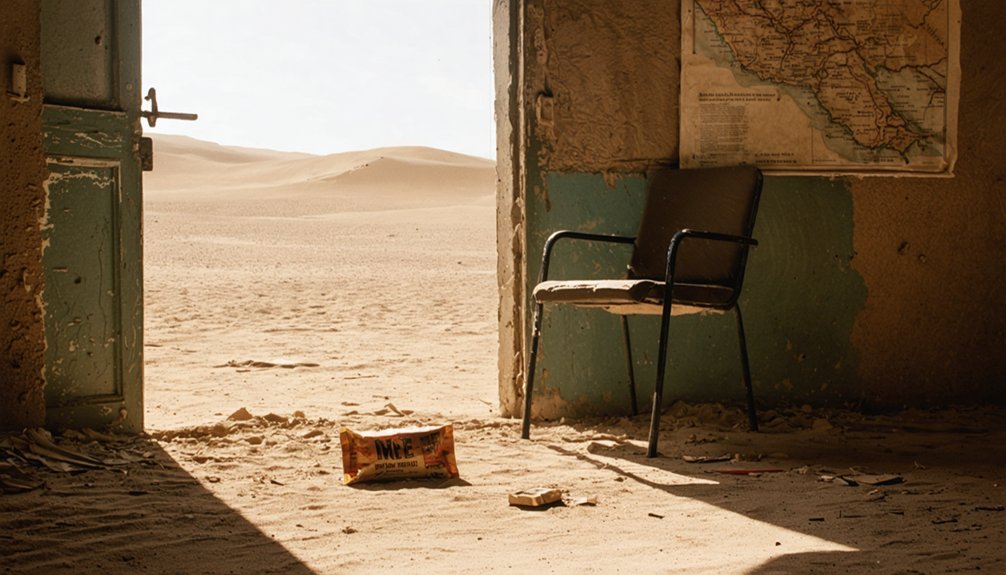
When you explore the tactical ghost towns constructed across major U.S. military bases, you’ll encounter intricate mock villages containing up to 585 buildings designed to simulate Middle Eastern urban environments and other foreign locales.
These battlefield reality cities feature dismantlable structures made from stacked intermodal containers, complete with religious sites, traffic circles, and shops where role-players create dynamic, unpredictable scenarios to prepare troops for urban combat.
The specialized training infrastructure at Fort Irwin, Fort Bragg, and Twentynine Palms offers soldiers realistic environments to practice Military Operations in Urban Terrain before deployment to conflict zones.
Battlefield Reality Cities
Across vast stretches of U.S. military installations, realistic ghost towns have emerged as critical training grounds where soldiers prepare for the complexities of modern urban warfare.
These battlefield simulations span thousands of acres, featuring cinderblock structures, market areas, and architectural elements that mimic war-torn environments from Middle Eastern villages to collapsed American suburbs.
You’ll find these tactical facilities populated by role players—often immigrants, military spouses, and veterans—who create authentic cultural interactions while unpredictably simulating protests, ambushes, and civilian behaviors.
Sensors record simulated combat hits, providing immediate feedback on performance during urban warfare scenarios.
- Structures include realistic details like graffiti, rusted vehicles, and defunct infrastructure
- Training focuses on room clearing, IED response, and civilian negotiations
- Historical evolution spans from Vietnam-era “Tigerland” to modern MOUT facilities
Simulated Foreign Environments
While physical battlefield replicas offer immersive training experiences, the military has significantly expanded its capabilities through sophisticated virtual simulations of foreign environments.
You’ll find the Army has developed detailed virtual versions of North Korea, South Korea, and major American cities like San Francisco and Las Vegas.
These simulated landscapes allow troops to train in specific combat zones without physical deployment. Within days, commanders can generate three-dimensional terrains of any global location using satellite imagery and AI rendering.
The system replicates diverse environments from Afghan mountains to Iraqi urban centers with customizable weather conditions.
Virtual training now enables joint operations involving up to 75,000 troops simultaneously across networks, regardless of their actual locations.
This technology dramatically reduces operational costs while maintaining realistic combat preparation across individual and collective training levels.
Dismantlable Urban Infrastructure
Beyond the virtual simulations, the military has established elaborate dismantlable urban infrastructures—tactical ghost towns that serve as physical training grounds for modern combat scenarios.
These extensive facilities feature modular design principles, allowing commanders to reconfigure entire city blocks to match current warfare theaters.
The tactical realism achieved in these environments is striking—from functioning doorways to staged market squares, complete with role-playing civilians and improvised threats.
What began as simple plywood structures has evolved into sophisticated training grounds spanning thousands of acres across diverse terrains.
- Structures include cinderblock buildings, simulated IEDs, and sniper positions for immersive combat scenarios
- Entire mock towns can be dismantled and rebuilt to reflect different conflict zones
- Role-players from relevant regions add cultural authenticity to training interactions
Environmental Legacy and Remediation Challenges in Former Military Sites
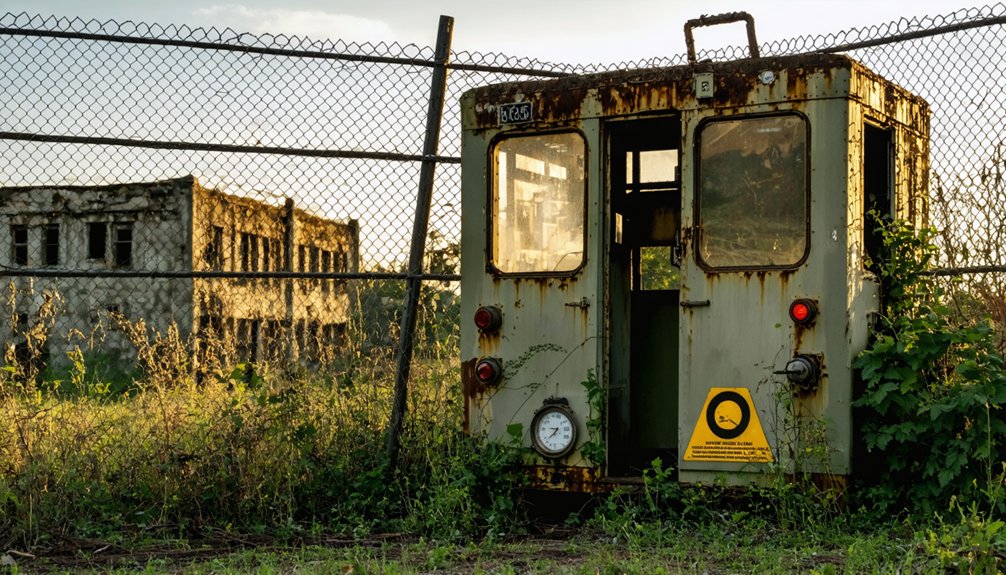
Former military installations have left behind a toxic environmental legacy that continues to threaten public health and ecological systems long after operations have ceased.
You’re living with the consequences of over 700 military sites contaminated with PFAS chemicals, where groundwater levels sometimes exceed 170,000 ppt—thousands of times above safe limits.
When you investigate these ghost bases, you’ll find a disturbing reality: nearly 3,000 private wells near these sites exceed drinking water standards, with some reaching 10,000 ppt of combined PFOS and PFOA.
The environmental remediation challenges are staggering—unexploded ordnance, chemical warfare residues, and heavy metals complicate cleanup efforts estimated between $8-35 billion.
The DoD’s conflicting priorities between operational readiness and environmental protection mean your communities near these abandoned sites continue bearing the burden of these persistent “forever chemicals.”
Overseas Military Ghosts: Abandoned Bases and Their Lingering Stories
The shadows of America’s military presence extend far beyond domestic contamination sites, reaching across oceans to forgotten installations that stand as silent witnesses to geopolitical shifts.
From Arctic outposts to Pacific atolls, America’s forgotten military footprints mark the landscape with rusting monuments to superpower strategy.
These abandoned secrets tell tales of Cold War tension and abrupt departures, leaving behind underground bunkers, equipment, and hazardous materials frozen in time. You’ll find places like Thule Air Base in Greenland, where military hardware remains preserved in Arctic conditions.
- Secretive underground complexes house untold stories of nuclear missile storage and espionage operations
- Abandoned barracks and training grounds have transformed into eerie ghost towns, spawning military folklore about hauntings
- Environmental hazards persist decades after closure, creating complicated legacies for local communities
These overseas military ghosts represent more than abandoned infrastructure—they’re archaeological time capsules of American strategic presence and the sudden geopolitical changes that rendered them obsolete.
From Desolation to Development: Success Stories in Military Base Conversion
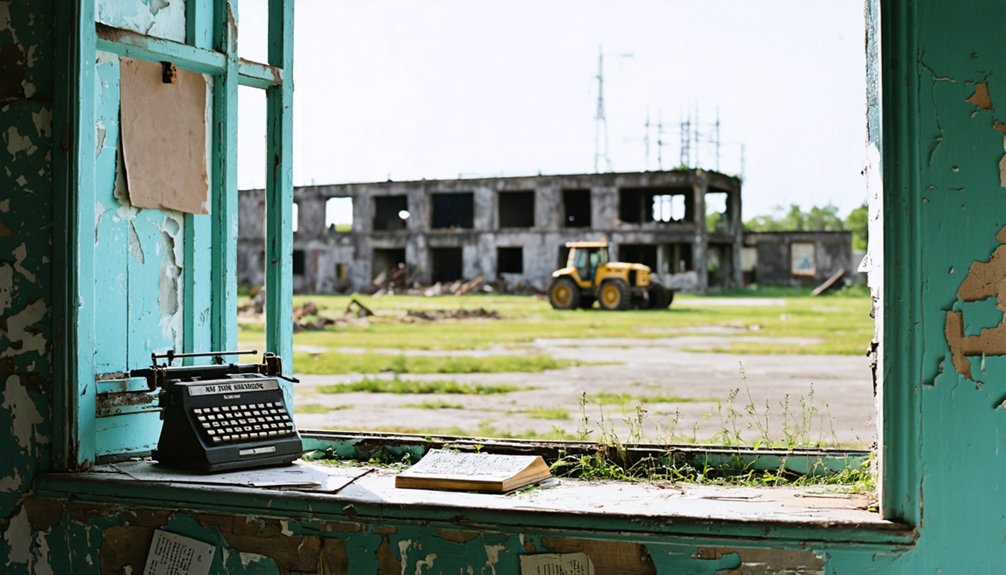
While many decommissioned military installations languish as toxic ghost towns, remarkable transformation stories have emerged across America’s landscape of abandoned bases.
Brooks City-Base exemplifies successful base redevelopment, where property values soared from $36.8 million to $617 million, generating a regional economic impact exceeding $1.5 billion.
The secret to economic revitalization lies in collaborative planning. Communities that held extensive public meetings—like Orlando’s Naval Training Center with over 170 gatherings—achieved sustainable changes.
Federal support through EDA grants and public benefit conveyances enabled diverse reuse opportunities.
The most successful conversions embrace mixed-use development. Devens retained 2,000 defense jobs while creating 1,700 new positions.
Brooks now hosts bioscience and renewable energy businesses. These transformations represent freedom from dependency on military spending, demonstrating how community vision can resurrect abandoned spaces into thriving economic centers.
Preserving Military History: The Cultural Significance of Base Ghost Towns
Beneath the crumbling façades and overgrown parade grounds of America’s military ghost towns lies an irreplaceable cultural heritage that transcends their operational significance.
When you explore these abandoned sites, you’re walking through living museums where ghost stories and military folklore connect generations of service members through shared experiences.
- Fort Monroe’s shift to national monument status preserves not just structures but the narratives of Lincoln sightings and Davis’ imprisonment.
- Military family oral traditions keep base ghost stories alive, creating continuity between past and present defenders.
- Paranormal tourism at places like Fort Mifflin has revitalized interest in Revolutionary and Civil War history.
These abandoned installations represent our national security evolution while providing economic opportunities through historical tourism.
Each haunted barracks and decommissioned bunker holds memories that would otherwise vanish into historical obscurity.
Frequently Asked Questions
How Do Civilians Legally Access Abandoned Military Facilities?
You’ll need permission from commanding authorities to gain civilian access. Contact the property custodian, submit formal requests, and strictly respect legal restrictions governing these federally controlled properties.
Can Paranormal Investigators Obtain Special Permissions for Ghost Hunting?
Like whispers in abandoned hallways, you’ll find paranormal permissions for ghost hunting nearly impossible to obtain through official channels. You’d need sponsorship from public affairs offices or commanding officers—rare exceptions exist through museum programs.
What Happens to Classified Materials Left in Abandoned Bases?
Classified materials left behind risk unauthorized exposure. You’ll find declassification processes weren’t followed properly, as standard classified document disposal requires destruction. Environmental factors can further compromise these forgotten secrets, creating national security vulnerabilities.
Do Military Personnel Report More Paranormal Experiences Than Civilians?
You’ll find military personnel report astronomically more paranormal experiences than civilians. Your hypervigilance in military culture, exposure to traumatic events, and time in historically charged locations heightens your sensitivity to unexplained phenomena.
How Are Unexploded Ordnance and Munitions Handled in Ghost Bases?
You’ll find that unexploded ordnance in abandoned bases undergoes rigorous munitions disposal by EOD professionals following strict safety protocols, often involving controlled detonations and thorough mapping to prevent accidental explosions.
References
- https://oldcc.gov/news/march-air-force-bases-downsizing-created-ghost-town-heres-whats-there-now
- https://www.military.com/feature/2025/10/25/haunted-military-sites-skeptics-guide-most-allegedly-haunted-military-sites.html
- https://soldiersangels.org/haunted-military-bases/
- https://doc.searls.com/2016/06/29/desert-warfare-training-in-live-ghost-towns-seen-from-the-sky/
- https://www.operationmilitarykids.org/abandoned-military-bases/
- https://www.youtube.com/watch?v=3d4bUMUUWxY
- https://www.wearethemighty.com/mighty-history/9-military-ghost-bases-youve-probably-never-heard-of/
- https://www.youtube.com/watch?v=MYe6MXx_3rE
- https://en.wikipedia.org/wiki/March_Air_Reserve_Base
- https://marchjpa.com/about/history-of-the-jpa/