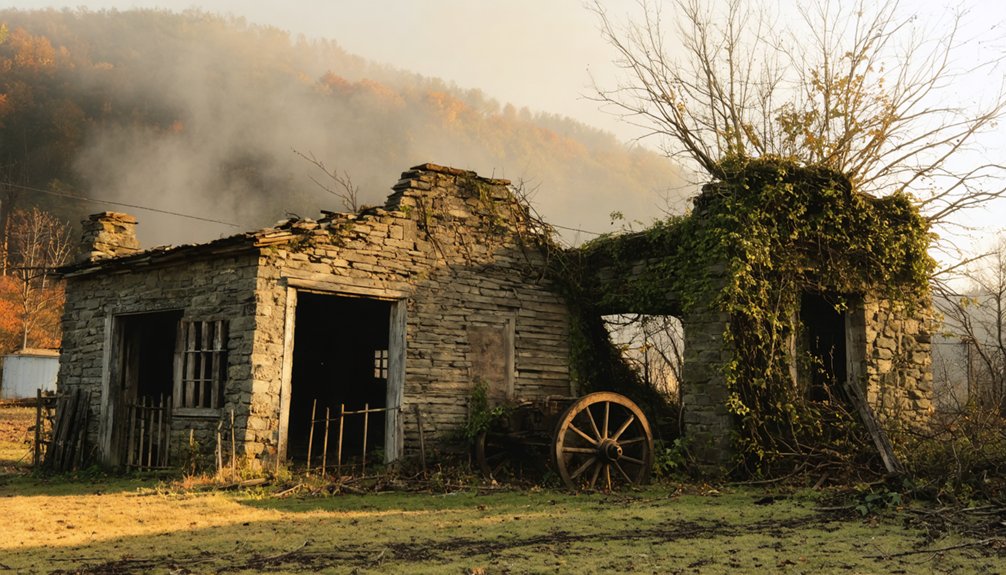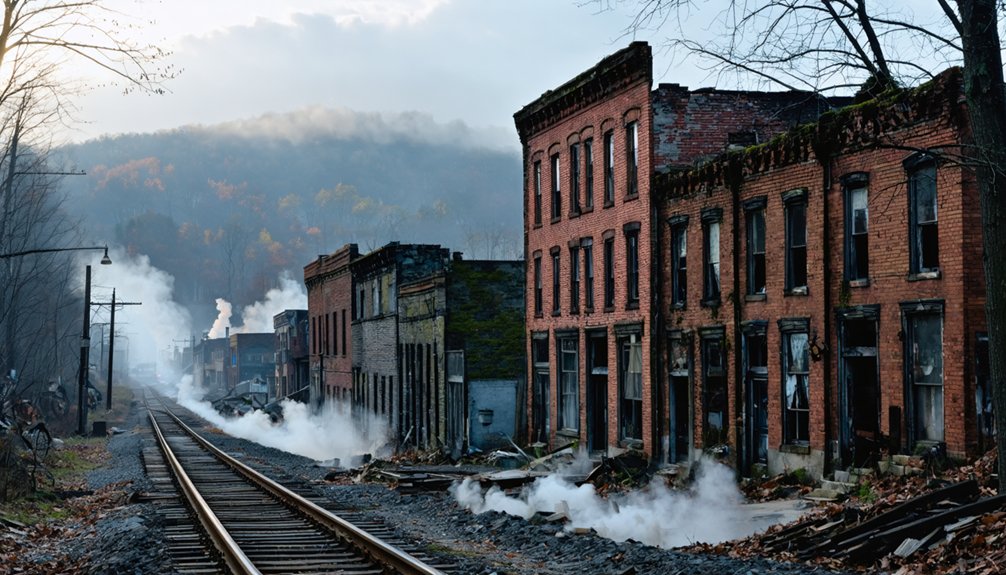
Civil War ghost towns emerged from strategic settlements that fell victim to post-war economic decline, disease outbreaks, and transportation shifts. You’ll find over 4,500 abandoned communities nationwide, with Texas hosting 550 alone. These sites employ “arrested decay” preservation techniques to maintain their architectural remnants as three-dimensional historical documents. Notable examples include Cahawba, Alabama and Batsto Village, New Jersey—each telling unique stories through their weathered facades that reveal more than written records ever could.
Key Takeaways
- Civil War ghost towns emerged from strategic locations that declined after losing economic significance, transportation routes, and due to failed Reconstruction efforts.
- Over 4,500 ghost towns exist nationwide, with their systematic collapse revealing patterns tied to transportation changes, resource depletion, and economic shifts.
- “Arrested decay” preservation techniques allow these historical sites to maintain authenticity while addressing conservation challenges like invasive species management.
- Abandoned settlements like Cahawba (Alabama) and Batsto Village (New Jersey) offer unique glimpses into Civil War history beyond written records.
- These ghost towns serve as three-dimensional historical documents that reflect wartime social hierarchies, military strategies, and post-war economic devastation.
Shadows of the Battlefield: Origins of Civil War Ghost Towns

While most Americans learn about the Civil War through accounts of famous battles and political upheaval, the conflict’s most haunting legacy may be found in the skeletal remains of once-thriving towns that vanished in its wake.
You’ll find these ghost towns often began as prosperous centers strategically positioned at river confluences or commercial hubs—like Cahawba, Alabama, once a state capital. At the confluence of the Alabama and Cahaba Rivers, Old Cahawba showcases the abandoned structures and landscapes that represent our nation’s complex history.
Military strategies transformed many into prisoner-of-war camps where disease flourished amid overcrowding. The war’s physical destruction, coupled with natural disasters like flooding, devastated infrastructure and displaced residents.
Towns transformed by war became breeding grounds for disease, while battles and floods erased what artillery spared.
Post-war economic decline struck swiftly as towns lost political significance or became bypassed by new transportation routes. These settlements exemplify what T. Lindsey Baker described as places where the reason for being no longer exists.
Failed Reconstruction efforts accelerated abandonment, with buildings dismantled for materials and populations relocating to more viable locations, leaving only shadows where communities once flourished.
Abandoned Frontiers: Mapping America’s Civil War Ghost Towns
The physical scars of the Civil War remain etched across America’s landscape in thousands of abandoned settlements that once buzzled with life and commerce.
You’ll find over 4,500 ghost towns scattered nationwide, with Texas leading at approximately 550 abandoned communities, many clustered in counties like Wilson, Guadalupe, and Bexar.
These forgotten frontiers form dense geographic patterns, challenging urban legends about isolated failures. Instead, they reveal systematic collapse across regions following the war.
When mapping these settlements, you’ll notice how transportation changes—particularly railroad disruptions during Confederate requisitions—accelerated their demise.
Despite frontier myths romanticizing their abandonment, most towns succumbed to practical factors: rerouted highways, environmental catastrophes, and economic shifts. Awareness of your surroundings is crucial when exploring these historically significant but potentially hazardous sites. These ghost towns vary in status from barren to submerged, each classification telling its own story of decline.
As you venture through abandoned towns in the Appalachian Mountains, you’ll encounter remnants of structures that once buzzed with life, now silent witnesses to the past. Each location offers a glimpse into the realities faced by their former residents, reflecting both the resilience and vulnerability of these communities. Exploring these landscapes provides an opportunity to appreciate the rich history embedded in the mountains, inviting reflection on the forces that shaped their fate.
Their overlapping distribution patterns tell a story of rapid development followed by equally swift decline as America’s postwar landscape transformed.
The Rise and Fall: Economic Forces Behind Ghost Town Formation
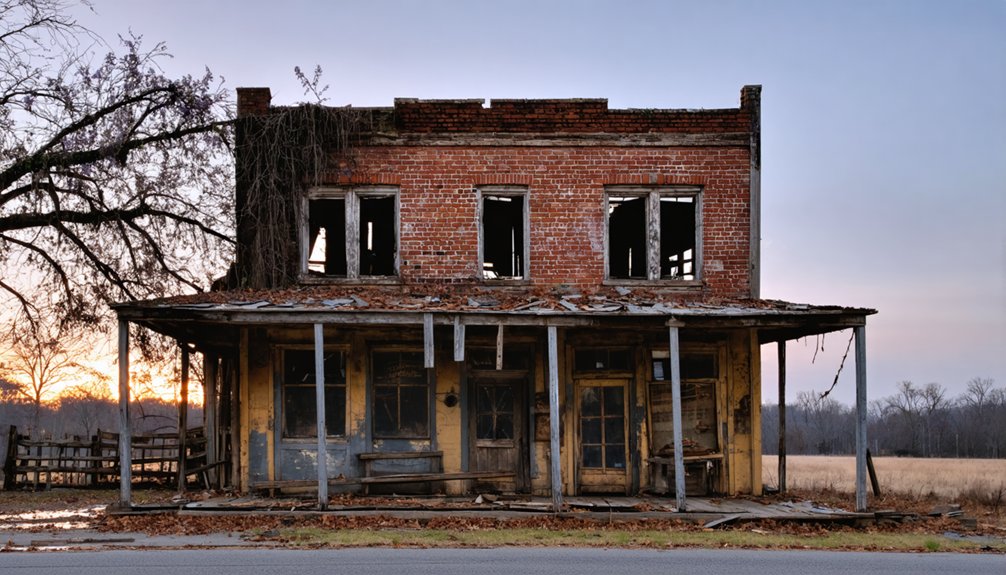
You’ll observe similar economic forces driving the formation of Civil War ghost towns as those that shaped America’s wider frontier decline.
The boom-bust cycles of mining settlements around strategic wartime resources collapsed when deposits depleted or Confederate defeat rendered certain industries obsolete.
Towns bypassed by post-war railroad development faced catastrophic economic isolation, while communities in heavily contested territories experienced irreversible resource depletion that prevented economic recovery. Many settlements suffered from the Panic of 1857 that triggered widespread economic uncertainty across Hennepin County and beyond. These abandoned settlements often become tourist attractions due to their historical significance and the nostalgic atmosphere they evoke.
Boom-Bust Mining Cycles
Beneath the ruins of Civil War-era ghost towns lies a complex economic story driven by boom-bust mining cycles that transformed vibrant communities into abandoned settlements.
These cyclical patterns of mining volatility undermined economic resilience, leaving once-thriving populations vulnerable to eventual collapse.
When you examine these historical economic patterns, four consistent phases emerge:
- Discovery phase – Rapid population influx and capital investment following mineral discovery
- Boom period – Employment spikes with 5-10% annual earnings growth and infrastructure expansion
- Peak production – Shift toward mechanization and contractor labor with diminishing returns
- Bust cycle – Precipitous 25%+ earnings decline leading to worker exodus and community abandonment
The destabilizing effects of these cycles reveal how dependent communities became on singular resource extraction, ultimately sacrificing long-term stability for short-term prosperity. Many of these mining regions operated as mono-industrial economies, making them especially vulnerable when mineral prices fluctuated on international markets.
Railroad Abandonment Impact
While the mining boom-bust cycle drove many communities into ghost town status, railroad abandonment emerged as an equally devastating economic force that systematically dismantled rural America’s commercial infrastructure throughout the twentieth century.
You can trace this railroad decline across rural regions where nearly 40% of U.S. track miles disappeared, accelerating dramatically after deregulation policies allowed companies to prioritize profitability over community service.
The community impact was catastrophic—direct economic losses reached $1 million annually in affected counties, while population decreased 22% between 1980-1995. Research shows that the Staggers Act of 1980 fundamentally altered how railroad companies could abandon unprofitable lines, leaving rural communities with limited recourse. Railroad consolidation led to the closure of local grain elevators, which diminished casual business interactions and further weakened small town economies.
When rail service vanished, highway infrastructure deteriorated under increased truck traffic, costing states millions in repairs. For farmers, shipping costs rose $0.056 per bushel, collectively resulting in multi-million dollar regional income losses.
These economic wounds triggered selective out-migration, leaving vulnerable towns with populations under 200 people facing extinction.
War-Depleted Resources
When the Civil War swept through America’s heartland, it systematically depleted critical resources that many towns relied on for their very existence, creating economic voids from which communities simply couldn’t recover.
Poor resource management during wartime accelerated the decline of once-thriving settlements, revealing how community resilience faltered under extreme economic pressure.
- Mining operations collapsed when laborers fled depleted sites, triggering exodus of supporting businesses and services.
- Agricultural lands suffered physical exhaustion from wartime disruptions, destroying long-term viability.
- Capital reserves evaporated amid inflation, preventing investment in alternative industries.
- Human resources diminished through casualties and migration, leaving insufficient workforce for economic recovery.
The war’s $3 billion economic drain, combined with sudden shifts in industrial demand, transformed bustling communities into abandoned landscapes nearly overnight. Southern communities were particularly devastated as Union blockades prevented crucial supplies from reaching struggling towns, severing economic lifelines.
Forgotten Architecture: Preserving Civil War Era Structures

You’ll notice that Civil War ghost towns employ unique architectural survival techniques, including “arrested decay” preservation at sites like Bodie and structural reinforcement at Fort Jefferson, where original features coexist with conservation interventions.
The physical remains—from crumbling courthouse foundations in Cahawba to the intact storefronts of St. Elmo—function as three-dimensional historical documents, communicating social hierarchies, economic priorities, and military strategies through their spatial arrangements and construction methods.
These architectural fragments require specialized preservation strategies that balance historical authenticity against environmental deterioration factors, creating a delicate equilibrium between allowing natural aging processes and preventing complete structural collapse.
Architectural Survival Techniques
Throughout the tumultuous years of the Civil War, a variety of architectural survival techniques emerged that have allowed numerous structures to withstand the ravages of time.
These earthwork techniques and preservation methods represent ingenuity born of necessity and strategic military planning.
- Adaptive fortification – Soldiers utilized local materials like soil, timber, and stone to construct defensive earthworks, maximizing protection while adapting to regional topography.
- Strategic redigging – Sites like Yorktown benefited from careful reconstruction efforts by the Civilian Conservation Corps in the 1930s, preserving original engineering designs.
- Functional repurposing – Civil War structures gained extended lifespans through conversion to civilian uses, incorporating existing features into new construction.
- Community preservation – Modern protection frameworks, including the National Historic Preservation Act, now safeguard these structures through collaborative efforts and minimal intervention approaches.
Ruins Tell Stories
Abandoned by time yet preserved through resilient materials, Civil War-era structures stand as silent witnesses to America’s most divisive conflict. Their weathered facades and crumbling walls tell stories that transcend written records. When you examine these ruins narratives, you’ll discover physical evidence of warfare—bullet holes piercing brick walls, soldiers’ graffiti etched into plaster—connecting you directly to those who lived through the turmoil.
Historical preservation efforts focus on these structures not merely as buildings but as three-dimensional historical documents. As you walk through abandoned homes with missing roofs or touch the weathered stones of a repurposed church, you’re engaging with the war’s human impact.
Though threatened by development and neglect, these sites remain irreplaceable cultural resources where the voices of soldiers, civilians, and enslaved people continue speaking through architectural remnants.
Walking Through History: Notable Civil War Ghost Towns Worth Exploring
The faded echoes of America’s most devastating conflict reverberate through the silent streets of Civil War ghost towns, where history’s footprints remain remarkably preserved despite the passage of time.
These abandoned settlements offer you unparalleled ghostly encounters and historical significance as you traverse their weathered remains.
- Cahawba, Alabama – Walk among ruins of the former state capital where Union soldiers were once imprisoned, now surrendered to the encroaching wilderness.
- Batsto Village, New Jersey – Explore intact ironworks that supplied Revolutionary War materials before Confederate requisition of its railroad.
- Bodie, California – Witness the frozen-in-time lawlessness of a gold rush town that boomed during Civil War westward expansion.
- St. Elmo, Colorado – Discover one of the best-preserved ghost towns with original structures that once supported critical wartime mining resources.
Echoes of the Past: Cultural Significance and Heritage Tourism

Civil War ghost towns transcend mere physical remnants of conflict to embody profound cultural significance as repositories of collective memory and identity.
When you visit these preserved historical landscapes, you’re engaging with layered heritage narratives that illuminate both the devastation of war and remarkable cultural resilience.
These sites function as immersive educational environments where guided tours, museums, and interpretive displays facilitate deeper cultural reflection about conflict’s consequences.
Through battlefield reenactments and living history demonstrations, you’ll experience multi-dimensional perspectives on complex historical events.
The preservation of these ghost towns supports local economies through heritage tourism while funding ongoing conservation efforts.
As you explore these open-air monuments, you’re participating in a critical act of remembrance that honors those affected by war while simultaneously contributing to contemporary cultural identity formation and historical understanding.
Reclaiming History: Modern Conservation Challenges and Solutions
While confronting the multilayered challenges of preserving Civil War ghost towns, modern conservation efforts must delicately balance historical authenticity with ecological sustainability.
You’ll find preservationists employing techniques like “arrested decay” to maintain structures in stable yet historically authentic conditions while simultaneously addressing environmental contamination from past industrial activities.
Four critical aspects of modern ghost town conservation:
- Native vegetation restoration that enhances historical authenticity while supporting endangered species habitats
- Multi-agency partnerships enabling extensive resource allocation across large conservation areas
- Strategic management of invasive species to rehabilitate Civil War-era landscapes without damaging high-value wildlife habitats
- Integration of archaeological remains with natural elements to create authentic interpretive experiences that respect environmental sustainability
These approaches represent the complex intersection of preservation science and ecological stewardship that defines contemporary ghost town conservation.
Frequently Asked Questions
Are Ghosts or Paranormal Activity Reported in Civil War Ghost Towns?
Yes, you’ll find abundant ghost sightings in Civil War ghost towns, with paranormal investigations documenting apparitions of soldiers, unexplained sounds, and equipment malfunctions—particularly in abandoned buildings that served as hospitals or prisons.
How Dangerous Is Exploring These Abandoned Towns Without Guided Tours?
You’re playing Russian roulette with your safety. Without proper urban exploration precautions, you’ll face structural collapses, hidden shafts, toxic contamination, wildlife, legal trespassing issues, and isolation from emergency services.
Can Metal Detectors Be Legally Used in Ghost Town Sites?
No, you can’t legally use metal detectors in most ghost towns without permits. Historical preservation laws and metal detecting regulations strictly prohibit this activity to protect cultural resources from damage and theft.
How Did Racial Segregation Impact the Layout of Civil War Towns?
You’ll find racial disparities deeply encoded in Civil War towns’ layouts through deliberate urban planning that used architectural segregation, physical barriers, and geographic boundaries to institutionalize racial hierarchies and control movement patterns.
What Personal Items Are Commonly Found in Civil War Ghost Towns?
From buttons to buckles, you’ll discover artifacts of personal significance in Civil War ghost towns: pocket mirrors, wooden toothbrushes, combs, canteens, coins, and dog tags—each offering historical significance through their discovery.
References
- https://devblog.batchgeo.com/ghost-towns/
- https://visitusaparks.com/top-ten-ghost-towns-in-america/
- https://www.christywanders.com/2024/08/top-ghost-towns-for-history-buffs.html
- https://www.mentalfloss.com/geography/american-ghost-towns-can-still-walk-through
- https://www.geotab.com/ghost-towns/
- https://ohioghosttowns.org/top-10-ghost-towns/
- https://www.loveexploring.com/gallerylist/188219/the-us-state-with-the-most-ghost-towns-revealed
- https://theforgottensouth.com/cahawba-alabama-ghost-town/
- https://en.wikipedia.org/wiki/Ghost_town
- https://www.battlefields.org/visit/heritage-sites/old-cahawba-archaeological-park