Several abandoned towns lie hidden in rainforests worldwide. You’ll find Velho Airão, Brazil’s 1694 rubber boom settlement now guarded by a single caretaker, and Fordlândia, Henry Ford’s failed $20 million Amazon experiment with deteriorating American-style houses. Archaeologists continue searching for the legendary Incan city of Paititi, while using LiDAR to uncover extensive pre-Columbian urban networks. These forgotten places reveal how nature rapidly reclaims human structures and the common patterns behind settlement collapse.
Key Takeaways
- Velho Airão in Brazil’s Amazon was founded in 1694 during the rubber boom but abandoned by 1985 after industry collapse.
- Fordlândia represents Henry Ford’s failed $20 million attempt to create an American industrial town in the Amazon rainforest.
- The ancient city of Paititi remains elusive, with expeditions searching the eastern Andes for this legendary gold-rich settlement.
- LiDAR scanning has revealed extensive ancient urban networks featuring pyramids, canals, and road systems throughout the Amazon.
- Mining ghost towns rapidly form and dissolve throughout rainforests as resources deplete, leaving environmental damage behind.
The Solitary Guardian of Velho Airão
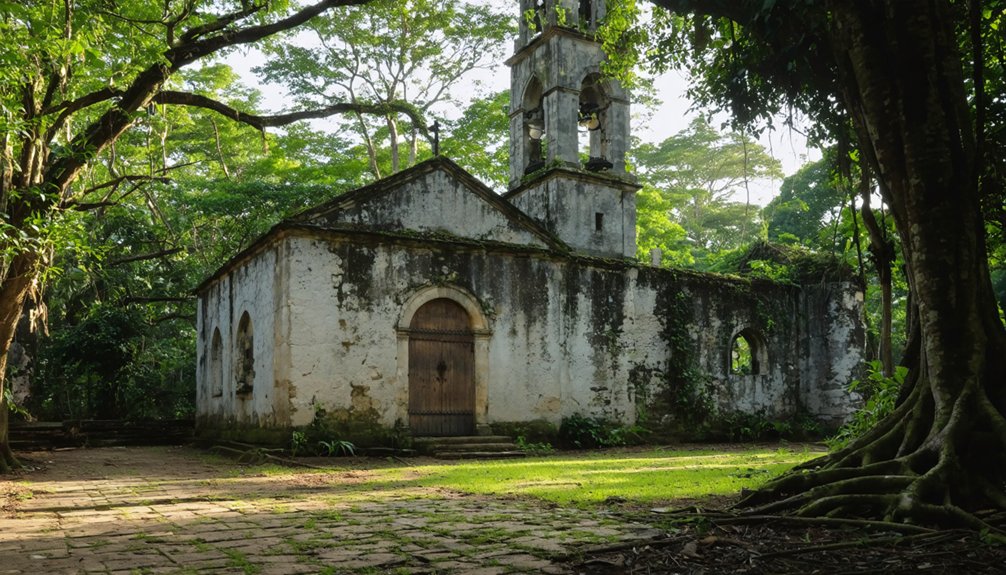
In the heart of Brazil’s Amazonian wilderness, Velho Airão stands as a tribute to the transient nature of human settlements. Once a prosperous rubber-boom town founded in 1694, this colonial outpost now lies largely reclaimed by the relentless jungle.
What makes Velho Airão truly remarkable is its solitary guardian—a lone resident who serves as both guide and keeper of the town’s historical significance. This sentinel watches over crumbling colonial structures that whisper stories of Portuguese missionaries, rubber barons, and eventual economic collapse. The town’s decline began rapidly after the collapse of the Amazonian rubber industry in 1945, leading to its near-total abandonment by 1985.
You’ll reach this ghost town via Novo Airão, located 2.5 hours from Manaus. As you explore the ruins declared a historic landmark in 2005, you’re witnessing the intersection of human ambition and nature’s patient reclamation—a poignant reminder of civilization’s impermanence in the face of environmental forces. Local tour companies offer boat trips through Anavilhanas that include visits to this fascinating abandoned village, providing context to the rubber boom’s dramatic rise and fall.
Fordlândia: Henry Ford’s Failed Jungle Utopia
If you visit Fordlândia today, you’ll find the ruins of Henry Ford’s ambitious $20 million attempt to transplant Midwestern American architecture and culture into the Brazilian rainforest.
The white clapboard houses, golf course, and industrial facilities—completely unsuited for the Amazonian climate—now stand deteriorated as nature steadily reclaims what Ford’s workers cleared and built between 1928 and the project’s abandonment.
These crumbling structures serve as physical reminders of how Ford’s utopian vision failed due to ecological ignorance, cultural insensitivity, and the fundamental incompatibility of his rigid industrial methods with the complex rainforest ecosystem. Ford’s original goal of producing 38,000 tons of latex annually fell devastatingly short, with only 750 tons ever harvested. The infamous Breaking Pans revolt of 1930 highlighted the deep resentment among local workers forced to adapt to American customs, culminating in riots that damaged much of the property.
American Midwest Transplanted
Three thousand miles from Detroit, deep in the Amazon rainforest, stood one of history’s most ambitious industrial experiments—Fordlândia.
Here, Ford transplanted not just a rubber plantation but an entire American industrial town, complete with Cape Cod-style houses utterly unsuited to the tropical climate.
You’d find familiar Midwestern comforts—golf courses, swimming pools, dance halls—all meant to recreate American life in the jungle.
This industrial ambition ignored local wisdom and environmental realities. Workers lived in houses with metal roofs that trapped heat while following rigid American work schedules and social customs.
The cultural friction was immediate and profound.
Despite offering double the standard wages, Ford couldn’t convince Brazilians to abandon their customs.
This tone-deaf approach culminated in the 1930 riot—a rejection of Ford’s attempt to forcibly transplant Midwest America into the Amazon.
The iconic 150-foot water tower, once the tallest Amazon structure, dominated the landscape as a symbol of Ford’s outsized ambitions.
Ford’s vision included breaking British rubber monopolies while creating modern infrastructure with schools and hospitals for the community.
Jungle Reclaims Infrastructure
While visitors today wander through Fordlândia’s ghostly remains, they’re witnessing nature’s methodical reclamation of Henry Ford’s failed utopia. The Amazon’s relentless growth has transformed once-modern jungle infrastructure into archaeological artifacts, with humid conditions accelerating decay.
You’ll find evidence of ecological failures throughout the site, where:
- Rusting industrial machinery stands frozen in time, overtaken by vegetation.
- Collapsed hospital buildings and administrative centers crumble further with each rainy season.
- Vine-covered Cape Cod-style homes—utterly unsuitable for the tropical climate—slowly disintegrate.
After $20 million invested (approximately $200 million today), Ford’s ambitious vision surrendered to natural forces.
The Brazilian government purchased the 2.5 million acres for merely $250,000 in 1945, leaving the remains as a reflection of humanity’s hubris when challenging the rainforest’s sovereignty. The primary factor behind Fordlândia’s agricultural disaster was Ford’s decision to plant rubber trees without consulting a botanist, leading to devastating pest infestations and diseases. The plantation workers eventually revolted against the American lifestyle restrictions, resulting in a violent riot over food service that represented the cultural clash inherent in the project.
The Elusive Gold City of Paititi
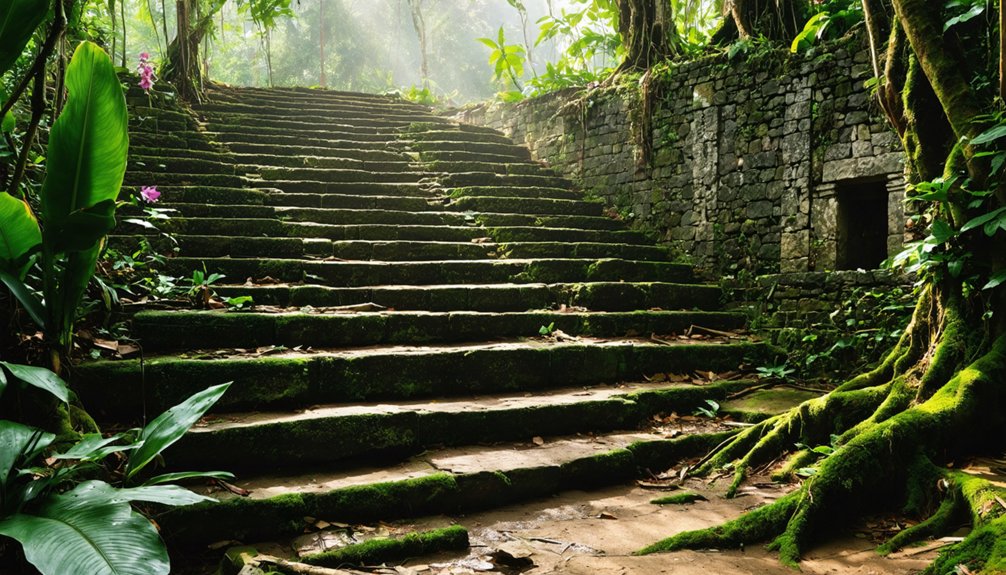
If you’re tracking the archaeological debates surrounding Paititi, you’ll find conflicting interpretations of satellite-identified structures like the Paratoari pyramids, which some experts classify as natural formations while others maintain they show human intervention.
The search trails left by numerous expeditions, from the ill-fated 1971 Nichols journey to Greg Deyermenjian’s systematic explorations, form a geographic network of hope and disappointment across the eastern Andean slopes. Discoveries of Inca ceramics at the Las Piedras site during the 2001-2003 Finnish-Bolivian expedition added intrigue to the ongoing search.
Modern archaeological techniques, including LiDAR and georadar surveys, now offer promising methods to distinguish between natural terrain features and potential Incan constructions beneath centuries of jungle growth. The recent documentation of Mameria’s ruins provides compelling evidence of Incan presence in the Amazon, strengthening the theory that Paititi may indeed exist nearby.
Archaeological Evidence Debates
The legend of Paititi, often referred to as El Dorado of the Andes, has captivated explorers and archaeologists for centuries through tantalizing fragments of evidence that neither conclusively prove nor disprove its existence.
Paititi legends persist largely due to Jesuit missionary accounts like Andres Lopez’s manuscript, rediscovered in 2001, describing an opulent jungle city.
The archaeological community remains divided on several key findings:
- Stone structures near Kimbiri that resemble Inca fortifications were later classified as natural formations.
- Pusharo petroglyphs interpreted as a “map” to Paititi remain controversial but compelling.
- Remote sensing technologies have identified anomalies that could represent undiscovered settlements.
You’ll find that modern geospatial analysis offers new possibilities for investigating these Inca mysteries, though conclusive evidence of Paititi continues to elude researchers.
Expedition Search Trails
Mapping the hunt for Paititi reveals a complex network of expedition trails that have crisscrossed the Amazonian rainforest for centuries, each following tantalizing clues toward the legendary gold city.
You’ll find the most significant routes concentrate along Peru-Brazil borderlands, where expedition logistics become nightmarishly complex. Thierry Jamin’s teams discovered stone carvings and geoglyphs that potentially serve as ancient navigation markers pointing toward Paititi’s location near Megantoni National Sanctuary.
Trail navigation remains perilous – you’re confronting dense jungle canopies that block satellite signals, treacherous mountain passes, and river systems that transform seasonally.
The 1979 Mameria discovery established essential baseline coordinates, but subsequent explorers have faced mosquito-borne diseases, equipment failure, and reportedly even digital sabotage that destroyed critical mapping data.
Indigenous territorial boundaries add another layer of complexity, requiring diplomatic negotiations before physical exploration can proceed.
Ancient Urban Networks Revealed by Modern Technology
Hidden beneath dense rainforest canopies, extensive ancient urban networks have recently emerged through revolutionary applications of modern technology. Airborne lidar scanning now penetrates jungle vegetation to reveal archaeological features invisible from ground level, transforming our understanding of pre-Columbian Amazon societies.
These ancient cities, once thought impossible in rainforest environments, featured sophisticated infrastructure including:
- Monumental architecture with conical pyramids exceeding 70 feet in height
- Complex water management systems with canals, reservoirs, and strategically placed embankments
- Extensive road networks connecting hierarchical settlements across miles of engineered landscape
The Casarabe Culture built urban centers spanning over a square mile with multiple defensive fortifications, while Chachapoya settlements flourished at elevations above 6,500 feet.
Archaeological technology continues revealing these lost civilizations, challenging European myths of “pristine” rainforests and demonstrating indigenous engineering mastery.
Ghost Towns of Extractive Industries in the Tropics
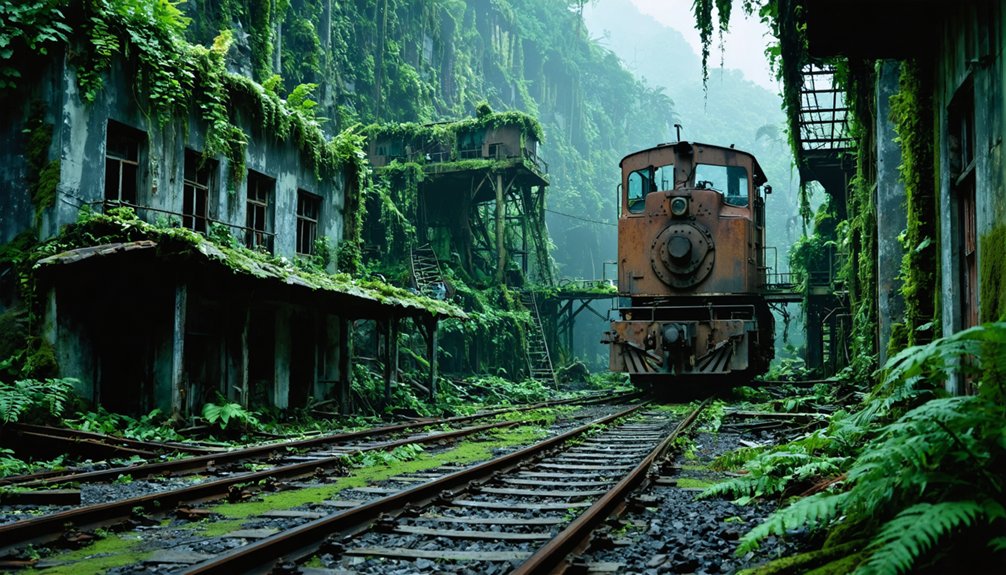
While ancient civilizations once built enduring urban networks within the rainforest, contemporary extractive industries have created their own distinct human settlements—ones destined for abandonment.
You’ll find these mining settlements scattered across Brazil, Indonesia, Ghana, and other tropical nations, where over 1.4 million hectares of forests have been sacrificed for mineral extraction.
Unlike their ancient predecessors, these boomtowns rapidly form and dissolve as resources deplete, leaving behind environmental consequences that persist for generations. The damage extends far beyond ghost towns themselves—up to 70 km beyond mining leases in the Brazilian Amazon.
Indigenous communities bear the heaviest burden, with 83% of Venezuela’s mining deforestation occurring on their ancestral lands.
The scars of these extractive industries—contaminated waterways, eroded landscapes, and fragmented ecosystems—remain long after the mining equipment falls silent.
When Nature Reclaims: The Process of Rainforest Succession
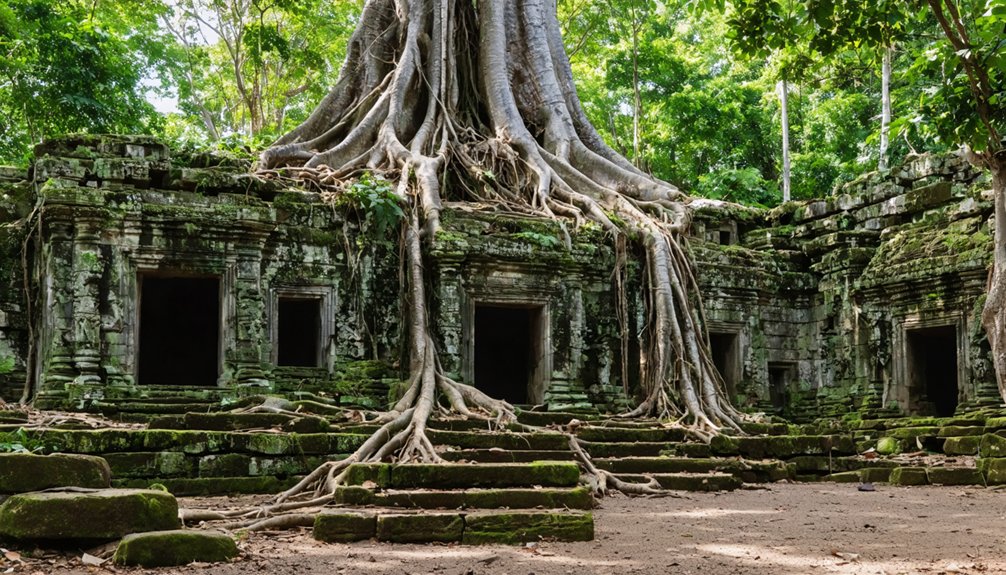
Nature’s resilience becomes evident in the stark contrast between human abandonment and ecological rebirth. When towns are forsaken in rainforest regions, secondary succession begins immediately, with pioneer species colonizing abandoned structures and cleared areas within months.
Nature reclaims what humans leave behind, launching ecological succession within months of abandonment in rainforest territories.
You’ll observe this reclamation process unfold in distinct phases:
- Fast-growing herbs and shrubs emerge through cracked concrete and between buildings.
- Early pioneer trees establish as roots penetrate foundations, accelerating structural collapse.
- Within 50-100 years, mature forest canopy develops, with only subtle remnants of human presence.
This shift from ghost town to thriving ecosystem demonstrates nature’s remarkable capacity to restore ecological balance. The process occurs faster in tropical regions due to abundant rainfall and warmth, though human-altered soils may influence which species dominate the restored landscape.
Hidden Histories: Lesser-Known Abandoned Settlements
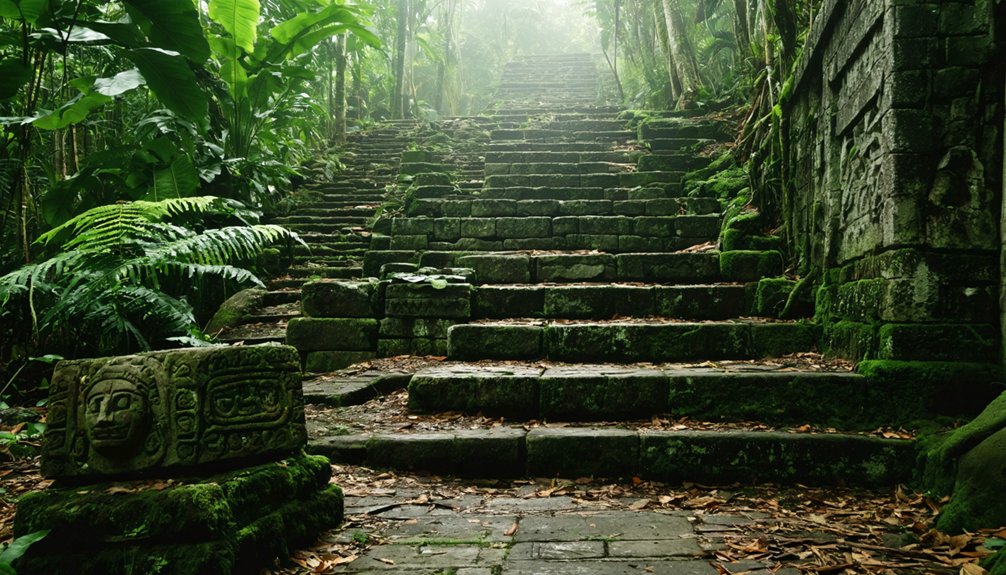
Beneath the dense canopy of tropical rainforests lie extraordinary abandoned settlements, their stories largely untold until recent technological advances revolutionized archaeological discovery.
You’ll find evidence of sophisticated hidden urbanism in the Casarabe civilization’s network of monumental structures connected by 600 miles of canals and raised causeways spanning the southwestern Amazon.
LiDAR technology has disclosed clock-face shaped villages with standardized layouts and well-maintained roadways that once thrived between 1300-1700.
The archaeological significance of these discoveries extends to the Upano Valley’s advanced hydraulic engineering systems spanning 60+ square miles, designed to manage annual flooding.
These settlements weren’t primitive outposts but complex urban centers with distinct neighborhoods, water management systems, and ceremonial structures—challenging long-held assumptions about pre-Columbian Amazon being an untouched wilderness.
The Mysteries of Ciudad Perdida
Deep in Colombia’s Sierra Nevada de Santa Marta mountains lies Ciudad Perdida, a mysterious pre-Columbian settlement that has captivated archaeologists since its rediscovery in the 1970s.
Nestled in Colombia’s mist-shrouded mountains, Ciudad Perdida remains one of archaeology’s most compelling enigmas.
This urban mystery flourished as the crown jewel of the Tayrona civilization from around 650 AD, predating Machu Picchu by approximately 650 years.
You’ll discover that Ciudad Perdida reveals sophisticated urban planning across its terrain:
- 170 stone terraces distributed through eight distinct sections
- Complex infrastructure including canals, pathways, and ceremonial spaces
- Capacity to support between 1,400-3,000 residents, with surrounding areas accommodating up to 8,000 people
The city thrived until Spanish conquest forced its abandonment, after which jungle reclaimed the site for four centuries—preserving one of South America’s most significant archaeological treasures until modern times.
Why Rainforest Settlements Fail: Patterns of Abandonment
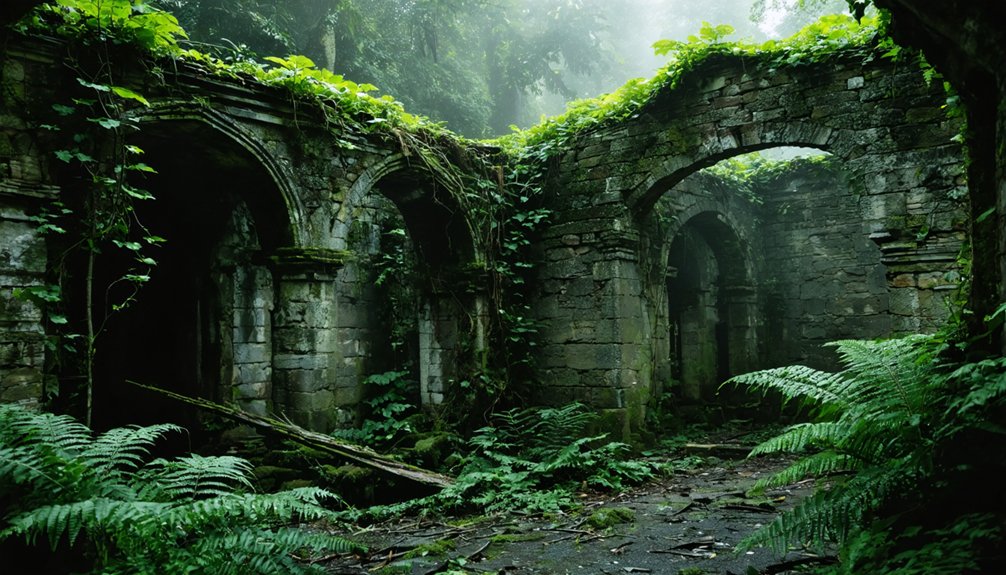
While flourishing rainforest settlements like Ciudad Perdida once supported thousands of inhabitants, the archeological record reveals consistent patterns of abandonment across tropical forest regions throughout history.
You’ll find both environmental and human factors driving settlement failure. Droughts, floods, and natural disasters trigger immediate abandonment, while gradual deforestation creates long-term vulnerability. Settlements located away from major waterways faced isolation and resource limitations that proved fatal to their sustainability.
Human activities accelerate this decline—agricultural intensification depletes soils, population growth strains resources, and social unrest disrupts communities.
The shift from small-scale to industrial deforestation has intensified environmental degradation, creating tipping points where ecosystem services collapse.
In regions like Mato Grosso and Pará, this pattern repeats: deforestation leads to soil exhaustion, altered water cycles, and ultimately, abandonment.
Frequently Asked Questions
Are Any Abandoned Rainforest Towns Safe for Overnight Exploration?
Like walking through a minefield at midnight, you’ll rarely find abandoned rainforest towns safe for overnight stays. They require extensive safety precautions, specialized overnight gear, and often violate trespassing laws.
Can Tourists Legally Collect Artifacts From These Abandoned Settlements?
No, you can’t legally collect artifacts. Such actions violate cultural heritage laws with serious legal implications. Artifact ownership remains with indigenous communities and governments, regardless of the site’s abandoned appearance.
Which Rainforest Ghost Towns Have Reported Paranormal Activities?
You’ll find paranormal sightings reported in Fordlândia, Velho Airão, and Paronella Park, where visitors describe ghostly encounters including shadow figures, unexplained sounds, and apparitions among jungle-reclaimed ruins and structures.
Exploring forgotten towns in Oregon can lead to equally eerie experiences, with tales of lost spirits roaming the remnants of abandoned buildings. As the mist rolls in, the stories of these once-thriving communities create an atmosphere that feels almost alive, inviting visitors to delve deeper into their histories. Each corner holds a mystery waiting to be uncovered, leaving travelers with a sense of wonder and curiosity.
How Do Indigenous Communities View These Abandoned Colonial Settlements?
Indigenous communities view these sites through complex cultural heritage lenses, often interpreting them as symbols of colonial trauma but also incorporating them into indigenous perspectives on resilience, sovereignty, and spiritual reclamation.
What Wildlife Dangers Exist When Visiting Abandoned Rainforest Towns?
Like a minefield of natural hazards, you’ll face lethal wildlife encounters including venomous snakes, disease-carrying mosquitoes, aggressive hippos, potentially deadly big cats, and toxic plants when exploring these forgotten settlements.
References
- https://www.rainforestcruises.com/guides/lost-cities-of-the-amazon
- https://www.youtube.com/watch?v=STsZWgXs5T4
- https://knycxjourneying.com/eerie-ghost-towns-around-the-world/
- https://en.wikipedia.org/wiki/List_of_ghost_towns_by_country
- https://www.youtube.com/watch?v=ePHWkMrjzBg
- https://www.atlasobscura.com/things-to-do/colombia/abandoned
- https://www.tripadvisor.com/Attractions-g294280-Activities-c47-t14-Brazil.html
- https://www.youtube.com/watch?v=w8GKk61ftAw
- https://danae-explore.com/en/guia-amazonia-manaus-novo-airao-anavilhanas/
- https://en.wikipedia.org/wiki/Velho_Airão