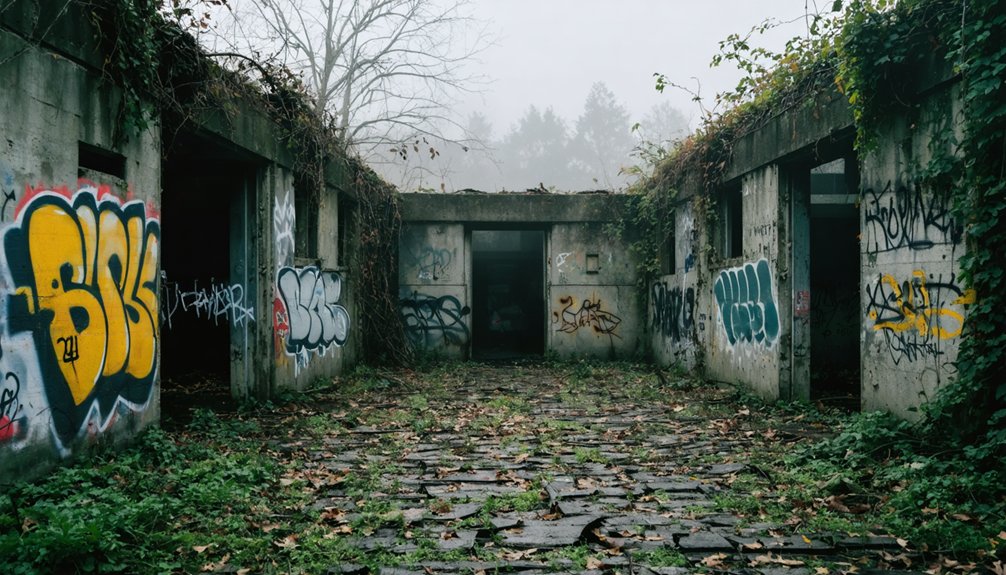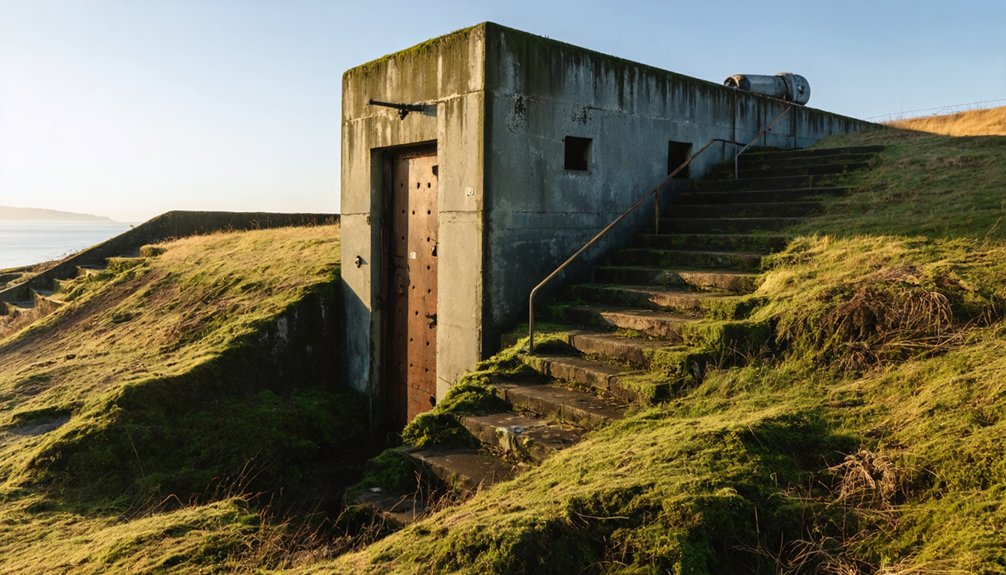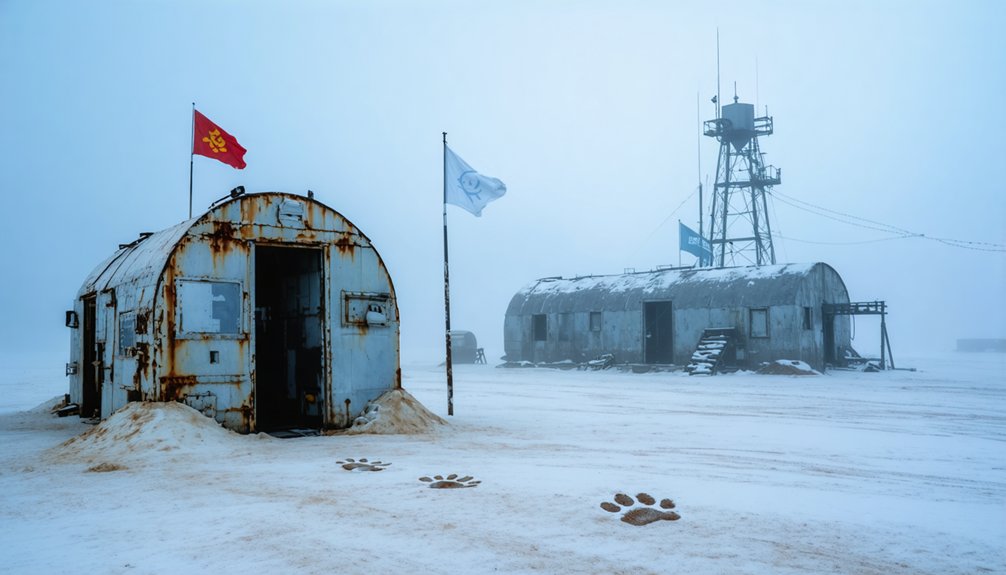
You’ll find hidden military ghost towns worldwide where Cold War strategies played out and were later abandoned. These include Greenland’s Camp Century (concealing Project Iceworm’s nuclear missile plans), Wisconsin’s repurposed Nike sites, South Africa’s Mariepskop radar outpost, Hungary’s numerous Soviet installations, and Yugoslavia’s massive Zeljava Air Base with its extensive tunnel network. The crumbling structures offer silent testimony to geopolitical tensions that once defined global security landscapes.
Key Takeaways
- Camp Century in Greenland was abandoned in 1966 and its nuclear waste may soon be exposed by climate change.
- Wisconsin’s Nike missile bases have been partially repurposed, with some military infrastructure still visible at former sites.
- Mariepskop Military Village in South Africa became a ghost town after 1994, leaving behind abandoned radar facilities.
- Hungary contains numerous “Soviet ghosts” including 60 army camps and 10 airbases abandoned after 1991.
- Yugoslavia’s Zeljava Air Base, deliberately demolished in 1991-1992, features an extensive tunnel network beneath Plješevica mountain.
The Buried Secrets of Camp Century in Greenland’s Ice Sheet
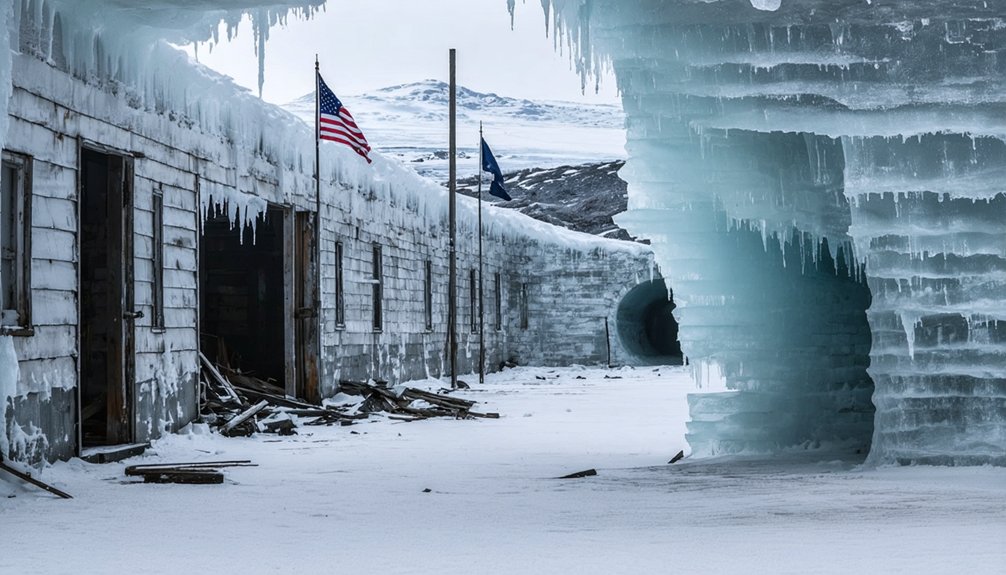
Deep beneath Greenland’s ice sheet, a remarkable Cold War relic remains frozen in time.
Built in 1959 by the Army Corps of Engineers, Camp Century represented cutting-edge Arctic construction techniques just 150 miles from Thule Air Base.
You might know it as a “city under ice” for scientific research, but its true purpose concealed Cold War secrets.
Camp Century served as proof-of-concept for Project Iceworm—a classified program to deploy 600 nuclear missiles within striking distance of the Soviet Union.
The U.S. hid these plans from Denmark while building the sprawling complex with 26 tunnels spanning nearly two miles.
Powered by the portable PM-2A nuclear reactor, the base operated until 1966 before abandonment, leaving its infrastructure entombed in ice. The secret military installation required 6,000 tons of supplies to be transported across the ice sheet during its construction phase. Climate change is now threatening to expose the abandoned waste as Arctic warming accelerates ice melt.
From Nuclear Alert to City Park: Wisconsin’s Nike Missile Base
While most Americans were unaware of the defensive network surrounding them, Milwaukee residents lived within the protective radius of eight Nike missile bases established in 1956 as part of America’s Cold War strategy.
Initially equipped with Ajax missiles, three sites were upgraded to nuclear-capable Hercules missiles by 1959, while the remaining five closed by 1963. These strategic installations protected Milwaukee’s industrial heartland from potential Soviet bombers until the final three sites shut down in 1971.
Milwaukee’s missile network evolved strategically – Ajax sites upgraded to nuclear Hercules systems, guarding industry against Soviet threat until 1971.
This Cold War legacy lives on through creative missile base redevelopment. You can now enjoy Summerfest where missiles once stood, play golf at the former Cudahy launch site, or explore Hillcrest Park in Waukesha, where concrete remnants still testify to America’s nuclear alert status. The Milwaukee Journal documented the closing of the lakefront Nike site in a May 14, 1969 article, marking the beginning of the end for the city’s defensive ring. Similar to Milwaukee’s transformation, many sites across the United States were part of a network of approximately 265 Nike bases that defended major cities and strategic locations.
Some abandoned sites remain on private property, their military purpose now just fading memories.
Abandoned Radar Outposts: South Africa’s Mariepskop Military Village
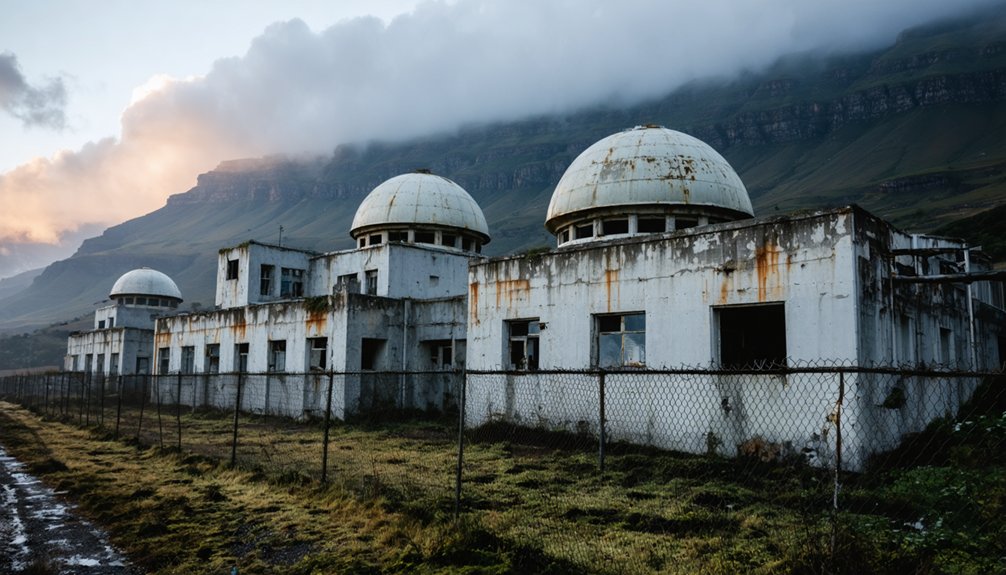
Perched atop one of South Africa’s most strategic mountains, Mariepskop Military Village operated as a critical radar outpost from 1965 until 2003, when the facility was suddenly abandoned.
The mountain, named after Pulana chief Maripe Mashile, transformed from an indigenous stronghold against 19th-century Swazi raiders to a Cold War sentinel. As part of Project NATSEC in the 1950s, you’d find this radar station constructed to protect South Africa’s industrial heartland from aerial threats.
The military history of this site reflects the apartheid regime’s border war priorities. The radar station became fully operational on November 18, 1965 and maintained surveillance of the region’s airspace for nearly four decades. During a notable incident in July 1981, radar operators tracked a MiG 17 aircraft that requested asylum at the facility.
After democracy arrived in 1994, priorities shifted. The ghost town that remains today – with its advanced radar technology now silent – stands as a forgotten relic of a different era, its operations transferred to more accessible locations like Hoodra Air Force Base.
Soviet Ghosts: The Cold War Military Infrastructure Left Behind in Hungary
Following the fall of the Iron Curtain in 1989, Hungary’s landscape became dotted with abandoned Soviet military infrastructure, leaving behind what many now call “Soviet ghosts.”
These remnants include approximately 60 army camps and 10 airbases that once housed the Southern Group of Forces established in Budapest in 1955.
Among these relics are the “Monolith” nuclear storage bunkers—three sophisticated facilities including one at “Little Moscow” in Urkut. CIA intelligence reports from 1979 confirmed these bunkers were specifically designed for long-term storage of nuclear warheads.
The Szentkirályszabadja helicopter base stands as a stark reminder, once a self-sufficient community of 8,000 residents with Soviet bunkers, abandoned barracks, schools, and shops. The base featured luxurious amenities that were significantly better than what was available to the surrounding Hungarian population.
During withdrawal, Soviets secretly dismantled combat equipment through dense woods to avoid detection.
Today, these ghostly structures resemble post-apocalyptic landscapes—silent witnesses to Hungary’s four-decade occupation that finally ended when Soviet forces departed in 1991.
Their faded walls whisper of forgotten soldiers and untold stories, echoing haunting tales from military installations that once echoed with life. Each corner hides relics of the past, where the air is thick with history and the shadows seem to hold secrets yet to be uncovered. Visitors often report an inexplicable chill, as if the spirits of those who served still linger among the remnants of their former posts.
Underground Fortresses: The Massive Tunnel Networks of Zeljava Air Base
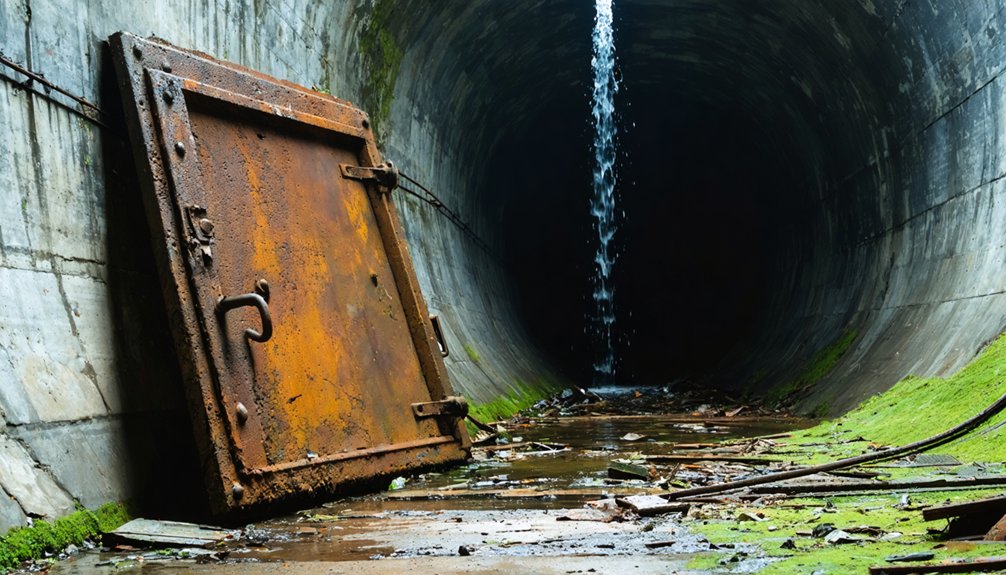
A marvel of Cold War engineering, the Zeljava Air Base represents one of Europe’s most ambitious underground military complexes.
Built beneath Plješevica mountain between 1954-1968, the facility features an intricate “M”-shaped tunnel architecture spanning 3.5 kilometers, designed to house 60 MiG-21 aircraft.
You’d find impressive military fortifications including 1.5-meter thick reinforced concrete walls able to withstand 20-kiloton nuclear blasts.
The complex’s four entrances were secured by massive blast doors—three electric 60cm-thick portals and one hydraulic door weighing over 100 tons.
The base operated as Yugoslavia’s NORAD equivalent with five runways, advanced radar systems monitoring airspace up to 300km away, and infrastructure to support 1,000 personnel. The Socialist Federal Republic of Yugoslavia invested approximately $6 billion in the construction of this strategic military installation.
The facility maintained autonomous systems that provided water, electricity, and air filtration, ensuring operational independence during potential conflicts.
Though deliberately demolished with 56 tons of explosives in 1991-1992, its remaining structures testify to Cold War military ingenuity.
Frequently Asked Questions
How Can Civilians Legally Access These Abandoned Military Sites?
Like opened doors to history, you’ll gain entry through public access points, state parks, official tours, legal permits, formal government requests, or by joining preservation initiatives and scheduled open houses.
What Hazardous Materials Remain at These Locations Today?
You’ll encounter unexploded ordnance, heavy metals, chemical warfare residues, petroleum spills, and asbestos. These toxic wastes create severe environmental impact, persisting decades after abandonment due to inadequate initial remediation efforts.
Are Any of These Bases Still Monitored by Military Personnel?
Like Area 51’s lesser-known cousins, most abandoned bases lack regular personnel presence. You’ll find military surveillance primarily at nuclear facilities, strategically sensitive locations, or bases with hazardous materials—never constant, but never truly unwatched either.
How Have Local Ecosystems Adapted to These Abandoned Structures?
You’ll observe remarkable ecosystem resilience after abandonment, as wildlife adaptation occurs in phases. Initially, opportunistic species colonize structures, followed by native flora reclaiming disturbed soils despite chemical contamination and physical barriers.
What Classified Technologies Were Left Behind When Bases Were Abandoned?
Imagine dusty consoles glowing in darkness. You’ll find classified remnants of stealth technology, UAV prototype components, and partial intelligence systems—military secrets abandoned when operations relocated to deeper underground facilities during the Cold War.
References
- https://mybaseguide.com/abandoned-military-bases
- https://www.youtube.com/watch?v=nCA4qyZsOSQ
- https://www.popularmechanics.com/technology/design/g1507/creepy-abandoned-military-sites-from-around-the-world/
- https://www.sightraider.com/the-red-army-in-hungary-airbases-bunkers-and-ghost-towns/
- https://www.youtube.com/watch?v=tpVKYlF2oUg
- https://www.youtube.com/watch?v=AxWKw0BmFL8
- https://www.youtube.com/playlist?list=PLenYgd5YLQJ744EWXrjBFt-EtBj8FFdPo
- https://www.wearethemighty.com/mighty-history/9-military-ghost-bases-youve-probably-never-heard-of/
- https://cires.colorado.edu/news/greenland-and-legacy-camp-century
- https://ahf.nuclearmuseum.org/ahf/history/camp-century/