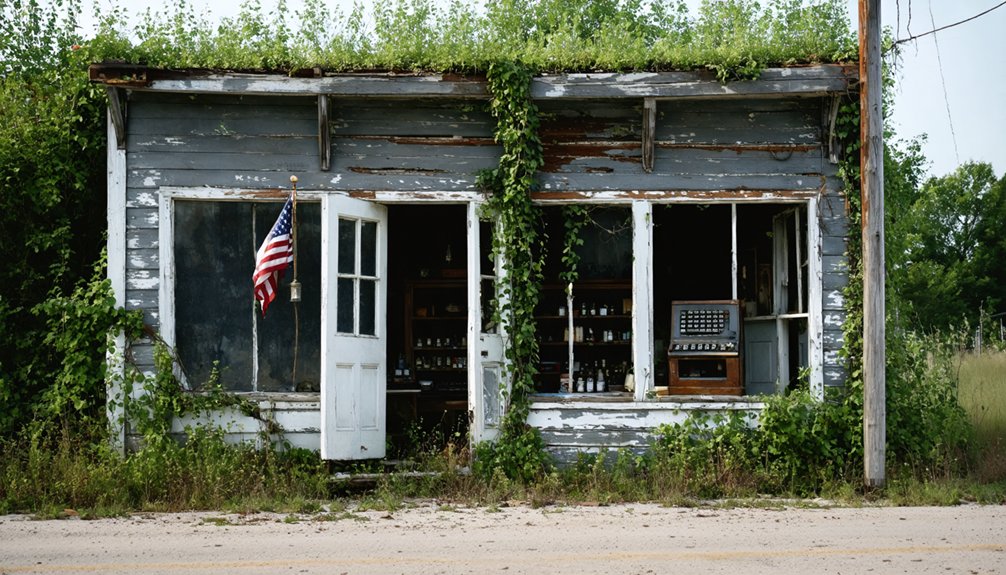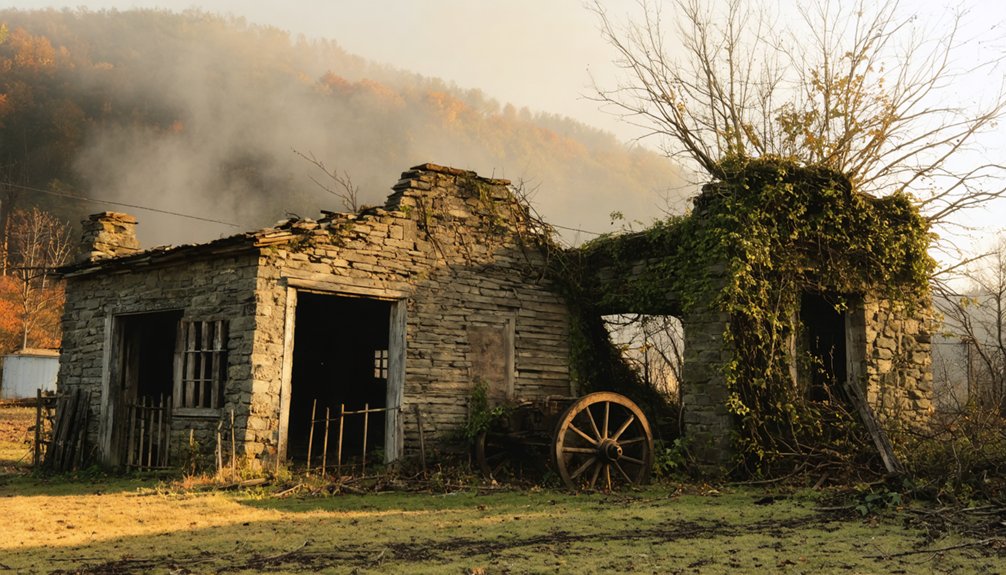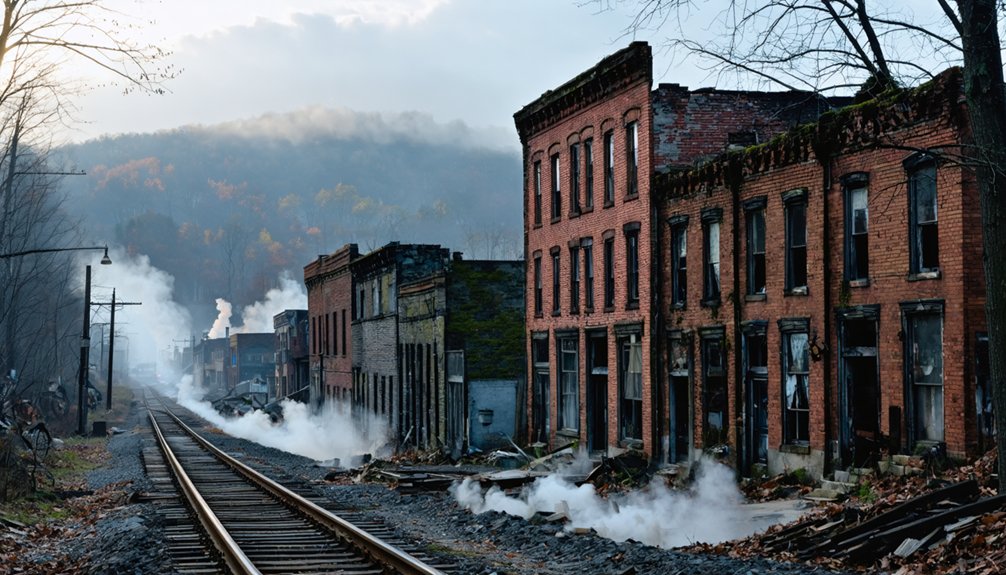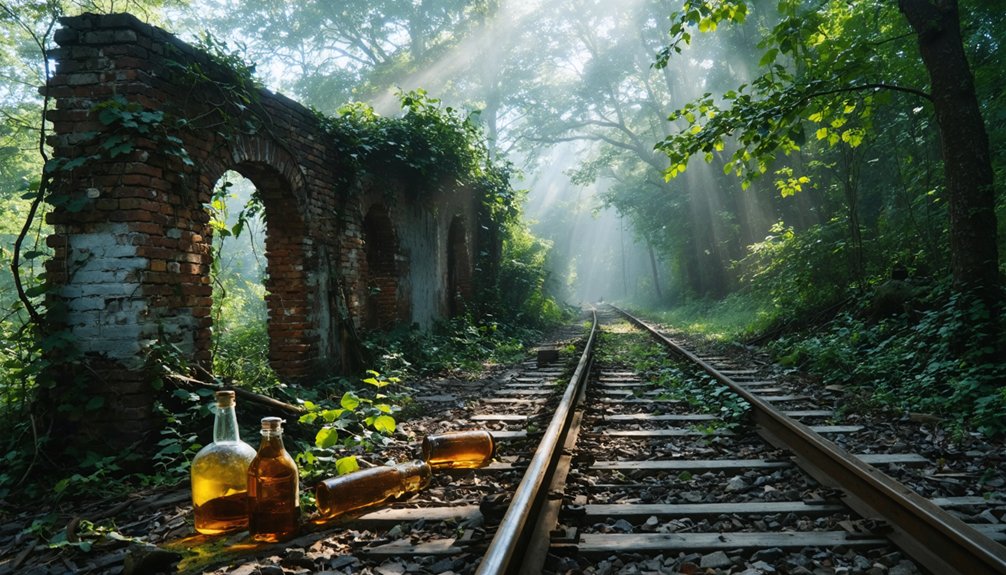
You’ll discover numerous lost Civil War-era towns across America, including underwater communities like Somerfield in Pennsylvania, abandoned capitals such as Cahawba in Alabama, and former prison camp sites like Camp Lawton. Economic collapse, flooding, fires, and transportation changes have erased these settlements from modern maps. Many exist now as preserved ruins or archaeological sites, their foundations and artifacts revealing stories of 19th-century life beneath the surface of contemporary America.
Key Takeaways
- Somerfield, Selbysport, and Jockey Hollow were submerged under Youghiogheny Reservoir in the 1940s, occasionally revealing Civil War era foundations during droughts.
- Cahawba, Alabama’s first capital (1820), declined after an 1865 flood and thrived during the cotton boom before being abandoned.
- Centralia, Pennsylvania lost 2,700 residents due to an underground coal fire that began in 1962.
- Civil War prison camps like Andersonville, Fort Delaware, and Camp Douglas have been abandoned but remain important historical sites.
- Transportation-dependent towns were abandoned when railroads declined, Confederate forces requisitioned resources, or river courses changed, making ports obsolete.
The Underwater Relics of Pennsylvania’s Flooded Communities
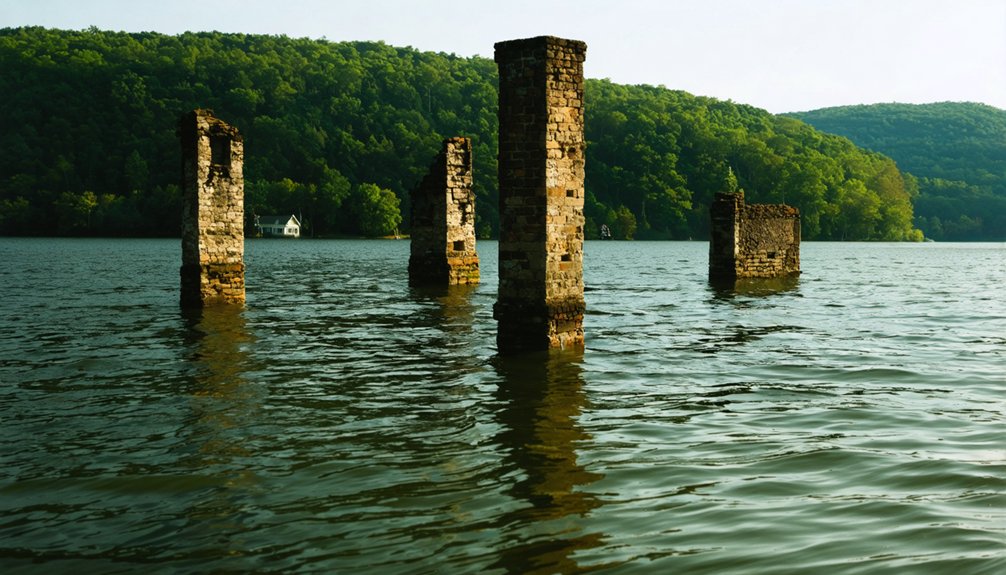
Beneath the placid waters of Pennsylvania’s Youghiogheny Reservoir lie the remains of once-thriving communities, ghostly relics to America’s complex relationship with progress and water management.
Submerged communities whisper forgotten stories beneath Pennsylvania waters, testament to our nation’s sacrifices for progress.
Towns like Somerfield, Selbysport, and Jockey Hollow were sacrificed in the 1940s when the Army Corps of Engineers constructed dams for flood control, forcing residents to abandon their homes.
These flooded towns occasionally reemerge during drought conditions, revealing foundations, roadbeds, and bridge remnants dating to the Civil War era.
Underwater archaeology at these sites has uncovered evidence of layered human habitation—from ancient Monongahela dwellings to Shawnee and Seneca settlements, and finally the 19th-century towns that flourished along the National Road established in 1816.
The Great Crossings Bridge near Somerfield, dedicated in 1818, represents early American engineering innovation now hidden beneath the reservoir’s depths. Historical records show this remarkable structure once supported the passage of notable historical figures like George Washington during early American westward expansion.
Similar to Bluffton in Texas, these communities were relocated before flooding in a sacrifice made for water management infrastructure that forever altered the regional landscape.
Capital to Ghost Town: The Rise and Fall of Cahawba, Alabama
While the waters of Pennsylvania claimed entire communities, Alabama’s story of abandonment unfolded through political decisions and natural disasters at Cahawba. Founded as the state’s first capital in 1820, Cahawba’s significance evolved from political center to commercial powerhouse during the antebellum cotton boom, when nearly two-thirds of its 2,000 residents were part of the enslaved population.
The town’s decline came swiftly after:
- The devastating 1865 flood that submerged much of the settlement
- Relocation of the county seat to Selma in 1866
- Withdrawal of federal troops after Reconstruction
During the Civil War, Cahawba was home to Castle Morgan, a Confederate prison that housed captured Union soldiers who later faced tragedy on the Sultana steamboat explosion. The town’s original grid layout with streets named after trees was designed to mirror Philadelphia, symbolizing Alabama’s ambitious vision for its first capital.
Mining Boomtowns: Gold, Silver, and Abandonment in the American West
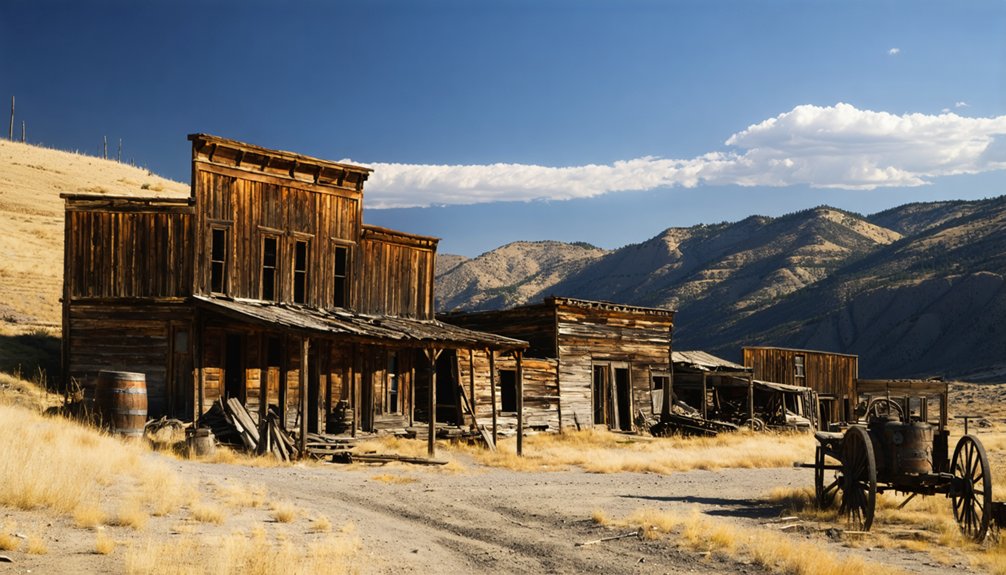
Unlike Alabama’s Cahawba, where political shifts and flooding sealed a capital city’s fate, the American West witnessed a different pattern of rise and fall through its mining settlements.
These boomtowns emerged explosively after gold, silver, and copper discoveries, transforming tent camps into structured communities with hotels, schools, and city halls practically overnight.
Virginia City swelled to 25,000 residents following Comstock silver discoveries, while Butte, Montana became America’s largest mining city with 100,000 inhabitants during World War I.
You’ll find these ghost towns scattered across Nevada, Colorado, South Dakota, and Idaho, each telling stories of rapid wealth and equally swift abandonment.
The forgotten lore of Bodie, California reveals tales of miners who struck it rich, only to see their fortunes vanish as quickly as they were made. Once a bustling hub filled with saloons and shops, Bodie now stands as a well-preserved ghost town, a testament to the fleeting nature of wealth. Visitors can wander through its empty streets and imagine the lives of those who called this rugged landscape home.
Mining legacies remain visible in environmental scars—deforestation, mercury pollution, and desertification—stark reminders of an era when extraction economies built towns designed to thrive only as long as precious metals flowed. Many mining towns lasted only a few months before being completely abandoned when local resources were depleted.
Life in these settlements was characterized by lawlessness and disorder, requiring vigilance committees to maintain some semblance of social order in the absence of formal law enforcement.
Civil War Prison Camps That Became Ghost Towns
You’ll encounter haunting remnants of prisoners’ daily suffering at abandoned Civil War prison camps like Andersonville, where nearly 13,000 Union soldiers perished from disease and starvation in overcrowded conditions.
The fortress remains at sites like Fort Delaware on Pea Patch Island now attract historical researchers and paranormal investigators, with its stone walls bearing silent witness to the 12,596 Confederate prisoners once held there. Today, visitors can experience the eerie atmosphere through ghost tours conducted during the Halloween season, especially during full moon nights.
At Camp Douglas in Chicago, where the death rate reached approximately 17%, the physical structures have vanished beneath urban development, including a Culver’s restaurant built atop what was once a smallpox burial ground. Originally a Union training camp, Camp Douglas housed nearly 30,000 Confederate prisoners between 1862 and 1865, often holding over 10,000 at one time despite being built for far fewer.
Prisoners’ Daily Suffering
Civil War prison camps represented some of the darkest chapters in American history, where the daily suffering of inmates reached almost inconceivable levels.
Prisoner mortality skyrocketed as men faced daily hardships beyond mere incarceration:
- Inadequate shelter forced many to sleep exposed to elements, particularly at places like Cahaba Prison where incomplete roofing left prisoners vulnerable to weather extremes.
- Contaminated water and severe food shortages created rampant disease, with smallpox outbreaks killing hundreds at camps like Blackshear.
- Physical abuse compounded suffering, while forced marches between facilities—such as the exhausting 60-mile trek from Blackshear to Andersonville—claimed additional lives.
These conditions weren’t merely the result of wartime scarcity; in many cases, neglect and deliberate cruelty by prison authorities magnified the suffering beyond what resource limitations alone would explain. With the suspension of prisoner exchanges in 1864, camps became dangerously overcrowded, leading to even more severe deterioration of conditions and increased death rates. Camp Lawton in Millen, Georgia was designed for 40,000 inmates but conditions remained dire despite being relatively better than Andersonville, with disease still widely prevalent among the approximately 10,000 prisoners held there.
Abandoned Fortress Remains
The physical vestiges of these wartime horrors survived long after the prisoners’ suffering ended, evolving into a collection of abandoned fortresses and ghost towns that dot the American landscape.
You’ll find Fort Jefferson‘s massive brick structure standing as America’s largest, though abandoned since 1906 when hurricanes and strategic obsolescence claimed its usefulness.
Camp Lawton’s 42-acre expanse, once holding 10,000 prisoners, now exists primarily within Magnolia Springs State Park.
Fort Delaware’s isolated island position preserved its haunting historical significance, while Camp Groce’s Texas grounds have largely returned to nature, with only historical markers indicating its former purpose.
Perhaps most ephemeral, Blackshear Prison Camp operated briefly in 1864 before being abandoned, leaving virtually no structural evidence of the 5,000 prisoners who once suffered within its makeshift confines.
How Natural Disasters Erased Historic Civil War Settlements
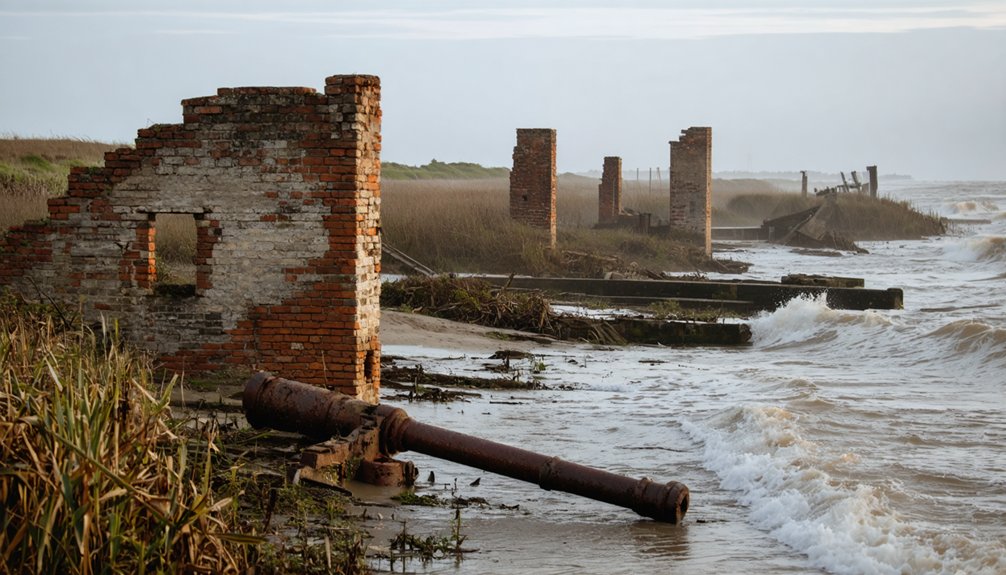
You’ll find that many Civil War-era towns across the South were completely erased from existence by catastrophic floods that swept through river valleys and coastal regions.
The 1889 Johnstown Flood exemplifies this destructive power, obliterating 1,600 homes and killing over 2,200 people in a community already struggling to rebuild after the war.
Communities situated along the Potomac River faced similar fates during the 1936 flood, when entire neighborhoods in towns like Cumberland, Paw Paw, and Hancock were washed away, leaving residents with little hope of recovery and leading to permanent abandonment.
Flood-Ravaged Southern Communities
While violent conflicts claimed countless lives during the Civil War era, natural disasters proved equally devastating to Southern communities, permanently altering the American landscape through catastrophic flooding events.
The flood impacts on settlements like Princeville, North Carolina—founded by former slaves in 1885—demonstrated both vulnerability and community resilience as residents repeatedly rebuilt despite seven major Tar River inundations between 1800-1958.
- Arkansas communities endured catastrophic submersion during the 1927 Mississippi River flood, with water depths reaching thirty feet and families displaced for months.
- Johnstown’s 1889 disaster obliterated multiple Pennsylvania towns when South Fork Dam failed, creating a debris-laden surge described as “a huge hill rolling over.”
- Princeville residents adapted by constructing homes on stilts near the Tar River, exemplifying determination to preserve their historic Black-founded community despite recurring floods.
Catastrophic Town Abandonment
Beyond mere population decline or gradual abandonment, numerous Civil War-era communities faced sudden, catastrophic extinction through devastating natural disasters that permanently altered America’s landscape.
You’ll find Centralia, Pennsylvania among the most dramatic examples, where an underground coal fire beginning in 1962 forced the evacuation of 2,700 residents as deadly gases seeped through ruptured earth.
Similarly, catastrophic losses struck mining settlements like Bodie, California and St. Elmo, Colorado, where fires destroyed critical infrastructure.
Urban decay accelerated in Ellaville, Florida after the 1986 Hillman Bridge replacement redirected traffic, eliminating commercial viability.
Perhaps most striking was Elko Tract, Virginia—deliberately erased during World War II for military deception purposes.
Across America, these towns represent communities where natural forces or human intervention triggered rapid collapse, leaving only scattered ruins as evidence of their Civil War-era origins.
Railroad Shifts and Economic Collapse: Transportation’s Role in Town Abandonment
Transportation infrastructure proved to be the lifeblood of many Civil War era towns, with its presence or absence often determining their ultimate fate. The requisition of railroads by Confederate forces devastated communities like Cahawba, Alabama, where economic viability collapsed when cotton distribution networks were severed.
You’ll find similar patterns across abandoned settlements whose economic foundations crumbled when transportation systems failed.
Transportation abandonment triggered town death through:
- Railroad requisition during wartime, immediately collapsing local economies dependent on commercial distribution
- Rerouting of major thoroughfares that bypassed once-thriving commercial hubs
- Natural shifts in waterways that rendered river ports obsolete, as witnessed in La Paz, Arizona
These transportation disruptions demonstrate how quickly a town’s prosperity could vanish when its connection to broader markets disappeared.
Military Deception: The Strange Case of Elko Tract, Virginia
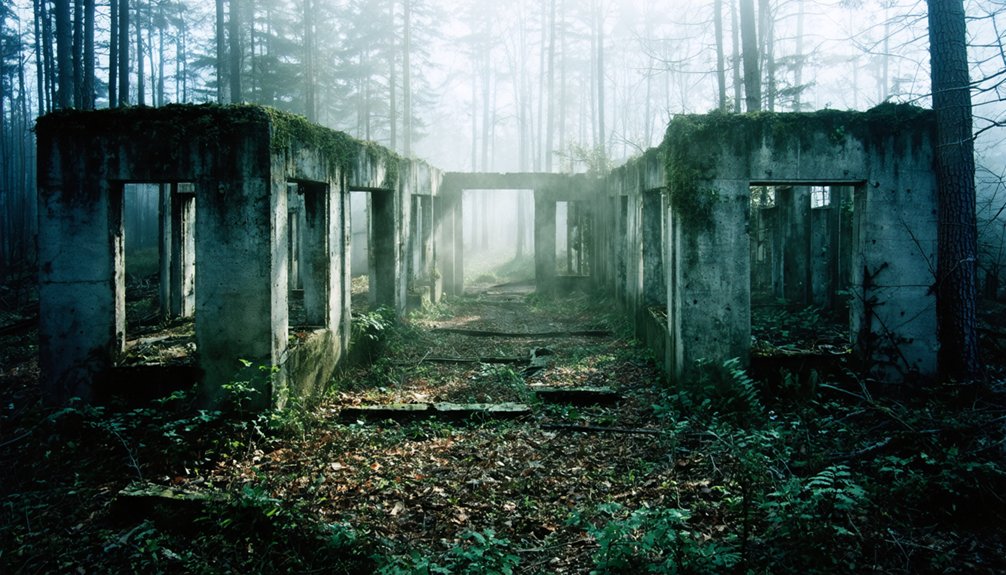
Military strategy occasionally birthed phantom communities that never genuinely existed, as exemplified by the peculiar case of Elko Tract, Virginia.
In 1942, the federal government condemned this 2,220-acre parcel and transformed it into an elaborate decoy airfield during World War II. The 936th Camouflage Battalion employed Hollywood-inspired military deception techniques, constructing fake runways, hangars, and aircraft from plywood and canvas to mimic Richmond Army Air Base.
Though never actually bombed, Elko Tract’s historical significance extends beyond wartime.
Post-war plans for an African-American mental hospital faltered, leaving infrastructure abandoned. Today, locals call it “The Lost City,” with visible remnants of both the decoy airfield and failed development projects.
This curious blend of wartime ingenuity and Cold War-era development attempts stands as a reflection of American strategic adaptation.
Preserved in Time: Civil War Ghost Towns You Can Still Visit Today
You’ll find America’s Civil War ghost towns preserved in various states of splendor, from mining boomtowns like Bodie, California, and St. Elmo, Colorado, to battleground communities like Cahawba, Alabama, which served as both the state’s first capital and a Confederate prison camp.
These sites offer a tangible connection to 19th-century life through their “arrested decay,” a preservation approach that maintains original structures without fully restoring them to pristine condition.
Walking through these historical remnants provides an unfiltered glimpse into the nation’s tumultuous past, where abandoned general stores, schoolhouses, and military installations reveal the sociopolitical forces that shaped—and ultimately destroyed—these once-thriving communities.
Mining Boomtowns Frozen Forever
Across the American landscape, dozens of remarkably preserved Civil War-era mining towns offer modern visitors an unparalleled glimpse into the nation’s industrial past.
These sites represent critical mining legacies that drove economic transformations throughout the western territories during and after the conflict. Virginia City exemplifies this period, reaching 25,000 residents following the 1859 Comstock Lode discovery that yielded extraordinary silver-gold wealth.
You’ll encounter three distinct categories of these frozen-in-time settlements:
- Comstock-era industrial centers with substantial infrastructure including churches, schools, and commercial districts
- Rapid boom-bust communities like Goldfield and Rhyolite that expanded explosively only to face abandonment
- Copper boomtowns that emerged as electrification demands accelerated nationwide
Railroad networks transformed these isolated outposts into economic powerhouses, enabling ore shipment to distant markets while simultaneously making these communities vulnerable to market fluctuations.
Preserved Battleground Communities
Several remarkably intact battleground communities offer visitors today an unparalleled window into the Civil War era, preserved through dedicated conservation efforts and historical protection initiatives.
When you explore Harpers Ferry, you’ll witness the convergence of three states and John Brown’s infamous raid site. Fredericksburg’s Slaughter Pen Farm allows you to trace actual Union assault routes via interpretive trails.
Gettysburg stands as perhaps the most thoroughly preserved battlefield landscape, with its surrounding towns maintaining authentic antebellum structures.
Throughout the Shenandoah Valley, communities like Port Republic showcase Jackson’s strategic brilliance while retaining civilian structures that withstood the conflict.
These Civil War communities exemplify successful historic preservation, safeguarding not just military infrastructure but also civilian life remnants – allowing you to experience history beyond abstract concepts through tangible, protected environments.
Walking Through Arrested Decay
While the ghosts of history may be metaphorical in most historic sites, Civil War ghost towns like Cahawba offer visitors a literal encounter with arrested decay—places where time stopped shortly after the war’s conclusion.
This former Alabama capital represents a pinnacle of historical preservation, allowing for urban exploration through tangible remnants of 19th-century life.
As you walk Cahawba’s ancient streets, you’ll experience:
- Building foundations and architectural fragments revealing antebellum construction techniques
- Prison camp remnants that silently testify to wartime occupation
- Street grids and structural outlines revealing urban planning from America’s formative decades
The site’s controlled deterioration provides a freedom rarely found in more commercialized historic venues—the ability to directly engage with unfiltered history while contemplating the economic and environmental forces that hastened such communities’ abandonment.
The Canal Towns That Never Flourished: Matildaville and Beyond
The silent ruins of Matildaville stand as a tribute to America’s earliest canal ambitions, representing one of many forgotten commercial settlements that promised prosperity but delivered disappointment. Founded in 1790 as the Patowmack Company’s headquarters, this 40-acre industrial vision championed by George Washington ultimately succumbed to the canal failure that defined its brief existence.
You’ll find similar stories in nearby South Lowell, later called Potomac, which failed to attract manufacturing despite ambitious plans. These industrial dreams collapsed under the weight of engineering limitations—Matildaville’s canal operated only one to two months yearly due to water level issues.
When War Economies Collapsed: Post-Civil War Industrial Decline
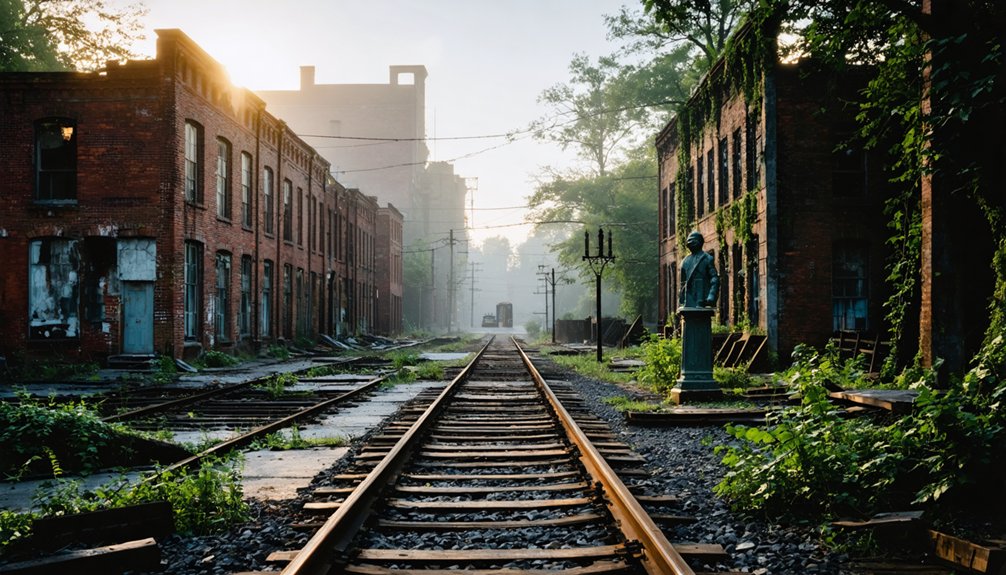
Just as canal-based commercial ventures collapsed under practical constraints, numerous Civil War-era industrial settlements experienced dramatic economic decline following the conflict’s end.
The economic disruption stemmed from multiple overlapping factors that devastated once-thriving communities:
Economic turmoil arose from converging forces that destroyed previously prosperous industrial centers across the nation.
- Southern towns suffered catastrophic industrial collapse after Union campaigns destroyed infrastructure and the emancipation of slaves eliminated their primary labor source.
- Railroad-dependent settlements disappeared when the speculative rail boom ended, leaving communities stranded by bankruptcies and abandoned infrastructure.
- Northern manufacturing towns gradually declined as wartime production needs evaporated and investment capital shifted to more profitable ventures.
You’ll find these ghost towns scattered across America’s landscape—silent monuments to economic systems that couldn’t adapt to peacetime realities or the inevitable shifts of industrial capitalism.
Frequently Asked Questions
What Resources Remained Valuable in Abandoned Civil War Towns?
You’ll find economic resources like military fortifications, iron production facilities, railroad infrastructure, and agricultural remnants retained value in abandoned Civil War towns despite their deteriorating physical condition.
How Did Black Communities Adapt After Abandoned Towns’ Decline?
Against all odds, you’ll find Black communities demonstrated remarkable resilience by establishing independent agricultural economies, preserving cultural traditions through churches and education, and forming tight-knit settlements despite property rights challenges and economic discrimination.
Were Any Lost Towns Deliberately Destroyed During Military Campaigns?
Yes, you’ll find numerous towns deliberately destroyed as military strategy during Civil War campaigns, including Atlanta’s burning by Sherman and Richmond’s destruction during Confederate retreat—both reflecting calculated town destruction tactics.
Did International Investors Lose Fortunes in These Abandoned Settlements?
You’ll find no evidence of international investments lost in these ghost towns. Available documentation focuses on domestic economic impacts rather than foreign capital ventures in these abandoned settlements.
How Many Lost Towns Became Temporary Refugee Camps Post-Civil War?
Like cybernetic networks, hundreds of Southern settlements transformed into refugee camps. You’ll find records suggesting numerous abandoned towns across the South provided post war settlement spaces, though precise refugee experiences remain incompletely documented.
References
- https://www.blueridgeoutdoors.com/go-outside/southern-ghost-towns/
- https://www.mentalfloss.com/geography/american-ghost-towns-can-still-walk-through
- https://www.christywanders.com/2024/08/top-ghost-towns-for-history-buffs.html
- https://www.visittheusa.com/experience/5-us-ghost-towns-you-must-see
- https://www.geotab.com/ghost-towns/
- https://devblog.batchgeo.com/ghost-towns/
- https://www.youtube.com/watch?v=inRD6vYBy8M
- https://www.legendsofamerica.com/gt-hiddentales/
- https://en.wikipedia.org/wiki/Lists_of_ghost_towns_in_the_United_States
- https://africawanderlust.com/food-lifestyle/12-united-states-ghost-towns-that-will-make-your-skin-crawl/