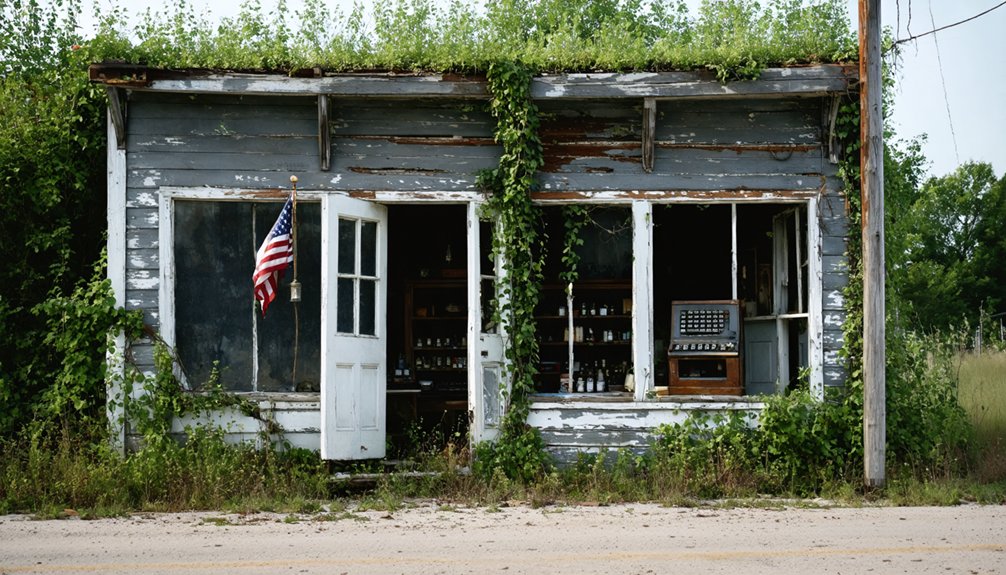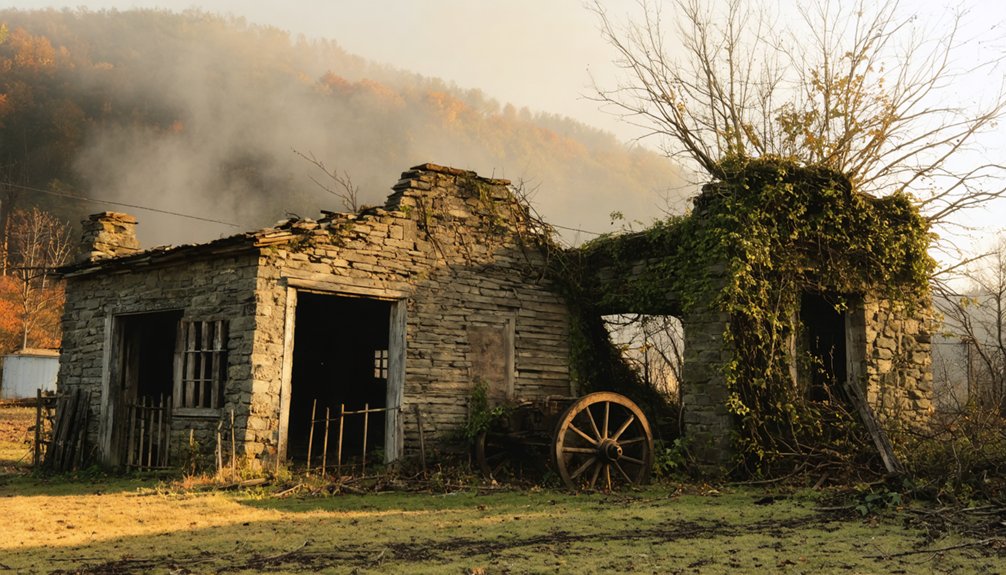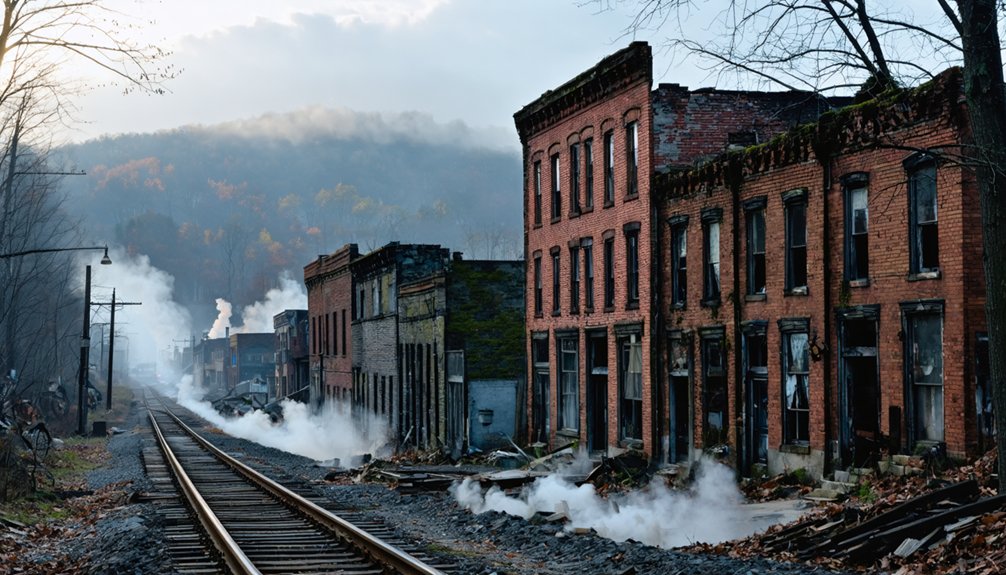
You’ll find numerous Civil War ghost towns across America, including Cahawba, Alabama’s abandoned first capital, and Richmond’s lost neighborhoods. Disease-ravaged communities, submerged towns beneath reservoir waters, Confederate river fortifications, and post-Emancipation African American settlements dot the landscape. Mining towns that supplied war materials and railway communities that collapsed when supply lines shifted complete this historical tapestry. These forgotten places offer powerful windows into how the conflict permanently altered the American landscape.
Key Takeaways
- Cahawba, Alabama was once the state capital before floods in 1865 and relocation of the county seat led to abandonment.
- Richmond, Virginia lost entire neighborhoods during Union occupation, with Shockoe Bottom suffering catastrophic destruction from the Evacuation Fire.
- Disease-ravaged communities in East Tennessee and coastal Carolinas were abandoned after military encampments spread deadly illnesses.
- Many Civil War-era towns were permanently submerged by post-war infrastructure projects like Tennessee Valley Authority dams.
- Confederate river defense outposts along the Mississippi, including Island No. 10 and Fort Pemberton, were abandoned and reclaimed by nature.
Cahawba, Alabama: The Abandoned First Capital
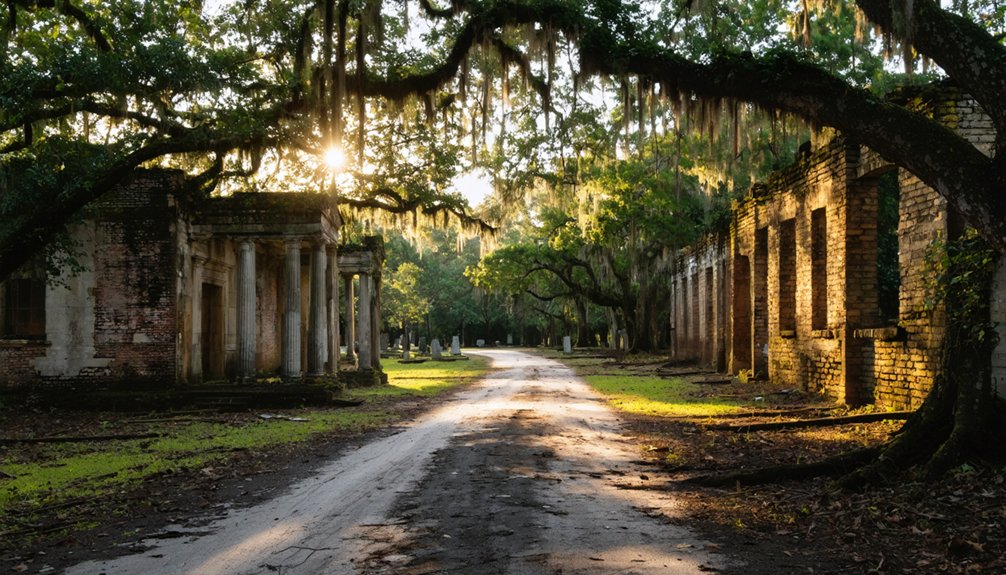
Nestled at the confluence of the Cahaba and Alabama Rivers, Cahawba emerged in the early 1820s as Alabama’s first state capital, built upon the ruins of a Native American settlement possibly known as “Maubila.”
The town’s strategic location provided excellent river access and abundant spring water, making it an ideal choice for the fledgling state’s political center. The city was designed in a grid layout similar to Philadelphia with streets named after trees.
Cahawba history reveals a dramatic rise and fall. Once home to over 3,000 residents and the wealthiest county in Alabama, it later housed thousands of Union prisoners in Castle Morgan during the Civil War. Many of these prisoners faced tragedy when they died in the Sultana explosion while being transported northward after their release.
Following devastating floods in 1865 and the county seat’s relocation to Selma, Cahawba rapidly depopulated.
Today, it’s Alabama’s most prominent ghost town tourism destination, featuring ruins of antebellum structures, artesian wells, and cemeteries that chronicle its complex past.
Richmond, Virginia’s Lost Neighborhoods During Union Occupation
If you visited Richmond after April 1865, you’d have witnessed the devastating transformation of Shockoe Bottom, where Union troops extinguished fires that Confederate forces had ignited during their retreat.
Military control reshaped Jackson Ward as Union encampments established order while providing essential supplies to destitute residents.
The occupation of Chimborazo, which continued for five years under generals Weitzel and Ord, created a lasting legacy of altered urban landscapes that required decades of reconstruction. The extensive damage was largely due to the Evacuation Fire that dramatically changed Richmond’s skyline when Confederate officials fled the capital. Today, visitors can explore these historic districts through ghost tours that reveal the haunting echoes of Richmond’s Civil War past.
Shockoe Bottom’s Wartime Destruction
Once a thriving commercial center since the 1730s, Richmond’s Shockoe Bottom district experienced catastrophic destruction during the final days of the Civil War.
As Union forces approached in April 1865, Confederate troops set fire to tobacco warehouses, initiating what became known as the Evacuation Fire.
The flames spread uncontrollably, ravaging thirty blocks of Richmond including Shockoe Bottom. This wartime destruction eliminated all visible evidence of the district’s dark past as America’s second-largest slave marketplace.
The inferno erased physical traces of approximately 69 slave traders and auction houses that had once dominated the area.
After the war, this site of immense suffering became a place of educational opportunity when the notorious Lumpkin’s Jail was transformed into a seminary for formerly enslaved people.
While rebuilding efforts commenced rapidly in the late 1860s, this wartime destruction permanently altered Shockoe Bottom’s landscape, ironically accelerating the erasure of physical reminders of the 300,000-400,000 enslaved people trafficked through its streets. Many new structures were constructed in a commercial Italianate style that characterized the district’s post-war architectural identity.
Jackson Ward Military Control
While Shockoe Bottom’s destruction represented the final physical scars of Richmond’s wartime experience, another neighborhood’s story reveals the complex social and political reconfiguration that followed Union occupation.
Jackson Ward’s trajectory under military occupation demonstrates how control shifted Richmond’s demographic landscape. Following the Civil War, this mixed community of free Blacks and immigrants transformed into a mainly African American district, developing community resilience despite political manipulation.
The 1871 gerrymandering concentrated Black voters into a single ward, limiting their citywide influence, before Jim Crow laws disenfranchised approximately 90% of Black voters.
- The neighborhood became a “safe space” during and after military occupation
- Despite voter suppression, residents maintained political influence through state elections
- By the early 1900s, the area evolved into “Black Wall Street,” a thriving business district with banks and insurance companies
The district’s historical significance was formally recognized when it was listed as a National Historic Landmark in 1978, acknowledging its cultural and architectural importance to American history.
Chimborazo Occupation Legacy
Situated strategically on Chimborazo Hill overlooking the James River, the Confederate’s largest military hospital complex transformed dramatically during Union occupation, revealing both the resilience and vulnerability of Richmond’s eastern neighborhoods.
When Union forces arrived in April 1865, they discovered Chimborazo Hospital in surprisingly good condition. Dr. McCaw’s peaceful surrender preserved the facility’s infrastructure, allowing Union surgeons to immediately repurpose it for treating their own wounded while maintaining Confederate patients in separate wards. The hospital’s ninety wards with whitewashed walls had treated approximately 78,000 patients during its Confederate operation.
This medical legacy continued briefly until operations ceased that summer. The pavilion-style design that promoted proper ventilation helped maintain the facility’s functionality during the transition period.
The hospital’s wooden structures were later dismantled by locals for building materials, erasing physical evidence of the site’s importance.
Though Richmond eventually reclaimed the land for public recreation, Chimborazo’s evolution from Confederate medical marvel to Union-controlled facility to ghost town exemplifies how war permanently altered the city’s landscape.
Abandoned Confederate Forts Along the Mississippi River
As you travel the Mississippi River today, you’ll find almost no visible remains of the once-formidable Confederate shore batteries and forts that formed a defensive network during the Civil War.
Fort Castle, Fort Leflore, and numerous earthwork fortifications along the river were abandoned during the Vicksburg Campaign as Union forces systematically dismantled Confederate river control between 1862-1863.
Most Confederate river outposts deteriorated rapidly post-war through a combination of natural erosion, flooding, and deliberate dismantling, with only archaeological traces remaining at sites like Lower Fort and Middle Fort on the Tallahatchie. Confederate strongholds like Fort Snyder were crucial defense points during the Siege of Vicksburg but now exist only as monuments or historic markers.
Confederate River Defense Outposts
During the American Civil War, Confederate forces established a network of strategic fortifications along the Mississippi River to prevent Union naval advances southward. These river defense outposts functioned as the Confederacy’s first line of protection for controlling essential waterways and commerce.
Columbus, Kentucky served as a critical “Gibraltar” of the river, with its commanding bluff position and heavy artillery batteries. Meanwhile, Island No. 10 became a key defensive position until its surrender in April 1862, opening the Upper Mississippi to Union control.
Confederate shore batteries dotted riverbanks throughout Mississippi, particularly near Warrenton.
- Fort Castle near the Yazoo River confluence represented one of several fortified mansions.
- The Confederate River Defense Fleet operated alongside these fortifications, though with coordination challenges.
- Many outposts now exist only as barely visible earthworks or have disappeared entirely due to river erosion.
Vicksburg Campaign Abandoned Sites
The Vicksburg Campaign of 1863 left a trail of abandoned Confederate fortifications that once formed a formidable defensive network along the Mississippi River.
You’ll find Confederate remnants at Fort Pemberton near Greenwood, where defenders repulsed Union naval forces three times in March 1863. This strategic outpost in the Yazoo Delta successfully exploited the region’s swampy terrain until Grant’s forces ultimately prevailed.
Fort Hindman at Arkansas Post, though captured early in the campaign, represents another ghost of Confederate river defense.
The most significant Vicksburg ruins stretch along three miles of waterfront bluffs where 37 heavy guns once controlled the vital hairpin turn in the Mississippi.
President Lincoln called Vicksburg “the key” to the river, while Jefferson Davis considered it “the nail head that holds the South’s two halves together.”
Post-War Deterioration Timeline
Following Union victory in 1865, abandoned Confederate forts along the Mississippi River entered a rapid cycle of deterioration that would render most unrecognizable within decades.
The timeline of post-war neglect unfolded quickly—strategic sites like Fort Jackson and Fort Pillow experienced immediate abandonment after Union capture, with no Confederate attempts to reclaim or restore these fortifications.
- Fort Jackson and St. Philip surrendered in April 1862, initiating years of exposure to Mississippi River flooding that eroded their earthworks.
- Port Hudson, the last Confederate Mississippi stronghold, fell in July 1863 after a siege that had already compromised its structural integrity.
- Fort Pillow’s fortifications deterioration accelerated after 1864 when vegetation overtook the site, transforming military architecture into concealed ruins.
These once-formidable defenses quickly became ghost sites, isolated by shifting riverbanks and reclaimed by nature.
Mining Ghost Towns That Supplied the War Effort
As the Civil War intensified demand for mineral resources across the nation, numerous mining operations expanded rapidly to meet the wartime supply needs, ultimately creating settlements that would later become ghost towns.
Eldorado Canyon mining operations, dating back to Spanish gold extraction in the 1700s, formalized into the Colorado Mining District during the 1860s peak Civil War period.
These isolated canyon operations now offer historical tours 44 miles south of Las Vegas.
Vulture Mine operations, which eventually produced 340,000 ounces of gold and 240,000 ounces of silver, contributed greatly to the war economy between 1863-1942.
The mine’s impressive revenue generation of up to $200 million directly facilitated the founding of Wickenburg and Phoenix before closing when resources were redirected to World War II efforts.
Fort Jefferson: From Civil War Prison to Deserted Monument
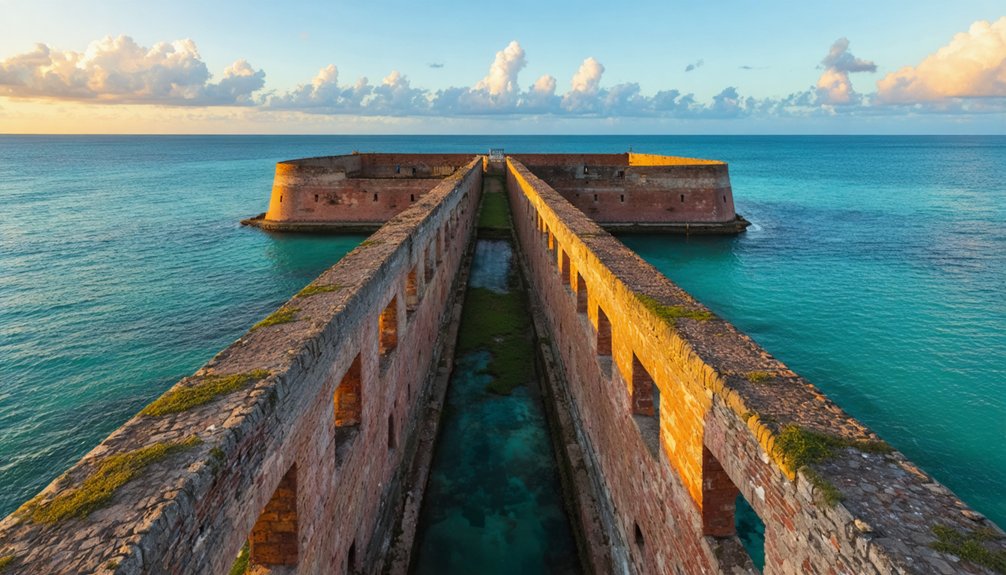
- You’ll find evidence of prison life in the “dungeons” where Dr. Mudd was confined after his escape attempt.
- Disease outbreaks, particularly yellow fever, plagued both prisoners and guards alike.
- The fort’s historical significance endures through its preservation as part of Dry Tortugas National Park.
- Underwater archaeological teams now document these submerged sites, preserving what remains through detailed mapping and artifact recovery.
- The Army Corps of Engineers’ numerous projects throughout the South disproportionately affected Civil War-era towns.
- Historical preservation efforts include interpretive centers at former town sites, displaying artifacts and telling stories of communities lost beneath the water.
- Fort Jefferson in Florida changed from military fortress to prison before hurricanes forced its abandonment in 1906.
- Harrisburg, Utah faced agricultural collapse after relocation due to flooding, with only the Orson B. Adams Home remaining intact.
- Steins, New Mexico exemplifies dual dependency collapse when both mining operations and railroad support disappeared.
- Union Level, Virginia flourished until the 1980s when train services ceased, followed by its post office closure in 1990, marking its death as a railway community.
- Nuttallburg, West Virginia collapsed when mining operations ended in 1958, cutting off its crucial transportation artery.
- Corinne, Utah’s significance evaporated when Union Pacific redirected routes to favor Mormon-dominated Ogden, demonstrating how quickly railway towns could fall.
- Cahawba, Alabama exemplifies failed community rebirth attempts after serving as state capital before declining post-Civil War.
- Saint Elmo, Colorado parallels many battle-scarred towns with its inability to recover from multiple devastating fires.
- Centralia, Pennsylvania shares similarities with Civil War ghost towns—catastrophic circumstances forcing complete evacuation.
- https://devblog.batchgeo.com/ghost-towns/
- https://visitusaparks.com/top-ten-ghost-towns-in-america/
- https://www.mythfolks.com/haunted-us-ghost-towns
- https://www.christywanders.com/2024/08/top-ghost-towns-for-history-buffs.html
- https://www.geotab.com/ghost-towns/
- https://www.legendsofamerica.com/ghosttowns-list/
- https://www.mentalfloss.com/geography/american-ghost-towns-can-still-walk-through
- https://ohioghosttowns.org/top-10-ghost-towns/
- https://theforgottensouth.com/cahawba-alabama-ghost-town/
- https://www.battlefields.org/visit/heritage-sites/old-cahawba-archaeological-park
Flooded Towns: Casualties of Post-War Infrastructure Projects
You’ll find many Civil War-era communities now exist only in historical records, having been sacrificed beneath reservoir waters for dam projects throughout the Tennessee Valley.
These submerged towns, including Willow Grove and areas near Hales Bar Dam, represent the permanent loss of tangible history as America prioritized infrastructure development over preservation.
The occasional dropping of water levels sometimes reveals these forgotten settlements, offering brief glimpses into communities that once thrived during one of America’s most tumultuous periods.
Submerging History Forever
The post-Civil War reconstruction era ushered in a wave of infrastructure development that inadvertently sacrificed numerous historical settlements to progress.
You can trace this submersion of history through projects like the Tennessee Valley Authority‘s dam constructions in the 1930s, which flooded parts of Shiloh battlefield and surrounding Civil War-era communities. The creation of Kentucky Lake and Lake Barkley similarly claimed historical settlements beneath their waters.
Communities Sacrificed Underwater
While water infrastructure projects brought undeniable economic benefits to post-Civil War America, they permanently erased dozens of historic communities beneath artificial lakes and reservoirs.
Tennessee witnessed significant Historical Displacement as the TVA transformed the landscape. Morganton’s crucial ferry crossing disappeared beneath Tellico Lake, while Johnsonville—site of a battle involving Nathan Bedford Forrest—vanished under Kentucky Lake‘s waters.
Fort Henry, already flood-prone during the Civil War, was completely submerged by the same project.
The human cost was substantial: 350 residents relocated from Johnsonville, while Norris Lake displaced 2,500 people and necessitated 7,000 grave relocations.
These Civil War Towns lost more than buildings; they lost cultural continuity. Community ties dissolved as churches and gathering places vanished, though some memories survive through photographs, oral histories, and relocated structures like Noeton’s Baptist Church.
abandoned civil war towns in america remain poignant reminders of a turbulent past. The scars of conflict are etched into the landscape, where remnants of once-thriving communities linger, evoking a sense of loss and reflection. Exploring these towns reveals stories of resilience and the enduring spirit of those who called them home.
Resurfacing Forgotten Settlements
As America’s water recedes during seasonal droughts, submerged ghost towns occasionally resurface to reveal their weathered structures and forgotten stories.
These ghostly echoes of the Civil War era include settlements like Cahawba, Alabama’s first capital, which was gradually abandoned after devastating floods and the Confederate appropriation of its essential railway connections.
The forgotten legacies of these communities resurface both literally and historically through preservation efforts:
These settlements represent America’s complex relationship with infrastructure development and environmental challenges during post-war reconstruction.
Disease-Ravaged Communities Following Troop Movements
During the American Civil War, disease swept through communities with devastating efficiency, often following the path of military encampments and troop movements. The cramped conditions of military camps became perfect breeding grounds for smallpox, typhoid, dysentery, and measles, with disease transmission exceeding combat casualties at alarming rates.
You’ll find evidence of this devastation in abandoned settlements throughout the South, particularly in East Tennessee and coastal Carolinas. Following troop withdrawals, disease outbreaks continued to decimate populations.
The 1878 yellow fever epidemic in Mississippi’s lower valley represents one of the most catastrophic examples, turning Beechland into a ghost town and permanently altering Memphis’s demographic makeup. Similarly, diphtheria epidemics ravaged western mining communities like Elkhorn, Montana, where the disease’s 20% mortality rate accelerated the town’s abandonment.
Railway Towns That Died When Military Supply Lines Shifted
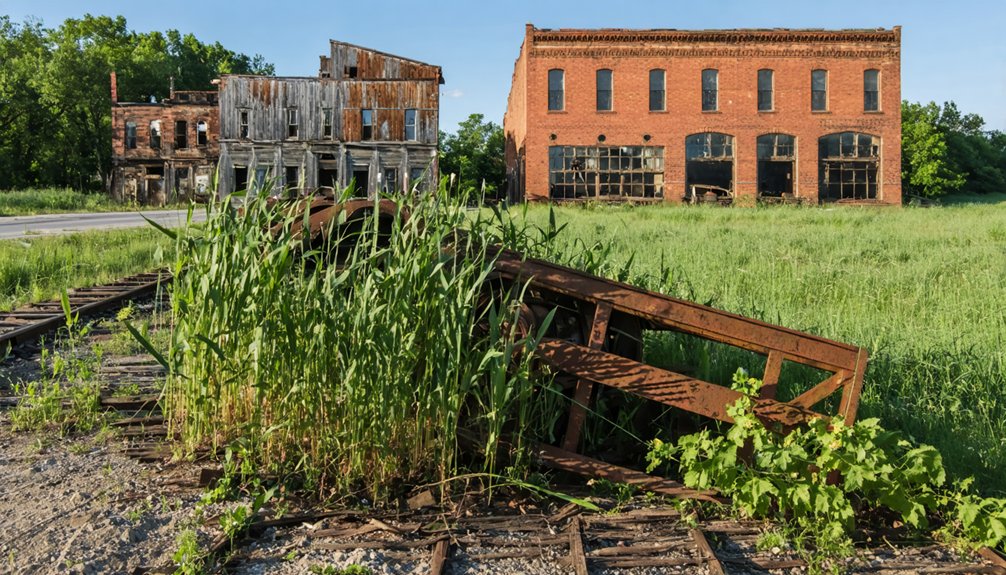
The shift of military supply lines following the Civil War triggered the death of numerous railway towns that had once thrived on strategic transportation routes.
These communities experienced devastating economic shifts when transportation networks evolved, leaving them without their primary lifeline. Railway decline impacted towns across America differently, yet their stories follow similar patterns of boom and abandonment.
African American Settlements That Flourished and Faded After Emancipation
While railway towns deteriorated with changing military supply routes, another type of community emerged from the ashes of the Civil War. Over 80 Black-established towns formed within fifty years post-Civil War, representing remarkable settlement successes amid harsh circumstances.
You’ll find these communities concentrated in Maryland, Virginia, and southeastern states, with migrations extending to Kansas, Oklahoma, and western territories.
These settlements displayed extraordinary community resilience, anchored by churches, schools, and kinship networks. Black farmland ownership in Texas rose from just 2% in 1870 to 31% by 1910.
However, environmental hardships, KKK terrorism, and resource limitations ultimately undermined many communities. Nicodemus, Kansas exemplifies this trajectory—its population plummeted from 500 in 1880 to fewer than 200 by 1910, though its historical significance persists as testimony to freedom’s frontier.
Battlefield Communities: Towns That Never Recovered From Battle Damage
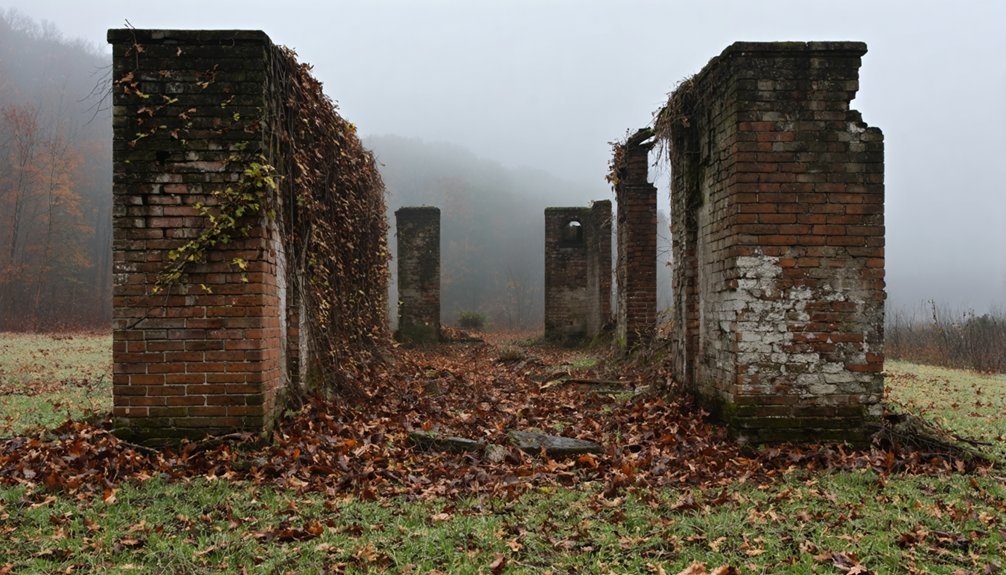
Throughout America’s landscape, battlefield communities stand as somber reminders of Civil War destruction that proved insurmountable for many towns. While some settlements demonstrated battlefield resilience, others like Rodney, Mississippi succumbed to both war damage and natural forces when the Mississippi River changed course, eventually leading to its official dissolution in 1930.
These abandoned communities offer physical evidence of how warfare combined with economic shifts created conditions from which certain towns could never recover.
Frequently Asked Questions
Which Civil War Ghost Towns Are Accessible to Visitors Today?
You can visit Civil War landmarks at Cahaba, Andersonville, Sharpsburg, Gettysburg, and Vicksburg. Each offers unique visitor experiences through preserved ruins, battlefields, museums, and ranger-led educational programs.
How Many Ghost Towns Still Contain Original Structures or Artifacts?
To sum it up, you’ll find at least eight ghost towns containing original artifacts and structures—Rodney, Cahawba, Virginia City, Bodie, Fort Jefferson, Batsto Village, Ruby, and Calico—maintained through historical preservation efforts.
Are Any Civil War Ghost Towns Considered Haunted?
Yes, several Civil War ghost towns have reported hauntings. You’ll find ghost stories surrounding Cahawba, Alabama, where apparitions of prisoners, slaves, and children are frequently documented at these haunted locations.
What Personal Belongings Were Typically Left Behind in Abandoned Towns?
Coincidentally, you’ll find abandoned belongings like furniture, kitchen items, books, photographs, and personal documents in these towns. Historical artifacts including tools, clothing, machinery, valuables, and religious items were commonly left during hasty evacuations.
Were Any Ghost Towns Deliberately Preserved as Historical Monuments?
Yes, you’ll find several ghost towns deliberately preserved through historical preservation efforts, including Cahaba (Alabama), Fort Jefferson (Florida), and Virginia City (Nevada)—all showcasing significant ghost town restoration maintaining Civil War-era structures.