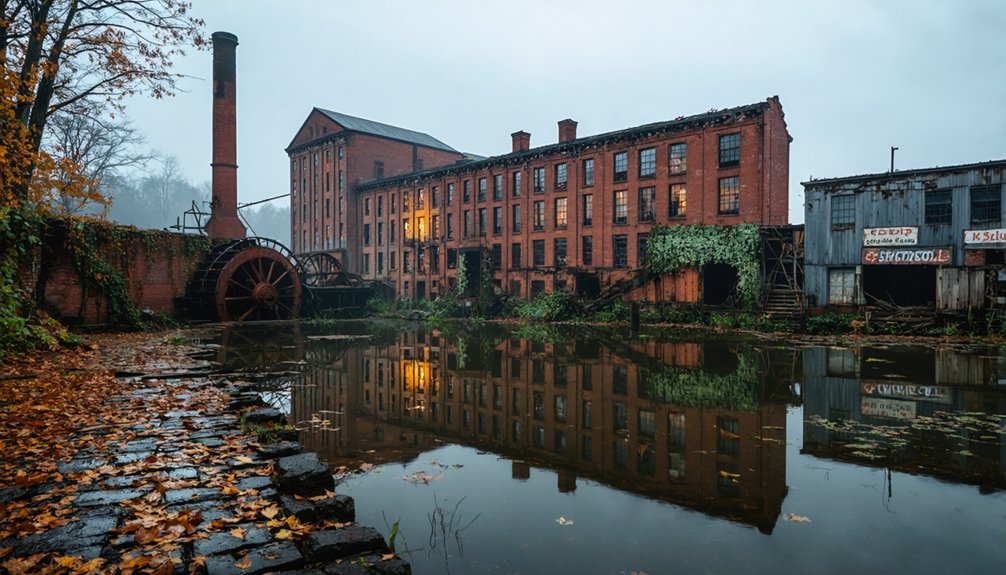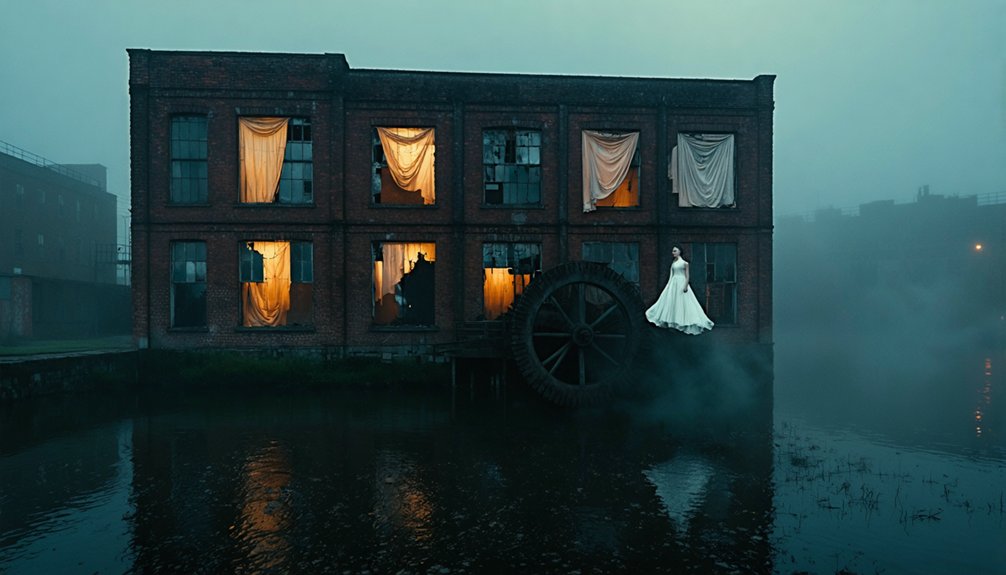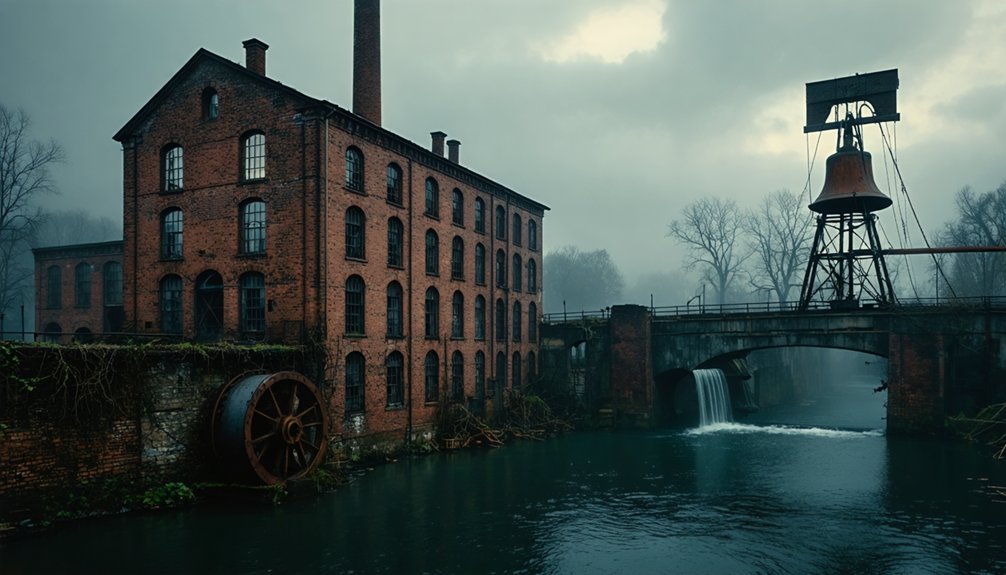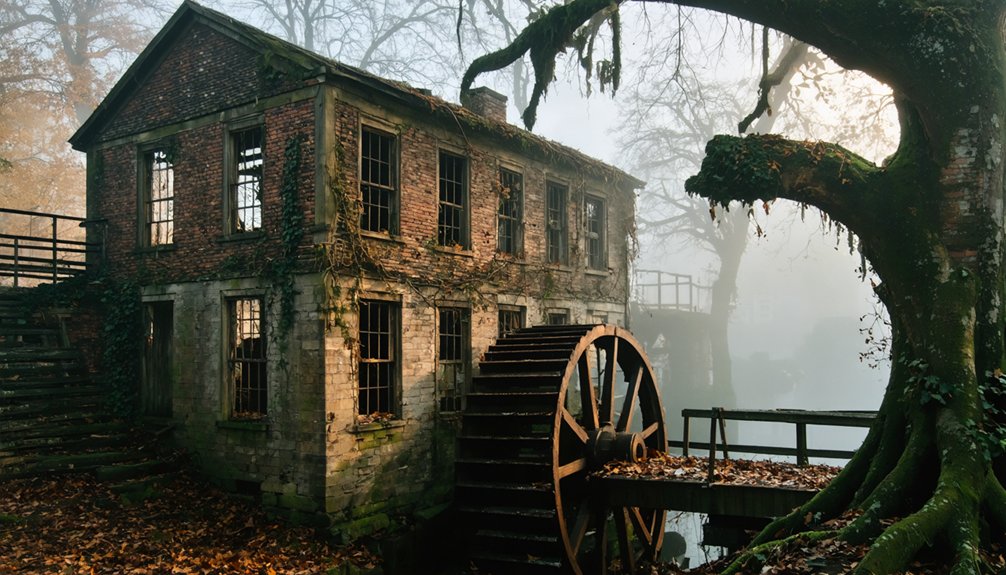
In historic mill ghost towns, you’ll encounter spectral machinery echoing through abandoned buildings, shadowy figures of former workers completing eternal shifts, and whispers of child laborers near dangerous equipment. Visitors commonly report cold spots, unexplained mechanical sounds, and rhythmic footsteps—especially at dawn and dusk when paranormal activity intensifies. These residual hauntings stem from tragic industrial accidents and harsh working conditions that imprinted trauma onto these preserved industrial landscapes. The authentic historical settings thin the veil between past and present.
Key Takeaways
- Visitors report unexplained auditory phenomena like ghostly machinery activation, whispers, and rhythmic footsteps from former workers.
- Apparitions of mill employees frequently appear as shadowy figures, with child laborer spirits among the most commonly sighted.
- Tragic accident echoes manifest in specific locations where workers died, creating intense emotional experiences for sensitive visitors.
- Mechanical sounds from long-silent equipment often occur at night when original shift changes would have happened.
- Seasonal variations in paranormal activity intensify during anniversary dates of disasters or significant mill closures.
Ghostly Footsteps Among Mill Ruins: Stories From Abandoned Production Sites
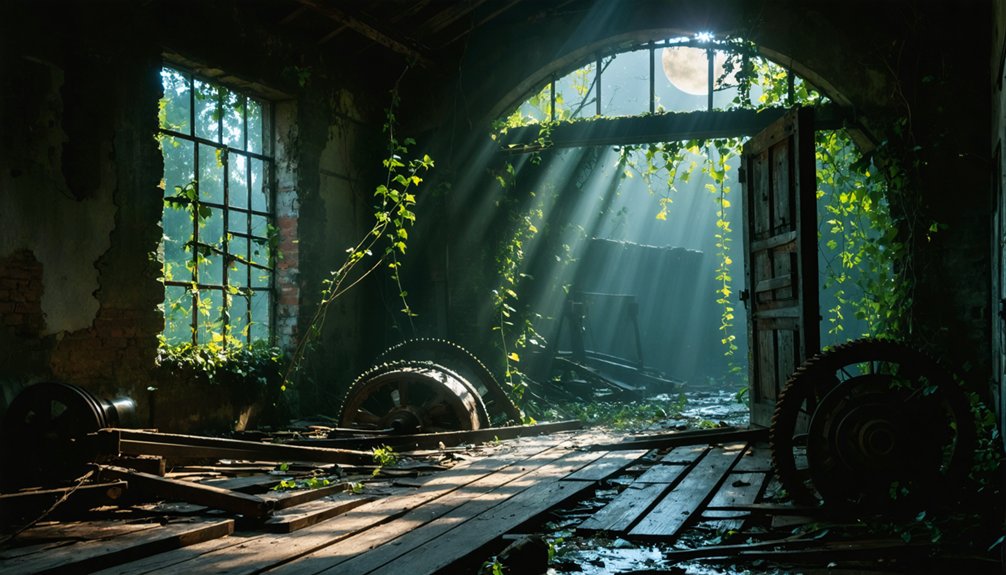
While exploring abandoned mill towns across America, visitors frequently encounter unexplained auditory phenomena that defy rational explanation.
You’ll hear ghostly echoes of footsteps traversing empty corridors and stairwells, accompanied by the startling sounds of long-dormant machinery mysteriously activating.
In locations like Coleridge, NC and Henry River Mill Village, these haunting melodies include indistinct whispers, sudden banging on walls, and even children’s laughter emanating from former worker housing. Coleridge’s decline began dramatically after the mill’s permanent closure in 1958, leaving many buildings to deteriorate and become settings for these paranormal accounts.
Paranormal investigators have documented EVPs at sites such as Broad Brook Company, where security cameras capture shadowy figures moving through darkened ruins.
The historical context offers potential explanations—24/7 operations led to fatal accidents, while sudden mill closures created community trauma.
These emotional imprints manifest as cold spots, invisible touches, and apparitions in period clothing. Many explorers require flashlight usage when venturing into the darkest recesses of these abandoned textile facilities, where the most intense paranormal activity is often reported.
Whispers in the Forest: Nature Reclaiming Industrial Landscapes
Long after the machinery falls silent, nature begins its quiet reclamation of abandoned industrial landscapes, transforming rust-laden ruins into vibrant ecosystems through a process that’s both haunting and beautiful.
You’ll witness spontaneous ecological succession at sites like Germany’s Alter Flugplatz, where broken concrete provides the foundation for self-propagating vegetation—industrial ghosts gradually surrendering to green life.
This nature’s reclamation exemplifies Gilles Clément’s principles of organic matter accumulation and natural decomposition.
As you explore these sites, you’ll observe how unmanaged natural processes at Berlin’s Spreepark have transformed an abandoned theme park into an ecological sanctuary.
The minimal intervention approach allows vegetation to weave through rusting metal and crumbling foundations, creating landscapes where human artifacts become armatures for biodiversity—haunting reminders of industry’s impermanence against nature’s persistent return.
These post-industrial spaces create a powerful visual appeal through the juxtaposition of nature with remnants of industrial decay, telling stories of both environmental resilience and human history.
Many of these sites were once considered brownfields before being transformed into ecological havens that attract visitors and contribute to community well-being.
The Spectral Shift Workers: Apparitions of Former Mill Employees
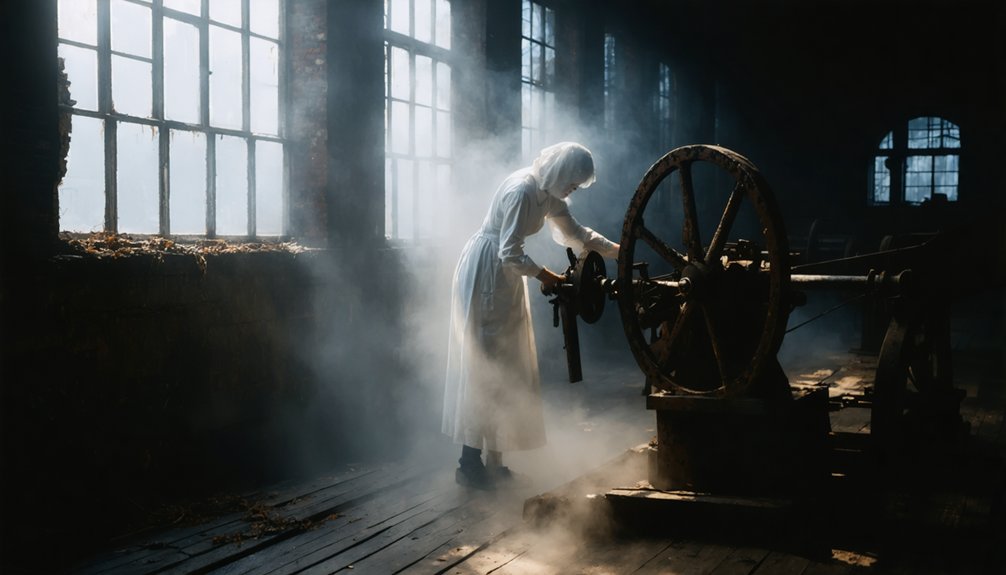
You’ll encounter the inexplicable sounds of midnight mill whistles echoing through abandoned textile complexes where no operational equipment remains.
Shadowy machine operators, dressed in period work clothes, have been documented by multiple witnesses performing their routine tasks before vanishing when approached.
These apparitions frequently coincide with locations of documented fatal accidents, where workers’ lives were tragically cut short by dangerous machinery during the industrial revolution. Despite its reputation for being “as safe as flour” in its day, the Benson Mill has its share of lingering spirits from the past.
Visitors at Slater Mill often experience immediate ghostly sensations upon entering the historic facility, with many reporting encounters with spirits of child laborers who once worked the dangerous equipment.
Midnight Mill Whistles
Among the most unsettling phenomena documented in historic mill ghost towns are the apparitions of former mill employees, often manifesting during the midnight hours when shifts would have once changed.
These spectral machinery sounds pierce the darkness without explanation, creating haunting melodies that echo through abandoned corridors.
Investigations have consistently revealed three distinct patterns:
- Mechanical grinding and squealing originating from sealed chambers
- Tapping sounds with metallic qualities and tactile vibrations
- Rhythmic footsteps on gravel pathways with no visible source
You’ll find these auditory manifestations follow seasonal variations, with peak activity during evening hours.
Multiple independent witnesses across different time periods have corroborated these experiences, suggesting these aren’t mere hallucinations but persistent echoes of the past breaking through into our present reality. Visitors are strongly advised against answering any unexpected whistling from trees, as local rangers warn such responses can attract unwanted attention.
This phenomenon was notably present at Willington Mill, where the strange occurrences attracted so much attention that it became known as the most haunted house in England during the nineteenth century.
Shadowy Machine Operators
Shadowing the dark corners of abandoned mills, spectral shift workers represent perhaps the most common paranormal manifestation reported in these industrial ghost towns.
You’ll encounter these shadowy figures near vintage machinery, where they appear to continue their eternal labor, operating looms and saws with phantom precision.
Witnesses consistently report sudden cold spots and the unsettling sensation of being observed before glimpsing these spectral laborers. Their features often include luminous or hostile eyes that intensify their threatening presence.
Many paranormal investigators have documented electronic voice phenomena suggesting these entities are attempting communication. Similar to the haunting at Buzzsaw: Madness at the Mill, these spirits often emit the distinctive sound of ancient machinery that once defined their working lives.
Historical records frequently link these manifestations to specific workers who suffered untimely deaths from industrial accidents.
Their persistent haunting may reflect unresolved trauma or deep-seated loyalty to the mill that defined their mortal existence.
Like the tragic tale of Margaret Hawthorne, these spirits are often connected to violent deaths that leave an imprint on the physical location.
Tragic Accident Echoes
Within the darkened recesses of abandoned mill complexes, tragic accident echoes manifest as some of the most disturbing paranormal phenomena documented by researchers.
These haunted labor sites carry the spiritual residue of workers who met violent ends, their apparitions often appearing at the precise locations where they died.
You’ll encounter these manifestations of spectral justice in several forms:
- Hollow-eyed figures wearing tattered period uniforms, standing motionless near dangerous machinery
- Phantom sounds of screams coinciding with the anniversary of documented industrial accidents
- Child worker apparitions, particularly in mills with histories of youth exploitation
These encounters aren’t random—they represent unresolved trauma seeking acknowledgment.
When you witness these phenomena at places like Slater Mill or Lincoln Mill, you’re experiencing history’s demand for recognition of sacrifices that built industrial America.
Capturing the Otherworldly: Photography Tips for Mill Ghost Towns
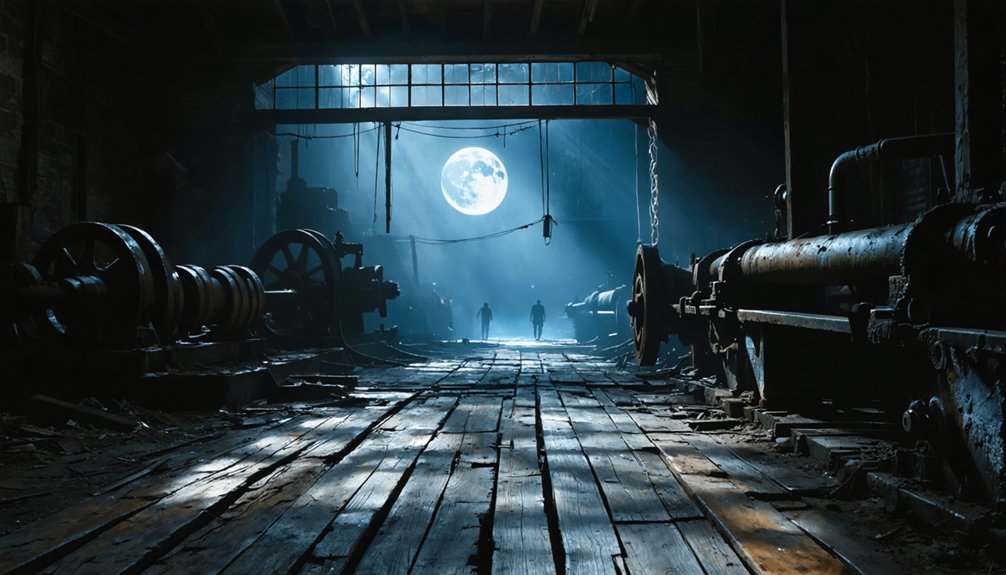
To capture the ethereal essence of mill ghost towns, you’ll achieve ideal results during golden hour when long, warm light rays penetrate abandoned machinery and highlight textural contrasts in weathered buildings.
When documenting decay, frame your composition to juxtapose structural deterioration against elements that suggest human presence—rusted tools, faded employee notices, or worn pathways between workstations.
Consider employing monochromatic processing to emphasize the timeworn textures of peeling paint, oxidized metal, and crumbling brickwork while removing the distraction of color that might diminish the haunting atmosphere.
Best Lighting Conditions
The interplay between light and shadow fundamentally shapes how mill ghost towns reveal their haunting character through photography. To capture their essence, you’ll need to master ghostly lighting and understand atmospheric conditions.
Avoid harsh midday sun, which creates unflattering contrast and obscures subtle details of decay.
- Golden hour delivers warm, diffused light that accentuates textures on weathered structures, enhancing depth and dimension.
- Blue hour’s cool ambience creates the perfect ethereal mood for conveying abandonment and mystery.
- Overcast days provide even illumination for intricate close-ups of deteriorating elements.
For dramatic night photography, utilize long exposures during moonlit evenings, enabling light-painting techniques that selectively illuminate architectural features.
Consider bracketing exposures when photographing scenes with significant contrast between interiors and bright skies to preserve both highlight and shadow detail.
Capturing Decay Artistically
Artistry emerges from entropy when photographers approach mill ghost towns with a deliberate eye for decay’s aesthetic qualities.
Frame your compositions through broken windows or doorways to create depth and mystery, while utilizing high-contrast shadows to accentuate the eerie ambience without artificial lighting.
For haunting beauty, focus on iconic elements—peeling paint, rusted machinery, and nature’s reclamation of industrial spaces.
These decay details reveal compelling narratives when captured in both contextual wide shots and intimate close-ups.
Consider black and white processing to emphasize texture and form, or experiment with long exposures to capture ethereal dust particles dancing in light beams.
Shoot in RAW format for maximum post-processing flexibility, and always travel with minimal equipment to navigate potentially unstable environments while preserving the integrity of these fragile historical sites.
Tragic Accidents and Their Lingering Spirits: Industrial Hauntings Explained
Throughout the haunting landscapes of America’s industrial ghost towns, violent workplace accidents have left more than just physical ruins—they’ve created the perfect conditions for spectral phenomena that continue to this day.
The industrial trauma of catastrophic boiler explosions, mine collapses, and molten metal spills has embedded spectral legacies into these abandoned communities.
The violent death of industry leaves wounds in reality where ghosts slip through, tethered to their final moments.
When you explore these forgotten places, you’ll encounter three common manifestations:
- Apparitions of workers still performing their duties at demolished mills
- Auditory phenomena including machinery sounds and screams from long-ago accidents
- Concentrated paranormal activity at sites where mass fatalities occurred
These hauntings often emerge from single-industry towns where disasters eliminated economic lifelines overnight.
The Industriana sawmill explosion (1858) and Pemberton Mill collapse (1860) exemplify how sudden industrial calamities transform thriving communities into ghost towns haunted by their tragic pasts.
Midnight Explorations: Why Dusk Intensifies Paranormal Experiences
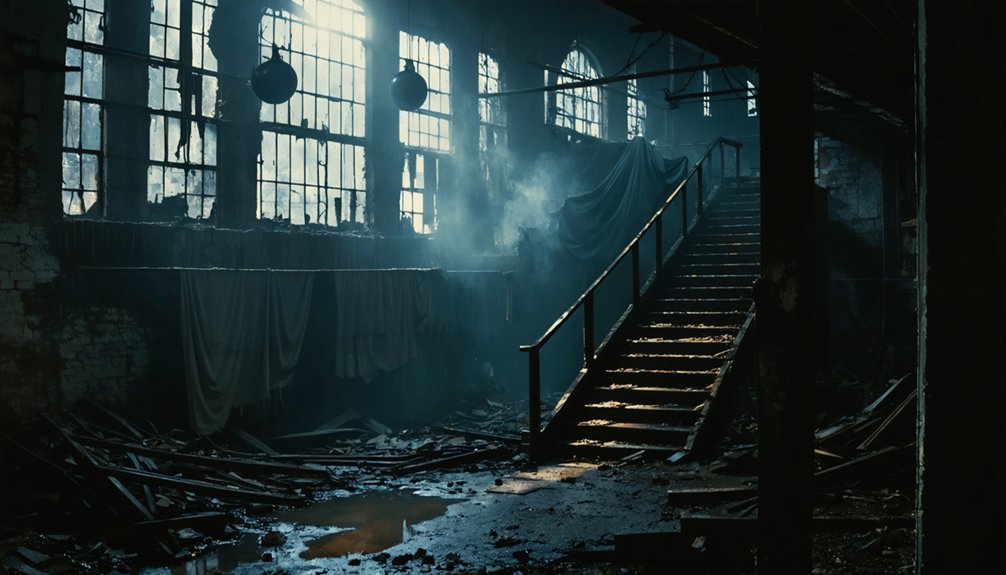
While daylight hours may reveal the structural remains of abandoned mill towns, dusk ushers in a fundamentally different perceptual experience that many paranormal investigators consider ideal for ghostly encounters.
As the sun sets, the air grows thick with stories of haunted tales from Colorado mines, where whispers of the past seem to intertwine with the rustling leaves. Investigators often set out in search of these spectral histories, hoping to unearth not just the eerie legends but also the truths hidden within the shadows. Each creak of timber and gust of wind serves as a reminder that the echoes of those who once toiled beneath the earth may still linger, awaiting discovery.
As darkness falls, you’ll experience heightened sensitivity to sounds and tactile sensations—your brain compensating for reduced visibility by amplifying other senses.
Between midnight and 3 a.m., during the traditional “witching hour,” your body temperature drops and alertness wanes, making you more susceptible to hallucinations and misinterpretations of ordinary stimuli.
The isolation of ghost towns compounds these dusk phenomena.
You’ll notice environmental shifts—temperature drops causing chills often misattributed to spectral presence, while wind through abandoned structures creates eerie sounds.
These natural occurrences, combined with your psychological expectation of the paranormal, create perfect conditions for perceiving the extraordinary in the ordinary.
Hidden Histories: Uncovering the Multicultural Stories Behind the Hauntings
The spectral phenomena reported in historic mill ghost towns often mask complex multicultural narratives that deserve closer examination.
These cultural hauntings emerge from the convergence of diverse populations drawn to resource extraction booms, where European, Asian, and Latin American immigrants labored alongside displaced Native Americans and African American communities.
- Locations like Allensworth, California reveal African American agency and autonomy, challenging simplistic haunting narratives.
- Religious and ethnic enclaves left behind spiritual landmarks that serve as focal points for paranormal activities.
- Cemetery archaeology exposes forgotten legacies of multicultural inhabitants through burial customs and memorial practices.
When you explore these abandoned settlements, you’re walking through layered histories where tragic accidents, labor conflicts, and cultural tensions created the perfect conditions for lingering spirits with unresolved stories to tell.
Preserved in Time: How to Respectfully Visit These Eerie Historic Sites
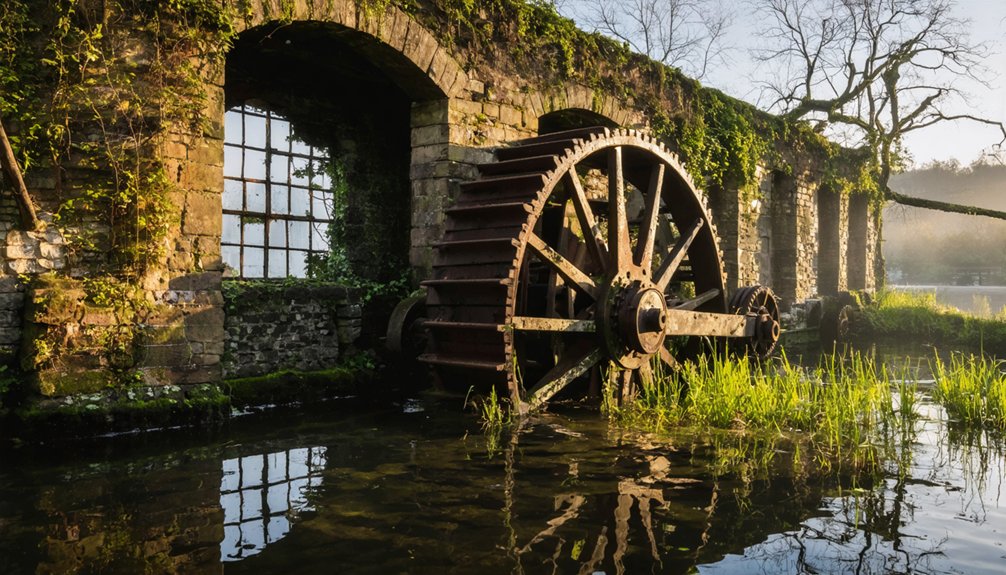
Behind every ethereal mist and shadowy figure in mill ghost towns lies a responsibility for preservation that falls upon both caretakers and visitors alike. These sites remain protected through frameworks like Mills Act contracts and “arrested decay” approaches that maintain their authentic character.
When you explore these historic locations, visitor responsibilities include staying on designated paths, avoiding artifact removal, and refraining from graffiti—fundamental preservation ethics that safeguard these fragile structures.
Respect the site’s integrity by viewing without disturbing, as many retain original equipment and furnishings in situ.
The collaboration between historical societies, volunteers, and government agencies guarantees sustainable stewardship, but your informed engagement matters equally.
Frequently Asked Questions
Can Children Safely Visit Mill Ghost Towns?
No, you shouldn’t bring children to mill ghost towns. Extensive evidence documents severe health risks from heavy metals, unstable structures, and contaminated soils that compromise child safety despite their ghost town history.
Are Paranormal Investigation Tools Allowed at These Sites?
You’ll need prior authorization for paranormal tools at most mill sites. Investigation etiquette requires following specific guidelines, with EMF detectors and EVP devices typically permitted when arranged through official channels.
How Are Indigenous Spirits Different From Mill Worker Apparitions?
Like two sides of a spiritual coin, indigenous folklore integrates spirits within ceremonial practices and cosmologies, while mill worker apparitions typically manifest spontaneously as trauma echoes without ritualistic framework or cultural mediation systems.
Which Ghost Towns Have Wheelchair Accessible Areas?
You’ll find wheelchair tours at Bodie, Calico, Ashcroft, and Garnet ghost towns. Each offers accessible attractions along main thoroughfares, though terrain varies considerably, requiring assessment of individual pathways before your paranormal explorations.
Do Seasonal Changes Affect Paranormal Activity in Mill Towns?
You’ll find seasonal hauntings intensify during winter months in mill towns, with documented evidence suggesting climate influence on paranormal activity through temperature fluctuations, atmospheric changes, and historical trauma patterns.
References
- https://albiongould.com/ghost-towns-to-visit-in-the-states/
- https://www.visitredwoods.com/listing/falk-historic-logging-ghost-town/526/
- https://www.christywanders.com/2024/08/top-ghost-towns-for-history-buffs.html
- https://www.mythfolks.com/haunted-us-ghost-towns
- https://www.youtube.com/watch?v=Gf9rL4_d_sw
- https://wildwestcity.com/old-west-ghost-towns/
- https://www.atlasobscura.com/lists/united-states-of-abandoned-places
- https://theforgottensouth.com/coleridge-north-carolina-ghost-town/
- https://www.youtube.com/watch?v=hQW3TZLHUas
- https://www.youtube.com/watch?v=okUutm-ZuDc