You’ll discover Idaho’s haunting silver mining towns scattered throughout its remote mountains. Silver City remains remarkably preserved with 70 original structures, while Burke bears the scars of mine disasters and toxic contamination. Gilmore flourished briefly before its 1927 power plant explosion led to abandonment. Lesser-known camps like De Lamar offer glimpses into the boom-and-bust cycles that generated over $60 million in precious metals. These ghostly settlements reveal deeper stories beneath their weathered facades.
Key Takeaways
- Silver City retains nearly 70 original structures including the Idaho Hotel with minimal modern updates.
- Burke endured tragic mine fires that killed 91 miners and left behind contaminated Superfund sites.
- Gilmore’s abandoned structures stand as eerie reminders of lead contamination 50 times above safe levels.
- Wallace, “The Silver Capital of the World,” preserves intact 19th-century architecture and mining museums.
- De Lamar’s haunting ruins exemplify the dramatic boom-and-bust cycle of Idaho’s silver mining communities.
Silver City: The Best-Preserved Ghost Town of Idaho’s Mining Era
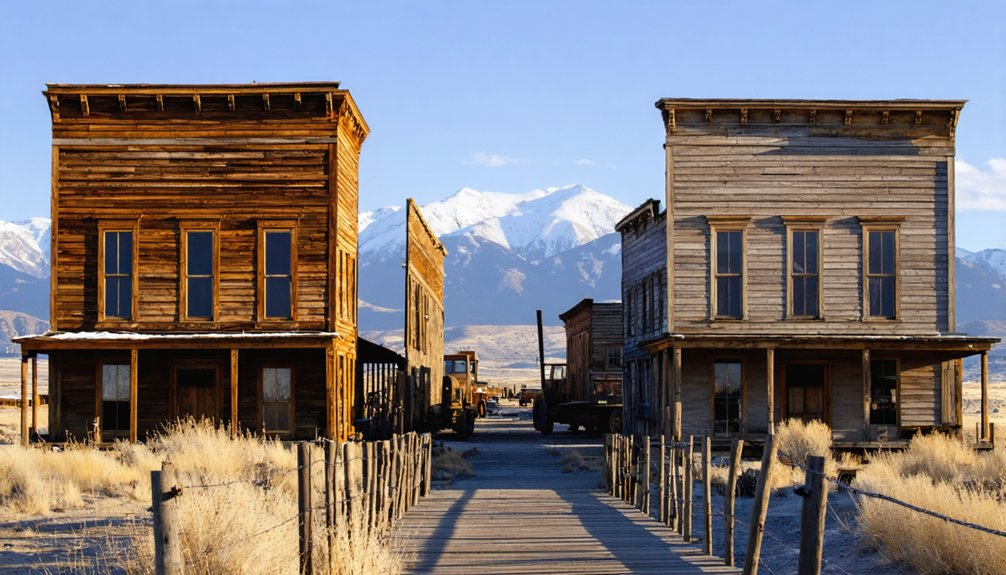
Nestled high in the Owyhee Mountains at an elevation of 6,200 feet, Silver City stands as Idaho’s most remarkably preserved mining ghost town, offering visitors an authentic glimpse into the state’s silver rush era.
Founded in 1864 after a significant silver discovery, this boomtown quickly flourished with over 2,500 residents and approximately 75 businesses during its peak.
Silver rush prosperity transformed this mountain outpost into a thriving hub of frontier commerce and opportunity.
Today, you’ll find nearly 70 original structures, including the still-operating Idaho Hotel and the 1869 Masonic Lodge.
Unlike many ghost towns facing preservation challenges, Silver City’s remote location has protected its historical integrity.
While exploring the streets where Idaho’s first daily newspaper operated, you’ll encounter descendants of miners who still inhabit this living museum.
Ghost town tourism thrives here in summer months, allowing you to experience Idaho’s mining heritage exactly as it was.
The town once boasted eight saloons among its many establishments that served the needs of miners and residents alike.
The harsh winter conditions reduce the population to just two caretakers during the coldest months of the year.
Burke’s Dangerous Legacy: Natural Disasters and Industrial Might
While Silver City offers a well-preserved glimpse of Idaho’s mining past, Burke presents a far darker chapter in the state’s industrial history—one marked by repeated natural disasters and devastating human tragedy.
If you venture to Burke today, you’ll walk ground where industrial safety was sacrificed for profit. The catastrophic Sunshine Mine fires of 1892 and 1972—each claiming 91 lives—stand as grim monuments to this disregard. Located in Shoshone County, Burke was established as a mining town in the late 19th century when silver deposits were discovered in the area.
You’ll find a valley scarred by environmental contamination from the 1973 Bunker Hill disaster, when executives bypassed pollution controls during high metal prices. The EPA has since designated this area as one of the largest Superfund sites in the United States, requiring decades of remediation.
Beyond these mining disasters lies a landscape of violent labor conflicts, including bombings and the assassination of Idaho’s former governor in 1905.
The last major operation, Star Mine, closed in 1991, leaving behind toxic legacies that continue to plague local communities.
The Rise and Fall of Gilmore: A Rocky Mountain Mining Tragedy
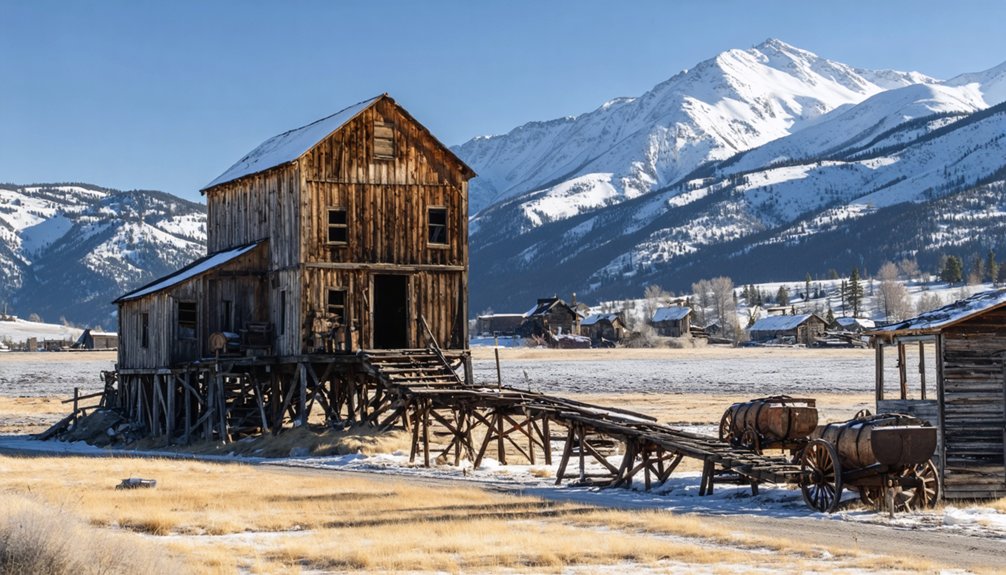
Deep in the Rocky Mountains of Idaho, Gilmore’s story begins in the 1880s when silver miners first established a settlement in Horseshoe Gulch, hauling their precious ore by mule teams to a smelter in Nicholia.
When you visit what remains of this once-thriving community, you’ll discover three haunting chapters of Gilmore’s legacy:
- The explosive growth after the 1910 railroad completion, bringing sophisticated mining infrastructure and expanding the population to nearly 1,000 residents.
- The catastrophic 1927 power plant explosion that devastated the town’s economy overnight.
- The environmental aftermath of lead contamination 50 times beyond safe levels.
Despite remarkable community resilience during its boom years, Gilmore’s final chapter was written when the last mine closed in 1929, leaving only toxic dust and weathered buildings. The town quickly transformed into a near-ghost town by the early 1930s. Today, visitors can explore approximately 20 dilapidated buildings that stand as silent witnesses to this mining town’s dramatic history.
Hidden Treasures: Lesser-Known Silver Camps Worth Exploring
Beyond the cautionary tale of Gilmore lies a trove of lesser-known silver mining camps scattered throughout Idaho’s rugged landscape.
You’ll discover hidden gems like Silver City, where over 250 mines operated between 1863-65, extracting at least $60 million in precious metals. The Idaho Hotel still stands with minimal modern updates, preserving its 19th-century character. At an elevation of 6,000 feet, Silver City became one of Idaho’s most prosperous boom towns, attracting thousands of fortune-seekers in the 1880s. The town was remarkably advanced for its era, featuring telegraph and telephones by 1880 and electricity in the 1890s.
Burke presents forgotten camps centered around silver, lead, and zinc extraction, now a ghost town with preserved structures documenting Idaho’s industrial past.
Meanwhile, Wallace—”The Silver Capital of the World”—offers urban mining heritage through its intact architecture and specialized museums.
For adventurous explorers, De Lamar’s ruins exemplify the boom-and-bust cycles common to these mining communities, with abandoned infrastructure silently narrating tales of frontier ambition and ultimate decline.
Echoes of the Past: How Mining Towns Shaped Idaho’s Heritage
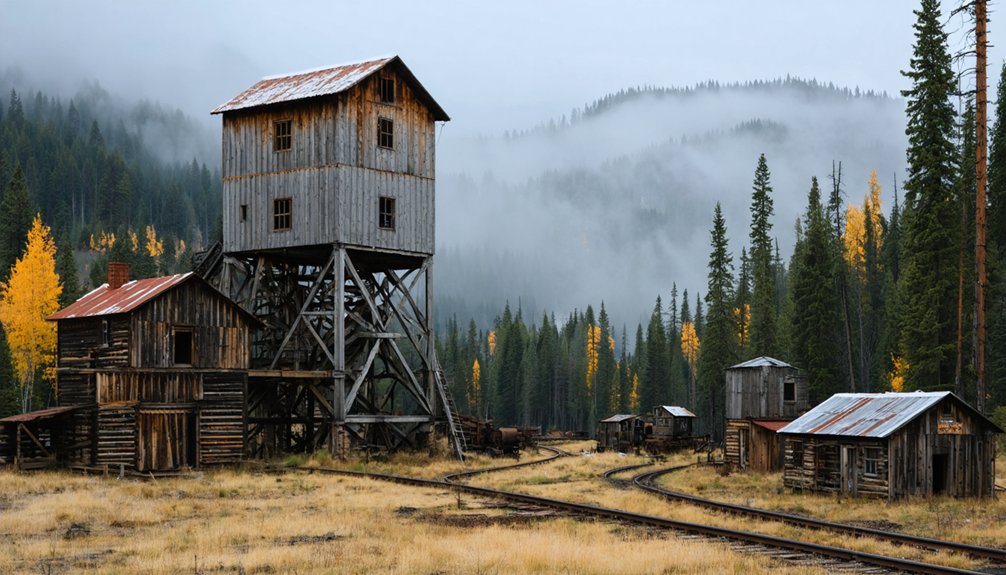
Throughout Idaho’s rugged landscapes, silver mining towns have left indelible marks on the state’s cultural and economic identity that you can still witness today.
Silver City exemplifies Idaho’s mining heritage, transforming from a frontier settlement into a technologically advanced community with telegraph lines by 1874 and telephones by 1880.
These historic communities contributed immensely to Idaho’s prosperity:
- Generated over $60 million in precious metals from Silver City alone, while Silver Valley produced minerals valued at over $50 billion in today’s currency.
- Established critical infrastructure that modernized remote areas decades before other western territories.
- Demonstrated remarkable community resilience through labor movements of the 1890s, when miners fought for fair wages despite dangerous conditions.
Descendants of original mining families continue preserving this legacy, maintaining connections to Idaho’s silver-laden past.
The Silver Valley region is particularly significant, having produced over a billion ounces of silver and ranking among the top ten mining districts in world history.
Frequently Asked Questions
Are There Any Paranormal Activities Reported in Idaho’s Ghost Mining Towns?
Yes, you’ll encounter ghost sightings in Silver City’s Idaho Hotel, Burke’s watchful presences, Bonanza’s eerie sensations, and Placerville’s haunted structures. These haunted locations reflect violent mining histories and sudden abandonments.
How Did Racial Minorities Fare in Idaho’s Silver Mining Communities?
You’d find racial dynamics in Idaho’s mining towns largely oppressive. Black citizens faced employment discrimination and social segregation despite voting rights, while Chinese communities experienced violent expulsion. Minimal community integration occurred except in Pocatello and Boise.
What Valuable Artifacts Remain Undiscovered in Abandoned Mining Towns?
You’ll find lost treasures including ore samples, mining equipment, personal artifacts, and possibly hidden relics like undocumented gold reserves in abandoned tunnels with their seventy miles of unexplored passages.
Did Any Famous Outlaws Hide in Idaho’s Remote Mining Communities?
You’d think lawmen knew where to look, but you’d be wrong. Idaho’s remote mining towns served as perfect outlaw hideouts for notorious criminals seeking freedom in Silver City’s tunnels and the Coeur d’Alene wilderness.
How Did Mining Towns Handle Medical Emergencies and Disease Outbreaks?
You’d face limited emergency response in mining towns—makeshift infirmaries, self-treatment, and delayed evacuations by horseback. Disease prevention relied on basic quarantines, community-led sanitation efforts, and rudimentary water protection measures.
References
- https://idaho-forged.com/idahos-ghost-towns-eerie-yet-approachable/
- https://www.historicsilvercityidaho.com
- https://www.youtube.com/watch?v=W347SjpcWF0
- https://westernmininghistory.com/state/idaho/
- https://www.youtube.com/watch?v=rTSZSlxTmbs
- https://history.idaho.gov/wp-content/uploads/2018/08/0064.pdf
- https://visitidaho.org/things-to-do/ghost-towns-mining-history/
- https://en.wikipedia.org/wiki/Silver_City
- https://idahosmammothcave.com/unique-things-to-do-in-idaho-ghost-town-hunting-in-silver-city/
- https://www.hhhistory.com/2016/10/a-ghost-town-that-lives-on-by-marilyn.html